

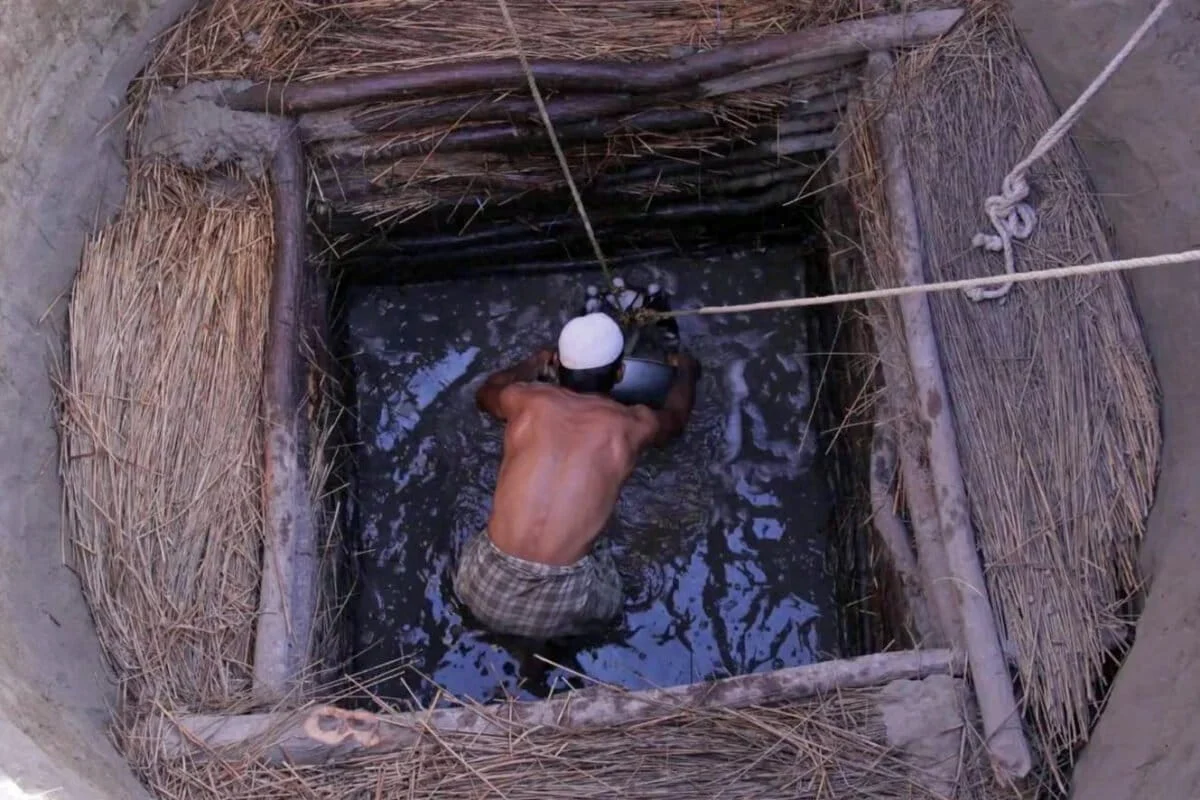
In the vast, shimmering expanse of the Banni grasslands in Kachchh, Gujarat, the horizon often dissolves into a haze of heat and salt. This is a landscape of extremes, where the mercury frequently climbs to a blistering 50°C (122°F) and the earth underfoot is often white with salt crusts. For the Maldhari pastoralists who have called this region home for centuries, survival is not merely a matter of endurance, but of profound geological intuition.
Nabudo Halepotra, a resident of this arid frontier, moves with a purpose that belies the oppressive heat. Like his ancestors before him, he possesses the rare ability to "read" a landscape that looks barren to the untrained eye. In a region where most groundwater is too saline to support human or animal life, Nabudo knows exactly where the earth hides its secret reservoirs of sweetness.
The secret lies in the virda—a shallow, hand-dug well that represents one of the most sophisticated examples of traditional ecological knowledge (TEK) in South Asia. As modern piped water systems falter under the weight of mismanagement and climatic shifts, these ancient structures remain the final line of defense against thirst for thousands of people and their livestock.
Main Facts: The Hydrology of Survival
The Banni grassland is a unique ecosystem, often described as one of the largest seasonal grasslands in Asia. However, its geological makeup presents a paradox: while it receives seasonal monsoon rains, the underlying groundwater is heavily brackish. The virda system is a brilliant adaptation to this specific hydro-geological constraint.
How a Virda Works
Unlike deep borewells that tap into permanent aquifers (which in Kachchh are often salty), a virda is typically dug in the dry beds of seasonal ponds, known locally as jheels. These ponds collect rainwater during the brief monsoon. As the pond surface dries up, the water doesn’t simply disappear; it percolates through the sandy soil, creating a thin layer of freshwater that floats atop the denser, heavier saline groundwater.
The Maldharis dig shallow, circular pits—the virdas—into these beds. The walls are often reinforced with the wood of the Prosopis juliflora or local grasses to prevent collapse. Because freshwater is lighter than saltwater, it seeps into these shallow wells from the upper layers of the soil. It is a delicate balancing act; if the well is dug too deep, it pierces the saline layer, ruining the supply.
The Social Fabric of Water
A virda is rarely an individual endeavor. They are dug collectively, often involving the labor of entire hamlets. The maintenance—de-silting the wells after the monsoon and reinforcing the structures—is a communal responsibility passed down through generations. For the Maldhari women, who are the primary water managers, the virda is more than a utility; it is a space of social cohesion and a symbol of their community’s resilience.
Chronology: From Grassland Paradise to Ecological Crisis
To understand the current state of the Banni and its water systems, one must look at the timeline of ecological and policy shifts that have reshaped the region over the last century.
1. The Era of Abundance (Pre-1960s):
Historically, the Banni was a lush grassland featuring over 40 species of nutritious grasses. The Maldharis lived a semi-nomadic life, moving their herds of Banni buffaloes and Kankrej cattle according to the availability of water and fodder. The virda system was the primary source of water, perfectly synced with the natural recharge cycles of the jheels.
2. The Introduction of the "Green Menace" (1960s):
In an attempt to stop the ingress of the Rann of Kachchh (the salt desert) into the grasslands, the Indian government aerially seeded Prosopis juliflora, an invasive shrub from South America. Locally known as Gando Baval (the "crazy thorn"), the plant spread uncontrollably. While it provided firewood, it began to choke out native grasses and, more critically, its deep taproots began to deplete the shallow freshwater lenses that feed the virdas.
3. The Shift to Modern Infrastructure (1980s – 2000s):
As part of the state’s developmental push, piped water schemes were introduced. Large-scale pipelines were laid to bring Narmada river water to the remote villages of Kachchh. This led to a gradual decline in the maintenance of traditional virdas, as many communities became dependent on the "tap."
4. The Contemporary Crisis (2010 – Present):
The limitations of modern infrastructure have become glaringly apparent. Piped water is often unreliable, with supplies frequently cut off for weeks due to pipe bursts, electricity failures, or upstream shortages. Meanwhile, climate change has made rainfall patterns increasingly erratic, leading to longer periods of drought and shorter, more intense bursts of rain that the silted-up jheels cannot effectively capture.
Supporting Data: The Scale of the Challenge
The urgency of preserving the virda system is backed by sobering environmental and economic data:

- Salinity Levels: In many parts of the Banni, groundwater salinity exceeds 5,000 to 10,000 ppm (parts per million), far above the WHO limit of 500 ppm for drinking water. The virda system is often the only way to obtain water with a salinity level below 1,000 ppm.
- Livestock Economy: The Banni is home to the Banni buffalo, a breed recently recognized for its high milk yield and ability to graze at night to avoid the heat. There are an estimated 150,000 to 200,000 heads of cattle in the Banni. Each buffalo requires 40-60 liters of water per day. Without virdas, the billion-rupee milk economy of Kachchh would collapse during the summer months.
- Invasive Spread: Prosopis juliflora now covers more than 50% of the Banni’s 2,500 square kilometer area. Research suggests that a single Prosopis tree can consume significantly more water than native shrubs, directly competing with the recharge of the shallow aquifers used by virdas.
- Temperature Extremes: Climate data shows a steady increase in the number of "heatwave days" in Gujarat. With temperatures hitting 50°C, the evaporation rates of surface water bodies have increased, making the "sub-surface" storage provided by virdas even more vital.
Official Responses: A Conflict of Perspectives
The government’s approach to the water crisis in Kachchh has historically been one of "engineering over ecology."
The Gujarat Water Supply and Sewerage Board (GWSSB) maintains that piped water is the only long-term solution for a growing population. Officials often point to the massive Narmada Canal project as the "lifeline of Gujarat." However, local activists and NGOs, such as Sahjeevan and the Banni Pashu Uchherak Maldhari Sangathan (BPUMS), argue that this top-down approach ignores the geographic reality of the Rann.
"The pipes often run dry just when we need them most—in the peak of May and June," says a local village pradhan. "When the electricity fails or the Narmada levels drop, the government has no ‘Plan B.’ Our virdas were always our Plan B, but the government doesn’t recognize them as official water sources."
In recent years, there has been a slight shift in rhetoric. Some local district officials have begun to acknowledge the importance of "recharge structures," but funding for the desilting of traditional jheels remains a fraction of what is spent on pipeline maintenance. There is also a lack of legal framework to protect the "water commons"—the land around virdas—from being encroached upon by salt manufacturing units or industrial expansion.
Implications: The High Cost of Losing Tradition
The decline of the virda system carries implications that reach far beyond the borders of Kachchh.
1. Food Security and Migration
If the Maldharis can no longer water their herds, they are forced into distress migration. This leads to the abandonment of villages and a surge in urban slums. Furthermore, the loss of the Banni buffalo—a breed uniquely adapted to climate change—would be a significant blow to India’s genetic biodiversity and dairy security.
2. Loss of Cultural Identity
The knowledge of how to find and extract water in a salt desert is an intangible heritage. As Nabudo Halepotra notes, if the youth do not learn to dig and maintain virdas, a body of knowledge accumulated over 500 years will vanish in a single generation. This "de-skilling" of the community makes them entirely dependent on the state, stripping them of their historical autonomy.
3. Ecological Tipping Point
The virda system is a "low-impact" technology. It does not deplete deep aquifers or cause land subsidence. In contrast, the failure of modern systems often leads to the illegal sinking of deep borewells, which pull up ancient saline water and ruin the soil for future generations.
4. A Lesson for the Future
As the world grapples with increasing water scarcity, the virda offers a masterclass in "living with the land" rather than "fighting against it." It proves that even in the most inhospitable environments, sustainable life is possible if we respect the natural limits of the ecosystem.
Conclusion
In the village of Berdo, where the piped water supply is at best a rumor, the sentiment is clear. "If there is no virda, our existence will be threatened. Our cattle will perish," says a local woman, her voice echoing the fears of thousands.
The story of the virda is not just a story of a hole in the ground. It is a story of the resilience of the human spirit and the sophistication of traditional science. As the sun sets over the Banni, casting long shadows across the salt flats, Nabudo Halepotra finishes his work at the well. The water he draws is clear, cool, and sweet—a miracle of the desert that has survived for centuries, but one that now hangs in a precarious balance between a forgotten past and an uncertain future.
The survival of the Banni depends not on more pipes, but on the recognition that sometimes, the best way forward is to look down at the ground beneath our feet and remember the wisdom of those who walked it before us.
