

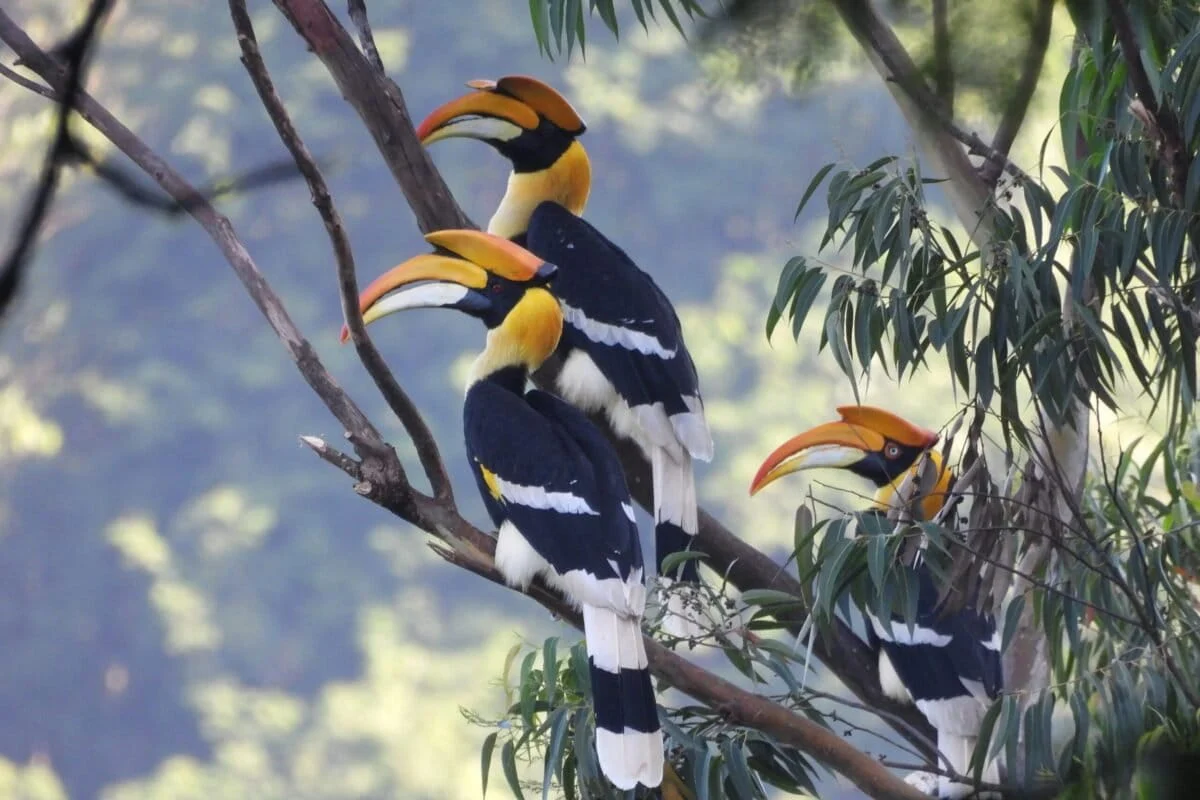
In a landmark achievement for avian conservation and evolutionary biology, a collaborative team of Indian researchers has successfully generated high-quality reference genomes for four threatened Asian hornbill species. This breakthrough, led by scientists from the Nature Conservation Foundation (NCF) in Mysore and the CSIR-Centre for Cellular and Molecular Biology (CCMB) in Hyderabad, provides a vital genetic map for the Great Hornbill, the Rufous-necked Hornbill, the Malabar Pied Hornbill, and the Wreathed Hornbill.
The study, recently published in the journal BMC Ecology and Evolution, marks a significant leap forward in our understanding of these "farmers of the forest." By decoding the complete genetic structure of these majestic birds, researchers have laid the groundwork for advanced conservation strategies that can address the twin threats of habitat loss and climate change.
Main Facts: A Genomic Milestone for Asian Biodiversity
The research represents one of the most comprehensive genomic undertakings for Asian avian species to date. Prior to this study, the global scientific community had access to the whole-genome information of only two out of the 32 known Asian hornbill species: the Great Hornbill and the Rhinoceros Hornbill. These earlier assemblies, however, were limited by the technology of their time, relying solely on short-read sequencing which often leaves gaps in the genetic narrative.
The four species targeted in this study—the Great Hornbill (Buceros bicornis), the Rufous-necked Hornbill (Aceros nundulatus), the Malabar Pied Hornbill (Anthracoceros coronatus), and the Wreathed Hornbill (Rhyticeros undulatus)—are all currently facing varying degrees of extinction risk. The International Union for Conservation of Nature (IUCN) lists several of these as ‘Vulnerable’ or ‘Near Threatened’ due to the rapid conversion of old-growth forests into agricultural land and the impacts of poaching.
A reference genome serves as a standardized "digital map" of a species’ DNA. It outlines the length of the genome, the number and arrangement of chromosomes, and the location of specific genes. For the researchers, this data is the "Rosetta Stone" required to translate how these birds have survived past geological shifts and how they might fare in an increasingly fragmented modern landscape.
Chronology: From Field Observations to Molecular Insights
The genesis of this research lies not in a laboratory, but in the dense, mist-covered canopies of the Western Ghats. The journey of the study’s corresponding author, Pooja Pawar, reflects a transition from traditional behavioral ecology to the cutting edge of conservation genomics.
2010s: The Fieldwork Foundation
Pawar’s interest began with a fundamental question: How does wildlife respond to a changing environment? During her Master’s dissertation, she conducted extensive field research in the Anamalai Hills of Tamil Nadu. Her work focused on comparing the breeding biology of Great Hornbills in pristine protected areas versus those living in the human-modified landscapes of Valparai, where coffee plantations have replaced much of the original rainforest.

While these observations provided critical data on nesting success and diet, they offered only a snapshot of the present. To understand the "why" behind these behaviors—and to look further back into the history of the species—Pawar realized she needed to look deeper than the feathers and the beak.
2020-2024: The Genomic Shift
As she transitioned into her Ph.D. at the Nature Conservation Foundation and Manipal Academy of Higher Education, Pawar expanded her scope. She recognized that the behavioral responses she witnessed in the field were the result of millions of years of evolution. To investigate how climatic, geographic, and anthropogenic factors influenced hornbill populations across geological epochs, she turned to genomics.
Between 2021 and 2024, the collaboration with CCMB Hyderabad allowed the team to utilize Next Generation Sequencing (NGS) facilities. This period involved the meticulous process of collecting tissue samples, extracting high-molecular-weight DNA, and employing a "hybrid" sequencing approach to ensure the highest possible accuracy for the four target species.
Supporting Data: The Science of Hybrid Sequencing
The technical success of this study rests on the researchers’ decision to move beyond traditional sequencing methods. The team employed a combination of two distinct technologies to build their reference genomes:
- Illumina Sequencing (Short-Read): This platform generates DNA "reads" of approximately 150 base pairs. While highly accurate at a local level, short reads are difficult to piece together when the genome contains repetitive sequences.
- Oxford Nanopore Technology (ONT) (Long-Read): ONT decodes much longer stretches of DNA, ranging from a few hundred to over 50,000 base pairs. These long reads act as the "scaffolding" that helps scientists understand the overall architecture of the genome.
By using a hybrid approach, the team minimized errors. The long ONT reads provided the structural framework, while the short Illumina reads were used to "polish" the data, ensuring high base-level accuracy.
Measuring Quality: The N50 Value
In genomics, the quality of an assembly is often measured by its "N50 value." This is a statistical measure representing the average length of the assembled DNA fragments (scaffolds). A higher N50 indicates a more contiguous and complete genome.
Pawar noted that the N50 values for the four new Asian hornbill genomes are significantly higher than previous short-read assemblies. While they have not yet reached the "chromosome-level" assembly seen in the African Southern Ground-hornbill—which remains the gold standard for hornbill genomics—these new references are the most robust data currently available for Asian species.

Historical Demographics (PSMC)
The researchers applied a method known as Pairwise Sequentially Markovian Coalescent (PSMC) to the new data. This allowed them to trace the "effective population size"—the number of individuals contributing to genetic diversity—back through time.
The data revealed that the Pleistocene epoch (roughly 2.5 million to 11,000 years ago) was a period of significant stress for all four species. As global climates fluctuated between ice ages and warmer periods, hornbill populations saw marked declines. Interestingly, the Wreathed Hornbill, which has a more expansive and migratory distribution, maintained a higher effective population size compared to the more localized Great and Malabar Pied Hornbills.
Official Responses: Expert Perspectives on Conservation
The publication of this research has been met with acclaim from the conservation community, highlighting a long-standing gap in Asian biodiversity data.
Pooja Pawar, lead author, emphasized the long-term value of the resource:
"Genomics allowed me to ask these questions at much larger temporal and geographic scales. I could go back in time to when the species originated or diverged from its sister species. This is a critical resource that is now available to researchers to be used as a reference going forward, saving the cost of generating the same resource again."
Meghana Natesh, a conservation genetics expert with WWF India (who was not involved in the study), pointed out the importance of representation:
"High-quality genome assemblies are critical for facilitating genomic research—from understanding population-level variation, movement, and connectivity to adaptive variation and population history. There has been a poor representation of Asian species in global genomic databases, and this research provides a very useful resource to bridge that gap."
Natesh further explained that such data is vital for "identifying at-risk populations with low genetic variation and elevated levels of harmful mutations," which can directly inform where conservation funds and efforts should be prioritized.
Implications: A New Era for Hornbill Conservation
The generation of these reference genomes has profound implications for how we protect Asian hornbills.

1. Identifying Adaptive Resilience
By comparing the genomes of arboreal (tree-dwelling) hornbills with their ground-dwelling counterparts, scientists can now identify specific genes responsible for environmental adaptation. If certain populations of Great Hornbills in the Western Ghats possess genetic markers that make them more resilient to heat stress or specific pathogens, conservationists can use this information to manage "genetic rescue" programs or prioritize the protection of those specific corridors.
2. Precision Population Monitoring
Traditional population monitoring relies on physical sightings, which can be difficult in dense tropical forests. With a reference genome, scientists can now use Environmental DNA (eDNA)—DNA collected from water, soil, or even fecal samples—to identify not just the presence of hornbills, but the health and genetic diversity of specific groups without ever having to trap or disturb the birds.
3. Understanding Climate Sensitivity
The PSMC data showing population crashes during the Pleistocene serves as a warning. It demonstrates that hornbills are highly sensitive to rapid climatic shifts. As the planet undergoes a modern, human-induced climate crisis, these genetic blueprints help scientists predict which species are most likely to reach a "genetic bottleneck" and require intervention.
4. Policy and Habitat Management
The research underscores the need for "landscape-level" conservation. Since the Wreathed Hornbill showed higher genetic resilience due to its wider range, the data supports the argument for maintaining large, contiguous forest corridors rather than small, isolated "islands" of trees.
In conclusion, the work of the NCF and CCMB team has turned a new page in avian science. By looking into the very code of life, they have provided a survival manual for some of Asia’s most iconic birds. As Pooja Pawar prepares to dedicate her doctoral thesis to answering the questions raised by this data, the scientific community now has the tools to ensure that the haunting call of the hornbill continues to echo through the forests of Asia for generations to come.
