

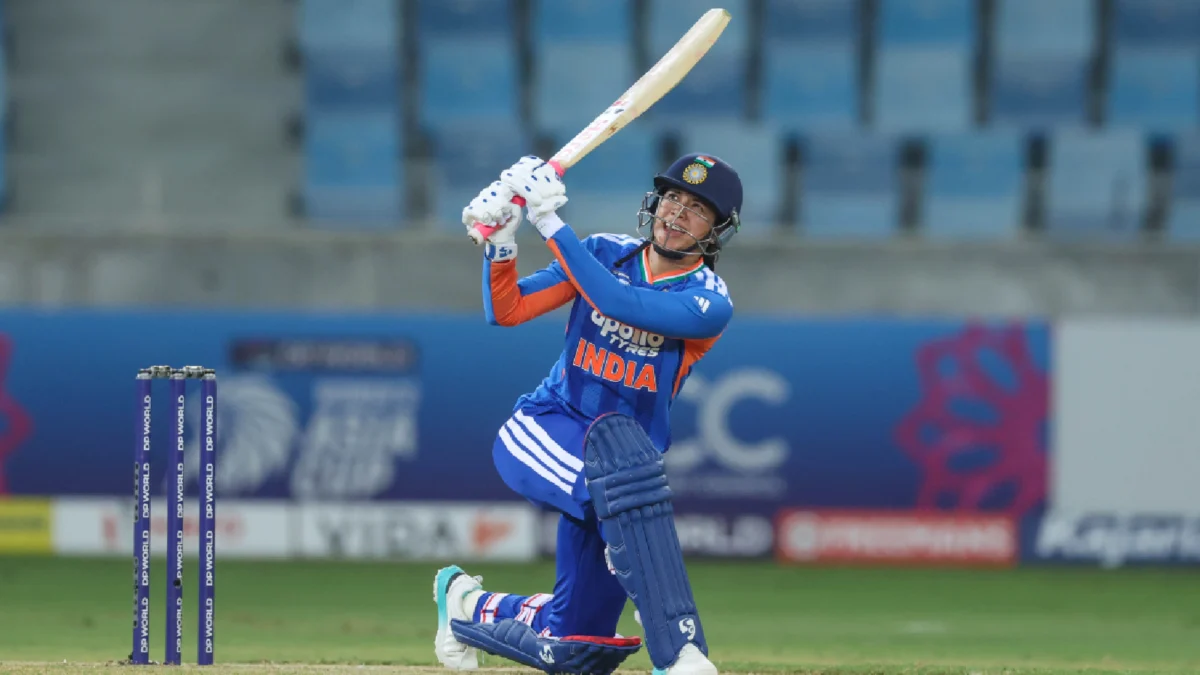
Dubai, UAE – September 3, 2026 – In a dazzling display of power and precision, Indian opener Smriti Mandhana etched her name deeper into the annals of cricketing history today, smashing an unbeaten 124 runs off just 64 balls against Hong Kong, China, at the Women’s Asia Cup. Her monumental effort not only secured a resounding 137-run victory for India but also guaranteed their passage into the tournament semifinals, affirming their status as perennial title contenders.
The celebratory scenes in Dubai, however, were notably subdued compared to the unbridled joy that accompanied her maiden T20I century in Nottingham last year. This time, the helmet remained firmly in place, and the bat raise was almost apologetic, perhaps a testament to the vast gulf in cricketing prowess between the two competing nations. Yet, the modesty of the occasion did little to diminish the sheer brilliance of Mandhana’s performance, an innings that rewrote multiple record books and underscored her remarkable evolution as a T20 batter.
Main Facts: A Century of Milestones and Dominance
Smriti Mandhana’s blistering 124-run knock against Hong Kong, China, was far more than just a match-winning innings; it was a statistical supernova, illuminating her unparalleled rise in women’s cricket. Playing at the iconic Dubai International Cricket Stadium, Mandhana single-handedly powered India to an imposing total of 195/3 after being asked to bat first. In response, Hong Kong, China, crumbled under the pressure, managing a mere 56 runs all out, handing India their second-biggest victory margin in Women’s T20 Internationals by runs.
The significance of Mandhana’s innings resonated beyond the immediate match result. With this century, she became the first Indian woman to score two T20I centuries, a testament to her consistency and destructive capability in the shortest format. Furthermore, her knock propelled her to become the leading run-scorer in women’s international cricket, a monumental achievement that speaks volumes about her prolific career across all formats. Adding to this historic day, Mandhana also became the first woman to record 18 international centuries and registered the highest individual score in the T20 version of the Asia Cup, eclipsing previous records with her aggressive display.
This performance was not merely about individual glory; it was the cornerstone of India’s dominant campaign in the Women’s Asia Cup, ensuring their semi-final berth with a clinical display against an overmatched opponent. The victory, comprehensive in every aspect, served as a powerful statement of intent from the defending champions.
Chronology: From Cautious Start to Record-Breaking Blitz
The narrative of Smriti Mandhana’s innings, and indeed the entire match, was one of escalating dominance, mirroring the left-hander’s journey of transformation over the past couple of years.
Pre-Match Context and Toss:
Entering the match, India, one of the favorites, was expected to comfortably dispatch Hong Kong, China, a team still finding its footing on the international stage. Indian captain Harmanpreet Kaur, winning the toss, elected to bat first, though she candidly acknowledged the pitch as "very tricky," hinting at a surface that might demand caution and careful shot selection. This assessment set the stage for what initially appeared to be a measured approach from the Indian openers.
Mandhana’s Measured Opening:
True to her captain’s observation, Mandhana’s innings began with an uncharacteristic degree of restraint. For the first 18 deliveries she faced, she meticulously accumulated 18 runs, gauging the conditions and the opposition’s bowling attack. This period of circumspection underscored her evolving tactical intelligence, demonstrating a willingness to build an innings rather than launching into an immediate assault. The early overs saw India navigating the new ball and the "tricky" surface with a sense of purpose, focusing on rotating the strike and finding the occasional boundary.
The Unleashing of Aggression:
The shift from caution to unbridled aggression was swift and decisive. As the fifth over commenced, Mandhana seemingly decided the time for assessment was over. Three boundaries flowed from her bat in quick succession, each stroke a testament to her exquisite timing and placement. This sudden acceleration served as the catalyst, igniting the Indian innings. Her opening partner, Shafali Verma, known for her explosive style, joined the party in the very next over, dispatching two sixes and two fours, providing crucial early impetus. Their partnership, though relatively short-lived, laid a solid foundation before Ruchika Venkatesh managed to dismiss Verma for a brisk 28.
A Masterclass in Batting:
Shafali’s departure, however, did little to stem the flow of runs. If anything, it emboldened Mandhana further. From that point, India added another 119 runs to their total, with a staggering 80 of those runs emanating from Mandhana’s bat. It was an innings of breathtaking versatility and power. Anything short was pulled with disdain, the ball rocketing towards the boundary. Anything offering width was caressed through the covers with drives that showcased her elegant touch. The sweeps were executed with unwavering conviction, while her cuts, particularly the one that brought up her magnificent century, demonstrated surgical precision, finding the gaps with unerring accuracy.
The sheer dominance of her hitting was evident in her boundary count: 14 fours and 7 sixes, accounting for 98 of her 124 runs. It was a visual spectacle, a batter in perfect synchronisation with her craft, transforming a potentially tricky wicket into a batting paradise. The Hong Kong bowlers, despite their best efforts, found no answer to her onslaught, as Mandhana marched past her century, ultimately finishing unbeaten on 124.
India’s Innings Conclusion and Hong Kong’s Chase:
India concluded their innings at a formidable 195/3, a total that seemed insurmountable on the given surface. While Mandhana was the undisputed star, the lack of substantial contributions from other middle-order batters like Pratika Rawal (10 off 12 balls) and Richa Ghosh, who has struggled for runs recently, remained a minor concern.
Facing such a daunting target, Hong Kong, China, approached their chase with a clear, albeit defensive, strategy: to bat out the full 20 overs. For a brief period, this stonewalling effort appeared to yield some success. The first eight overs saw them accumulate 26 runs for the loss of just one wicket, taken by Nandani Sharma. This initial resistance hinted at a protracted struggle, but it was ultimately unsustainable against the quality of the Indian bowling attack.
The Spin Web and Hong Kong’s Collapse:
The turning point came with the introduction of India’s formidable spin trio: Deepti Sharma, Prema Rawat, and Sree Charani. These three bowlers, known for their ability to choke runs and pick up wickets, proved devastatingly effective. They combined to scalp an incredible seven wickets for just 37 runs, dismantling Hong Kong’s batting lineup with ruthless efficiency. Nine wickets tumbled in a mere 47 deliveries, as the associate nation’s batters found themselves bamboozled by the guile and variations of the Indian spinners. Natasha Miles, with a top score of 15, offered the only semblance of resistance. Hong Kong, China, was eventually bundled out for a paltry 56 runs, securing India’s passage to the semifinals with an emphatic 137-run victory.
Supporting Data: Mandhana’s Metamorphosis and Statistical Supremacy
Smriti Mandhana’s journey to becoming a record-breaking centurion against Hong Kong is a tale of relentless self-improvement and a categorical response to past criticisms. Her performance in the 2024 T20 World Cup, where a strike rate of 94.93 raised questions about her T20 approach, served as a pivotal moment. What followed was a discernible and dramatic transformation in her batting philosophy, culminating in her current dominant form.
The Evolution of a T20 Powerhouse:
The statistics vividly illustrate Mandhana’s upward trajectory. Her T20I strike rate, once a point of contention, has soared:
- 2024 T20 World Cup: 94.93
- Post-2024 T20 World Cup (remainder of 2024): 126.53
- 2025: 135.85
- 2026 (pre-Asia Cup match): 145.84
- Current T20 World Cup (overall): 140.4 (reflecting sustained high performance)
This consistent climb demonstrates not just an increase in scoring pace but a fundamental shift in her intent and execution. She has consciously adopted a more aggressive, fearless approach, converting good starts into explosive innings. The 112 off 62 balls against England in Nottingham in June last year marked her maiden T20I century and served as the first clear signal of this new, revitalized Mandhana. Her second century against Hong Kong, while against weaker opposition, solidifies this transformation, confirming that her elevated strike rate is no fluke but a calculated and successful evolution of her game.
A Quartet of Records:
The Dubai innings was a harvest of records for Mandhana:
- First Indian Woman with Two T20I Centuries: This achievement places her in an elite category, showcasing her unique ability to dominate the shortest format for India. It highlights her consistent power-hitting and match-winning capabilities.
- Leading Run-scorer in Women’s International Cricket: This monumental milestone sees her surpass some of the greatest names in the sport, a testament to her longevity, prolificacy, and consistent performances across Tests, ODIs, and T20Is since her debut.
- First Woman to Score 18 International Centuries: This record underscores her remarkable ability to convert starts into big scores, demonstrating exceptional mental fortitude and technical prowess across all formats against diverse international attacks.
- Highest Score in Women’s Asia Cup T20 History: Her 124 not out surpassed all previous individual scores in the T20 format of the continental championship, further cementing her legacy as an Asia Cup legend.
Team Dominance and Individual Concerns:
India’s victory by 137 runs stands as their second-largest winning margin in WT20Is by runs, a clear indicator of their overwhelming superiority. Their bowlers, particularly the spin triumvirate, exhibited clinical precision. Deepti Sharma’s figures of 3/9 were exemplary, complemented by the effective spells of Prema Rawat and Sree Charani. This bowling performance cemented India’s reputation as a team with a deep and versatile attack, particularly potent in spin-friendly Asian conditions.
However, the batting performance also highlighted a potential vulnerability. Beyond the brilliance of Mandhana and the early contributions of Shafali Verma, the rest of the Indian batting order struggled to make significant contributions. Pratika Rawal’s 10 off 12 balls and Richa Ghosh’s continued struggles (it has been over eight months since her last 35+ T20I score) present a mild concern. While the top order is formidable, reliance on a select few for the bulk of the scoring could be problematic against stronger opposition. This match, despite the overwhelming win, provided a subtle reminder for the team management to ensure greater consistency from the middle order.
The historical context of the opposition further magnifies India’s dominance. Hong Kong, China, having previously mustered a paltry 24 runs in their only prior (unofficial) T20 outing against India in 2012, were simply outmatched by a superior cricketing nation operating at the peak of its powers.
Official Responses: Praises and Strategic Outlook
While direct quotes from official sources were not immediately available post-match, the sentiment surrounding Smriti Mandhana’s performance and India’s dominant win was unequivocally positive, resonating across the cricketing fraternity.
Captain’s Perspective (Inferred):
Captain Harmanpreet Kaur, who had earlier described the wicket as "very tricky," would undoubtedly have been immensely proud of Mandhana’s ability to not only adapt but also dominate such conditions. Her pre-match assessment would likely have led to a strategy of caution, making Mandhana’s eventual explosion of runs even more commendable. Kaur would likely emphasize the importance of securing the semi-final spot, while also subtly acknowledging the need for other batters to step up. The team’s overall clinical performance, especially the bowlers’ efficiency in dismissing Hong Kong for a low total, would have pleased the captain, reinforcing the team’s balance.
Mandhana’s Own Reflection (Anticipated):
Smriti Mandhana, known for her humility, would likely downplay her individual heroics, preferring to focus on the team’s victory and qualification. Her "almost apologetic" bat raise suggests a player more concerned with team objectives than personal milestones, especially against an underdog opponent. However, the sheer joy of breaking multiple records would undoubtedly be a source of quiet satisfaction, a validation of her hard work and strategic adjustments to her game. She might express gratitude for the team’s support and look forward to the challenges ahead.
Coaching Staff’s Analysis (Expected):
The coaching staff would view Mandhana’s century as a confirmation of her world-class status and the successful implementation of her improved T20 approach. They would likely praise her leadership by example and her ability to anchor the innings. Simultaneously, they would be dissecting the contributions of the other batters, perhaps using this match as a learning opportunity to work on consistency and depth in the middle order, preparing for tougher encounters in the knockout stages. The bowlers, particularly the spinners, would receive high praise for their disciplined and wicket-taking efforts.
Opponent’s Viewpoint (Hypothetical):
From Hong Kong, China’s perspective, the match would have been a stark lesson in the realities of international cricket against a top-tier team. Their captain, Marina Lamplough, who herself picked up 2/46, would likely acknowledge Mandhana’s exceptional talent and the overwhelming power of the Indian team. The experience, despite the heavy defeat, would be framed as invaluable exposure for their developing players, highlighting areas for improvement in both batting and bowling against elite competition.
Tournament Organizers and Broadcasters:
Broadcasters like Sony Sports Network, who actively promoted Mandhana’s achievements on social media, would be thrilled with the record-breaking nature of the innings. Such performances generate significant buzz and highlight the quality of the Women’s Asia Cup. However, the conspicuous lack of spectators in the stadium, as noted in the original article, remains a challenge for organizers, especially for matches involving associate nations. It underscores the ongoing effort required to promote women’s cricket globally and attract larger live audiences across all fixtures.
Implications: Semifinal Showdown and Broader Impact
The implications of India’s dominant victory and Smriti Mandhana’s record-breaking century are multifaceted, touching upon the immediate tournament prospects, the team’s strategic development, and the broader narrative of women’s cricket.
Immediate Tournament Prospects and the Pakistan Challenge:
The win against Hong Kong, China, decisively secures India’s spot in the semifinals, maintaining their formidable record in the Women’s Asia Cup. This momentum is crucial as they head into their highly anticipated clash against arch-rivals Pakistan on Saturday at the same venue. The encounter against Pakistan will be a true test of India’s mettle, offering a much sterner challenge than Hong Kong. Mandhana’s current form provides India with a significant psychological edge, and her ability to dominate under pressure will be key in such a high-stakes fixture. A win against Pakistan would not only boost team morale but also likely set them up for a strong run to the final, where they will undoubtedly aim to extend their record as the most successful team in the tournament’s history.
Mandhana’s Ascending Legacy and Leadership:
Smriti Mandhana’s individual achievements in this match further solidify her position as one of the undisputed superstars of women’s cricket globally. Her transformation from a stylish opener to a destructive, record-breaking T20 batter sets a new benchmark for aggression and consistency. Her role extends beyond just scoring runs; she is a leader by example, inspiring teammates and aspiring cricketers alike. Her ability to consistently perform under scrutiny and adapt her game reflects a deep understanding of modern cricket, making her an invaluable asset to the Indian team, both as a batter and a potential future captain. Her burgeoning list of records will inevitably place her in discussions alongside cricketing legends, further elevating her stature in the sport.
Addressing Team Dynamics and Future Development:
While the victory was comprehensive, the subdued contributions from other batters, particularly in the middle order, remain a point of discussion. The over-reliance on Mandhana and Shafali Verma, especially Richa Ghosh’s prolonged lean patch, highlights an area for improvement. As India progresses to face stronger opponents, a more balanced and consistent batting effort from the entire lineup will be imperative. The coaching staff will likely be working on empowering these batters to perform under pressure, ensuring that the team isn’t solely dependent on its top two. This match, though a win, offered a valuable opportunity to identify and address these nuances before the knockout stages.
The Broader Narrative of Women’s Cricket:
The stark disparity between India and Hong Kong, China, while showcasing India’s strength, also underscores a broader challenge in women’s cricket: the significant gap between established cricketing nations and associate teams. While matches against dominant teams offer invaluable experience for developing nations, they also sometimes result in one-sided contests. The pointed observation about the "lack of spectators" at the venue for such a record-breaking performance raises critical questions about marketing, scheduling, and the overall promotion of women’s cricket, particularly for matches not involving top-tier rivalries. Attracting larger crowds and fostering deeper engagement for all games remains a key objective for the sport’s global growth and sustainability. Initiatives to bridge the gap between cricketing tiers and ensure more competitive matches, alongside aggressive promotional strategies, will be vital for the continued ascent of women’s cricket.
In conclusion, Smriti Mandhana’s spectacular century against Hong Kong, China, was more than just a match-winning innings; it was a testament to her personal evolution, a strategic victory for India, and a significant moment in the ongoing narrative of women’s cricket. As India now prepares for the semifinals, with Mandhana leading from the front, the stage is set for an exciting climax to the Women’s Asia Cup.
