

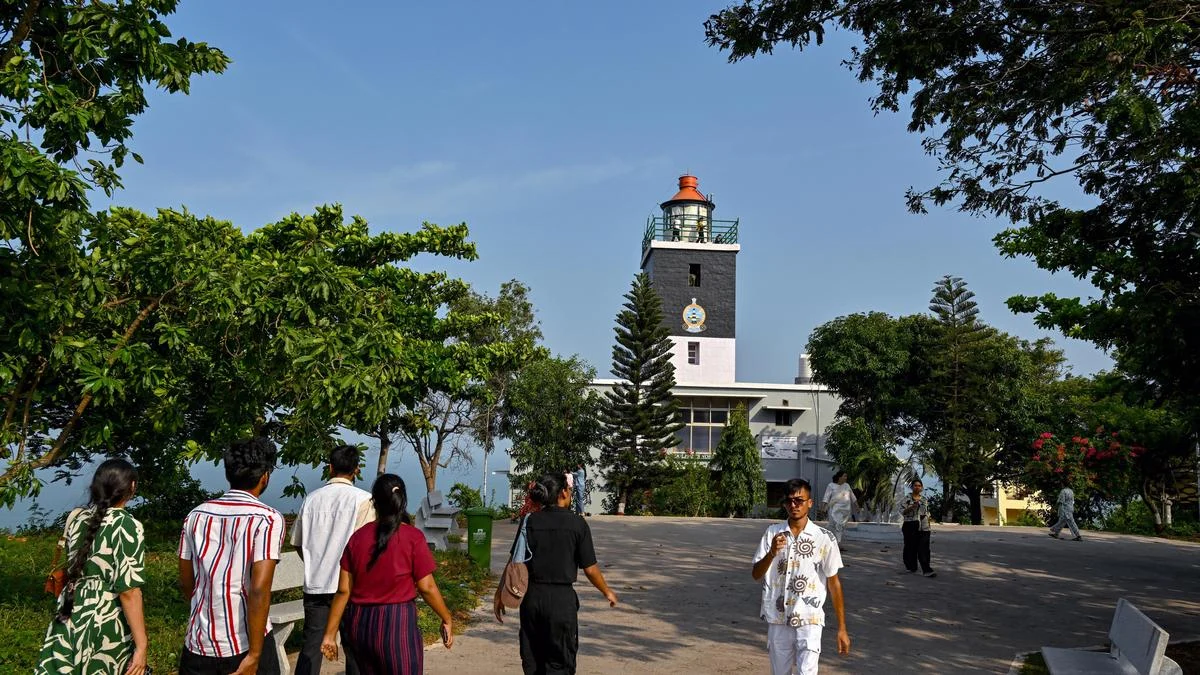
As of late August 2026, the lighthouse continues to serve as a vital navigational beacon for the Visakhapatnam Port while offering visitors a rare, panoramic vantage point that encapsulates the city’s dual identity: a bustling industrial powerhouse and a serene coastal retreat.
The Ascent to Dolphin’s Nose: A Transition of Character
The journey to the lighthouse is as much a part of the experience as the destination itself. Driving toward Dolphin Hill, the urban sprawl of Visakhapatnam—affectionately known as the "City of Destiny"—begins to peel away. The road winds through a landscape where the character of the city shifts abruptly. To one side, the dense industrial installations of the port and the heavy machinery of the shipyard stand as monuments to India’s maritime economy. To the other, the verdant slopes of the Eastern Ghats meet the sea.
The route passes through high-security zones maintained by the Indian Navy and the Visakhapatnam Port Authority. This presence lends a sense of gravity to the drive, reminding visitors that they are entering a strategically sensitive area. The headland itself, named for its uncanny resemblance to a dolphin’s snout breaching the water, rises 358 meters above sea level, providing a natural platform for what has become one of the most powerful lighthouses on India’s eastern seaboard.
Main Facts: The Structure and the Experience
Operated by the Directorate of Lighthouses and Lightships under the Ministry of Ports, Shipping and Waterways, the Dolphin’s Nose Lighthouse is a masterpiece of mid-century functionalist architecture. The current tower, commissioned on June 15, 1957, stands as a 19-meter-square masonry structure. Its iconic black and white horizontal bands are designed for maximum visibility during daylight hours, serving as a "daymark" for sailors long before the evening glow of the beacon takes over.
For a modest entry fee of ₹10, the public is granted access during a narrow but popular window from 3:00 p.m. to 5:00 p.m. daily. Inside the compound, a meticulously landscaped garden offers a moment of repose before the ascent. The climb involves a narrow, winding staircase that challenges the legs but rewards the eyes. Small apertures in the masonry offer "shutter-speed" glimpses of the horizon, building anticipation for the gallery at the summit.
From the top, the scale of Visakhapatnam’s maritime operations is laid bare. Below, the Inner Harbour teems with activity—massive bulk carriers, naval frigates, and tugboats appear like toys in a vast bathtub. To the south, the pristine sands of Yarada Beach curve away into the distance, shielded from the city’s noise by the very hills that house the lighthouse.

Chronology: A Century of Maritime Evolution
The history of light signaling on Dolphin Hill predates the current concrete tower by over half a century, reflecting the evolution of Visakhapatnam from a colonial outpost to a strategic naval hub.
- 1902: The First Signals: The maritime history of the site began with the erection of a flagstaff on the fort. This was primarily used to hoist storm warning signals, a critical service for a coastline frequently battered by cyclonic activity in the Bay of Bengal.
- Early 1900s: The Masonry Tower: Shortly after the flagstaff, a modest light was placed on a 15-meter circular masonry tower. While rudimentary by modern standards, it provided the first consistent nighttime guidance for vessels entering the roadstead.
- 1926: The Stevenson Survey: A pivotal moment occurred when lighthouse expert Alan D. Stevenson conducted a survey of the coast. Stevenson, belonging to the famed family of lighthouse engineers (which included the father of author Robert Louis Stevenson), identified Dolphin’s Nose as the optimal location for a " landfall light"—the first light a ship sees when approaching a coast.
- 1940: War-Era Operations: The first light at the current site became operational in 1940, serving a crucial role during World War II as Visakhapatnam became a key logistics point for the Allied forces in the Indian Ocean.
- 1957: The Modern Era: The current tower was inaugurated on June 15, 1957, by Lal Bahadur Shastri, who was then the Union Minister for Transport and Communications. This marked the transition to a high-power optical system capable of guiding modern commercial shipping.
- 1961–1998: Technological Integration: The station evolved from a simple light tower into a sophisticated data hub. A Japanese-made radio beacon was installed in 1961, followed by the implementation of Differential Global Positioning System (DGPS) corrections in 1998, which revolutionized the accuracy of satellite navigation for ships in the region.
Supporting Data and Technical Specifications
The Dolphin’s Nose Lighthouse is not merely a tourist attraction; it is a high-tech navigational aid that remains essential despite the advent of GPS.
- Luminous Range: The powerful beacon has a luminous range of approximately 32 nautical miles (roughly 59 kilometers). This ensures that vessels far out in the Bay of Bengal can fix their positions long before they reach the harbor entrance.
- Height: The tower stands 19 meters tall, but its effective focal plane height is significantly higher due to its position on the 358-meter hill.
- Modern Aids: The station is equipped with an Automatic Identification System (AIS), which allows the lighthouse to "communicate" digitally with the bridge systems of passing ships, providing them with the lighthouse’s identity, position, and status.
- Radar Transponders (Racon): These devices respond to a ship’s radar pulse by painting a specific character (usually a Morse code letter) on the ship’s radar screen, allowing for identification even in heavy fog or rain.
Official Responses and Governance
The management of the lighthouse falls under the Directorate General of Lighthouses and Lightships (DGLL). In recent years, the Ministry of Ports, Shipping and Waterways has pivoted toward a "Lighthouse Tourism" policy. This national initiative seeks to preserve the heritage of India’s 75 iconic lighthouses while generating revenue and public interest.
Officials from the Directorate have noted that the Dolphin’s Nose site is one of their most successful "dual-use" facilities. "The challenge is balancing the stringent security requirements of a major port and naval base with the public’s desire to access historical landmarks," an official source stated during a recent review of the facility. "By limiting visiting hours to the late afternoon, we ensure that the operational integrity of the light and the security of the surrounding hill are maintained while allowing the public to enjoy the heritage value of the site."
Furthermore, the integration of modern DGPS and AIS technology at the site is part of the government’s "Sagar Mala" project, which aims to modernize India’s ports and maritime infrastructure to compete with global standards.
Historical Implications: The Hill That Remembers
Beyond its role in navigation, Dolphin Hill is a silent witness to military history. Long before the 1957 tower was built, the British Army utilized the hill as a strategic military camp. Its height provided an unmatched lookout over the coast, making it impossible for enemy fleets to approach unseen.
The area is also intrinsically linked to the Battle of Vizagapatam in 1804. This naval engagement, part of the Napoleonic Wars, saw a French squadron under Admiral Linois clash with a British Royal Navy ship and two East India Company vessels. The shadows of the hill provided tactical cover during such skirmishes, and the modern lighthouse stands on ground that has been contested for centuries.

Implications for the Future: Tourism and Preservation
The continued popularity of the Dolphin’s Nose Lighthouse, as evidenced by the steady stream of visitors in August 2026, suggests a growing public appetite for "slow tourism"—experiences that combine physical activity, historical education, and natural beauty.
However, the site faces challenges. The environmental sensitivity of Dolphin Hill, coupled with the increasing traffic toward Yarada Beach, requires a delicate balance. Urban planners in Visakhapatnam are currently looking at the Dolphin Hill corridor as a potential "Heritage Zone." This would involve stricter regulations on construction to preserve the "dolphin" silhouette of the hill and perhaps expanding the museum facilities at the base of the lighthouse to better showcase the technological artifacts—like the original 1961 radio beacon—currently housed there.
As a half-day outing, the lighthouse serves as the perfect anchor for a trip to the south of the city. When combined with a visit to the secluded Yarada Beach, it offers a comprehensive narrative of Visakhapatnam: the view from the heights of history followed by a descent to the timeless rhythm of the waves.
Conclusion
The Dolphin’s Nose Lighthouse remains more than just a guide for ships; it is a guide for the city’s soul. In an era of digital navigation and rapid urban expansion, this black-and-white tower stands as a reminder of a time when the safety of a thousand sailors depended on a single lamp and a sturdy masonry wall. For the tourists who climb its stairs in the waning light of a Friday afternoon, it provides something even more valuable: a moment of clarity and a perspective of the world that only height and history can provide.
Visitor Information Summary (2026):
- Location: Dolphin Hill, Visakhapatnam (en route to Yarada Beach).
- Hours: 3:00 PM – 5:00 PM Daily.
- Entry Fee: ₹10 per person.
- Pro Tip: Photography is permitted, but visitors must adhere to security guidelines regarding the surrounding Naval installations. Combined trips with Yarada Beach are highly recommended for the full coastal experience.
