

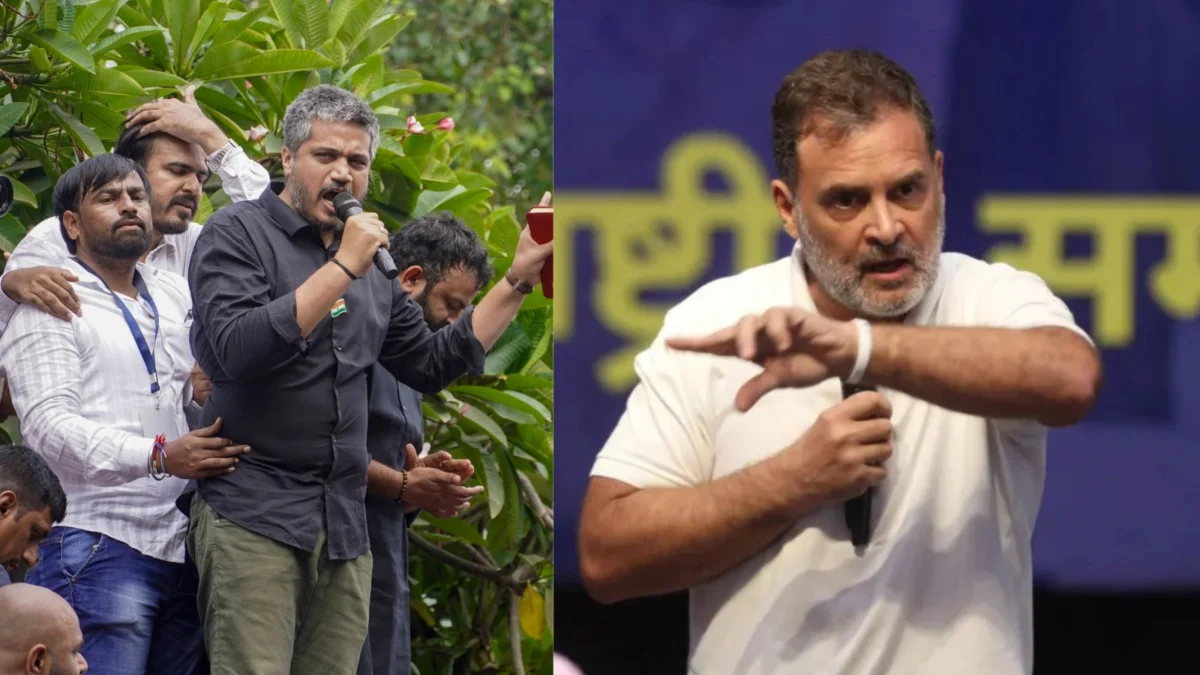
Mumbai, Maharashtra – September 8, 2026 – In a political landscape defined by evolving alliances and dynastic complexities, Rohit Pawar, the dynamic MLA from the Nationalist Congress Party (Sharadchandra Pawar) faction, has increasingly signaled a deep and strategic alignment with the Indian National Congress. His recent actions, ranging from a determined pursuit of justice for his late uncle, former Maharashtra Deputy Chief Minister Ajit Pawar, to a vocal advocacy for student rights, underscore a calculated political trajectory that observers believe could reshape the Maha Vikas Aghadi (MVA) and potentially impact Maharashtra’s political future.
Pawar’s burgeoning proximity to the Congress party, particularly its high command and state leadership, has become a focal point of political discussion. This alignment is not merely a matter of convenience but appears to be a deeply considered move by a young leader keen on carving out his distinct identity while leveraging the established network and ideological foundations of the Grand Old Party.
Main Facts: A Convergence of Ambition and Ideology
The narrative of Rohit Pawar’s increasing closeness to the Congress leadership began in March 2026, following the tragic aircraft crash that claimed the life of his uncle, Ajit Pawar. Rohit Pawar, driven by a demand for a fair and transparent investigation into the incident, embarked on a series of high-profile meetings in Delhi. He met with Leader of Opposition Rahul Gandhi, Congress President Mallikarjun Kharge, and senior leader K.C. Venugopal, seeking their support and submitting crucial documents related to the crash.
These meetings, particularly the hour-long session with Rahul Gandhi, were not just about garnering support for an investigation; they were interpreted as a significant political overture. The assurance reportedly given by one of the Congress leaders – "keep on fighting; the time of our ideology will surely come" – served as an implicit endorsement and a nod to a shared political philosophy.
The subsequent inability to register a First Information Report (FIR) in Maharashtra led Pawar to take the extraordinary step of traveling to Bengaluru, a Congress-governed state, where a zero FIR was successfully registered at the High Grounds police station. This move, while legally permissible, carried immense political symbolism, highlighting the perceived unresponsiveness of the Maharashtra state machinery and showcasing Congress’s willingness to extend support across state lines.
In the months that followed, Rohit Pawar’s public actions further solidified perceptions of his growing affinity for the Congress. His prominent role in welcoming Rahul Gandhi to Pune for the "Chhatron ki Goonj" event, marked by hundreds of posters, was a clear demonstration of solidarity. Ideologically, Pawar has explicitly stated, "The name of our party carries the word ‘Congress’; there is no difference in our ideologies. Pawar saheb (Sharad Pawar) was in the Congress. That party is not new to us. Even though we are different on paper, we have been allies for decades. Right now, the foremost task in front of both of us is to return to power in the state and at the Centre in 2029." This statement encapsulates his vision for a united front, rooted in historical ties and a shared political objective.
Chronology of Convergence: From Personal Tragedy to Political Alignment
The sequence of events leading to Rohit Pawar’s current political stance paints a clear picture of calculated moves and growing ideological resonance.
February 2026: The Tragic Loss and Unanswered Questions
The sudden and tragic death of Maharashtra Deputy Chief Minister Ajit Pawar in an aircraft crash sent shockwaves through the state’s political establishment. Ajit Pawar, a veteran leader and a formidable force in Maharashtra politics, left behind a void and a myriad of questions surrounding the circumstances of the incident. For Rohit Pawar, his nephew, this was not just a personal loss but a call to action, demanding transparency and accountability.
March 2026: Delhi Darshan – Seeking Support and Alliance
Just over a month after the crash, in March, Rohit Pawar made his crucial trip to Delhi. His primary objective was to meet key Congress leaders to press for a thorough investigation into his uncle’s demise. The meetings were carefully orchestrated:
- Meeting with Rahul Gandhi: As the Leader of Opposition, Gandhi’s endorsement was vital. The hour-long discussion signified a deep dive into the matter and, crucially, an ideological exchange. Rahul Gandhi, himself a scion of a prominent political family, likely understood the gravity of Rohit’s quest for justice and the political ramifications.
- Meeting with Mallikarjun Kharge: The Congress President’s involvement lent institutional weight to Rohit Pawar’s demands, signaling the party’s official support.
- Meeting with K.C. Venugopal: As the General Secretary (Organisation), Venugopal’s presence indicated that the Congress machinery was being activated to consider Pawar’s appeal. The encouraging words, "keep on fighting; the time of our ideology will surely come," served as both personal encouragement and a broader ideological affirmation.
Late March 2026: The Bengaluru Breakthrough – A Zero FIR
Frustrated by the perceived lack of progress and alleged stonewalling by authorities in Maharashtra, Rohit Pawar demonstrated his determination. Unable to register an FIR in his home state, he strategically traveled to Bengaluru, the capital of Congress-governed Karnataka. There, he successfully registered a zero FIR at the High Grounds police station. This move was a masterclass in political maneuvering, showcasing how an opposition leader could leverage a friendly state government to circumvent perceived obstacles in a state where his family’s faction was in opposition. It also highlighted the practical aspects of inter-state cooperation within the INDIA bloc, even before formal agreements.
Subsequent Months (April-August 2026): Public Affirmations and Shared Platforms
The period following the FIR saw a noticeable intensification of Rohit Pawar’s public alignment with the Congress.
- "Chhatron ki Goonj" Event: Rohit Pawar’s enthusiastic welcome for Rahul Gandhi at the Pune event was a clear public display of allegiance. The sheer volume of posters and active participation indicated a deep investment in promoting Gandhi’s outreach initiatives, particularly among the youth.
- Media Statements: His repeated assertions to media outlets like The Indian Express about the shared history and ideology between NCP (Sharadchandra Pawar) and Congress further cemented this perception. He consistently highlighted Sharad Pawar’s Congress roots and the decades-long alliance, portraying the current alignment as a natural progression rather than a sudden shift.
- Virtual LoP Role: Rohit Pawar consciously stepped into the vacuum created by the absence of an officially recognized Leader of Opposition in Maharashtra. He began adopting a role reminiscent of Rahul Gandhi’s own activism, focusing on public grievances and holding the government accountable.
Early September 2026: Amplifying Youth Voices
The recent protests in Pune regarding the Maharashtra Public Service Commission (MPSC) paper leak, where thousands demanded the resignation of chairperson Vivek Bhimanwar, provided another platform for Rohit Pawar to align with Rahul Gandhi. Pawar championed the students’ cause, drawing direct comparisons to Gandhi’s advocacy for similar issues at the national level. Gandhi’s subsequent public support for the Pune protesters underscored the growing synergy between the two leaders on critical issues affecting the youth.
This chronology demonstrates a carefully orchestrated series of actions, transitioning from a personal quest for justice to a broader political alignment, all while strategically positioning Rohit Pawar as a key player in Maharashtra’s opposition landscape.
Supporting Data and Political Context: Navigating Maharashtra’s Complex Web
The political landscape of Maharashtra is notoriously complex, characterized by shifting alliances, dynastic politics, and a constant struggle for dominance. Rohit Pawar’s moves must be understood within this intricate framework.
The Leadership Vacuum in Maharashtra
One of the critical factors enabling Rohit Pawar’s rise as a de facto opposition leader is the current political vacuum in Maharashtra. The state assembly lacks an officially sanctioned Leader of Opposition. This situation arises when no single opposition party or pre-poll alliance commands sufficient numbers to stake a claim to the post, or when the Speaker delays recognizing such a leader. In the absence of a formal LoP, the role of scrutinizing the government and articulating public grievances often falls to assertive individual legislators. Rohit Pawar has skillfully stepped into this breach, projecting himself as a consistent and vocal critic of the BJP-led government.
His strategy mirrors Rahul Gandhi’s approach at the national level, where Gandhi has consistently taken on the ruling establishment, often through direct engagement with affected communities and clear presentations of facts and figures. Pawar’s adoption of similar tactics – hitting the streets, organizing press conferences with data-backed presentations, and championing issues like farmers’ distress, women’s safety, and student recruitment irregularities – positions him as a credible and relatable voice of opposition. The recent MPSC paper leak, which sparked widespread protests in Pune, provided a perfect opportunity for Pawar to demonstrate this commitment. His immediate and vocal support, coupled with Rahul Gandhi’s endorsement of the protesters, amplified the issue and showcased a united opposition front on youth-centric concerns.
The Significance of a Zero FIR
The act of registering a zero FIR in Bengaluru, a Congress-governed state, was not merely a legal formality but a powerful political statement. A zero FIR allows any police station, regardless of territorial jurisdiction, to register a complaint, which is then transferred to the appropriate police station for investigation. While legally sound, using it in another state when local avenues were perceived as blocked, underscored:
- Perceived Inaction in Maharashtra: It implicitly accused the Maharashtra state machinery of either complicity or deliberate obstruction in the investigation into Ajit Pawar’s crash.
- Inter-Alliance Solidarity: It demonstrated the practical utility of the INDIA bloc, showing how allied parties could extend administrative and political support to each other, even when facing resistance in their home states.
- National Attention: By involving a Congress-ruled state, the issue gained a national dimension, drawing more attention to the demand for a transparent investigation.
The Baramati By-election and Family Dynamics
The Baramati Assembly bypoll was another crucial moment showcasing Rohit Pawar’s strategic acumen and his deepening ties with Congress. Baramati is the undisputed stronghold of the Pawar family, a constituency that has consistently returned a Pawar to power. The decision by Rohit Pawar to persuade the Congress to stand down and not contest against Sunetra Pawar – Ajit Pawar’s wife and the current Deputy Chief Minister and leader of the rival NCP faction – was a complex move.
- Minimizing Intra-Family Conflict: While ideologically opposed to his aunt’s faction, Rohit Pawar might have sought to avoid a direct, divisive contest within the broader Pawar family, which could have been perceived as weakening the family’s overall political influence in its bastion.
- Strengthening Congress Ties: More importantly, it demonstrated his influence within the Congress and his commitment to the alliance. By facilitating a smoother path for Sunetra Pawar (albeit from the rival faction) without Congress opposition, he likely built goodwill with the state Congress leadership, particularly Harshvardhan Sapkal, the state chief. This contrasts sharply with his aunt, Baramati MP Supriya Sule, who has openly expressed reservations about the state Congress, further highlighting Rohit’s unique positioning. This move signals Rohit’s pragmatic approach to politics, prioritizing long-term alliance building over immediate electoral contests that might strain relationships.
The 2029 Imperative
Rohit Pawar’s explicit statement about the "foremost task" being to "return to power in the state and at the Centre in 2029" provides the overarching strategic context for his actions. This long-term vision positions his current alignment with Congress not as an isolated incident but as part of a broader, concerted effort to consolidate opposition forces ahead of the next general and state elections. It indicates a clear intent to work within the larger framework of the INDIA alliance, seeing Congress as a vital partner in achieving electoral success.
Official Responses: A War of Words
Rohit Pawar’s burgeoning political profile and his increasingly vocal opposition have naturally drawn fire from the ruling Bharatiya Janata Party (BJP) and its allies, while being staunchly defended by his own party faction.
BJP’s Criticism: Allegations of Political Opportunism
The BJP has been quick to dismiss Rohit Pawar’s activism as mere political opportunism, accusing him of exploiting genuine public grievances for personal gain.
- BJP MLA Vikram Pachpute stated, "The NCP (SP) leader is merely playing politics. He has not given any concrete policy inputs or solutions to the issues he raises. This is nothing more than an attempt to increase his political stature by latching onto student protests and other public sentiments." This critique aims to delegitimize Pawar’s efforts by portraying them as hollow and self-serving.
- Former BJP MLA Jagdish Mulik echoed this sentiment, alleging that Rohit Pawar’s attempt to "give political colour" to students’ issues would "never succeed." Mulik’s comments suggest that the BJP believes the public, particularly the youth, will see through Pawar’s intentions and not be swayed by what they term as opportunistic politics. The BJP’s strategy is to frame Pawar as an individual driven by ambition rather than genuine concern, thereby undermining his credibility. They attempt to paint him as another dynastic politician trying to make a mark without substantive contributions.
NCP (Sharadchandra Pawar)’s Defense: Upholding Democratic Values
The Nationalist Congress Party (Sharadchandra Pawar) has robustly defended Rohit Pawar, framing his actions as a necessary and legitimate exercise of democratic accountability.
- NCP (SP) leader Amol Matele retorted sharply to the BJP’s accusations, stating, "If the BJP thinks raising issues concerning students as an attempt to gain political mileage, then it just shows the insensitive nature of the ruling party. The BJP should refrain from making such childish comments." Matele’s defense positions Pawar’s activism as a duty of the opposition – to highlight governmental failures and advocate for citizens’ rights. He argues that by dismissing these concerns as "political," the BJP reveals its own detachment from the common person’s struggles. The NCP (SP) emphasizes that questioning the government, especially on matters like paper leaks that affect thousands of young lives, is fundamental to a functioning democracy. They portray Pawar as a courageous voice standing up for the voiceless, in stark contrast to a ruling party perceived as indifferent.
Congress’s Implicit Endorsement: A Strategic Asset
While not issuing official statements directly responding to the BJP’s criticism of Rohit Pawar, the Congress party’s actions and implicit endorsements speak volumes. The senior state Congress leader quoted in the original article provides insight into their perspective: "He does not want to leave any scope for speculation and does not want to be seen as unreliable politically." This suggests that Congress views Rohit Pawar as a reliable and strategically important ally. His consistent alignment and public support for Congress initiatives enhance his value to the party.
The Congress sees in Rohit Pawar a young, energetic leader who is willing to take on the establishment and connect with crucial demographics like students and farmers. His ability to mobilize support and articulate opposition concerns makes him a significant asset, especially in Maharashtra, where Congress is striving to regain its historical prominence. The Congress likely perceives his independent streak, combined with his willingness to work within the alliance framework, as beneficial for rejuvenating the opposition’s image and strengthening the MVA.
Implications: Reshaping Maharashtra’s Political Landscape
Rohit Pawar’s evolving political journey and his strategic embrace of the Congress carry significant implications for the future of Maharashtra politics, the Maha Vikas Aghadi (MVA), and even the broader national political discourse.
Strengthening the Maha Vikas Aghadi (MVA)
The most immediate implication is the potential strengthening of the Maha Vikas Aghadi (MVA) in Maharashtra. Comprising the Shiv Sena (UBT), NCP (Sharadchandra Pawar), and Congress, the MVA’s effectiveness hinges on seamless coordination and a shared vision. Rohit Pawar’s close alignment with Congress leadership, both at the state and national levels, can foster greater cohesion within the alliance. His ability to bridge the gap between the NCP (SP) and Congress, especially given his aunt Supriya Sule’s reservations about the state Congress, could lead to more unified strategies and a more robust opposition to the ruling BJP-led alliance. This increased synergy could translate into better electoral coordination in future state and national polls.
A New Face for Opposition Leadership in Maharashtra
In the absence of a recognized Leader of Opposition, Rohit Pawar is effectively positioning himself as a prominent voice of dissent. His proactive engagement with public issues, his style of communication, and his ability to draw parallels with Rahul Gandhi’s national activism could carve out a unique space for him. This might galvanize the opposition base and provide a fresh, dynamic face to counter the incumbent government. Should this trend continue, he could emerge as a key leader in the MVA, potentially influencing ticket distribution and campaign strategies in the upcoming 2029 elections.
Redefining the NCP (Sharadchandra Pawar)’s Future
Rohit Pawar’s trajectory also holds profound implications for the NCP (Sharadchandra Pawar) itself. Amidst speculation about a potential merger of his faction with the rival NCP (Ajit Pawar faction) and joining the BJP-led NDA, Rohit’s strong ties to Congress offer an alternative path. His actions suggest a commitment to the secular and progressive ideology historically associated with the Congress and, by extension, Sharad Pawar’s political legacy. This could cement the NCP (SP)’s identity as a firm constituent of the INDIA bloc, distinct from the BJP-aligned faction. It also implies that the younger generation of Pawars might be charting divergent political courses, with Rohit firmly aligning with the Congress, potentially shaping the party’s long-term ideological direction.
Youth Leadership and Public Engagement
Rohit Pawar’s focus on issues like paper leaks and student grievances, coupled with his adoption of modern communication techniques (like presentations at press conferences), resonates strongly with the youth demographic. This approach, mirrored by Rahul Gandhi, signifies a broader trend in Indian politics where young leaders are attempting to connect directly with a demographic that often feels disenfranchised. By championing these causes, Pawar is not just gaining political mileage but also potentially inspiring a new generation of political activists and voters. His emphasis on drawing "inspiration" from Rahul Gandhi and viewing him as a leader for the LoP-deprived Maharashtra reflects a desire to consolidate progressive youth voices.
Impact on the 2029 Elections
Ultimately, Rohit Pawar’s strategic alignment is a long-term play for the 2029 state and national elections. His efforts to build goodwill with the Congress high command and state leadership, coupled with his public outreach, are designed to create a strong foundation for future electoral contests. By positioning himself as a reliable ally and an effective opposition voice, he increases his own political capital and strengthens the MVA’s prospects. The success of this strategy will depend on his ability to maintain this momentum, convert public support into votes, and navigate the complex intra-alliance dynamics as 2029 approaches. His commitment to bringing both the state and Centre back to power for the MVA/INDIA alliance showcases a comprehensive political vision that goes beyond immediate gains.
Conclusion: A New Chapter for Rohit Pawar and Maharashtra
Rohit Pawar’s political journey, ignited by a personal tragedy and fueled by a clear strategic vision, marks a significant development in Maharashtra politics. His determined pursuit of justice for his uncle, coupled with his proactive engagement on critical public issues and a visible ideological alignment with the Congress, positions him as a rising star within the opposition ranks.
Far from being a fleeting alliance, Pawar’s growing proximity to the Congress appears to be a well-thought-out strategy to carve his own political identity, drawing lessons from his uncle Ajit Pawar’s complex political trajectory. As a senior Congress leader aptly noted, Rohit is keen on charting his path "without anyone’s patronage," and "keeping Congress in good faith is beneficial to him in that as well." This suggests a mutually beneficial relationship, where Congress gains a dynamic young leader in Maharashtra, and Rohit Pawar secures a robust platform for his political ambitions and a strong ideological anchor.
As Maharashtra moves towards the crucial 2029 elections, Rohit Pawar’s evolving role, his ability to rally public support, and his deepening ties with the Congress will undoubtedly be a key factor in shaping the state’s political future and the fortunes of the Maha Vikas Aghadi. His journey underscores the shifting sands of Indian politics, where individual ambition, dynastic legacies, and ideological alignments converge to redefine the contours of power.
