

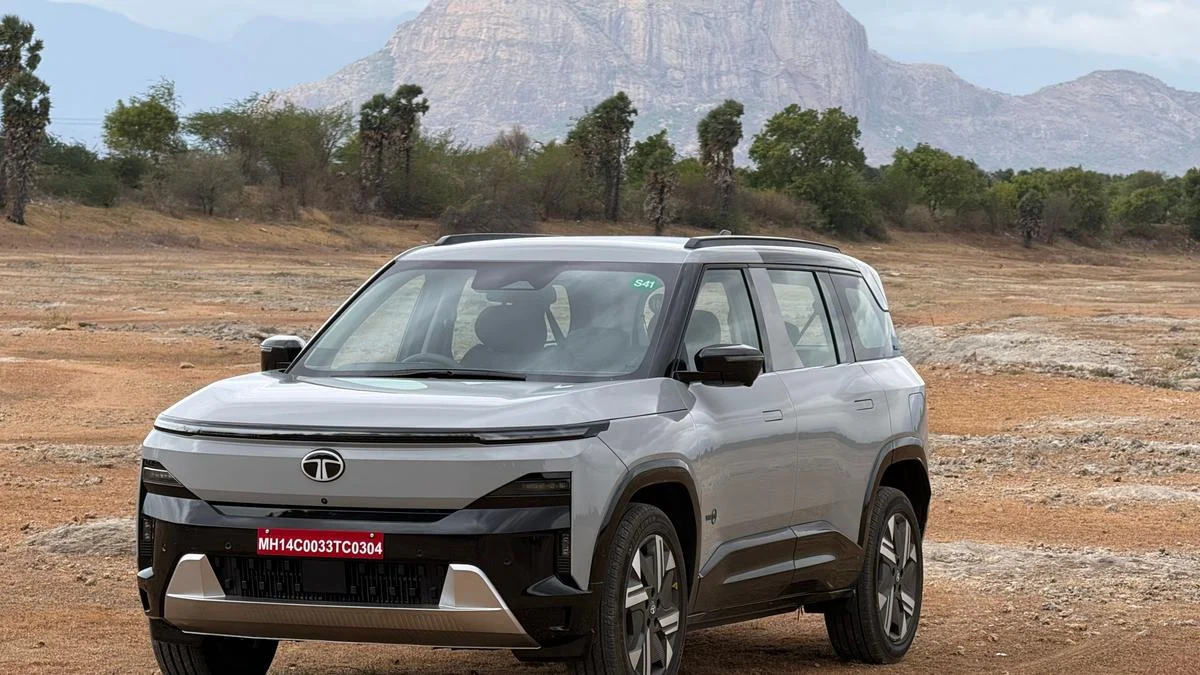
The Indian automotive landscape is currently witnessing a paradigm shift, one where nostalgia meets cutting-edge electrification. Perhaps no vehicle embodies this transition more poignantly than the Tata Sierra.ev. Once a cult classic that defined the aspirational SUV segment in the 1990s, the Sierra has returned, not as a smoky diesel workhorse, but as a sophisticated, high-performance electric vehicle (EV).
After an extensive day of testing across the diverse terrains of Coimbatore—ranging from congested city arteries and high-speed highways to a controlled test track and a punishing off-road course—it is evident that Tata Motors has produced more than just a tribute act. The Sierra.ev stands as one of the most complete, refined, and technologically advanced vehicles to ever roll off the company’s production lines.
Main Facts: The Specifications and Market Positioning
The Tata Sierra.ev enters the market with a clear mission: to dominate the premium mid-size electric SUV segment. Positioned within a price bracket of INR 18.79 – 24.79 Lakh (ex-showroom), it targets both the environmentally conscious urbanite and the weekend adventurer.
Powertrain and Performance
Tata has launched the Sierra.ev with two distinct battery configurations to cater to different user needs:

- The Flagship 75 kWh Variant: This version features a sophisticated dual-motor Quad Wheel Drive (QWD) system. It utilizes a 234 bhp motor at the rear axle and a 138 bhp motor at the front, culminating in a combined torque output of 504 Nm. This setup allows the SUV to sprint from 0 to 100 km/h in a staggering 5.8 seconds, placing it among the fastest vehicles currently manufactured in India.
- The 63 kWh Variant: Designed for those who prioritize efficiency over outright performance, this version utilizes a single rear-mounted motor, providing a more traditional Rear-Wheel Drive (RWD) experience while maintaining ample power for daily commutes.
Range and Charging
Range anxiety remains a primary concern for Indian EV buyers, and Tata has addressed this with substantial battery density. The 75 kWh pack boasts a claimed MIDC (Modified Indian Drive Cycle) range of 665 km. In real-world conditions, including mixed highway and city driving, a realistic expectation sits between 450 to 500 km. Furthermore, the vehicle supports high-speed DC fast charging, capable of adding 263 km of range in just 15 minutes, significantly lowering the barrier for long-distance interstate travel.
Chronology: A Day Behind the Wheel
To truly understand the Sierra.ev, one must experience it across the varied environments it was designed to conquer. Our test day in Coimbatore provided a chronological look at how the vehicle adapts to changing demands.
Phase 1: The Urban Commute
Navigating the morning traffic in Coimbatore revealed the Sierra.ev’s "gentle giant" persona. Despite its imposing stance, the steering is tuned to be remarkably light at low speeds, making lane changes and tight u-turns effortless. The "Summon Mode" and "Auto Park Assist" features, often seen in luxury European imports, worked seamlessly, allowing the vehicle to navigate tight parking spots with minimal driver intervention.
Phase 2: The Open Highway
As the city limits faded, the Sierra.ev showcased its high-speed stability. Unlike many SUVs that feel floaty or nervous at speeds above 100 km/h, the Sierra.ev tracked arrow-straight. The low center of gravity, a natural byproduct of the floor-mounted battery pack, combined with a rigid chassis to keep body roll in check. The most impressive aspect here was the Frequency Dependent Damping (FDD) suspension. It ironed out expansion joints and highway undulations with a level of maturity usually reserved for vehicles twice its price.

Phase 3: The Test Track and Performance Limits
On the closed circuit, the 504 Nm of torque was given full rein. However, the Sierra.ev’s delivery of power is what sets it apart. While many EVs provide an abrupt, almost violent surge of torque, the Sierra.ev builds momentum progressively. It feels sophisticated rather than aggressive. We also put the braking system through repeated hard stops. The transition between regenerative braking (which is adjustable via paddles) and traditional friction braking was nearly undetectable, providing a consistent and reassuring pedal feel.
Phase 4: Off-Road Resilience
The final leg of the day involved a demanding off-road course. The Quad Wheel Drive system demonstrated its intelligence here, distributing torque instantly to the wheels with the most grip. Whether climbing rocky inclines or navigating muddy ruts, the Sierra.ev remained composed. The instant torque of the electric motors provides a distinct advantage over internal combustion engines in off-road scenarios, allowing for precise, low-speed crawling without the need for a complex low-range transfer case.
Supporting Data: Engineering and Cabin Refinement
The Sierra.ev is built on Tata’s dedicated acti.ev architecture, which allows for better space utilization and structural integrity compared to "converted" EV platforms.
Ride Quality and NVH Levels
A significant portion of the development budget clearly went into Noise, Vibration, and Harshness (NVH) levels. The suspension noise is exceptionally well-suppressed, and the choice of tires has minimized road roar. However, the data from our high-speed runs did indicate one area for improvement: wind noise. At speeds exceeding 100 km/h, there is a noticeable whistle around the A-pillars, which becomes more prominent simply because the rest of the cabin is so eerily silent.

The Digital Sanctuary
The interior is a "three-screen" masterpiece. The dashboard is dominated by:
- A high-resolution primary infotainment system.
- A fully digital instrument cluster for the driver.
- A secondary passenger-side display.
A standout feature is the integration of AirConsole, which allows passengers to use their smartphones as controllers for multiplayer games—a clever way to pass the time during a charging stop. The audio experience is handled by a Dolby Atmos-enabled JBL Black system, which creates a 360-degree soundstage that is arguably the best in its class.
Official Context and Strategic Direction
While official statements from Tata Motors emphasize the "Spirit of Adventure," the Sierra.ev represents a broader strategic shift for the company. By moving into the INR 20-25 Lakh bracket with such a feature-rich offering, Tata is signaling its intent to move beyond being a "budget" EV player (a reputation built by the Nexon and Tiago EVs) and into the "premium lifestyle" segment.
Engineers at Tata have noted that the Sierra.ev was benchmarked against global standards. The inclusion of an Augmented Reality Head-Up Display (HUD) and a comprehensive ADAS (Advanced Driver Assistance Systems) suite indicates that Tata is no longer just following market trends but is attempting to set them. The "Frunk" (front trunk) and the flat floor in the rear are direct results of the acti.ev platform’s efficiency, providing class-leading legroom and storage.

Implications: A Disruptor in the Making
The arrival of the Sierra.ev has significant implications for the Indian automotive market and its competitors.
Challenging the Status Quo
The Sierra.ev enters a ring currently occupied by the MG ZS EV and the upcoming Hyundai Creta Electric and Mahindra BE 6. By offering a dual-motor AWD system—a rarity in this price segment—Tata has carved out a unique niche for those who want performance and off-road capability alongside eco-credentials.
The "Nostalgia Premium"
Tata is successfully leveraging the "Sierra" brand name to evoke emotional connections. However, unlike other manufacturers who have failed by slapping legendary names on mediocre products, the Sierra.ev appears to have the mechanical substance to back up the badge. This could force competitors to rethink their design philosophies, moving away from generic crossovers toward vehicles with more "character."
Infrastructure and Adoption
With a realistic 500 km range, the Sierra.ev effectively "solves" range anxiety for the vast majority of Indian users. Its ability to utilize the fastest DC chargers currently available in India means it will serve as a catalyst for the further expansion of the highway charging network.

Conclusion: The New Benchmark?
No vehicle is without its flaws. The inconsistent performance of the driver-side one-touch window and the aforementioned wind noise at highway speeds are minor blemishes on an otherwise stellar package. However, these are "software and sealing" issues that are far easier to rectify than fundamental mechanical failures.
The Tata Sierra.ev is a triumph of Indian engineering. It manages to be many things at once: a serene city commuter, a high-speed highway cruiser, a tech-heavy mobile lounge, and a capable off-roader. It doesn’t ask the buyer to compromise on performance for the sake of the environment, nor does it sacrifice comfort for the sake of ruggedness.
If the goal was to create a vehicle that honors the legacy of the original Sierra while pointing a definitive finger toward the future of mobility, Tata Motors has succeeded. In a segment that is rapidly becoming crowded, the Sierra.ev doesn’t just stand out—it leads. For those looking to transition to electric mobility without losing the "soul" of driving, the Sierra.ev is, quite simply, the one to bring home.
