

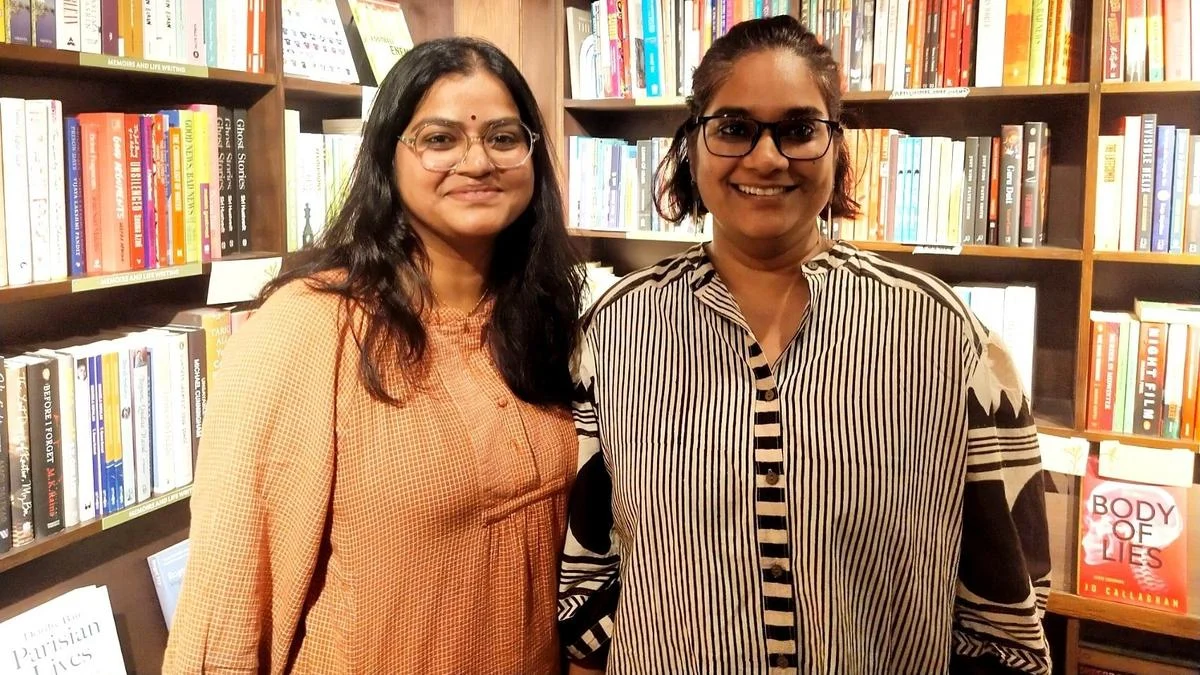
BENGALURU – On a quiet evening on September 13, the wooden rafters of the Champaca Bookstore in Bengaluru played host to a gathering that felt less like a standard book launch and more like the unveiling of a new way of seeing the world. Readers, researchers, and bibliophiles converged for the first public launch of Cities in Fiction, a pioneering online archival project that seeks to bridge the gap between the ethereal world of narrative and the physical reality of geography.
Founded by Apoorva Saini and Divya Ravindranath, Cities in Fiction is a digital literary archive designed to find, recognize, and pinpoint real-world locations mentioned in Indian literature. By categorizing works through state, city, and specific geographical markers, the project offers a unique interface where a user can click on a map and be directed to the titles and authors who have immortalized those specific coordinates in prose.
Main Facts: A Digital Repository for Literary Landscapes
The core mission of Cities in Fiction is to create a comprehensive database at the intersection of urban studies and literary analysis. For decades, the Western world has celebrated its literary geography—one can take a "Sherlock Holmes tour" of London or follow James Joyce’s Leopold Bloom through the streets of Dublin. However, a centralized, accessible map for the vast and varied landscapes of Indian fiction has been conspicuously absent until now.
Currently, the archive boasts a curated list of nearly 700 books. The database is not limited to contemporary urban centers; it spans the length and breadth of the Indian subcontinent, covering rural hamlets, semi-urban towns, and even the "fictional cities" that have become as real to readers as any metropolitan hub.
The project operates as a public-access tool, allowing users to navigate through:
- Real-World Geographies: Mapping specific neighborhoods in Mumbai, Bengaluru, and Delhi.
- Regional Landscapes: Identifying stories set in the backwaters of Kerala, the tea gardens of Assam, or the rugged terrains of the Himalayas.
- Fictional Settlements: Recognizing iconic imagined spaces such as R.K. Narayan’s Malgudi and Khushwant Singh’s Mano Majra, which, while not found on a physical GPS, occupy a permanent place in the cultural geography of India.
Chronology: From a Personal Need to a Global Platform
The journey of Cities in Fiction began long before its public debut this week. While the project has been operating in an online capacity for the past three years, its conceptual roots are found in the academic and personal frustrations of its founders.
September 2021 – September 2023: The Silent Phase
Apoorva Saini and Divya Ravindranath spent two years conceptualizing the framework. Coming from a literature background, Saini found a disconnect between her education and her environment. The founders spent this period developing the technical infrastructure and beginning the arduous task of manual data entry, sourcing titles that were deeply rooted in specific locales.

September 2023: The Soft Launch
The database went live with a modest collection of approximately 100 books. This "beta" phase allowed the founders to test the user interface and gauge interest within academic circles. The response was immediate, as researchers began to see the potential for using the map as a tool for sociological and urban research.
2024 – 2026: Expansion and Crowdsourcing
Over the next three years, the database grew sevenfold. This growth was fueled by a collaborative model; authors, researchers, and casual readers from across the globe began contributing titles. This period saw the project evolve from a private archive into a community-driven repository of collective memory.
September 13, 2026: The Public Launch
The event at Champaca Bookstore marked the project’s transition into the public eye. Titled ‘Cities in Fiction: A Database of Literary Landscapes,’ the launch featured a deep-dive discussion between co-founder Apoorva Saini and renowned educator Vijeta Kumar, centering on how geography dictates the soul of a story.
Supporting Data: The Scale of the Archive
The data underlying Cities in Fiction reveals a fascinating trend in Indian publishing. Of the 700 books currently listed, the distribution highlights the "literary heavyweights" of the Indian landscape:
- Urban Concentration: Mumbai and Bengaluru remain the most documented cities in Indian fiction. The archive includes works like Jeet Thayil’s gritty explorations of Mumbai and Vivek Shanbagh’s nuanced portrayals of a rapidly transforming Bengaluru.
- The Rural-Urban Divide: While urban narratives dominate contemporary English-language fiction, the archive has made a concerted effort to include regional translations that map the "mofussil" (small town) and rural experience.
- Global Footprint: Though primarily focused on India, the archive includes a selection of cities abroad where the Indian diaspora or Indian characters have left a significant narrative mark.
- The "Fictional" Category: A dedicated section for "Fictional Cities" acknowledges that places like Arundhati Roy’s Ayemenem (though based on a real village) or the aforementioned Malgudi function as distinct geographical characters in their own right.
Official Responses: The Founders’ Vision
During the launch, Apoorva Saini reflected on the "homelessness" she felt as a student of English literature in India.
"As a literature student, I was fascinated with Jane Austen, John Keats, and others, but felt I knew Ireland much better than my own homeland through their stories," Saini explained. "This gap in finding a set database to list and explore books through places familiar to us was the motivation behind this initiative. We wanted to create a space where a reader could see their own street, their own city, reflected in the pages of a book."
Co-founder Divya Ravindranath, speaking from the audience, emphasized the sociological value of the project. "This initiative brings together our love for cities and our love for fiction, bringing a unique look at cityscapes," Ravindranath said. "No two authors will write about a city and its experiences in the same way. It is also a great way of memory-keeping. As cities change, the fiction written about them becomes a historical record of what was once there."
Educator and writer Vijeta Kumar provided a poignant perspective on the "micro-geographies" of fiction. She shared an anecdote about a student who observed that "cows in Bengaluru are nameless, while the ones in my hometown have names." This observation, Kumar argued, is exactly what Cities in Fiction captures—the varying degrees of social intimacy and anonymity that define different geographical spaces.

Implications: Literary Tourism and Academic Research
The emergence of Cities in Fiction carries significant implications for several sectors:
1. The Future of Digital Humanities
The project is a prime example of the growing field of Digital Humanities in India. By using technology to map narrative, Saini and Ravindranath are providing a tool that can be used by urban planners to understand the "felt experience" of a city, or by historians to track the evolution of social norms across different regions.
2. Cultural Preservation and Memory
In a country where urban development is rapidly erasing historical landmarks, literature often serves as the final repository of a city’s former self. Cities in Fiction acts as a digital preservation project, ensuring that the Bengaluru of the 1980s or the Mumbai of the 1970s, as captured in novels, remains accessible to future generations.
3. Global Scalability and Influence
The project’s impact is already transcending national borders. At the launch event, it was revealed that academics from South Africa have reached out to the founders to replicate the model for their own literary landscapes. An audience member from South Africa noted that the Indian archive inspired her to start a similar project to map the stories of Johannesburg and Cape Town. This suggests that Cities in Fiction could serve as a blueprint for a global network of literary maps.
4. Boosting "Literary Tourism"
By making it easy to identify books set in specific locations, the archive has the potential to boost literary tourism in India. Travelers may soon use the database to curate reading lists for their trips, seeking out stories that provide a deeper, more textured understanding of the places they visit.
Conclusion: A New Way to Read
As the event at Champaca Bookstore concluded, the sentiment among the attendees was one of discovery. Cities in Fiction is more than just a list of books; it is a testament to the power of place. It reminds us that every street corner has a story and every city is a collection of a million different narratives, waiting to be mapped.
For those looking to explore the intersection of the real and the imagined, the archive is now fully accessible to the public. As Saini and Ravindranath continue to expand their database, the map of Indian literature promises to become as detailed and vibrant as the country itself.
To explore the literary map of India, visit www.citiesinfiction.com.
