

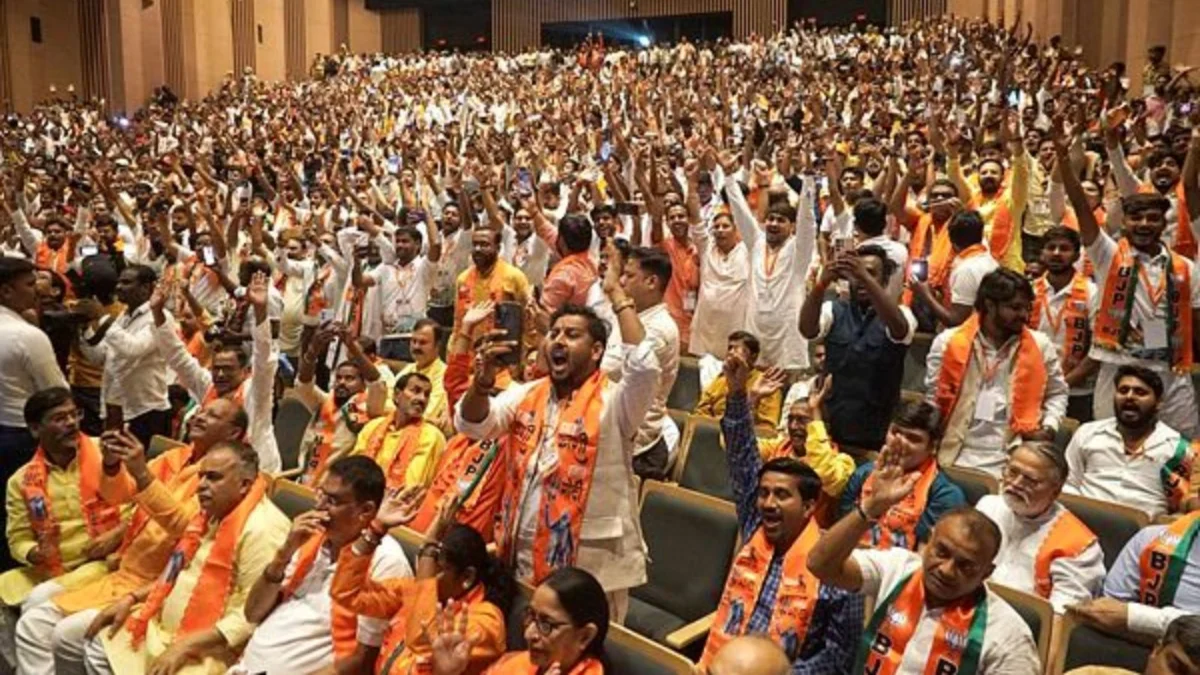
Varanasi, Uttar Pradesh – The ancient city of Varanasi, Prime Minister Narendra Modi’s parliamentary constituency, transformed into a vibrant hub of political activity and spiritual reverence on Thursday as leaders from across the National Democratic Alliance (NDA) converged to celebrate his 76th birthday. The occasion was not merely a personal milestone but a significant political statement, marking Modi’s completion of 25 illustrious years in public office and underscoring the renewed strength and unity of the BJP-led coalition.
The day’s events were meticulously planned to blend traditional Hindu rituals with modern political outreach, featuring high-profile attendance from key allies such as Telugu Desam Party (TDP) chief N. Chandrababu Naidu and Lok Janshakti Party (Ram Vilas) leader Chirag Paswan. They were joined by senior Bharatiya Janata Party (BJP) figures, including Defence Minister Rajnath Singh and Uttar Pradesh Chief Minister Yogi Adityanath, alongside Union Minister of State for Finance Pankaj Chaudhary. The collective presence of these leaders in Varanasi sent an unequivocal message of solidarity and shared vision, particularly in the wake of recent electoral successes and the formation of a new coalition government at the Centre.
The festivities commenced with solemn prayers and rituals, designed to invoke blessings for the Prime Minister’s health and continued leadership. This spiritual prelude seamlessly transitioned into a series of public engagements, culminating in the symbolic flagging off of a motorcycle journey from Varanasi to Vadnagar in Gujarat – Modi’s hometown. This ambitious "Vadnagar-Varanasi Motorcycle Yatra" serves as a central pillar of the BJP’s nationwide "Seva Sankalp Abhiyan" (Resolve to Serve Campaign), an extensive program launched to commemorate the Prime Minister’s quarter-century of dedicated public service. The campaign aims to propagate his vision of a developed India, deepen grassroots connections, and reinforce the party’s commitment to public welfare across the nation.
A Day of Rituals and Resounding Declarations: The Chronology
The day unfolded with a precise blend of spiritual devotion and political messaging, carefully orchestrated to highlight both the personal milestone of the Prime Minister’s birthday and the collective resolve of the NDA.
Morning Devotion at Kashi Vishwanath
The dawn in Varanasi saw the arrival of the distinguished political delegation, headed straight for the sacred precincts of the Kashi Vishwanath temple. This ancient shrine, dedicated to Lord Shiva, holds immense spiritual significance for millions of Hindus worldwide and is a cornerstone of Modi’s spiritual and political connection to his constituency. Inside the sanctum sanctorum, Rajnath Singh, Yogi Adityanath, Chandrababu Naidu, Chirag Paswan, and Pankaj Chaudhary offered prayers, seeking divine blessings. The atmosphere was charged with devotion as the leaders participated in traditional rituals, their presence underscoring the deep cultural and religious roots that often intertwine with India’s political landscape. Defence Minister Singh, addressing reporters outside the temple, articulated the collective prayer: “We have prayed to God that our Prime Minister Modi ji has a long life and remains healthy throughout his life. We have also prayed that the goal of a developed India can be achieved soon.” His words encapsulated the dual aspirations for personal well-being and national progress, a recurring theme throughout the day.
Sacred Offerings by the Ganga
Following the temple visit, the focus shifted to the ghats of the holy Ganga. Here, a poignant ceremony unfolded as 76 young priests, representing each year of the Prime Minister’s life, performed special prayers and a milk ‘abhishek’ (ritual bathing) of the sacred river. The ‘abhishek’ is a time-honored Hindu ritual, often performed to purify and invoke blessings, and its execution on this scale was a powerful visual testament to the spiritual reverence surrounding the Prime Minister. The sight of these young priests, dedicated to their sacred duties, performing a ritual for the longevity and health of the nation’s leader, resonated deeply with the traditional ethos of Varanasi. This event served not only as a spiritual offering but also as a cultural spectacle, drawing parallels between Modi’s leadership and the ancient spiritual heritage of India.
Public Address: Unifying Voices and Developmental Visions
The spiritual observances were followed by a robust public address, where the assembled leaders took to the stage to share their messages with an eager crowd. The air was thick with anticipation and enthusiasm as local BJP workers and supporters cheered on the dignitaries. The speeches, delivered with fervent conviction, provided a platform for the NDA allies to articulate their shared vision for India and their unwavering support for Prime Minister Modi. This segment of the day was crucial for political messaging, allowing the coalition to project an image of strength, unity, and a clear roadmap for the nation’s future.
Official Voices: Reinforcing Unity, Vision, and Dedication
The public addresses were a powerful demonstration of the NDA’s resolve, with each leader contributing to a unified narrative of progress, stability, and unreserved support for Prime Minister Modi.
Rajnath Singh’s Homage: A "Half-Inning" of Service
Defence Minister Rajnath Singh, a seasoned leader within the BJP, delivered a speech that lauded Prime Minister Modi’s monumental achievements over his 25 years in public office. His choice of metaphor – calling these 25 years merely a "half-inning" – was particularly striking. It suggested a future brimming with continued service and leadership, implying that Modi’s political journey is far from over and that he is poised to lead India for many more decades. This statement served to reassure the party cadre and the public of sustained stability and consistent policy direction. Singh’s emphasis on Modi’s vision for a "developed India" resonated with the national aspiration for progress and prosperity, aligning the Prime Minister’s personal journey with the country’s collective destiny. His words painted a picture of a leader whose dedication to the nation is profound and whose impact is set to endure.
Chandrababu Naidu: Championing NDA Unity and Cooperative Federalism
The address by Telugu Desam Party (TDP) chief and Andhra Pradesh Chief Minister N. Chandrababu Naidu was arguably one of the most significant moments of the day. His presence and emphatic declarations underscored the renewed strength of the NDA coalition, especially given the recent political dynamics where TDP rejoined the alliance. Naidu’s statement, "Today, I say it clearly, we stand together; we will stay together for the future. Our unity is our strength, our unity is the country’s strength. NDA ek hai, NDA majboot hai (The NDA is one and strong)," was a powerful reaffirmation of alliance cohesion. The chants of "Har Mahadev" and "Jai Shree Ram" interspersed throughout his speech further connected his political message with the cultural and religious sentiments prevalent among the audience, broadening his appeal beyond regional lines.
Naidu unequivocally credited Prime Minister Modi for charting India’s course towards becoming a developed nation within the next 20-25 years. He highlighted the diversity within the alliance – "We are from different states, different regions, we speak different languages, we carry different traditions, but our goal is one: strong India" – showcasing the NDA as a microcosm of India’s unity in diversity, bound by a common national objective.
The Pillars of Partnership: Andhra Pradesh and the Centre
A central theme of Naidu’s speech was the tangible benefits of "cooperative federalism," a principle he asserted was not just a slogan but a "daily experience" for Andhra Pradesh. He cited the Centre’s support for key state projects like the construction of Amaravati, the proposed capital city, and the ambitious Polavaram irrigation project. These examples served to illustrate how a harmonious Centre-state relationship, facilitated by the NDA partnership, translates directly into accelerated development and progress at the ground level. For a state like Andhra Pradesh, which has faced its share of developmental challenges, the Centre’s backing is crucial, and Naidu’s acknowledgment underscored the practical advantages of being a part of the ruling coalition. He stressed that "development happens at a fast pace when the Centre and the states move together," a message intended to reassure regional constituents and highlight the efficacy of collaborative governance.
The VKS Mantra and Visionary Leadership
Naidu introduced a catchy "VKS mantra" for the country to remember, with ‘V’ standing for Vadnagar (PM Modi’s birthplace), ‘K’ for Kashi (his parliamentary constituency), and ‘S’ for September 17 (his birthday). This mnemonic device skillfully linked the Prime Minister’s personal journey and significant dates to a national celebration, suggesting that Modi’s life and work are integral to the nation’s narrative. He urged for this mantra to be celebrated nationwide, further embedding Modi’s persona into the collective consciousness.
Beyond political alliances, Naidu also advocated for visionary projects like the linking of India’s major rivers. "If you link all rivers, India will be unstoppable. India has plenty of water. If you link the Brahmaputra, the Ganga, the Mahanadi, the Cauvery, and the Godavari, then India will be a different India," he proclaimed. This ambitious proposal, a long-standing national debate, highlighted a shared vision for infrastructural development and resource management.
Concluding his praise, Naidu lauded Modi’s exceptional understanding of advanced technologies, a trait he found rare among leaders. He remarked that while he had encountered many Chief Ministers, only Modi possessed such a grasp of cutting-edge fields like space technology, drone technology, electronics, robotics, semiconductors, and even quantum technology. This emphasis on technological acumen positioned Modi as a forward-thinking leader capable of steering India into the future, aligning with the government’s push for digital transformation and technological self-reliance.
Chirag Paswan’s Unwavering Allegiance: A "Shadow" of Support
Union Minister Chirag Paswan, leader of the Lok Janshakti Party (Ram Vilas), delivered an impassioned speech that reiterated his steadfast support for Prime Minister Modi. His declaration, "Till the PM is there, Chirag Paswan will stand with him like his shadow," conveyed an almost filial devotion and absolute loyalty. This statement carries particular weight in the context of Bihar politics, where the LJP (Ram Vilas) holds significant sway and its alliance with the BJP is crucial for electoral success. Paswan elevated Modi’s stature beyond that of a mere political leader, asserting, "I say this confidently that Narendra Modi is not just the name of the prime minister of India; that is the name of the country’s honour and pride." This deification of the Prime Minister underscores the BJP’s strategy of projecting Modi as a symbol of national identity and aspiration. In a gesture of profound respect, Paswan concluded his speech by touching the feet of senior leaders Rajnath Singh, Yogi Adityanath, and Chandrababu Naidu, a powerful cultural and political symbol of deference and unity within the alliance.
The "Seva Sankalp Abhiyan": A Nationwide Endeavor
The birthday celebrations in Varanasi were merely the inaugural event of a much larger, nationwide campaign: the "Seva Sankalp Abhiyan." This extensive initiative, spanning several weeks, is designed to commemorate Prime Minister Modi’s 25 years of unwavering dedication to public service, a journey that began with his first political office.
Marking a Quarter-Century of Public Service
The 25-year milestone is a significant benchmark in any political career. It encompasses Modi’s tenure as the Chief Minister of Gujarat, where he spearheaded a model of governance focused on economic development, followed by his transformative years as Prime Minister of India. The "Seva Sankalp Abhiyan" aims to highlight the continuum of his service, showcasing how his early experiences shaped his national vision. Beyond the symbolic motorcycle yatra, the campaign includes a diverse array of public welfare activities across the country. These typically involve health camps, blood donation drives, environmental initiatives such as tree planting and cleanliness campaigns, and various outreach programs designed to directly benefit citizens. The overarching goal is to not only celebrate the Prime Minister’s achievements but also to actively engage with the public, disseminate information about government programs, and reinforce the BJP’s commitment to grassroots development and community service. This comprehensive approach serves to strengthen the party’s organizational structure and connect with voters at a deeper, more personal level.
The Vadnagar-Varanasi Motorcycle Yatra: A Symbolic Journey of Connection
The physical manifestation of the "Seva Sankalp Abhiyan" and the highlight of the day’s events in Varanasi was the flagging off of the Vadnagar-Varanasi Motorcycle Yatra. This unique initiative encapsulates a blend of spiritual journey, political outreach, and youth engagement.
Conception and Inauguration of the Yatra
Following the public addresses, a grand spectacle unfolded as 500 enthusiastic youngsters, clad in pristine white T-shirts emblazoned with photographs of religious sites in Vadnagar, the sacred Ganga, and Prime Minister Modi, mounted 250 bikes. Amidst showers of flowers from cheering BJP workers, the caravan set off on its epic journey. The core idea behind this ambitious yatra is profoundly symbolic: to exchange holy water from the rivers of Modi’s birthplace, Vadnagar, with the sacred waters of the Ganga in his parliamentary constituency, Varanasi. This exchange is meant to facilitate "jalabhishek" (ritual bathing with water) at various religious places along the route, spiritually connecting the two pivotal locations in the Prime Minister’s life and political narrative. It is a journey that intertwines personal history with national identity, leveraging spiritual symbolism for political messaging.
An Epic Route with a Purposeful Itinerary
The motorcycle yatra is not merely a ride; it is a meticulously planned, multi-faceted engagement campaign. The bikers are slated to travel an astonishing 2,100 km over approximately 20 days, traversing through 1,159 villages spread across 193 districts in 10 states. Significantly, the route includes 50 districts in the politically crucial state of Uttar Pradesh, which is slated for elections in the near future. This strategic routing ensures maximum visibility and interaction with a diverse cross-section of the electorate.
Grassroots Engagement and Public Outreach
The daily itinerary for the bikers is intensive and purposeful. They are expected to ride at least 100 km each day and organize a program every 25 km. These programs are designed for direct grassroots engagement and include a range of activities: planting trees to promote environmental consciousness, running cleanliness drives echoing the "Swachh Bharat Abhiyan," and speaking to local communities about Prime Minister Modi’s extensive public service and the achievements of his government. A key component of these mini-events involves playing a 15-minute video on PM Modi on an LED screen, providing a visual narrative of his leadership. Furthermore, the participants are tasked with collecting feedback from the public about various government programs, creating a direct channel for citizen engagement. Meetings with local religious leaders are also scheduled, reinforcing cultural ties and seeking blessings for the journey and the nation. This comprehensive approach transforms the yatra into a powerful, rolling public relations and feedback mechanism.
Voices from the Road: Participants’ Resolve
The yatra has attracted participants from diverse backgrounds, all united by their enthusiasm for the Prime Minister and the mission. Dibon Lepcha, the BJP Yuva Morcha general secretary in Gangtok, Sikkim, is one such participant. A postgraduate in geography, Lepcha temporarily stepped away from his family resort business to join the yatra, driven by a mix of excitement and apprehension. "I am excited and nervous too. I am excited to be part of this yatra that is associated with PM Modi ji. But I am also nervous because it is a long yatra on bikes with many tasks to complete on the route," he shared, encapsulating the sentiment of many riders who are undertaking a challenging but personally rewarding journey.
Shiv Shankar Kumar, a BJP mandal unit president from Jharkhand’s Hazaribagh district, provided insights into the logistical support for the participants. "The party is providing us with bikes, helmets, raincoats, T-shirts and a diary in a bag. The responsibility of refuelling the bikes has been given to the in-charge," he explained, highlighting the meticulous planning behind the expedition. His statement underscores the organizational capability of the BJP in mobilizing and supporting such a large-scale event, ensuring that participants are well-equipped for the arduous journey ahead.
Orchestration and Monitoring: The Lucknow War Room
To ensure the smooth execution and effective monitoring of such an extensive and geographically spread-out campaign, the BJP has established a dedicated "war room" in Lucknow. This central command center is responsible for tracking the progress of the yatra in real-time, coordinating logistics, addressing any unforeseen challenges, and ensuring that the daily programs are conducted as planned. The existence of such a sophisticated monitoring system highlights the professionalism and strategic depth with which the BJP approaches its public outreach initiatives, treating them with the precision of a political campaign.
Broader Implications: Solidifying Alliances and Shaping Narratives
The celebrations in Varanasi and the launch of the "Seva Sankalp Abhiyan" carry profound political and social implications, extending far beyond the immediate festivities.
Reinforcing NDA Cohesion
The enthusiastic participation and strong endorsements from key allies like Chandrababu Naidu and Chirag Paswan are critical for reinforcing the cohesion of the NDA. In India’s multi-party democratic landscape, coalition stability is paramount, especially after a recent election that saw the BJP relying more heavily on its allies. Naidu’s unequivocal declaration of "NDA ek hai, NDA majboot hai" serves as a powerful message, not only to the alliance’s internal members but also to the opposition, signaling a united front. This demonstration of solidarity helps to quell any speculation about internal differences and projects an image of a strong, unified government capable of delivering on its mandate.
Cultivating Modi’s Persona: Visionary, Spiritual, Technocrat
The events meticulously crafted a multi-faceted persona for Prime Minister Modi. The spiritual rituals at Kashi Vishwanath and by the Ganga connect him deeply with India’s ancient cultural and religious heritage, portraying him as a leader rooted in tradition. Simultaneously, Naidu’s praise for Modi’s technological acumen positions him as a modern, forward-thinking leader capable of steering India into the digital age. This blend of tradition and modernity, spirituality and technological vision, helps to cultivate a comprehensive image of Modi as a leader who respects the past while building for the future. The "VKS mantra" further embeds his personal journey into the national consciousness, transforming his life story into a narrative of national significance.
Strategic Outreach and Electoral Preparedness
The "Seva Sankalp Abhiyan" and particularly the Vadnagar-Varanasi Motorcycle Yatra are not just celebratory events; they are highly strategic political outreach programs. The yatra, with its extensive route through numerous districts and states, including 50 in poll-bound Uttar Pradesh, serves as a powerful grassroots mobilization tool. By engaging directly with villagers, conducting cleanliness drives, planting trees, and showcasing Modi’s achievements through videos, the BJP is effectively strengthening its party base and disseminating its message at the local level. This deep engagement helps to collect public feedback, identify local concerns, and present the government’s initiatives as solutions, thereby bolstering public support and laying the groundwork for future electoral success. It is a sustained campaign designed to keep the party and its agenda in the public eye, preparing the ground for upcoming elections.
Sustaining Momentum: The "Half-Inning" Prophecy
Rajnath Singh’s comment about Modi’s 25 years in public service being merely a "half-inning" carries significant implications for the future political landscape. It projects an image of enduring leadership and ambition, suggesting that the Prime Minister has many more decades of service ahead. This narrative of continuity and long-term vision aims to instill confidence in the public and the party cadre, signaling sustained stability and a clear direction for the nation. It reinforces the idea that Modi’s leadership is not a fleeting phenomenon but a long-term commitment to India’s development and global standing, solidifying his influence and the BJP’s position in Indian politics for the foreseeable future.
In conclusion, Prime Minister Narendra Modi’s 76th birthday celebration in Varanasi was far more than a personal tribute. It was a meticulously orchestrated political event that served to reinforce NDA unity, celebrate two and a half decades of public service, project a powerful image of leadership, and launch a massive nationwide outreach campaign. Through a blend of spiritual reverence, public declarations, and strategic grassroots engagement, the event effectively articulated the coalition’s shared vision for a developed India under Modi’s continued stewardship.
