

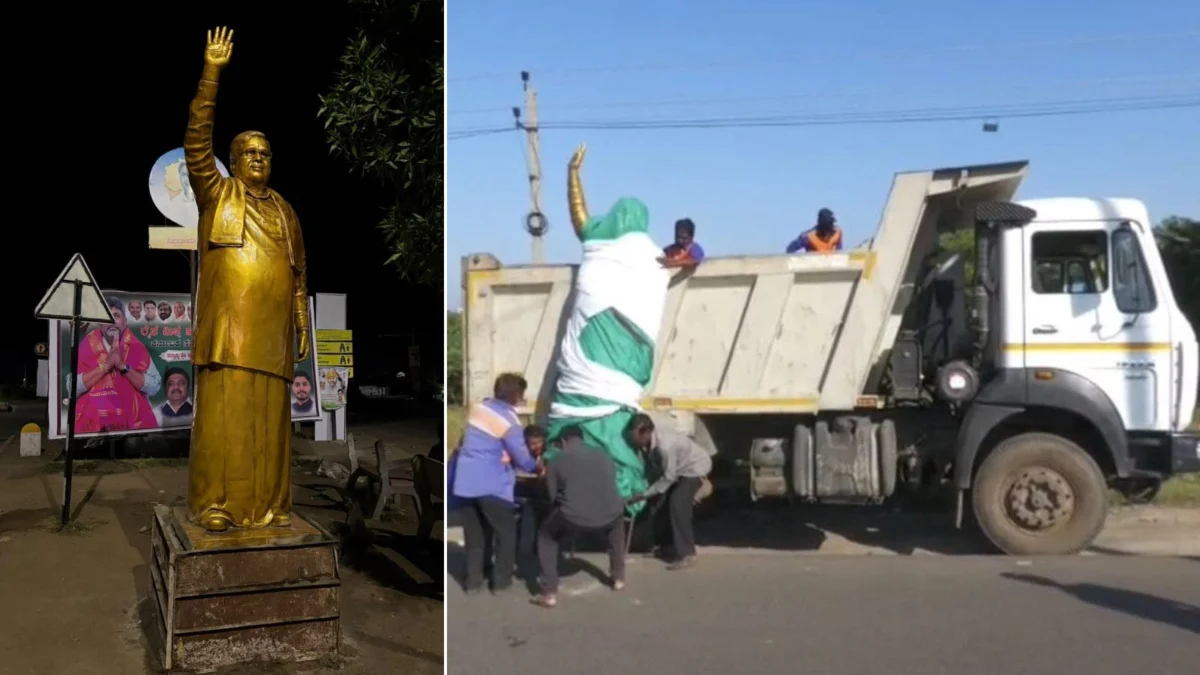
Bengaluru, Karnataka – A nine-foot statue, erected under the cloak of night and swiftly dismantled by dawn, has laid bare the simmering factional tensions threatening to destabilize the ruling Congress party in Karnataka. The unauthorized installation of former Chief Minister Siddaramaiah’s likeness in Kalaburagi, strategically timed to coincide with Chief Minister D.K. Shivakumar’s official tour of the district, was more than a mere act of devotion by supporters; it was a potent, symbolic challenge that has peeled back the veneer of unity painstakingly crafted after the party’s triumphant return to power in May 2026.
The incident, which saw the statue appear near a junction already christened “Siddaramaiah Circle” before its removal by civic authorities and police, serves as a stark reminder that the internal power struggle within the Karnataka Congress is far from resolved. What initially appeared to be a smooth transition of power from the veteran Siddaramaiah to the ambitious D.K. Shivakumar has devolved into a complex web of rivalries, jostling for influence, and public displays of dissent that now threaten to overshadow the government’s agenda and public image.
Main Facts: A Symbolic Clash in Karnataka’s Political Landscape
The core of the recent political flashpoint in Karnataka revolves around the dramatic events of late Wednesday and early Thursday in Kalaburagi. A towering nine-foot statue of former Chief Minister Siddaramaiah was clandestinely installed by his fervent supporters. This audacious act took place near a prominent junction that had, through local recognition and unofficial naming, already become known as "Siddaramaiah Circle." The timing of this installation was anything but coincidental; it occurred precisely as Chief Minister D.K. Shivakumar was scheduled to visit the very same district as part of the Kalyana Karnataka Utsav, intending to launch several development projects in Afzalpur.
The strategic placement of the statue, along a route Shivakumar was expected to traverse, transformed it from a simple tribute into a potent political statement. It was a clear, public declaration of loyalty to Siddaramaiah, designed to assert his enduring influence and perhaps even to overshadow the incumbent Chief Minister’s visit. However, the unauthorized nature of the installation quickly led to its demise. By Thursday morning, officials from the Kalaburagi City Corporation, aided by local police, had moved swiftly to remove the statue, citing the absence of necessary permissions. This swift administrative action, while upholding civic rules, carried undeniable political undertones, effectively sending a message that such unsanctioned displays of factionalism would not be tolerated.
This episode is not an isolated incident but rather the latest manifestation of deep-seated factional tensions that have gripped the state Congress since the change of guard in June. While the party celebrated a resounding victory in the May 2026 assembly elections, the subsequent battle for the Chief Minister’s chair between Siddaramaiah and Shivakumar had already exposed the cracks within the party’s seemingly unified facade. The statue incident, therefore, acts as a vivid symptom of a larger, systemic struggle for control, influence, and identity within the Karnataka Congress, signaling that the uneasy truce brokered by the central leadership is constantly under strain.
Chronology: Unpacking the Genesis of Internal Discord
The roots of the current turmoil can be traced back to the very moment the Congress secured its decisive mandate in the May 2026 assembly elections, bringing an end to the previous coalition government’s turbulent tenure.
Post-Election Power Dynamics (May-June 2026)
The euphoria of victory was swiftly followed by a high-stakes internal power struggle for the Chief Minister’s post. Both Siddaramaiah, a seasoned political veteran with a strong track record as CM and a formidable leader of the AHINDA bloc, and D.K. Shivakumar, the dynamic and resourceful state party president credited with steering the campaign, laid claim to the top job. The intense lobbying and public posturing necessitated the intervention of the party’s central leadership in Delhi. After days of negotiations, which reportedly involved various formulas for power-sharing, a compromise was reached: D.K. Shivakumar was named Chief Minister. While the party presented a united front to the public, with both leaders appearing alongside central figures, the underlying tensions and unfulfilled aspirations were palpable. The subsequent formation of the cabinet was also fraught with difficulties, as Shivakumar had to navigate various factions, caste equations, and regional demands to ensure a delicate balance. Each ministerial portfolio became a pawn in the ongoing internal chess game, revealing the intricate power dynamics at play.
The Hariprasad Appointment and Early Friction (June-July 2026)
In a strategic move widely interpreted as an attempt to prevent the consolidation of excessive power in Shivakumar’s hands, veteran Congress leader and MLC B.K. Hariprasad was appointed as the Karnataka Congress chief soon after Shivakumar assumed office. Hariprasad, a long-serving loyalist with a national profile and a significant OBC (Other Backward Classes) identity, was seen as a crucial counter-balance. However, this strategic appointment quickly turned into a source of open friction. During the protracted discussions over cabinet expansion, Hariprasad made remarks that sent shockwaves through the party. He famously declared, "Whoever wants power and posts can go with Shivakumar. Those who want to strengthen the Congress and the hand of (Congress Parliamentary Party Chairperson) Sonia Gandhi and Mallikarjun Kharge, come with me." This statement, made shortly after taking charge, was a thinly veiled broadside against Shivakumar, explicitly distinguishing between ambition for power and loyalty to the party’s foundational principles and central leadership. It served as an early warning of the deep ideological and personal rifts that had begun to emerge.
The 100-Day Event Snub and Escalation (September 2026)
The tensions escalated further in September when reports surfaced that B.K. Hariprasad was purportedly not invited to an event marking 100 days of the Shivakumar government on September 10. Such an omission, particularly for the state party chief, was seen as a grave breach of protocol and a deliberate snub. Hariprasad was reportedly displeased and expressed his discontent within party circles, signaling the growing chasm between the Chief Minister’s office and the state party organization. CM Shivakumar, in an attempt to play down the issue, attributed the incident to seating arrangements governed by protocol and claimed everyone, including Opposition MLAs, had been invited. He further attempted to mend fences by publicly describing Hariprasad as "supreme in Karnataka Congress" and "above even the CM." While intended to diffuse the situation, these statements, coming after a public slight, were widely interpreted as damage control rather than genuine respect, underscoring the severity of the rift.
The Kalaburagi Statue Incident (September 2026)
The events in Kalaburagi represent the culmination of these escalating tensions. The unauthorized installation of Siddaramaiah’s statue, strategically placed along Shivakumar’s planned route, was a direct and symbolic act of defiance. It was a clear message from Siddaramaiah’s loyalists that their leader’s influence remained potent, even if he no longer held the CM’s chair. The swift response from the Kalaburagi City Corporation and police, leading to the statue’s removal, demonstrated the administration’s stance against unsanctioned installations. However, the political message embedded in the removal was equally significant: an attempt to assert the CM’s authority and to curb public displays of loyalty that could undermine the government’s unity. This incident, coming on the heels of other internal squabbles, cemented the perception that the Karnataka Congress is indeed a house divided.
Supporting Data: The Undercurrents of Power and Identity
The factionalism within the Karnataka Congress is not merely a clash of personalities; it is deeply entrenched in the state’s complex socio-political fabric, involving caste equations, regional loyalties, and the struggle for control over crucial demographic blocs.
The Siddaramaiah Legacy and AHINDA Bloc
Siddaramaiah’s political journey is intrinsically linked to the AHINDA (Alpasankhyataru, Hindulidavaru, Dalitaru – Minorities, Backward Classes, Dalits) bloc. During his previous tenure as Chief Minister (2013-2018), he meticulously cultivated and championed this coalition, implementing numerous welfare schemes aimed at empowering these marginalized communities. His populist policies, such as "Anna Bhagya" (subsidized food grains), resonated deeply with these segments, cementing his image as their undisputed leader. This strategic alignment transformed him into a significant force, capable of mobilizing a substantial vote bank that transcends traditional party loyalties. Even after stepping down as CM, Siddaramaiah’s influence remains formidable. While some within the party privately acknowledge that his direct power may wane over time, his symbolic stature and the unwavering loyalty of the AHINDA communities ensure he remains a kingmaker, a gravitational pull that cannot be ignored. The paradox of his "waning influence" yet "significant force" underscores the complexity of his position; he may no longer wield executive power, but his moral authority and popular appeal continue to shape the state’s political discourse.
D.K. Shivakumar’s Rise and Consolidation
D.K. Shivakumar, on the other hand, hails from the powerful Vokkaliga community, a dominant caste in the Old Mysuru region. Known for his organizational prowess, financial acumen, and ability to navigate political crises, Shivakumar has meticulously built his reputation as a troubleshooter and a formidable political operator. His elevation to Chief Minister represents a significant shift in the party’s power dynamics, bringing a strong Vokkaliga leader to the helm. To truly solidify his position and ensure the government’s stability, Shivakumar faces the daunting task of expanding his base beyond his traditional Vokkaliga support. He needs to convincingly project an inclusive image and demonstrate his ability to govern for all communities, effectively challenging Siddaramaiah’s historical ownership of the AHINDA narrative. His every move is now scrutinized for signs of how he intends to balance his community’s aspirations with the broader electoral requirements of a diverse state.
B.K. Hariprasad: The OBC Counterbalance
B.K. Hariprasad is a veteran Congress leader with a long and distinguished career, including multiple terms as a Rajya Sabha MP. His appointment as Karnataka Congress Chief was a deliberate strategic move by the central leadership to create an alternative power center. As a prominent OBC leader, Hariprasad provides a crucial counter-narrative and a check on the consolidated power of both Shivakumar and Siddaramaiah. His national experience and deep understanding of party dynamics make him an astute player. His public statements, often challenging the CM’s authority, are not merely personal grievances but calculated moves to assert his position as an independent voice for the party’s ideological core and to rally those who might feel sidelined by the dominant factions. His role is to ensure internal equilibrium, preventing any single leader from becoming too powerful, thereby safeguarding the party’s broader interests.
Satish Jarkiholi and the ST Challenge
Public Works Department Minister Satish Jarkiholi represents another critical dimension of this internal struggle. A prominent leader from the Scheduled Tribe (ST) community, particularly influential in the Belagavi region of North Karnataka, Jarkiholi has historically been a loyalist of Siddaramaiah. However, the political landscape has shifted significantly since Siddaramaiah stepped down as CM. Jarkiholi has reportedly begun positioning himself as a potential successor to Siddaramaiah as the face of the AHINDA bloc, eyeing the Chief Minister’s post for 2028. His assertive declaration that "AHINDA is not the property of anyone" was a direct challenge to Siddaramaiah’s perceived dominion over this crucial vote bank. This remark highlights his ambition to carve out his own space and leadership within the party, independent of his former mentor.
Adding another layer of complexity to Jarkiholi’s trajectory are the Enforcement Directorate (ED) raids on his premises. While Congress leaders criticized the action as politically motivated, especially given Jarkiholi’s ST background, the Opposition leader R. Ashoka of the BJP alleged it was an "inside job," linking it to the ongoing contest for the chief minister’s post within the Congress. These raids introduce a significant element of uncertainty to Jarkiholi’s political positioning, potentially undermining his efforts to project himself as a clean and viable leader for the future. Whether these investigations are genuine or politically engineered, they undeniably impact his ability to challenge for the leadership space.
The Caste Calculus and Regional Dynamics
Karnataka politics is a complex tapestry woven with threads of caste and regional loyalties. The dominant Lingayat and Vokkaliga communities, along with the numerous OBCs, SC/STs, and minorities, form distinct electoral blocs. Leaders like Siddaramaiah draw strength from the AHINDA combine, while Shivakumar relies heavily on the Vokkaliga base. Jarkiholi’s influence in North Karnataka among ST communities further complicates the picture. These internal battles within the Congress are, in essence, proxy wars for control over these critical demographic and geographic segments. The ability to unite these diverse groups under a single banner is key to electoral success, and the current factionalism threatens to fragment these crucial support bases, offering fertile ground for the opposition.
Official Responses: Navigating the Narrative
In the face of escalating internal strife, the various stakeholders have adopted carefully calibrated responses, attempting to manage public perception while addressing the underlying issues.
Congress Leadership’s Public Stance
Chief Minister D.K. Shivakumar has consistently attempted to downplay the factional tensions, particularly concerning his relationship with B.K. Hariprasad. His public statements, attributing the alleged snub at the 100-day event to "protocol" and going so far as to describe Hariprasad as "supreme" and "above even the CM," are clear attempts at damage control. These are designed to project an image of unity and respect within the party, reassuring the public that the government is stable and focused on governance. However, such statements, often appearing forced, do little to quell the internal whispers or convince political observers that all is well. Other Congress functionaries generally follow this lead, issuing generic calls for party unity and emphasizing the collective responsibility to deliver on electoral promises. The central leadership, while acknowledging the issues privately, maintains a more nuanced public stance, often opting for silence or general exhortations for discipline, preferring to address the deep-seated problems through closed-door meetings and mediation efforts rather than public pronouncements that could further inflame the situation.
Opposition’s Critique – BJP’s ‘Divided House’ Allegation
The Bharatiya Janata Party (BJP), quick to seize on any signs of discord within the ruling dispensation, has been vocal in its criticism. State BJP president B.Y. Vijayendra immediately capitalized on the Kalaburagi incident and the broader factionalism, describing the Congress as a "divided house." This narrative is a strategic move by the opposition to portray the Congress government as unstable, internally conflicted, and therefore incapable of effective governance. By highlighting these internal rifts, the BJP aims to erode public confidence in the ruling party and deflect attention from its own internal challenges or any critiques of its past performance. B.K. Hariprasad, however, was swift to hit back, retorting on Thursday by asking Vijayendra to "put his own party’s state unit in order before commenting on the Congress." This counter-attack, while a deflection, indicates that the Congress is acutely aware of the BJP’s intentions to exploit its internal vulnerabilities.
The Bureaucratic Response
The removal of Siddaramaiah’s statue by the Kalaburagi City Corporation, with assistance from the police, represents the official administrative response to an unauthorized installation. Officials cited the absence of prior permission as the reason for its swift dismantling, underscoring the importance of adhering to civic regulations. While the action was legally justified, the timing and the political context surrounding it were unmistakable. The swiftness of the removal could also be interpreted as a move to assert the Chief Minister’s authority and to send a clear message that such public acts of factionalism, especially those designed to undermine the incumbent leadership, would not be tolerated by the state machinery. This bureaucratic action, therefore, had significant political ramifications, reinforcing the power dynamics at play.
Implications: The Road Ahead for Karnataka Congress
The ongoing factionalism within the Karnataka Congress carries significant implications for the party’s stability, the government’s effectiveness, and its future electoral prospects.
Governance Challenges and Policy Impact
Perhaps the most immediate and tangible implication of sustained internal strife is its potential to derail governance. A government constantly battling internal dissent can struggle to maintain focus on policy formulation, implementation, and the delivery of its election promises. Critical decisions might be delayed, cabinet unity could be compromised, and the public’s perception of the government’s efficiency and resolve could plummet. If ministers and party leaders are preoccupied with jockeying for position and undermining rivals, the administration risks becoming a ‘lame-duck’ government, unable to effectively address the pressing issues facing the state. This distraction could lead to a loss of public trust and disillusionment, directly impacting the party’s mandate.
Intra-Party Power Realignments
The current period marks a crucial phase of realignment within the Karnataka Congress. With Siddaramaiah no longer at the helm, the party is struggling to define its new leadership structure. Chief Minister D.K. Shivakumar faces the Herculean task of consolidating his authority while simultaneously accommodating other powerful leaders like Hariprasad and Jarkiholi, who have their own aspirations and support bases. This ongoing struggle for power could lead to the emergence of new alliances and rivalries as leaders strategically position themselves for the 2028 assembly elections. The central leadership, therefore, faces a delicate balancing act: to mediate effectively and enforce discipline without being perceived as micromanaging, which could alienate regional strongmen. The outcome of these power realignments will largely determine the party’s internal cohesion for years to come.
The 2028 Assembly Elections and Beyond
The specter of the 2028 Assembly elections looms large over the current internal conflicts. A party riddled with public factionalism presents a weak and divided front to the electorate, potentially eroding voter confidence. The ability to present a united and coherent message to the voters is paramount for electoral success, and the current infighting directly jeopardizes this. A significant concern is the struggle for control over the crucial AHINDA vote bank. If this bloc, meticulously nurtured by Siddaramaiah, fragments due to internal rivalries, it could severely undermine the Congress’s electoral strength. Such a scenario would offer a clear advantage to the BJP, which would eagerly exploit the divisions to regain power.
Central Leadership’s Dilemma
The All India Congress Committee (AICC) faces a profound dilemma. Over-intervention in state affairs could be perceived as dictatorial and might alienate powerful regional leaders who resent central micromanagement. Conversely, under-intervention risks allowing the factionalism to spiral out of control, potentially leading to irreparable damage to the party’s image and organizational structure. As internal sources privately acknowledge, the challenge of finding "clear successors" as Siddaramaiah’s influence gradually wanes is immense. Promoting new leadership without alienating existing heavyweights and their loyalists requires astute political maneuvering. The central leadership may ultimately be compelled to impose stricter disciplinary measures if the factionalism openly harms the party’s public image and its ability to govern effectively.
Conclusion
The unauthorized installation and swift removal of Siddaramaiah’s statue in Kalaburagi is far more than a local incident; it is a powerful microcosm of the systemic struggle for power, identity, and control within the Karnataka Congress. While internal dynamics are not uncommon in large, diverse political parties, the public nature and strategic timing of these spats pose a significant challenge to the party’s stability and its ability to deliver effective governance. The coming months will be crucial in determining whether the Congress can successfully navigate these turbulent internal waters, restore a sense of unity, and focus on its mandate, or if the deep fissures will widen, potentially undermining its hard-won return to power and jeopardizing its future prospects in the electorally significant state of Karnataka. The party’s ability to demonstrate cohesion will be the ultimate test of its leadership and its resilience in the face of daunting internal and external pressures.
