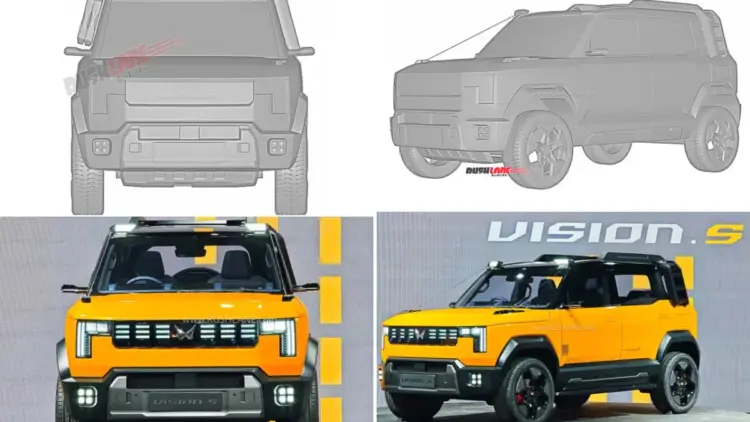
The Indian automotive landscape is currently witnessing a paradigm shift, moving away from conventional hatchbacks and sedans toward a diverse array of SUVs. At the forefront of this revolution is Mahindra & Mahindra, a manufacturer that has successfully pivoted its entire identity toward becoming a global SUV powerhouse. Recently, the company reached a significant milestone in its product development roadmap with the design patenting of the Mahindra Vision S.
Expected to debut in production form by 2027, the Vision S is the final piece of the "Vision" concept quartet that Mahindra unveiled last year. This vehicle represents a strategic masterstroke: a monocoque SUV that wears the rugged, boxy attire of a traditional ladder-frame off-roader. By positioning the Vision S as a sub-4-meter offering, Mahindra is not just expanding its portfolio; it is directly challenging the dominance of the Maruti Suzuki Jimny while offering a more refined, family-friendly alternative.
Main Facts: A New Breed of "Sophisticated Ruggedness"
The Mahindra Vision S is built upon the brand’s new NU_IQ modular platform, a versatile architecture designed to support multiple body styles and powertrain configurations. The patent filings reveal a vehicle that prioritizes a "tall-boy" stance and a commanding road presence, despite its compact dimensions.

Key Design Highlights from the Patent:
- Front Fascia: The SUV features an upright, blunt nose characterized by inverted L-shaped LED enclosures. The patent confirms space for the illuminated six-slot grille, a signature element of Mahindra’s modern design language.
- Off-Road Aesthetics: The design includes a rugged bull-bar-styled front bumper, heavy underbody protection (skid plates), and a clamshell bonnet that adds a sense of muscularity.
- Profile and Silhouette: Protruding, squared-off wheel arches and thick body cladding emphasize its "go-anywhere" intent. Interestingly, the patent shows flush-fitting door handles, a feature usually reserved for premium segments.
- Rear Architecture: The rear is dominated by a tailgate-mounted spare wheel—a non-negotiable trait for any SUV claiming lifestyle status. The tail lamps appear to be vertically stacked and connected by a light bar, mirroring the design of the larger Thar Roxx.
Technical Foundation:
Unlike the Mahindra Thar, which uses a body-on-frame chassis for extreme off-roading, the Vision S utilizes monocoque construction. This choice is critical for the target demographic: urban enthusiasts who desire the "macho" look of an off-roader but require the ride quality, handling, and fuel efficiency of a modern crossover.
Chronology: From Concept to Reality
The journey of the Vision S from a digital render to a patented design has been swift, reflecting Mahindra’s aggressive "Twin Peaks" strategy.
- August 2023: Mahindra unveils four "Vision" concepts—the X, T, SXT, and S—at a global event. These concepts were designed to showcase the future of the brand’s sub-4-meter and compact SUV lineup.
- Late 2023 – Early 2024: Patents for the Vision X, T, and SXT are filed and granted. These models are expected to eventually replace or sit alongside the current XUV 3XO and Bolero Neo lineups.
- Mid-2024: Test mules of a boxy, compact SUV begin appearing on Indian roads near Mahindra’s research facility (MRV) in Chennai. These prototypes provided the first glimpses of the interior layout and lighting signatures.
- October 2024: The design patent for the Vision S is officially granted. This confirms that the most rugged of the four concepts has moved into the final stages of production readiness.
- 2025–2026: Extensive real-world testing and component finalization are expected to take place.
- 2027: The anticipated commercial launch of the production-spec Vision S.
Supporting Data: Powertrains, Interior, and Dimensions
To compete in the cutthroat sub-4m segment, Mahindra is equipping the Vision S with a mix of proven mechanicals and futuristic technology.

Powertrain Options
The NU_IQ platform is "engine agnostic," meaning it can accommodate internal combustion engines (ICE), hybrids, and battery electric vehicle (BEV) setups.
- Petrol: The SUV is likely to feature the 1.2-liter mStallion Turbo Petrol engine found in the XUV 3XO, producing approximately 110–130 PS.
- Diesel: Mahindra remains committed to diesel; the 1.5-liter mHawk engine (from the Thar and Bolero Neo) is the primary candidate, offering high torque essential for the SUV’s rugged persona.
- Future-Proofing: While the 2027 launch will focus on ICE, an EV variant under the "XUV.e" or "BE" sub-brands is a distinct possibility by 2028.
Interior and Technology
Insights from test mules suggest the Vision S will borrow heavily from the Thar Roxx and the upcoming BE 6 electric SUV.
- Digital Cockpit: A twin-screen setup featuring a 10.25-inch infotainment system and a matching digital instrument cluster.
- Software: It will run the next-generation AdrenoX OS, offering over 60 connected car features, wireless Apple CarPlay, and Android Auto.
- Comfort: Despite its rugged exterior, the interior will offer ventilated seats, a panoramic sunroof (on top trims), and a 360-degree camera system.
Comparative Positioning
| Feature | Mahindra Vision S | Maruti Suzuki Jimny | Tata Nexon |
|---|---|---|---|
| Chassis | Monocoque | Ladder Frame | Monocoque |
| Drive Type | FWD / Optional AWD | 4WD (Standard) | FWD |
| Engine (Petrol) | 1.2L Turbo | 1.5L NA | 1.2L Turbo |
| Approach | Lifestyle/Urban | Hardcore Off-road | Family Crossover |
Official Responses and Strategic Context
While Mahindra & Mahindra officials have not released a specific statement regarding the Vision S patent, the company’s leadership has been vocal about their "unapologetic SUV" philosophy. During recent earnings calls, the management emphasized that their future growth would be driven by "filling the white spaces" in the SUV market.

The Vision S is a direct response to the "white space" between a soft-road crossover (like the XUV 3XO) and a dedicated off-roader (like the Thar). Industry analysts suggest that Mahindra’s strategy is to capture the "lifestyle" buyer who finds the Jimny too cramped or the Thar too utilitarian for daily city commutes.
Furthermore, the patenting of the Vision S confirms Mahindra’s intent to defend its turf against upcoming rivals. Renault is reportedly working on a sub-4m rugged SUV (rumored to be the Bridger), and Tata Motors is whispered to be developing a "mini-Safari" or Scarlet project. By securing the design now, Mahindra is signaling to the market that it intends to lead, not follow, in the lifestyle sub-4m category.
Implications: Reshaping the Sub-4m Landscape
The arrival of the Vision S in 2027 will have far-reaching implications for the Indian automotive industry and consumer behavior.

1. The Death of the "Bland" Compact SUV
For years, the sub-4m segment was dominated by vehicles that looked like raised hatchbacks. The Vision S, with its limb risers, roof-mounted utility racks, and auxiliary lights (likely offered as official accessories), will force competitors to adopt more aggressive styling.
2. Democratization of ADAS and Safety
By integrating Level-2 ADAS (Advanced Driver Assistance Systems) into a rugged, compact vehicle, Mahindra is setting a new safety benchmark. Features like Autonomous Emergency Braking and Lane Keep Assist will no longer be exclusive to premium "soft" SUVs.
3. The Monocoque Advantage
By choosing a monocoque over a ladder frame, Mahindra is solving the biggest complaint against lifestyle SUVs: poor high-speed stability and bumpy ride quality. If the Vision S can deliver Thar-like looks with XUV-like comfort, it could potentially cannibalize sales from both segments.

4. Supply Chain and Customization
The patent specifically highlights accessories like roof ladders and utility racks. This suggests that Mahindra is looking to capitalize on the high-margin "personalization" market, encouraging owners to customize their vehicles directly from the showroom—a trend that has been incredibly successful with the Thar.
5. Global Aspirations
The Vision S isn’t just for India. Its design language and platform modularity make it a prime candidate for export to markets like South Africa, Australia, and parts of South America, where compact, rugged vehicles are in high demand.
Conclusion
The patenting of the Mahindra Vision S is more than just a legal formality; it is a declaration of intent. As the automotive world moves toward electrification, Mahindra is ensuring that the transition does not come at the cost of character. The Vision S promises to be a vehicle of contradictions—rugged yet comfortable, compact yet spacious, and traditional in look yet modern in tech.

When it hits the showrooms in 2027, the Vision S will likely be the catalyst that transforms the sub-4m segment from a category of convenience into a category of passion. For the Indian consumer, the wait for a truly versatile, "miniature" dream SUV is well and truly on.