

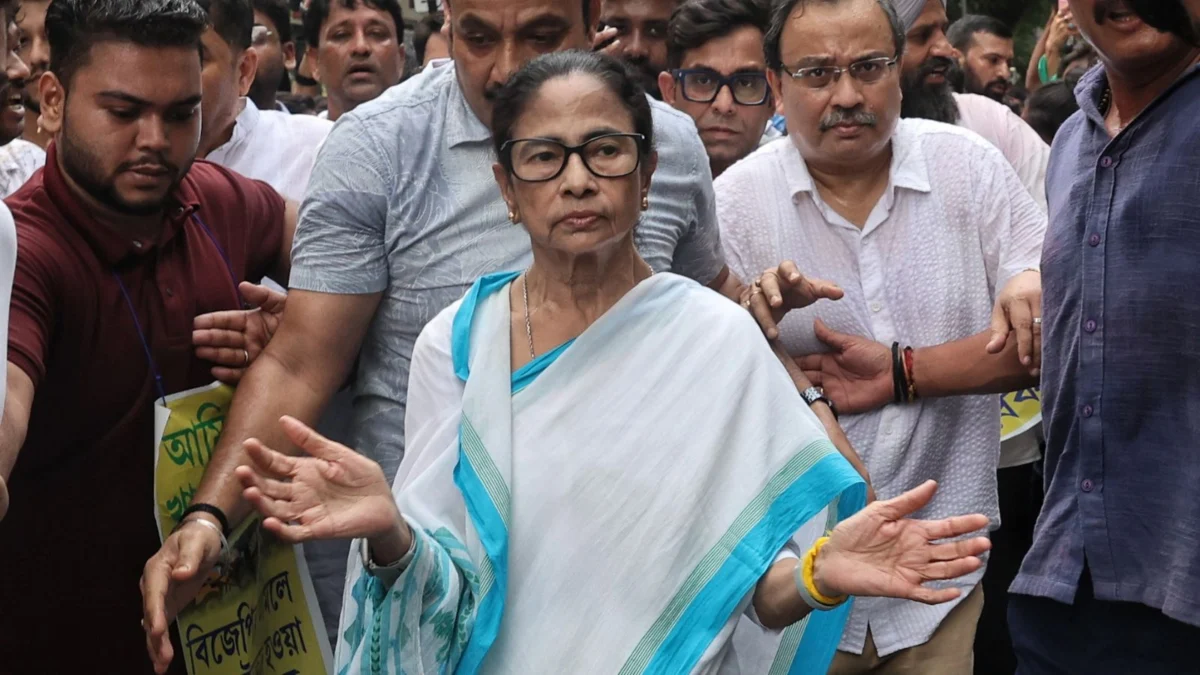
The revelation comes amidst a period of unprecedented internal turmoil and electoral setbacks for the TMC, which recently lost power and is grappling with significant fractures within its ranks. The Congress, on the other hand, appears to be weighing its options carefully, sensing a potential opportunity to reclaim lost ground in a state where it once held sway.
Main Facts: A Contentious Offer and a Resounding Rejection
The core of the controversy lies in an alleged proposal made by the Mamata Banerjee-led Trinamool Congress to the central leadership of the Indian National Congress. According to Pradip Bhattacharya, a former state Congress president, the TMC contacted a senior Congress leader in New Delhi approximately 15 days prior to the official announcement of the bypoll schedule. The purported offer involved a quid pro quo: the Congress would contest the by-election in Nandigram, a constituency laden with historical significance for the TMC, while the TMC would focus its efforts on Rejinagar in Murshidabad district.
The Congress high command, Bhattacharya stated, took time to deliberate on the proposal and subsequently sought the counsel of its state unit leaders. The consensus from the West Bengal Congress leadership was unequivocal: the timing was not right for any form of alliance or electoral understanding with the TMC. "The state leadership felt that this was not the right time for an alliance. It can be considered when the time is appropriate, but not now. This is the correct decision," Bhattacharya asserted to PTI, underscoring the state unit’s firm stance.
Sources within the Congress high command further indicated that while former Chief Minister Mamata Banerjee herself reportedly reached out to the Congress leadership in Delhi, engaging in a phone conversation with All India Congress General Secretary (Organisation) K.C. Venugopal, the Pradesh Congress Committee (PCC) was "dead against" any form of tie-up. The unanimity among senior Bengal Congress leaders to maintain an arm’s length from the TMC was striking, reflecting deep-seated resentments and a strategic vision for independent growth.
Adding to the complexity, TMC senior party leader Kunal Ghosh emphatically denied Bhattacharya’s claims, stating "No" when directly questioned about the alleged proposal. This direct contradiction highlights the opacity and high stakes involved in the behind-the-scenes political maneuvering.
For the Nandigram bypoll, the Mamata-led party has fielded Sanchita Pradhan (Dey), a new face, while the rebel TMC faction has nominated Mohammad Eteshamul Haque. The Congress candidate is Milan Pradhan. The Bharatiya Janata Party (BJP), a formidable force in the current political landscape, has named Hasirani Rath as its candidate. Rath is the mother of Chandranath, a former aide to the Chief Minister who was tragically shot dead near Kolkata on May 6, adding an emotional dimension to the BJP’s campaign.
Chronology of the Political Dance
The timeline of this alleged overture and its subsequent rejection offers a glimpse into the rapidly shifting political dynamics of West Bengal.
- Approximately 15 days before bypoll announcement (Late August/Early September 2026): According to Pradip Bhattacharya, the Mamata Banerjee-led TMC allegedly contacts a senior Congress leader in New Delhi, proposing an electoral adjustment for the upcoming bypolls in Nandigram and Rejinagar. Mamata Banerjee herself reportedly speaks with K.C. Venugopal.
- Early September 2026: The Congress high command seeks time to consider the proposal and consults with its West Bengal state unit leaders.
- Mid-September 2026: The West Bengal Congress leadership unanimously advises against an alliance or understanding with the TMC at this juncture.
- Tuesday, September 16, 2026: Pradip Bhattacharya publicly reveals the alleged TMC offer and the Congress’s rejection. TMC leader Kunal Ghosh denies the claims.
- October 6, 2026: The scheduled date for the crucial by-elections in Nandigram and Rejinagar, which will serve as a barometer of the state’s political pulse.
This sequence of events underscores the urgency within the TMC to consolidate its position and the Congress’s strategic patience as it observes its former ally’s struggles. The backdrop to this is the ongoing disintegration of the TMC after its electoral defeat and the rise of the BJP as the dominant force in the state.
Supporting Data: Unpacking the Political Landscape
The alleged offer and its rejection are not isolated incidents but are deeply embedded in the complex political history and current realities of West Bengal. Several factors provide crucial context:
The Importance of Nandigram: A Symbol of Power and Loss
Nandigram holds an almost mythical status in West Bengal politics, intrinsically linked to the TMC’s meteoric rise to power. The anti-land acquisition movement that began there in 2007, marked by intense farmer protests and clashes, proved to be a pivotal moment. It effectively eroded the rural base of the then-incumbent Left Front, paving the way for Mamata Banerjee’s historic victory and the end of 34 years of Left rule in 2011. For the TMC, Nandigram is not just a constituency; it is a powerful symbol of its origin, its struggle, and its eventual triumph.
However, Nandigram has also become a symbol of the TMC’s recent setbacks. In the 2021 Assembly elections, Mamata Banerjee herself contested from Nandigram, only to lose to her former aide and now Chief Minister Suvendu Adhikari by a narrow margin of 1,956 votes. The 2026 general election further solidified this shift, with Adhikari retaining the constituency by a more comfortable margin of 9,665 votes against TMC candidate Pabitra Kar. Adhikari subsequently vacated the Nandigram seat to retain Bhabanipur, from where he had defeated Banerjee, thereby necessitating the current bypoll.
The TMC’s alleged willingness to offer Nandigram to the Congress speaks volumes about its current vulnerability. A hat-trick of losses in its foundational constituency would be a devastating blow to the party’s morale and its already tarnished image. It suggests a strategic retreat, acknowledging the uphill battle they face in a constituency that has repeatedly delivered defeats to the party in recent times.
The Fractured Trinamool Congress: A Party in Disarray
The current state of the TMC is one of profound disarray, a stark contrast to its peak years. The party has not only lost power but has also suffered severe internal fragmentation. Both its legislative party and parliamentary party have experienced significant breakaways. Rebel MLAs have publicly staked claim to the party name and symbol, creating a legal and existential crisis for the Mamata-led faction. Adding to this, rebel MPs have reportedly joined the little-known Nationalist Citizens Party of India (NCPI) and have openly backed the BJP-led National Democratic Alliance (NDA).
This internal rebellion extends to the very symbols of party identity and operational capacity. The image caption accompanying the original article explicitly mentions that "The loyalists publicly claimed they were confident about retaining the party symbol and access to the bank accounts, with sources close to Mamata Banerjee saying they were waiting for the rebels to move the EC." This detail highlights the ongoing legal and administrative battle for control over the party’s fundamental assets – its name, symbol, and finances. Such a battle, particularly with the Election Commission (EC), is time-consuming, resource-intensive, and deeply demoralizing.
In this context, the Mamata-led party appears to be a mere "shell of its former self." Its organizational structure is weakened, its leadership challenged, and its cadre base fractured. The alleged offer to the Congress could be interpreted as a desperate measure to salvage some political capital and prevent a complete rout in key bypolls, particularly Nandigram. The party’s focus on Rejinagar, a Muslim-dominated constituency where it historically performs better, underscores this strategic shift towards consolidating its strengths where it has a higher probability of success.
Rejinagar: A Strategic Alternative
In contrast to the historical and emotional burden of Nandigram, Rejinagar in Murshidabad district presents a more pragmatic opportunity for the TMC. This constituency is predominantly Muslim, a demographic that has historically formed a significant portion of the TMC’s support base. If the party decides to concentrate its efforts there, it stands a better chance of victory, especially given the current internal strife.
The bypoll in Rejinagar became necessary after former TMC leader and Aam Janata Unnayan Party (AJUP) MLA Humayun Kabir vacated the seat to retain Naoda, another constituency he won. Kabir had previously indicated that he would back the Opposition party if Mamata Banerjee herself decided to contest the polls, suggesting a potential for cross-party support against the BJP. For the TMC, securing Rejinagar could provide a much-needed morale booster and a symbol of its enduring, albeit diminished, electoral capacity.
Congress’s Strategic Calculation: Repaying in Kind
For many Congress old-timers and state leaders, the idea of backing the Mamata-led party is fraught with historical baggage and strategic considerations. The TMC played a significant role in the rapid decline of the Congress in West Bengal. Although the two parties were allies when the Left Front was unseated in 2011, differences quickly emerged, leading to their separation in 2013. Subsequently, there was a steady "trickle" of local Congress leaders defecting to the TMC, further weakening the grand old party’s presence in the state.
Now, with the TMC facing an existential crisis – a formidable BJP and a powerful rebel faction – the Congress sees an opportunity to "repay the Mamata-led party in kind." The prevailing sentiment within the Bengal Congress is that the TMC is "in disarray" and that allying with it would be counterproductive. As one senior leader remarked, "At many places, TMC workers are joining the Congress. The TMC is in disarray. Why should we help the TMC stand up?"
Another leader articulated a more ambitious vision: "When the TMC was in power it never showed an inclination to ally with the Congress. Now they are desperate. The Congress should ideally now try to claim the political space occupied by the TMC… We should become the natural choice for all those who are opposed to the BJP, including minorities. A tie-up with the TMC will erode prospects of our independent growth after all these years." This indicates a clear strategy to position the Congress as the primary opposition to the BJP, especially by appealing to the minority vote bank that previously gravitated towards the TMC. Not allying with the TMC, therefore, offers the Congress the best chance to fill any political vacuum created by the TMC’s decline and rebuild its independent strength.
The BJP’s Position
The BJP, meanwhile, stands to benefit from the ongoing internecine warfare between the TMC and the Congress. By fielding Hasirani Rath, the mother of a murdered aide to the Chief Minister, the BJP aims to leverage emotional appeal and consolidate its base. The party’s rise in West Bengal has been meteoric, capitalizing on the erosion of the Left and the perceived vulnerabilities of the TMC. Any division or lack of coordination among the opposition parties further strengthens the BJP’s hand, allowing it to project itself as the sole stable alternative.
Official Responses: A War of Words
The public statements from both sides reflect the deep mistrust and strategic posturing.
Pradip Bhattacharya, representing the Congress, was forthright in his claims: "The party high command sought time and subsequently consulted state leaders about the proposal. The state leadership felt that this was not the right time for an alliance. It can be considered when the time is appropriate, but not now. This is the correct decision." His statement was detailed, outlining the sequence of events and the rationale behind the Congress’s decision.
In stark contrast, Kunal Ghosh, a senior TMC leader, offered a curt and unequivocal denial: "No," he stated to PTI when asked about Bhattacharya’s comments regarding the alleged proposal. This complete denial creates an immediate "he said, she said" scenario, making it difficult for the public to ascertain the truth and further muddying the political waters.
Sources within the Congress, however, continued to provide background, indicating that while Mamata Banerjee herself might have reached out to K.C. Venugopal, the local TMC leadership’s contact with the Pradesh Congress Committee met with strong resistance. The unanimity among state Congress leaders against any tie-up with the Mamata-led party underscores the deep-seated grievances and a strategic decision to prioritize independent growth.
Implications: A Shifting Sand in West Bengal and Beyond
The alleged offer and its rejection carry significant implications, both for the immediate by-elections and the long-term political trajectory of West Bengal and the national opposition alliance.
Immediate By-election Impact
The bypolls in Nandigram and Rejinagar, scheduled for October 6, will now be multi-cornered contests. In Nandigram, the presence of candidates from the Mamata-led TMC, the rebel TMC faction, the Congress, and the BJP ensures a fragmented vote. This fragmentation could potentially benefit the BJP, which has demonstrated a strong ability to consolidate anti-TMC votes. For the Congress, contesting independently allows it to test its own strength and potentially win votes from disillusioned TMC supporters.
In Rejinagar, the TMC’s chances might be better if it can consolidate the minority vote. However, the Congress also seeks to appeal to this demographic, potentially splitting votes and again benefiting the BJP or even the AJUP.
The Future of the TMC
Having lost power and most of her organization, Mamata Banerjee is in an unprecedentedly vulnerable position. Her "free bird" declaration after the election defeat, promising to be "on the streets again to take on the BJP," requires significant political muscle and alliances. The Congress’s rejection of her alleged overture suggests that such a "helping hand" may not be forthcoming. This makes the path to revival for the Mamata-led TMC incredibly arduous. Without alliances, and with an ongoing battle for its very identity, the party risks further marginalization and even political oblivion.
Congress’s Revival Prospects
For the Congress, this moment presents a critical juncture. By refusing to align with a weakened TMC, it is making a clear statement about its ambition to reclaim its independent political space. The strategy is to position itself as the "natural choice for all those who are opposed to the BJP," including crucial minority voters. If the TMC continues to fade and the rebels gain more power, the Congress could indeed fill the resulting political vacuum. However, this strategy is not without risks; it requires robust organizational efforts and compelling leadership to convince voters that the Congress is a viable alternative to both the BJP and the fractured TMC.
The INDIA Alliance: A Test of Unity
The dynamics in West Bengal also have broader implications for the INDIA alliance, the national coalition of opposition parties formed to counter the BJP in the 2024 Lok Sabha polls. While Mamata Banerjee was pushed into an "uneasy alliance" with the Congress and the Left at the national level, the "bad blood" at the state level prevented any electoral understanding in 2024. The current rejection of an alliance offer further highlights the deep fissures within the INDIA bloc when it comes to state-level politics.
The inability of key INDIA constituents to forge electoral understandings in crucial states like West Bengal undermines the very premise of the alliance. If constituent parties are unable to set aside historical animosities and state-level rivalries, the effectiveness of the national front against the BJP remains questionable. This development serves as a stark reminder that national alliances do not automatically translate into cohesive state-level cooperation, especially when powerful regional players are involved.
In conclusion, West Bengal’s political landscape remains a turbulent sea. The alleged TMC offer and the Congress’s firm rejection underscore the profound shifts occurring within the state. As the TMC grapples with internal strife and electoral decline, the Congress sees an opening to resurrect its fortunes. Meanwhile, the BJP watches keenly, poised to capitalize on any further fragmentation of the opposition. The bypolls on October 6 will not merely elect representatives; they will serve as a crucial barometer of these evolving power dynamics, shaping the future of West Bengal politics for years to come.
