

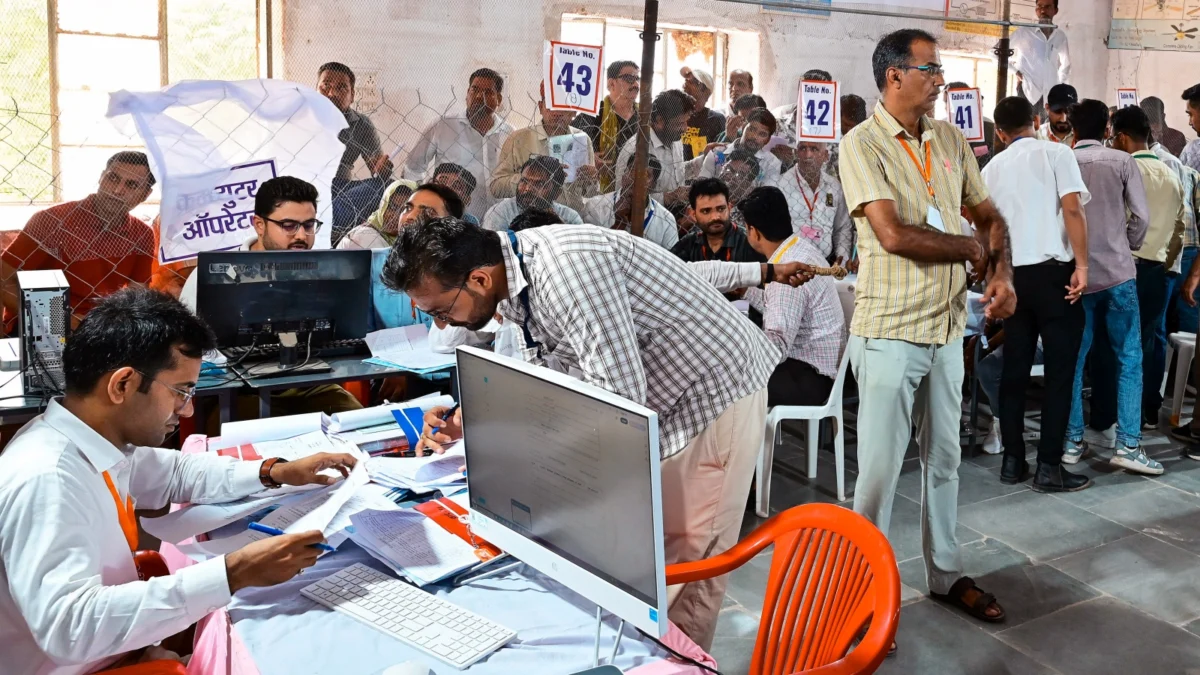
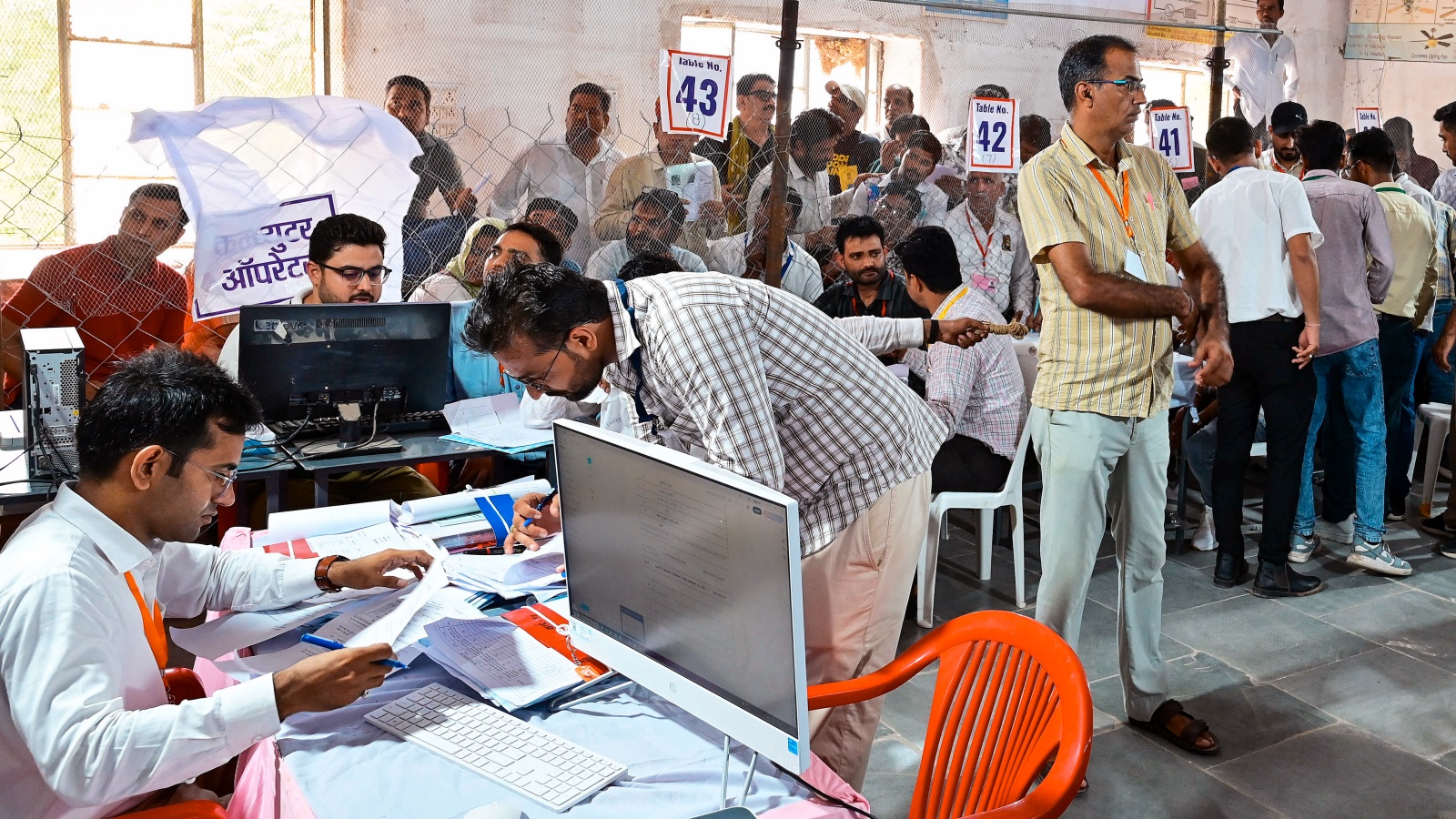
The recent urban local body elections in Rajasthan have ignited a fierce debate surrounding the delimitation of urban wards, with the opposition Congress party alleging that the redrawing of boundaries unfairly tilted the playing field in favour of the ruling Bharatiya Janata Party (BJP). An extensive analysis of results from the Jaipur, Jodhpur, and Kota Municipal Corporations reveals a striking paradox: Congress candidates, despite often polling significantly more votes and winning with larger margins, secured fewer wards compared to their BJP counterparts. This intricate dance of vote distribution versus ward allocation has brought the contentious issue of electoral cartography, often dubbed "gerrymandering," to the forefront of Rajasthan’s political discourse.
Main Facts: A Vote-Share Paradox
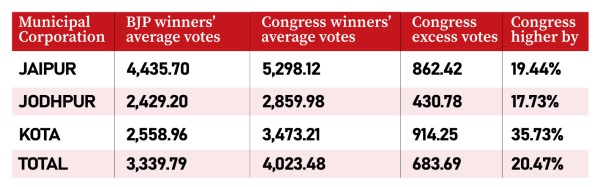
At the heart of the controversy lies a stark statistical anomaly. Across the three major municipal corporations of Jaipur, Jodhpur, and Kota, Congress candidates who emerged victorious garnered an average of 20.47% more votes than their winning BJP counterparts. This substantial difference in individual candidate performance, however, did not translate into a commensurate number of ward victories for the Congress.
The aggregate data further underscores this vote-share paradox. The Congress collectively polled 10,34,999 votes across the three corporations, marginally outperforming the BJP, which secured 10,19,160 votes. Yet, the BJP managed to clinch 180 wards, a significant lead over the Congress’s 140 wards, resulting in a 40-ward difference. This outcome suggests that while Congress votes were often concentrated in specific wards, leading to emphatic victories, BJP votes were more strategically spread, enabling them to win a greater number of wards, albeit often with narrower margins. The average votes polled per ward across these corporations also reflect this trend, with Congress averaging approximately 2,957 votes across 350 wards, slightly more than the BJP’s average of 2,912.
The Allegations: Political Cartography and "Gerrymandering" Claims
The Congress party has been vocal in its accusations, asserting that the delimitation exercise was a deliberate attempt by the BJP to manipulate electoral outcomes. Former Chief Minister Ashok Gehlot, speaking on Thursday, highlighted specific concerns within his Assembly constituency of Sardarpura in Jodhpur. He claimed that multiple wards traditionally supportive of the Congress – sometimes three or four at once – were merged into a single ward, while BJP-leaning wards were either preserved intact or divided into several smaller wards. This, Gehlot argued, diluted the Congress’s concentrated voter base and fragmented its support.
Echoing Gehlot’s sentiments, Congress state president Govind Singh Dotasra vehemently condemned the delimitation as "illegal" and "dishonest." He asserted that had the ward boundaries been drawn fairly, the Congress would have secured an additional 1,500 wards across the state. Dotasra’s allegations extend to claims of results being forcibly withheld in wards where Congress candidates were leading, suggesting a broader conspiracy to create a favourable atmosphere for the BJP and Chief Minister Bhajan Lal Sharma. The party has even requested a recount in 1,316 wards, citing irregularities and suspicious vote counts.
"They succeeded in the delimitation conspiracy they hatched," Gehlot stated, acknowledging, "It was also our fault that we did not pay much attention to it because we trusted the government." This statement underscores a sense of regret within the Congress leadership for not anticipating or actively challenging the delimitation process more vigorously.
Supporting Data: Unpacking the Numbers
A deeper dive into the electoral statistics from Jaipur, Jodhpur, and Kota provides compelling evidence supporting the Congress’s claims of an uneven playing field. The data reveals a consistent pattern where winning Congress candidates garnered substantially more votes than their BJP counterparts, yet often saw fewer overall victories.
Vote Discrepancy Across Corporations
The average votes secured by winning candidates paint a clear picture of this disparity:
- Jaipur: A winning BJP candidate received an average of 4,435.7 votes, while a winning Congress candidate polled an average of 5,298.12 votes. This represents a significant 19.44% more votes for the Congress winner.
- Jodhpur: The trend continued, with BJP winning candidates averaging 2,429.20 votes compared to Congress winners’ 2,859.98 votes, a 17.73% advantage for the Congress.
- Kota: The most staggering difference was observed in Kota, where winning Congress candidates averaged 3,473.21 votes against the BJP’s 2,558.96 votes, marking a massive 35.73% lead for the Congress.
Overall, across these three key corporations, each winning Congress candidate polled approximately 684 more votes than their BJP counterpart, translating to an average advantage of 20.47 percent. This indicates a highly efficient vote concentration for the Congress, which paradoxically worked against them in terms of ward count due to the ‘winner-take-all’ nature of the electoral system.
Total Vote Share vs. Ward Wins
The aggregate vote shares further highlight the incongruity between popular support and electoral outcomes. Across Jaipur, Jodhpur, and Kota, the Congress garnered 39.57% of all votes polled, narrowly exceeding the BJP’s 38.97%. This seemingly minor difference of just 0.6% in total vote share belies the significant 40-ward advantage the BJP secured. This demonstrates a classic case where a party can win more seats without necessarily winning the popular vote, a phenomenon often attributed to electoral district design.
Demographic Skew: More Populous Congress Wards
Beyond mere vote counts, demographic data also suggests an imbalance. Wards won by the Congress consistently had larger populations, implying a higher density of voters and a more substantial mandate for their representatives.
- Jaipur: The average population of a ward won by the Congress was around 21,745, notably higher than the 20,682 for wards won by the BJP.
- Jodhpur: Congress-won wards had an average population of 10,900, compared to 10,224 for BJP-won wards.
- Kota: Similarly, Congress secured wards with an average population of approximately 10,962, against 9,980 for the BJP.
Cumulatively, across the three municipal corporations, the average population of wards won by the Congress stood at 15,333, in contrast to 14,679 for BJP-won wards. This difference of 655 persons, or 4.46%, suggests that Congress representatives are elected from more populous areas, theoretically representing a larger constituent base. Dotasra explicitly cited examples like Jaipur’s Ward 31 with 13,499 voters and Ward 135 with 32,272 voters, underscoring the vast discrepancies in ward sizes created by the delimitation.
Dominance in Top Performances
Further evidence of concentrated Congress strength comes from the analysis of individual candidate performances and victory margins.
- In Jaipur, all five candidates who polled the highest individual vote counts were from the Congress.
- In Jodhpur and Kota, four out of the top five highest individual vote-getters were Congress candidates.
- Regarding victory margins, the Congress swept all top five positions in Jaipur. In Jodhpur and Kota, Congress candidates secured three of the top five largest victory margins, with BJP candidates accounting for the remaining two.
This data collectively paints a picture of Congress winning big in specific, often more populous, wards, while the BJP managed to distribute its votes more effectively across a larger number of smaller or less populous wards to secure a majority of seats.
Statewide Context
Zooming out to the broader picture across 309 civic bodies in Rajasthan, the BJP polled 35.21% of the total votes, marginally ahead of the Congress’s 34.30%, a difference of 0.91%. Independents garnered a significant 27.31%, highlighting the fragmented nature of local politics. While the statewide figures show a slight BJP lead in overall vote share, the specific anomalies in the major corporations remain a point of contention regarding the impact of delimitation.
Chronology of Delimitation: A Tit-for-Tat Political Saga
The current controversy is not an isolated incident but rather the latest chapter in a cyclical political struggle over electoral boundaries in Rajasthan, characterized by each party accusing the other of "gerrymandering" when in power.
2014 BJP Government Era
The narrative begins with the municipal elections held in 2014 under the Vasundhara Raje-led BJP government. At that time, Jaipur Municipal Corporation had 91 wards, while Jodhpur and Kota each had 65 wards. The BJP secured a dominant victory, winning 64 out of 91 wards in Jaipur, 39 out of 65 in Jodhpur, and 53 out of 65 in Kota. These results showcased a strong BJP hold over urban civic bodies when the corporations were unified.
2020 Congress Government Reforms
Upon assuming power, the subsequent Congress government under Ashok Gehlot undertook its own significant delimitation exercise. Citing reasons of better administration and governance, the Congress government divided each of the three major corporations into two: Jaipur was split into Jaipur Greater (150 wards) and Jaipur Heritage (100 wards); Jodhpur into Jodhpur North and Jodhpur South (80 wards each); and Kota into Kota North (70 wards) and Kota South (80 wards). This move effectively increased the total number of wards across these cities from 221 to 560.
In the 2020 civic polls conducted under this new structure, the Congress managed to secure 261 out of the 560 wards with a 40.08% vote share, while the BJP won 242 wards with 37.81% of the votes. Thanks to this bifurcation and the resulting vote distribution, the Congress achieved a clear majority in Jodhpur North and Kota North. While the BJP won Jaipur Greater and Jodhpur South, the Congress, with the crucial support of Independents, successfully formed boards in Jaipur Heritage and Kota South as well.
During this period, the BJP vehemently opposed the Congress’s delimitation, leveling similar accusations of political manipulation. BJP MP and Union Minister Arjun Ram Meghwal had then alleged that the Congress had realized its dwindling public support in urban areas and feared losing mayoral posts in unified corporations, leading to the split. Then-state BJP president Satish Poonia also claimed that despite "discrepancies in delimitation and voting, along with misuse of power," the Congress failed to secure a clear mandate, only managing clear majorities in two out of the six newly formed civic bodies. This historical context underscores the cyclical nature of these political battles over electoral boundaries.
Current BJP Government’s Reversal
With the BJP back in power, the pendulum swung once more. The incumbent BJP government reversed the Congress’s 2020 bifurcation, unifying the six corporations back into three. This latest exercise brought the ward counts down to 150 in Jaipur and 100 each in Jodhpur and Kota, significantly altering the electoral landscape once again.
BJP state president Madan Rathore, in an interview last year, articulated the party’s justification for this reversal: "The Congress did delimitation in their time, keeping in mind their political ambitions. They made wards for 500 votes and some wards for 10,000 votes. The Congress created districts…just for their political goals. We have to rectify this mess." This statement frames the current delimitation as a corrective measure against what the BJP considered arbitrary and politically motivated actions by the previous government. Rajasthan Parliamentary and Law Affairs Minister Jogaram Patel further asserted in November last year that the delimitation of both panchayati raj institutions and urban local bodies was carried out in accordance with "public sentiment" and prioritized "the spirit of democratic decentralisation to ensure better accessibility of governance and administration."
Official Responses and Counter-Arguments
The latest round of allegations has elicited strong responses from both sides, each defending its actions and condemning the other’s.
Congress leaders, including Ashok Gehlot and Govind Singh Dotasra, have maintained a unified front, steadfastly asserting that the current delimitation was an "illegal" and "dishonest" exercise designed to benefit the BJP. Their arguments are bolstered by the detailed statistical analysis showing the discrepancy between vote shares and ward wins. Dotasra’s claim of the Congress potentially winning "1,500 more wards" statewide if not for this alleged manipulation highlights the perceived scale of the impact. The focus on disparate ward populations and the consolidation of Congress-supporting areas into single large wards are central to their accusations of deliberate "gerrymandering." The request for recounts in over a thousand wards further demonstrates their deep mistrust of the electoral process under the new boundaries.
On the other hand, the ruling BJP has consistently defended its delimitation, portraying it as a necessary rectification of the "mess" created by the previous Congress government. Madan Rathore’s statements emphasize that the Congress’s earlier delimitation was driven by "political ambitions" and created wards with vastly unequal voter populations. The BJP frames its actions as a move towards greater fairness and administrative logic, aligning with "public sentiment" and promoting "democratic decentralization," as articulated by Jogaram Patel. Their argument suggests that the current delimitation aims to restore balance and address the perceived irregularities introduced by the Congress.
This exchange of accusations highlights a recurring theme in Indian politics, where delimitation exercises, crucial for democratic representation, often become battlegrounds for partisan advantage, leading to a cycle of accusations and counter-accusations with each change of government.
Implications: The Future of Urban Governance and Electoral Fairness
The ongoing controversy surrounding ward delimitation in Rajasthan carries profound implications for the future of urban governance, electoral fairness, and democratic principles in the state. The phenomenon of a party winning fewer seats despite securing a higher vote share or winning with larger margins is a classic symptom of gerrymandering, where electoral districts are drawn to concentrate the opposition’s votes into a few districts while spreading one’s own votes thinly across many, maximizing seat wins.
Firstly, such allegations, whether proven or not, erode public trust in the impartiality of electoral processes. If voters perceive that boundaries are drawn not to ensure fair representation but to manipulate outcomes, it can lead to disillusionment and disengagement from democratic participation. This is particularly critical at the local level, where citizens directly interact with their elected representatives and expect responsive governance.
Secondly, the unequal population distribution across wards, as alleged by the Congress and supported by the data, can lead to disparities in representation. Wards with significantly larger populations mean that individual representatives must cater to a greater number of constituents, potentially straining resources and reducing the effectiveness of local governance. Conversely, representatives from smaller wards might have a more manageable constituent base, leading to uneven access to services and political influence.
Thirdly, the cyclical nature of these delimitation disputes – with each ruling party reversing the decisions of its predecessor and facing similar accusations – suggests a systemic issue. It underscores the urgent need for a more transparent, independent, and rule-bound process for redrawing electoral boundaries, insulated from partisan political influence. An independent body, with clear guidelines and public consultation mechanisms, could help restore faith in the fairness of such exercises.
Finally, the outcome of this delimitation will significantly shape urban governance in Jaipur, Jodhpur, and Kota for the foreseeable future. The party that controls these municipal corporations wields considerable power over urban development, infrastructure projects, and resource allocation. If the electoral map is perceived as skewed, it can exacerbate political polarization and hinder collaborative governance, ultimately impacting the quality of life for millions of urban residents. The current dispute, therefore, is not merely about numbers and percentages; it is about the fundamental integrity of democratic representation at the grassroots level in Rajasthan. The calls for recounts and investigations highlight the deep divisions and the critical need for resolution to ensure the health of local democracy.
