

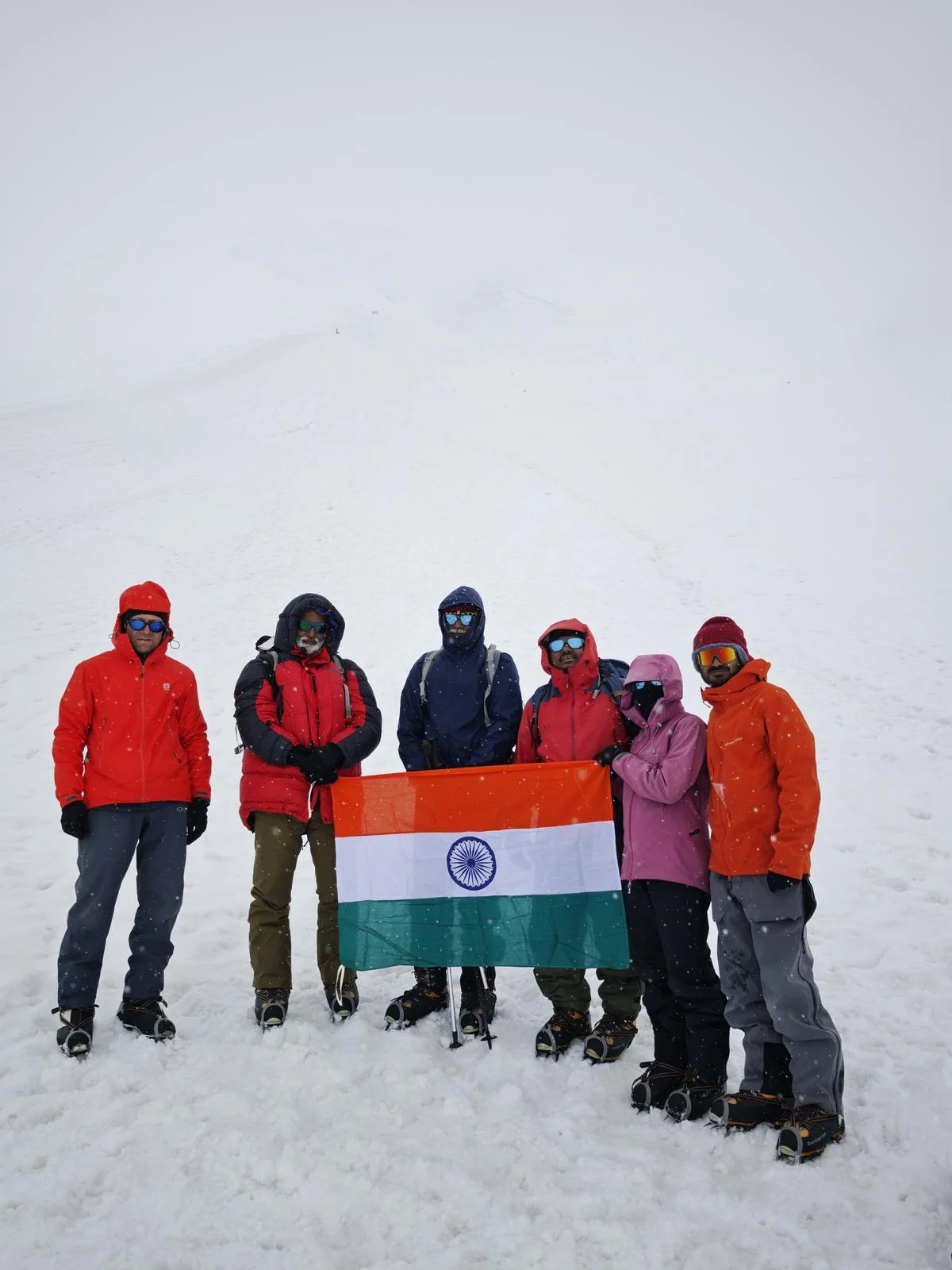
WAYANAD, KERALA — In the rarefied air of the Caucasus Mountains, where the borders of Europe and Asia blur beneath a blanket of perennial snow, T.J. Marce stood as a testament to the enduring capacity of the human spirit. At an age when most are content with the quietude of a sedentary retirement, the 74-year-old former Kerala State Road Transport Corporation (KSRTC) employee from Wayanad has carved his name into the annals of Indian mountaineering.
On August 15, 2026, coinciding with India’s milestone 80th Independence Day, Marce reached the summit of Mount Elbrus, the highest peak in the European continent. Standing at 5,642 meters (18,510 feet), the dormant volcano is a formidable challenge for even seasoned climbers. For Marce, however, it was more than a climb; it was the second jewel in his quest to conquer the "Seven Summits"—the highest peaks on each of the seven continents.
Main Facts of the Expedition
The expedition was a meticulously planned eight-day venture involving a five-member team hailing from the diverse landscapes of Kerala. Led by veteran trekker S. Seshadri, the team represented a cross-section of age and geography, proving that the passion for the mountains transcends generational boundaries.
The Team Composition
- T.J. Marce (74): A native of Kavumannam in Thariode, Wayanad. A retired KSRTC employee whose late-blooming passion for high-altitude trekking has seen him summit two major peaks in less than a year.
- S. Seshadri (Lead): An experienced mountaineer from Wayanad who spearheaded the logistical and tactical execution of the climb.
- G.J. Aghina Soorya (Co-lead): Hailing from Kozhikode, she served as the only female member of the team, providing critical leadership during the ascent.
- M.P. Muraleedharan (66): A fellow Wayanad native and a frequent climbing partner of Marce, representing the growing demographic of "silver trekkers."
- P. Athif: A climber from Malappuram who brought previous experience from African expeditions to the team.
The Achievement
Based on available records and digital mountaineering databases, T.J. Marce is believed to be the oldest Indian to successfully summit Mount Elbrus. His achievement at the age of 74 years, six months, and 26 days sets a new benchmark for senior athletes in the country. The team’s success on August 15 added a patriotic fervor to the accomplishment, as they unfurled the Indian tricolor atop the "Roof of Europe" amidst freezing temperatures and howling winds.
Chronology of a Late-Life Ascent
The journey to the top of Elbrus did not begin in Russia, but rather in the mist-covered hills of the Western Ghats and the dusty depots of the KSRTC.
The Early Spark and Retirement
For decades, Marce’s life was defined by the rhythms of public service. However, beneath the routine of a transport employee lay a dormant fascination with the wild. Upon his retirement, rather than settling into a quiet life in Thariode, Marce began to systematically pursue the trekking interests of his youth.
September 2025: Kilimanjaro
The momentum for the Elbrus expedition began exactly one year prior. In September 2025, Marce and M.P. Muraleedharan traveled to Tanzania to take on Mount Kilimanjaro. At 5,895 meters, Kilimanjaro is Africa’s highest point. The duo successfully summited the peak, a feat that served as a proof-of-concept for their physical endurance. This was preceded by a grueling trek to the Everest Base Camp (EBC) in Nepal, which provided the necessary acclimatization and technical familiarity with high-altitude environments.

August 2026: The Elbrus Campaign
The team arrived in the Caucasus region in early August 2026. The expedition was scheduled over eight days to allow for "climb high, sleep low" acclimatization rotations.
- Days 1–4: The team focused on acclimatization hikes, moving between base camps and higher elevations to adjust their bodies to the thinning oxygen.
- Days 5–7: Preparations were made at the high camps, monitoring weather windows. The Caucasus range is notorious for sudden, violent shifts in weather.
- August 15 (Summit Day): The final push began in the early hours of the morning. The team navigated the "Saddle"—the pass between the twin peaks of Elbrus—before tackling the steep final ascent to the West Summit.
Supporting Data: The Challenges of Elbrus
Mount Elbrus is often deceptively categorized as a "walk-up" mountain because it does not require extensive technical rock climbing. However, the supporting data from this expedition highlights the sheer physical toll such an ascent takes, particularly on older climbers.
Weather and Atmospheric Conditions
During the final ascent, the team encountered extreme weather. Winds were recorded at approximately 65 km/h, creating a significant wind-chill factor that pushed temperatures well below freezing.
- Altitude: 5,642 meters. At this height, the effective oxygen level is roughly 50% of what is available at sea level.
- The Saddle Point: This is a critical geographical feature of Elbrus. The team reported that the most grueling conditions were faced after reaching this point, where the wind tunnels between the peaks, making the final descent as dangerous as the ascent.
Physical Preparation for Seniors
Climbing at 74 requires a specialized regimen. Marce’s preparation involved long-distance walking and cardiovascular training in the undulating terrain of Wayanad. Medical experts note that for septuagenarians, the primary risks at high altitude include rapid dehydration, increased strain on the cardiovascular system, and a slower recovery rate for muscle tissue. Marce’s ability to maintain a steady pace alongside younger climbers like Athif and Soorya suggests an exceptional level of physiological resilience.
Official Responses and Perspectives
The success of the expedition has drawn praise from the trekking community in Kerala and beyond.
The Lead’s Perspective
Expedition lead S. Seshadri emphasized that the summit was merely a byproduct of a larger philosophical journey. "The summit is only one part of the journey," Seshadri remarked following their return. "The preparation, the people, the challenges, and the safe return are equally important. The journey to the mountains on foot is transformational. From the first trail to the highest mountains, we believe everyone must trek."
The Climber’s Reflection
Speaking from his home in Kavumannam, T.J. Marce remained humble about the record. "When I summit a mountain and look down, it gives me a different kind of satisfaction," he said. "The expedition itself gives me a lot of energy. I want to summit more mountains, but that requires a lot of planning and preparation. Maybe, I will undertake my next big trek next year."

Marce’s daughter and family have been supportive of his pursuits, noting that his health and spirit have seemed rejuvenated since he began his high-altitude journey. His story has become a local sensation in Thariode grama panchayat, where he is now seen as an ambassador for active aging.
Implications: The Rise of the "Silver Trekker"
The feat achieved by Marce and Muraleedharan (66) points toward a significant shift in Indian adventure sports—the rise of the senior adventurer.
1. Challenging Ageist Stereotypes
Historically, high-altitude mountaineering was viewed as the domain of the young or the professional elite. Marce’s success challenges the "retirement narrative" in India, which often emphasizes rest over rigor. By summiting two of the Seven Summits in his mid-70s, Marce provides a blueprint for "active aging," suggesting that the body’s decline can be significantly mitigated through discipline and passion.
2. The Growth of Kerala’s Trekking Culture
The fact that a five-member team from three different districts of Kerala (Wayanad, Kozhikode, and Malappuram) organized and executed an international expedition speaks to the maturing trekking infrastructure in the state. Groups like these are moving beyond the Western Ghats to the Himalayas and the great ranges of the world, fostering a culture of global exploration within the Malayali community.
3. The Seven Summits Ambition
With Kilimanjaro and Elbrus completed, Marce, Muraleedharan, and Athif are now officially on the "Seven Summits" track. This pursuit requires not only physical stamina but significant financial and logistical planning. Their progress may inspire more structured support for amateur mountaineers in India, perhaps through government grants or corporate sponsorships for senior athletes.
Conclusion
As T.J. Marce returns to the greenery of Wayanad, his eyes are already set on the horizon. His journey from the bus depots of Kerala to the icy crags of the Caucasus serves as a powerful reminder that the peak of one’s life is not a fixed point in time, but a destination one chooses to climb toward. In the thin air of Mount Elbrus, Marce didn’t just find a record; he found a "different kind of satisfaction" that only comes to those who refuse to let age define their boundaries.
The 80th Independence Day of India was marked by many celebrations, but few were as quiet, as cold, and as profoundly inspiring as the one held at 5,642 meters by a 74-year-old man from a small village in Kerala.
