

MYSURU, KARNATAKA – In the quiet village of Badagalapura, located on the fringes of the southern Indian state of Karnataka, the cost of one of the world’s most successful conservation stories is written in the scars of its residents.
Forty-five-year-old Mahadeva Gowda was tending to his cotton crop in late 2025 when a tiger lunged from the undergrowth. The attack was instantaneous. Before Gowda could comprehend the movement, the predator’s claws had torn through his face. After multiple reconstructive surgeries, Gowda is now permanently blinded, his speech slurred, and his ability to provide for his family destroyed. He is a living testament to a burgeoning crisis: as India’s tiger population reaches historic highs, the boundaries between wild habitats and human settlements are vanishing.

Main Facts: A Conservation Triumph Meets a Human Tragedy
The recovery of the Bengal tiger (Panthera tigris tigris) is a cornerstone of Indian national pride. From a nadir of approximately 1,411 individuals in 2006, the population has surged to an estimated 3,682 according to the 2022 census. However, this success has birthed a secondary crisis. Approximately 30% to 35% of India’s tigers now live outside protected reserves, roaming through a "tiger landscape" that includes farms, villages, and infrastructure projects.
In Karnataka, the Bandipur and Nagarhole reserves have become victims of their own success. Bandipur, spanning 1,456 square kilometers, is currently home to between 154 and 175 tigers. Experts suggest these parks are reaching their "carrying capacity," forcing younger tigers to disperse in search of territory and older, injured tigers to seek easier prey in the form of livestock—and occasionally, humans.

Key Statistics at a Glance:
- Total India Tiger Population (2022): 3,682.
- Tigers Outside Protected Areas: ~35%.
- Karnataka Tiger Captures (Sept 2025 – May 2026): 30.
- Bandipur Population Density: 154–175 tigers in 1,456 sq km.
- Reserves with Zero Tigers: 5 (highlighting the uneven distribution of the population).
Chronology of Conflict: The Autumn of 2025
The situation in the Mysuru district escalated sharply in late 2025, a period that coincides with the tiger mating season (October to December) when movement and territorial aggression are at their peak.
- Mid-October 2025: Mahadeva Gowda is attacked in his cotton field in Badagalapura. He survives but is left permanently disabled and blinded.
- Late October 2025: Two weeks after the Gowda incident, 55-year-old farmer Rajashekarappa is killed by a tiger while grazing cattle in a field near Bennegere village.
- Late 2025 – Early 2026: Following a string of fatal attacks, including the death of a woman named Rukmini in a maize field, the Karnataka Forest Department takes the unprecedented step of suspending trekking and safari activities in Nagarhole and Bandipur to focus on "problem animal" management.
- September 2025 – May 2026: Forest department records show 30 tigers are captured across the state. While most are released back into core forest areas, the frequency of these interventions highlights the rising frequency of human-wildlife overlap.
Supporting Data: The Geography of an "Overflowing" Forest
The primary driver of the conflict is a lack of space. While India boasts 58 tiger reserves, the distribution of the cats is remarkably uneven. A news report analysis found that 18 reserves host fewer than 10 tigers, and five have none at all. Conversely, reserves in the Western Ghats (Karnataka) and Central India (Madhya Pradesh and Maharashtra) are "overflowing."

S. Prabhakaran, a former conservator of forests at Bandipur, notes that tiger movement is a biological imperative. "Tigers have been present in this landscape for centuries," he explains. However, he clarifies that the intensity has changed. During mating seasons and periods of high density, dispersing sub-adults must traverse human-dominated landscapes to find unoccupied territories.
Furthermore, the physical condition of the tigers plays a role. Kumar Pushkar, Karnataka’s Principal Chief Conservator of Forests (Wildlife), points out that while healthy tigers typically avoid humans, old or injured cats find it difficult to hunt wild ungulates like sambar or spotted deer. "On average, they attempt 20 times to get one prey," Pushkar says. For a cat with broken canines or a limp, a cow or a slow-moving human becomes an unfortunate alternative.

Official Responses and Mitigation Strategies
The government’s response has historically been reactive—capturing "problem" tigers after an attack occurs. Between late 2025 and mid-2026, the Karnataka Forest Department used camera traps to identify specific tigers through their unique stripe patterns, ensuring the correct animal was targeted for removal.
The Translocation Debate
Translocation—moving a tiger from a high-conflict area to a low-density reserve—is a cornerstone of the National Tiger Conservation Authority’s (NTCA) strategy. Vaibhav C. Mathur, a senior official with Project Tiger, points to the success of "Zeena," a tigress moved 1,000 km from Maharashtra to Similipal in Odisha. Despite an initial "exploratory phase" where she wandered across three states, she eventually settled and gave birth to four cubs in June 2026.

However, veteran scientists like Y.V. Jhala, former dean of the Wildlife Institute of India (WII), argue that translocation isn’t a panacea. "You’re moving a problem from one area to another," Jhala says. He notes that "man-eaters"—tigers that deliberately hunt humans—should rarely be released back into the wild, as their chances of establishing a new territory without conflict are slim.
Financial and Technological Interventions
The Ministry of Environment, Forest and Climate Change has launched the "Management of Tigers Outside Tiger Reserves" initiative, backed by 887 million rupees ($9.33 million). This funding is directed toward:

- AI-Enhanced Monitoring: Using drones and smart camera traps to detect tigers near villages in real-time.
- Corridor Restoration: Protecting the "wild pathways" that allow tigers to move between reserves without entering farms.
- Compensation: Streamlining payments for livestock loss to prevent retaliatory killings by farmers.
Implications: Redefining Carrying Capacity and Coexistence
The escalating conflict has forced experts to rethink the very definition of "carrying capacity." K. Ramesh, a human-wildlife conflict expert with the WII, argues that we must look beyond "numerical carrying capacity" (how many tigers can fit in a box).
Three Dimensions of Capacity:
- Numerical: The raw number of individuals a habitat can support.
- Ecological: The availability of prey and water. Experts like K. Ullas Karanth suggest that "over-managing" forests—creating artificial watering holes and grasslands—has artificially inflated tiger numbers in small areas, leading to more spillover.
- Social: This is the most volatile factor. It refers to the level of tolerance local communities have for the predators.
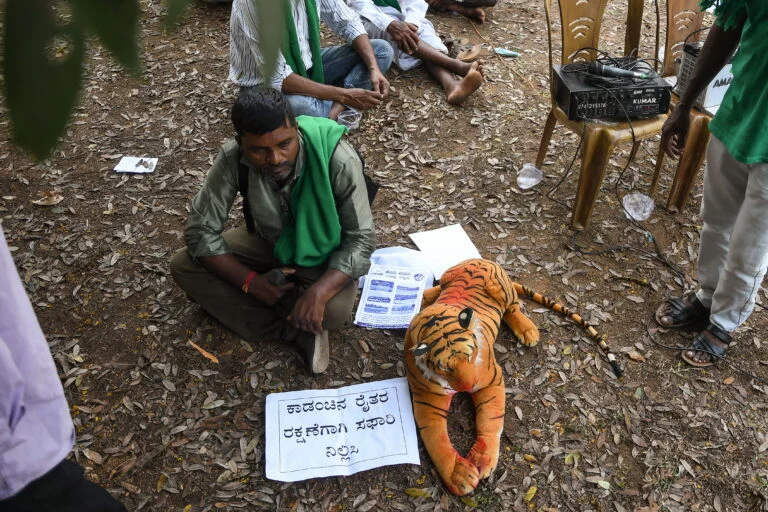
"If the local community turns hostile, there could be a backlash which could set back decades of tiger revival efforts," warns Jhala. In Mysuru, this hostility is already palpable. Farmers have staged protests in front of government offices, demanding the closure of illegal resorts and better protection from the "forest that has entered the field."

The Land-Use Dilemma
India’s human population has grown to nearly 1.5 billion, and the demand for land is relentless. Linear infrastructure—roads, railways, and canals—is increasingly slicing through established tiger corridors. When a corridor is severed, a tiger is "trapped" in a fragment, forcing it to interact with the people living on the edges.
Ramesh suggests that the future of conservation lies in "zoning." Instead of rigid boundaries, India needs a land-use policy that recognizes "shared landscapes." This would involve managing areas outside reserves not just for agriculture, but as ecological buffers where human activity is calibrated to minimize risk.

Conclusion: A Fragile Future
For Mahadeva Gowda, the debates over ecological carrying capacity and national census figures provide no solace. His life is now confined to the walls of his home, dependent entirely on his wife, Indrani. His story serves as a sobering reminder that conservation success cannot be measured by tiger numbers alone.
As India moves into its next phase of wildlife management, the challenge is no longer just "saving the tiger." It is about saving the social contract between the state and the people who live alongside the world’s most formidable predator. Without a shift from reactive captures to proactive landscape management and social support, the very success of Project Tiger may become its greatest threat.

The goal for 2026 and beyond is clear: ensuring that the roar of a rebounding tiger population does not become a death knell for the communities that share its soil.
