

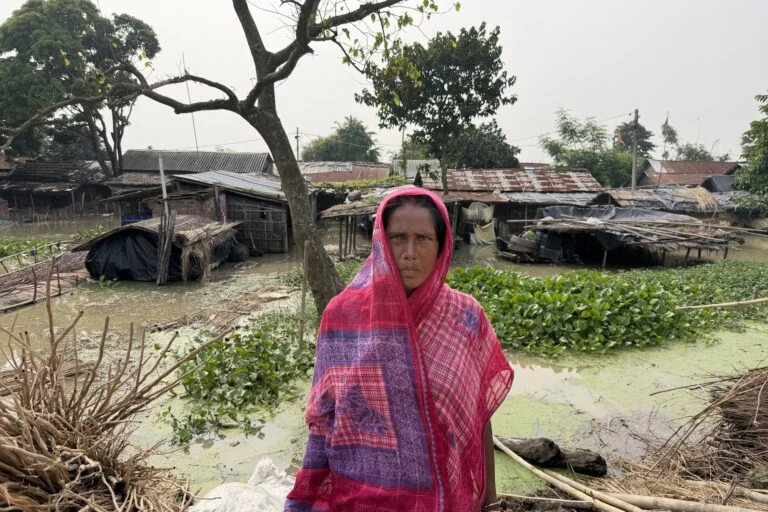
KATIHAR/SAHEBGANJ – For Geeta Devi, a 35-year-old farmer in the Gandhi Tola neighborhood of Manihari, Bihar, the monsoon is no longer a season of renewal; it is a recurring siege. As the Ganga and its tributaries surged past their danger marks in September 2026, Geeta found herself navigating waist-deep water inside her three-room mud house. While the structure still stands, its integrity weakens with every hour it remains submerged.
With her husband working as a daily-wage laborer in Delhi, the burden of survival rests entirely on her shoulders. She manages four children, a small herd of livestock, and a submerged agricultural plot. Every day, she braves the contaminated floodwaters to check on her elevated belongings, a desperate ritual to ensure that the few assets she has left have not been claimed by the silt-laden currents.
Geeta’s story is a microcosm of a massive humanitarian and ecological crisis unfolding across 15 districts of Bihar and neighboring Jharkhand. Despite a technical rainfall deficit, the region is reeling under one of the most complex flood events in recent history, exposing the widening gap between official disaster management narratives and the grim reality on the ground.
I. The Scale of the Catastrophe: 5 Million Lives in Limbo
According to official state government releases dated September 14, 2026, the floods have devastated 88 blocks and 575 gram panchayats. Approximately 5 million (50 lakh) people have been directly affected. The hydrological data paints a terrifying picture of a region under water:

- The Kosi River: Flowing dangerously above the mark at Baltara and Kursela.
- The Ganga: Surging past danger levels at Digha, Gandhi Ghat, Hathidah, Bhagalpur, Kahalgaon, and Munger.
- Other Tributaries: The Budhi Gandak (Khagaria), the Punpun (Paliganj), and the Bagmati and Ghaghra (Benibad and Darauli) have all breached critical thresholds.
In Manihari, the destruction is total. "There were around 400 houses here. Everything is under water," Geeta Devi explains from her makeshift camp on a railway embankment. She is surrounded by the remnants of her life: a small patch of cut grass for her goats and cattle tied nearby. The fields, once the source of her livelihood, are now inaccessible even by boat due to the treacherous rise in water levels.
II. The Great Paradox: Flooding in a Rain-Deficit Year
The 2026 flood defies the traditional "script" of Bihar’s monsoon. Historically, floods in North Bihar are triggered by heavy rainfall in the mountains of Nepal, which sends torrents of water down the Gandak, Kosi, and Bagmati rivers. This year, however, the meteorology was inverted.
Bihar recorded a staggering 35% rainfall deficit for the season, while neighboring Uttar Pradesh saw a 3% deficit. How, then, did the state end up underwater?
The Saturated Soil Phenomenon
Himanshu Thakkar, coordinator of the South Asia Network on Dams, Rivers, and People (SANDRP), points to a late-monsoon surge. "Initially, the monsoon rainfall was very low. However, in late August and September, the intensity increased sharply," Thakkar explains.

During the early monsoon, dry soil acts as a sponge. By the time the late rains arrived in September, the ground was already saturated. "Whatever additional rainfall occurred, it had nowhere to go but to accumulate as runoff," Thakkar notes. This "flash" accumulation, combined with high rainfall in the upper catchment areas of Uttar Pradesh, funneled massive volumes of water into the Ganga, which then backed up into its tributaries in Bihar.
Catchment Degradation
Experts argue that the severity of the runoff is exacerbated by environmental neglect. Deforestation in the catchment areas and the systematic destruction of local water bodies—which traditionally acted as natural "shock absorbers"—have reduced the land’s capacity to hold water. "The rainfall is converting into runoff faster than ever before," says Thakkar.
III. The Farakka Factor: Infrastructure as a Bottleneck
A central villain in Bihar’s recurring flood narrative is the Farakka Barrage, a 2.4-kilometer embankment in West Bengal designed to divert water into the Hooghly River. For years, Bihar’s water experts and politicians have blamed the barrage for creating a "backwater effect."
When the Ganga is full, the barrage restricts the free flow of water and leads to the accumulation of massive amounts of silt and sedimentation. This raises the riverbed, meaning even moderate rainfall can cause the river to breach its banks. "Once Farakka is full, the water finds it very difficult to drain out," Thakkar explains. This creates a stagnant, long-lasting flood situation that persists long after the rains have stopped.

IV. The Human and Economic Toll: Beyond the "Flat Payout"
While the state government highlights its relief efforts—citing 1,260 community kitchens serving 12 million meals and the distribution of 400,000 tarpaulin sheets—the survivors tell a different story.
The Invisible Victims
Geeta Devi is not part of the official statistics. "We have not received anything from the government. We bought everything ourselves," she says. To secure a temporary roof, she had to borrow ₹1,500—a significant sum for a subsistence farmer—to buy bamboo and tarpaulin.
Further inland, in Hanswar village, Pradeep Kumar Mandal, 60, surveys eight acres of submerged paddy and maize. A former village head (sarpanch), Mandal estimates that 1,000 acres of farmland have been destroyed in his village alone. "I lost ₹1 lakh this year. I no longer have the courage to farm next year," he admits.
The Data Gap
A major point of contention is the lack of transparent data regarding losses. Bihar’s Disaster Management Standard Operating Procedure (SOP) requires the collection of detailed damage assessments, including crop loss, cattle mortality, and property damage. Yet, official public figures remain conspicuously silent on these metrics.

Avinash Kumar, Joint Secretary in Bihar’s Disaster Management Department, stated that assessments would only be released once the water recedes. He maintained that no human deaths had been reported and only "one or two" cattle had died—a claim that stands in stark contrast to the scenes of neck-deep water and abandoned villages.
The True Cost of a Flood
Eklavya Prasad, managing trustee of Megh Pyne Abhiyan (MPA), argues that the government’s approach to relief is fundamentally flawed. MPA’s independent survey of 2,290 households across seven districts revealed a staggering average loss of ₹5.51 lakh per household.
"By the time a family recovers from one flood, the next one has already arrived," Prasad says. The government typically provides a flat cash payout months after the event, which bears no relation to the actual economic devastation—lost seeds, destroyed tools, dead livestock, and the structural collapse of homes.
V. Jharkhand: A Mirror Image of Despair
The crisis does not respect state borders. Across the Ganga in Jharkhand’s Sahebganj district, the devastation is identical. In Lal Bathani village, 32-year-old Pintu Yadav and his family work neck-deep in water to salvage fodder for their cattle.

"Three acres of fodder crop are gone. The loss is around ₹3 lakh," Pintu says, his voice muffled by the sound of the tractor they’ve brought to the water’s edge to haul away what little they can save.
In the Mahadevpur area of Sahebganj, resident Saiba Bano describes the government’s relief as insulting. "They gave us 5 kg of flattened rice (chura), two candles, and 200 grams of jaggery. Our entire house is submerged; we are living on the roof. How long will 5 kg of rice last?"
Bijay Kumar, Additional Collector of Sahebganj, estimates that 45,000 families across 68 villages have been affected. While NDRF platoons have been deployed, the official stance remains the same: "Assessment will begin once the water returns to normal."
VI. Implications: A Cycle of Debt and Migration
The long-term implications of the 2026 floods go far beyond the immediate need for food and shelter. The recurring nature of these disasters is driving a permanent shift in the region’s socio-economic fabric.

- Forced Migration: With agriculture becoming an impossible gamble, the men of the region are fleeing to cities like Delhi, Mumbai, and Bengaluru to work as unskilled laborers. This leaves women, children, and the elderly to manage the increasingly frequent climate shocks.
- The Debt Trap: Farmers like Geeta Devi and Pradeep Mandal are forced to borrow from private moneylenders at exorbitant rates to rebuild their homes and replant crops, leading to a cycle of generational poverty.
- Health Crises: Stagnant water and the lack of sanitation in makeshift shelters on railway tracks and highways are breeding grounds for water-borne diseases, a secondary crisis that often goes unmonitored.
- Infrastructure Failure: The reliance on embankments and barrages like Farakka, without addressing siltation and natural drainage, suggests that the current engineering paradigm is failing the people of the Ganga basin.
As the sun sets over the flooded plains of Katihar, Geeta Devi looks toward her half-submerged mud house. She knows the water will eventually recede, leaving behind a thick layer of silt and a mountain of debt. She will rebuild, not because she is "resilient," but because she has no other choice. She will wait for the mud to dry, and then she will wait for the Ganga to rise again.
