KATHMANDU/ANTALYA – In a landmark decision that signals a new era for international climate finance, the United Nations’ Fund for Responding to Loss and Damage (FRLD) has provisionally approved a $21.6 million allocation for Nepal. This decision, finalized during an extraordinary board meeting on October 22, 2026, marks the first time the fund has been mobilized to support a nation reeling from a climate-induced catastrophe.
The funding comes in the wake of the devastating debris flows and flash floods that ravaged Nepal in late August 2026, claiming over 1,300 lives and causing billions of dollars in infrastructure damage. While the sum represents only a fraction of the total recovery costs, its release is being hailed as a "historic first step" in operationalizing a mechanism that developing nations have fought for over three decades.
1. Main Facts: The First Test of the Loss and Damage Fund
The Fund for Responding to Loss and Damage was formally established during COP28 in Dubai, following years of intense negotiations between the Global North and the Global South. Its primary mission is to provide rapid, high-impact financial assistance to developing countries that are disproportionately affected by the adverse effects of climate change—events that go beyond what communities can adapt to.
The $21.6 million allocation to Nepal is "provisional," meaning the Nepalese government must now submit a formal application detailing the specific deployment of these funds. This request is scheduled for review and final approval during the tenth FRLD Board meeting this coming December.
Key Highlights of the Allocation:
- Amount: $21.6 million (USD).
- Trigger Event: The August 26, 2026, flash floods and debris flows.
- Purpose: Immediate recovery and addressing non-economic losses.
- Significance: The first-ever payout from the FRLD since its inception.
- Context: The decision precedes COP31, set to take place in Antalya, Türkiye, in November 2026.
Despite the breakthrough, the allocation highlights a staggering "finance gap." Nepal has informed the FRLD board that the initial costs for recovery and reconstruction are estimated at $4.71 billion—nearly 218 times the amount currently provisionally released.
2. Chronology of a Catastrophe: From Rockfall to Global Response
The crisis began in the high altitudes of the Himalayas, where rising temperatures have fundamentally altered the stability of the mountain range.
August 26, 2026: The Disaster Strikes
A massive wall of rock and glacier ice, spanning approximately two square kilometers, collapsed in the high-altitude regions of Nepal. This collapse triggered a "cascading geohazard"—a series of events where a landslide or ice fall enters a river system, creating a debris flow that gathers momentum and mass as it descends. The resulting flash floods tore through downstream villages, destroying bridges, hydroelectric plants, and thousands of homes.
August 31, 2026: The Formal Appeal
Five days after the disaster, the Government of Nepal issued a formal letter to the FRLD Board. The letter was an urgent plea for assistance, citing the scale of the destruction and the clear link to anthropogenic climate change. This letter set the bureaucratic wheels in motion, leading to a series of intensive consultations throughout September and October.
September – October 2026: Scientific Assessment
The World Weather Attribution (WWA) group conducted a rapid study to determine the role of climate change in the event. Their report, released in mid-October, confirmed that while the physical trigger was a rock collapse, "warming and permafrost degradation likely weakened the source rock wall." This scientific backing was crucial in categorizing the event as a "climate-induced loss and damage" event rather than a standard natural disaster.
October 22, 2026: The Extraordinary Meeting
Following "relentless pressure" from climate advocates and member states, the FRLD Board convened an extraordinary meeting. This session resulted in the provisional release of the $21.6 million, breaking the long-standing deadlock on how and when the fund should be used.
3. Supporting Data: The Human and Economic Toll
The scale of the August 26 disaster is difficult to comprehend through numbers alone, yet the data provided by the Nepalese government and international observers paints a grim picture of the vulnerability of mountain ecosystems.
The Human Cost
- Fatalities: Approximately 1,300 people were confirmed dead or missing.
- The Pilgrim Crisis: Among the deceased were hundreds of Indian pilgrims who were traveling through the mountains for religious festivals. This highlighted the regional impact of Himalayan disasters.
- Displacement: Over 50,000 people were displaced, with many still living in temporary shelters as of late October.
The Economic Impact
The financial toll of the floods has threatened to derail Nepal’s economic development for years to come.
- Estimated Immediate Damages: $2.69 billion. This includes the destruction of roads, telecommunications, and agricultural land.
- Reconstruction Costs: The Nepal government estimates it needs $4.71 billion to rebuild "better and more resiliently."
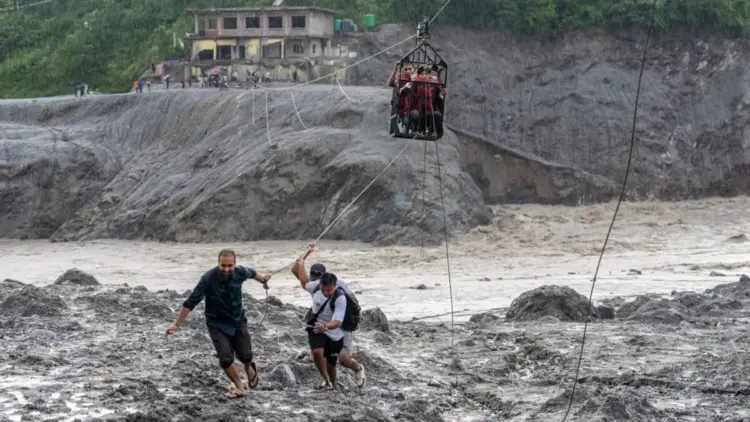
- Infrastructure Loss: Significant damage was reported to the Trishuli River basin’s infrastructure. In the Bidur area of the Nuwakot district, residents were forced to use makeshift ziplines to cross the river after permanent bridges were swept away.
Scientific Data from the WWA
The World Weather Attribution report emphasized that the Himalaya is warming at a rate significantly higher than the global average. This "rapid warming" causes permafrost—ground that has been frozen for millennia—to thaw. When the ice within rock fractures melts, the "glue" holding the mountains together disappears, leading to the kind of catastrophic collapse seen on August 26.

4. Official Responses: Solidarity and Criticism
The reaction to the FRLD’s decision has been a mixture of diplomatic praise and sharp criticism from civil society regarding the speed of the response.
The FRLD Board’s Perspective
In a press statement, the FRLD Board emphasized the "strong solidarity" shown by all members. The board noted that the decision was made in accordance with strict Rules of Procedure but acknowledged the urgency of Nepal’s situation. The provisional release is intended to show the international community that the fund is functional ahead of the COP31 summit in Türkiye.
The Government of Nepal
Nepalese officials have welcomed the funding but continue to stress the inadequacy of the amount. A spokesperson for the Ministry of Finance noted, "While we are grateful for this first-of-its-kind support from the United Nations, the gap between the $21 million offered and the $4.7 billion needed is a chasm that needs to be bridged by the global community."
Civil Society: "Seven Weeks is Too Long"
The most vocal critic of the process has been Harjeet Singh, Global Convenor of the "Fill the Fund" campaign. While acknowledging the "historic" nature of the step, Singh criticized the bureaucratic hurdles that delayed the meeting.
"No country should have to endure a catastrophe and wait seven weeks, through historic letters and relentless pressure, just to unlock the Fund’s first-ever emergency meeting," Singh stated. He argued that the current system is too reactive. "We must set up a permanent rapid-response system that moves support in days, not months. For a family that has lost their home and livelihood, seven weeks is an eternity."
5. Implications: The Road to COP31 and Beyond
The provisional release of funds to Nepal has profound implications for the future of global climate policy and the upcoming COP31 negotiations in Antalya.
Setting a Precedent
The Nepal case establishes a precedent for how "attribution" will play a role in funding. By utilizing the WWA report to link the disaster to permafrost degradation and warming, the FRLD has signaled that scientific evidence of climate influence will be a key criterion for future payouts. This may lead to a surge in demand for rapid attribution studies globally.
The "Loss and Damage" Litmus Test
For years, the Loss and Damage fund was a theoretical concept. Now that it has been "tested," the focus will shift from whether the fund exists to how much money is in it. Currently, the fund is largely reliant on voluntary contributions from wealthy nations. The Nepal disaster proves that even a single event in a small nation can require billions, suggesting that the current pledges to the FRLD are woefully insufficient.
Geopolitical Pressures in the Himalayas
The disaster also underscores the vulnerability of the "Third Pole"—the Hindu Kush Himalaya region. As a transboundary mountain range, disasters in Nepal often affect India, China, and Bangladesh. The death of Indian pilgrims in this event highlights the need for a regional approach to disaster management and climate finance, potentially leading to new diplomatic frameworks between South Asian neighbors.
The Call for a Rapid-Response Mechanism
Harjeet Singh’s call for a "days, not months" response system is likely to become a major talking point at COP31. Advocates will push for a "trigger-based" system where funds are released automatically when certain climate thresholds (such as rainfall intensity or glacial melt rates) are met, bypassing the need for extraordinary board meetings and formal letters of request.
Conclusion: A Bitter Victory
The $21.6 million headed to Kathmandu is a victory for climate justice, representing the first time the world’s wealthiest nations have put a price tag on the irreversible damage caused by their historical emissions. However, for the residents of the Trishuli River basin—still pulling themselves across rivers on ziplines and mourning 1,300 of their neighbors—it is a bitter victory.
As the international community prepares to meet in Antalya for COP31, the Nepal disaster serves as a stark reminder: the climate crisis is no longer a future threat; it is a current, catastrophic reality. The FRLD has proven it can work, but the world must now decide if it is willing to fund it at the scale the crisis demands. The "historic first step" has been taken, but the marathon toward true climate reparations has only just begun.