Main Facts: The Evolutionary Marvel of the Open Plains
The blackbuck (Antilope cervicapra), often referred to as the "Prince of the Plains," stands as one of the most striking and ecologically significant species of the Indian subcontinent. As the sole living member of the genus Antilope, it occupies a unique taxonomic position, representing a lineage that has adapted specifically to the demanding conditions of open grasslands and semi-arid plains.
Evolutionarily, the blackbuck is a master of endurance and speed. In an environment where there is virtually nowhere to hide from predators, the species developed a survival strategy based on sheer velocity. Historically, the blackbuck was the primary prey for the Asiatic cheetah. This "evolutionary arms race" resulted in the blackbuck becoming one of the fastest land animals in the world, capable of maintaining sustained speeds of over 80 kilometers per hour. While the cheetah was driven to extinction in India during the 20th century, the blackbuck remains, a testament to its resilience and the enduring nature of its specialized habitat.
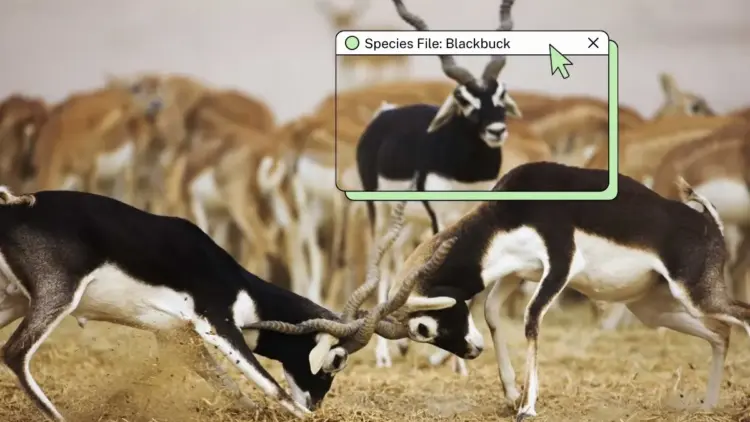
Biologically, the species exhibits significant sexual dimorphism. Females and fawns are generally light brown or yellowish-tan, lacking horns. In contrast, mature males are distinguished by their striking black-and-white coats and long, ringed, corkscrewed horns that can grow up to 75 centimeters in length. Their social structure is equally complex; while females and young live in herds, mature males are highly territorial. During the breeding season, males participate in "lekking"—a ritualized display where they congregate in specific areas to perform leaps, calls, and sparring matches to attract mates.
Beyond its aesthetic and biological appeal, the blackbuck is a "key indicator species." According to Mihir Godbole, founder of The Grasslands Trust-India, the presence and health of blackbuck populations directly reflect the health of the grassland ecosystem. Because they are specialized grazers that cannot thrive in dense forests or heavily modified agricultural landscapes without significant conflict, their survival is inextricably linked to the preservation of India’s rapidly vanishing open natural ecosystems (ONEs).
Chronology: From Subcontinental Dominance to Fragmented Pockets
The history of the blackbuck is a narrative of dramatic decline followed by a precarious, localized recovery.
The Era of Abundance (Pre-19th Century)
Before the colonial era, the blackbuck was found in massive herds numbering in the tens of thousands across the entirety of the Indian subcontinent, from the foothills of the Himalayas to the tip of the peninsula, and from the Indus Valley in the west to the Bengal delta in the east. They were an integral part of the cultural and spiritual landscape, depicted in Mughal miniature paintings and revered in ancient Vedic texts.
The Colonial Decimation (1800s – 1947)
The arrival of British rule and the proliferation of high-powered firearms marked the beginning of a dark era for the species. Blackbucks were targeted relentlessly for trophy hunting. Their preference for open plains made them easy targets for "shikar" (hunting) parties. By the early 20th century, populations that once blanketed the plains were reduced to scattered remnants.
Post-Independence and Regional Extinction (1947 – 1970s)
Following India’s independence, the pressures of a growing population and the "Green Revolution" led to the massive conversion of grasslands into agricultural fields. This habitat loss, combined with continued poaching, led to the species being declared extinct in the wild in Pakistan and Bangladesh by the late 1960s. In Nepal, only a tiny, isolated population survived in the Khairapur region.
The Era of Legal Protection (1972 – Present)
The turning point for the species in India came with the enactment of the Wildlife (Protection) Act of 1972. The blackbuck was placed under Schedule I, granting it the highest level of legal protection, equivalent to that of the Bengal tiger. Since then, conservation efforts have focused on establishing protected reserves. While the 2016 estimate placed the Indian population at approximately 35,000, recent localized surveys suggest numbers may be increasing in certain pockets, even as the quality of their habitat continues to decline.
Supporting Data: Distribution, Demographics, and Emerging Threats
The survival of the blackbuck is currently concentrated in 13 Indian states, but their distribution is highly fragmented.
Population Strongholds
The primary sanctuaries for the species include:
- Velavadar Blackbuck National Park (Gujarat): Perhaps the most famous site, showcasing a thriving population in a coastal grassland ecosystem.
- Tal Chhapar Sanctuary (Rajasthan): A critical desert grassland habitat.
- Point Calimere (Tamil Nadu): A unique coastal population.
- Ranebennur and Jayamangali Reserves (Karnataka): Key southern strongholds.
- Ganjam District (Odisha): A unique case where blackbucks live outside protected areas, protected entirely by local communities.
The Rising Threat of Feral Dogs
While habitat loss remains the primary long-term threat, a more immediate and violent danger has emerged: packs of feral dogs. As human settlements encroach upon grasslands, domestic dogs revert to a semi-feral, predatory state. Unlike natural predators like wolves or leopards, feral dogs often hunt for sport rather than just sustenance and can overwhelm blackbucks through sheer numbers.

Data from Haryana’s Hisar district provides a harrowing look at this trend. Between 2016 and 2020, official records indicate that over 360 blackbucks were killed by feral dogs in that district alone. Conservationists argue that the actual number is likely much higher, as many kills go unreported in remote areas.
Habitat Metrics and "Wasteland" Classification
A significant hurdle in blackbuck conservation is the official classification of their habitat. In India’s "Wasteland Atlas," grasslands are frequently categorized as "wastelands"—land that is not being used for "productive" agriculture or forestry. This classification makes it legally and politically easier to divert these lands for solar farms, industrial parks, or infrastructure projects. Currently, less than 5% of India’s grasslands fall within the Protected Area (PA) network, leaving the majority of blackbuck populations vulnerable to land-use changes.
Official Responses and Conservation Frameworks
The Indian government and various state agencies have implemented several layers of protection to stem the decline of the blackbuck, though enforcement remains a challenge.
Legal Status and State Recognition
By placing the blackbuck in Schedule I of the Wildlife (Protection) Act, the Indian government has made hunting or trading the species a non-bailable offense with mandatory prison sentences. Furthermore, the species holds immense symbolic value; it is the official State Animal of Punjab, Haryana, and Andhra Pradesh. This status ensures that the species remains a priority in state-level wildlife action plans.
The Role of Community Conservation: The Bishnoi Precedent
One of the most effective "official" responses isn’t a government policy, but a cultural one. The Bishnoi community of western Rajasthan is world-renowned for its devotion to nature. For the Bishnois, protecting the blackbuck is a religious mandate. In regions inhabited by the Bishnois, blackbucks often roam freely through villages and agricultural fields, unafraid of humans. This community-led vigilance has proven more effective than any fence or patrol in preventing poaching.
Similarly, in the Ganjam district of Odisha, the local community believes that the presence of blackbucks brings prosperity and good harvests. This belief has led to a successful co-existence model where the population has grown from a few dozen to several thousand without a formal national park designation.
Government Initiatives on Feral Dog Management
In response to the alarming mortality rates in states like Haryana and Rajasthan, some state forest departments have begun exploring dog sterilization programs and the construction of "deer rescue centers." However, these initiatives are often underfunded and struggle to keep pace with the rapid growth of the dog population near urban fringes.
Implications: The "Wasteland" Myth and the Future of Biodiversity
The plight of the blackbuck serves as a microcosm for the broader crisis facing India’s open natural ecosystems. The implications of current trends suggest a looming ecological imbalance if policy shifts are not enacted.
The Fallacy of Grassland Conversion
The most significant implication for the future is the urgent need to reclassify grasslands. As long as the "wasteland" narrative persists, the blackbuck’s habitat will continue to shrink. Converting a grassland into a forest (through "compensatory afforestation" or "greenings" drives) or into a solar park might seem environmentally friendly on paper, but for the blackbuck, it is a death sentence. They require wide, unobstructed views to detect predators; planting trees in a grassland actually aids predators like leopards and dogs, making the blackbuck more vulnerable.
The Connectivity Crisis
As blackbuck populations become confined to smaller "islands" of protected land, the risk of inbreeding increases. Genetic stagnation can lead to reduced fertility and increased susceptibility to disease. Ensuring "wildlife corridors" that allow herds to move between fragmented patches of grassland is essential for the long-term genetic health of the species.
Climate Change and Invasive Species
Climate change is altering rainfall patterns, which in turn affects the growth of the specific grasses the blackbuck relies on. Furthermore, invasive plant species like Prosopis juliflora (locally known as Vilayati Kikar) are taking over open plains, turning them into dense, thorny thickets that are unsuitable for blackbuck grazing or movement.
Conclusion: A Call for Integrated Conservation
The blackbuck is more than just a beautiful antelope; it is a sentinel for the health of India’s plains. Its survival depends on a shift in perspective—from viewing grasslands as "wastelands" to recognizing them as vital, carbon-sequestering, biodiversity-rich ecosystems. Professional conservationists argue that the future of the blackbuck lies in a "landscape-level" approach that integrates government protection, community participation, and a scientific understanding of grassland ecology. Without such a holistic strategy, the "Prince of the Plains" may eventually find itself with no plains left to rule.