MAHOBA, UTTAR PRADESH — In the parched, undulating landscapes of the Bundelkhand region, the arrival of the monsoon is usually a prayer answered. But for the farmers of Mahoba district, the 2026 southwest monsoon transformed from a hope into a harrowing paradox. After being warned by government agencies to prepare for a severe drought driven by a record-breaking El Niño, farmers invested their dwindling resources into low-water crops. Instead of the predicted dry spell, they were met with catastrophic, late-season flooding that has left the region’s agricultural economy in tatters.
The crisis in Mahoba serves as a stark illustration of the widening "forecast gap" in the era of climate change, where traditional predictive models are increasingly failing to account for localized extreme weather events. As standing crops of sesame, pulses, and vegetables rot in waterlogged fields, the disaster has also exposed deep systemic flaws in India’s crop insurance framework, particularly for the landless tenant farmers who form the backbone of the rural workforce.
Main Facts: A Season of Contradictions
The 2026 monsoon season in Mahoba was defined by a cruel irony. In June, the Ministry of Agriculture classified Mahoba as one of 111 "high-priority" districts due to its extreme vulnerability to rainfall deficits and low irrigation coverage (under 25%). Anticipating a powerful El Niño—a climate pattern typically associated with suppressed rainfall in India—the Krishi Vigyan Kendra (KVK) and the Indian Council of Agricultural Research (ICAR) issued urgent advisories.
Farmers were instructed to pivot away from water-intensive crops and instead sow hardy varieties like sesame (til), groundnut, and black gram (urad), which are designed to withstand dry conditions. However, the atmosphere defied the models. While much of India experienced its fourth-lowest monsoon rainfall since 2001, Mahoba was deluged. Between June 1 and September 30, the district received 1,127 mm of rain—a staggering 90% above its long-period average of 588.4 mm.
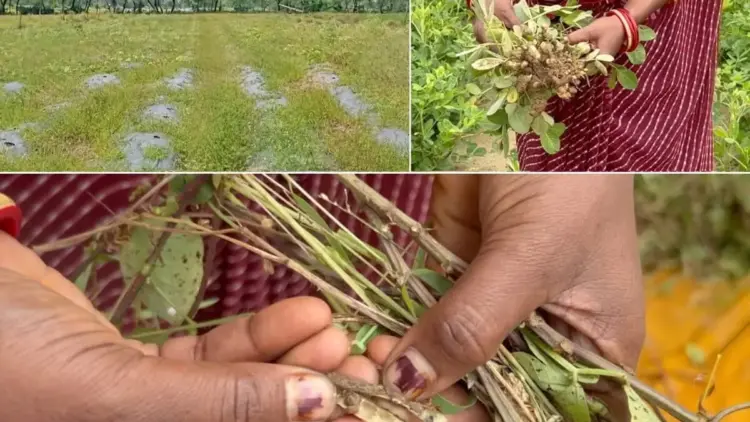
The result was a total agricultural washout. The very crops chosen for their drought resistance were the least equipped to survive submerged conditions. Estimates from local officials and NGOs suggest that between 70% and 80% of the standing kharif (monsoon) crops in the worst-hit villages, such as Chandpura and Bijapur, have been destroyed.

Chronology of a Climate Disaster
The agricultural nightmare unfolded in three distinct phases, each compounding the farmers’ misery:
1. The Warning Phase (May – June 2026):
As the monsoon approached, international and national weather agencies flagged a "historic" El Niño. Based on these forecasts, the ICAR-Agricultural Technology Application Research Institute (ICAR-ATARI) released a contingency plan. KVK officials held village-level meetings and consulted with sarpanches to spread the word: "Plant for a drought." Farmers like Jaidevi of Chandpura village took the advice to heart, planting three bighas of sesame and urad.
2. The Deficit Phase (June – Mid-August 2026):
The monsoon lived up to the dire predictions initially. It arrived nearly 20 days late, and rainfall remained sparse throughout July and early August. During this period, the low-water crops seemed like a wise choice. However, the lack of early rain stunted initial growth, making the plants more vulnerable to any subsequent stress.
3. The Deluge Phase (Late August – September 2026):
The weather pattern underwent a violent reversal in late August. Intense, localized low-pressure systems began lashing the Bundelkhand region. By September 15, fields that were once cracked from thirst were transformed into lakes. The heavy rain continued through the end of the month, coinciding exactly with the period when sesame and pulses were reaching maturity and preparing for harvest. Instead of being harvested, the crops rotted on the stalk.
Supporting Data: The Statistical Divergence
The 2026 season was a year of "meteorological extremes," where national averages masked regional catastrophes.
- Regional vs. National Trends: While Uttar Pradesh recorded its highest monsoon rainfall in 18 years, India as a whole struggled. The national rainfall of 759.4 mm was the 13th lowest since 1901. This divergence highlights the increasing difficulty of using broad national forecasts to make local planting decisions.
- The Mahoba Excess: The India Meteorological Department (IMD) confirmed that Mahoba’s 1,127 mm of rain was nearly double the "normal" amount. In a region where groundwater levels have been plummeting for decades, the soil was unable to absorb the sudden volume of water, leading to prolonged waterlogging.
- The Economic Hit: In Bijapur village, farmer Jag Kushwaha reported that a half-hectare cucumber field, which usually yields a profit of ₹80,000, produced almost nothing this year. "In one field, there is not even a flower left," Kushwaha said. For a family of 11, this loss represents the disappearance of their entire income for the next quarter.
Official Responses and the Forecast Gap
Scientists and government officials admit that the current forecasting infrastructure is struggling to keep pace with "anthropogenic" (human-caused) climate change.

Atul Kumar Singh, a scientist at IMD Lucknow, explained that while seasonal forecasts are effective at predicting broad, long-term trends over large areas, they are currently unable to pinpoint "extreme weather events" at a localized level. "Climate change has modified the complex interactions between the Earth’s systems," Singh noted. "This makes forecasting at different spatial and temporal scales incredibly challenging."
Raghwendra Singh, Director of ICAR-ATARI, echoed these sentiments, pointing out that Bundelkhand’s lack of irrigation makes it uniquely vulnerable. In Western Uttar Pradesh, robust irrigation systems allow farmers to mitigate rainfall deficits. In Mahoba, farmers are entirely at the mercy of the clouds. When the clouds behaved in a way that the models didn’t predict, the farmers had no safety net.
In response to the crisis, Mahoba District Magistrate Ghazal Bharadwaj announced that relief would be fast-tracked under the Pradhan Mantri Fasal Bima Yojana (PMFBY). A consolidated report from the Agriculture Department, the Revenue Department, and IFFCO-TOKIO General Insurance is expected by late November. Furthermore, the state government began distributing Ativrishti (excess rainfall) relief on October 13.
The Tenant Farmer Crisis: No Land, No Aid
While government relief is promised, a significant portion of the farming population may never see a rupee of it. This is due to the "documentation gap" affecting tenant farmers.
In Bundelkhand, a large percentage of cultivation is done through informal "sharecropping" or rental agreements. These farmers, like Babu Lal Kushwaha of Bijanager, do not own the land they till.
"We take land on rent," Babu Lal explained. "Whatever aid comes will go into the bank account of the landowner. We are left with the debt and the dead crops."

The PMFBY does technically have provisions for tenant farmers, but it requires a formal, written lease—a rarity in rural Uttar Pradesh. Ram Sajivan, Deputy Director of Agriculture in Mahoba, noted that many farmers avoid written agreements for fear that the tenant might eventually claim legal rights to the land. This "culture of informality" leaves the most vulnerable producers entirely excluded from the state’s primary insurance mechanism.
Data from the PMFBY report dated September 11, 2026, illustrates the scale of the challenge: out of 5.93 lakh applications recorded over the past year, only 1.82 lakh farmers actually received claims. Many claims remain stuck in "unverified" status due to mismatched bank details or lack of land records.
Implications: Agriculture in an Unpredictable Future
The tragedy in Mahoba is not an isolated incident; it is a precursor to the future of Indian agriculture under a changing climate. The implications are three-fold:
1. The Necessity of Hyper-Local Forecasting:
The "Forecast Gap" identified by IMD scientists suggests that seasonal outlooks are no longer sufficient. There is an urgent need for "block-level" or even "panchayat-level" weather modeling that can warn farmers of extreme rainfall events at least 10–14 days in advance, allowing them to adjust harvest times or drainage strategies.
2. Reform of Insurance Protocols:
The exclusion of tenant farmers from disaster relief is a systemic failure that threatens food security. If those who actually do the work of farming are not protected from climate shocks, the rural economy will face a permanent labor drain as farmers migrate to cities in search of daily wage work. Experts suggest that insurance should be linked to the "cultivator" rather than the "landowner," perhaps through the use of "Kisan Credit Cards" or verification by local village councils.
3. Infrastructure Overhaul:
Mahoba’s classification as a "high-priority" district was based on its lack of irrigation. However, the 2026 monsoon showed that "water management" must include both irrigation (for drought) and drainage (for floods). Bundelkhand’s traditional water harvesting structures, such as Chandela tanks, need restoration to manage these extreme swings in moisture.

For farmers like Sampat and her husband, who continued to work their rotting fields despite suffering from high fevers, the nuances of climate modeling mean little. "We were told the rain wouldn’t come, so we planted for a dry year," Sampat said. "Now the crops are gone, the money is gone, and we have no other option."
As the 2026 monsoon ends, the fields of Mahoba remain silent and waterlogged—a somber reminder that in the tug-of-war between scientific models and a changing climate, it is the farmer who is left holding the rope.