

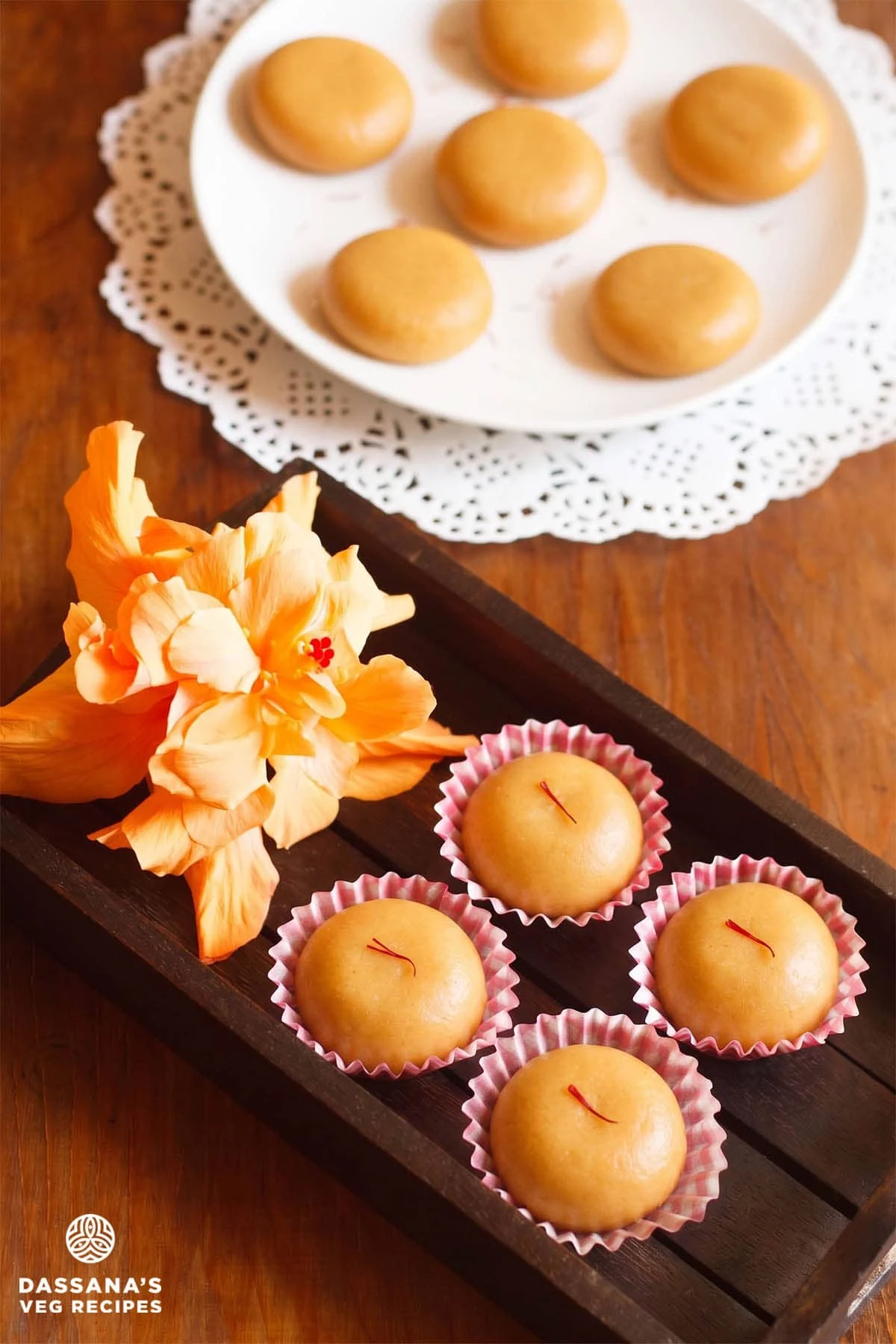
In the vast and intricate landscape of Indian gastronomy, few categories carry as much emotional and cultural weight as Mithai (sweets). At the heart of this sugary pantheon lies the Peda, a dense, milk-based fudge that has served as a staple of celebrations, religious offerings, and everyday indulgence for centuries. Among its many variations, the Mawa Peda—also known as Khoya Peda—stands out as a testament to the transformative power of heat and patience. By reducing milk to its very essence, culinary practitioners create a treat that is simultaneously humble in its ingredients and regal in its complexity.
Main Facts: The Essence of Mawa Peda
Mawa Peda is a traditional Indian sweet characterized by its soft, moist texture and a distinctively gentle caramelized milk flavor. Unlike its more intensely browned cousin, the Mathura Peda, the standard Mawa Peda maintains a light golden hue, achieved through a precise balance of sautéing and reduction.

The core of the dish is Mawa (or Khoya), which consists of milk solids reached by slowly simmering milk in a large open iron kadai until all moisture evaporates. To transform these solids into the celebrated Peda, they are rehydrated with whole milk, sweetened with sugar, and enriched with Ghee (clarified butter). The resulting mixture is flavored with the "royal" spices of the East—cardamom and saffron—and finished with a garnish of emerald-green pistachios.
From a technical standpoint, the preparation of Mawa Peda is an exercise in moisture management. The addition of a full cup of whole milk to the mawa ensures a succulent mouthfeel, distinguishing this recipe from drier, more crumbly versions. However, this moisture requires a lengthy reduction process, demanding constant vigilance from the cook to prevent scorching and to ensure the perfect "dropping consistency" that allows the sweet to hold its iconic disc-like shape.

Chronology: The Metamorphosis from Solid to Sweet
The creation of Mawa Peda is a chronological journey that requires approximately 45 to 60 minutes of active cooking and cooling. The process can be divided into four distinct phases: the preparation, the reduction, the flavoring, and the architectural shaping.
Phase I: Preparation and Initial Sautéing
The process begins with the structural breakdown of 250 grams of mawa. Because mawa is often sold in dense blocks, it must be grated or crumbled to ensure even heat distribution. Simultaneously, the culinary environment is prepared by greasing a tray with ghee, a crucial step to prevent the sticky, sugar-rich mixture from bonding to the surface during the cooling phase.

The active cooking commences in a heavy-bottomed pan—essential for heat retention and preventing hotspots. A tablespoon of ghee is heated over a low flame, followed by the addition of the crumbled mawa. This initial 2-to-3-minute sautéing period is vital; it wakes up the fats in the milk solids and begins the subtle Maillard reaction that provides the base layer of flavor.
Phase II: The Reduction and Integration
Once the mawa has softened and begun to melt into a uniform paste, one cup of whole milk is introduced. This stage represents the most time-consuming portion of the chronology. As the milk and mawa merge, half a cup of sugar is added. The introduction of sugar temporarily thins the mixture as it dissolves into a syrup, creating a bubbling, liquid state.

For the next 20 minutes, the mixture is simmered over low heat. During this period, the water content in the milk evaporates, and the sugar begins to undergo a mild caramelization process. The artisan must stir the mixture at regular intervals, ensuring that the thickening mass does not adhere to the bottom of the vessel.
Phase III: Flavor Infusion and Final Thickening
As the mixture reaches a semi-solid state, the aromatic elements are introduced. Saffron strands, which provide both a golden tint and a floral undertone, are integrated early in the reduction. Toward the end of the cooking cycle, a quarter teaspoon of cardamom powder is folded in. Adding cardamom late in the process preserves its volatile oils, ensuring the scent remains potent in the finished product.

The final 10 to 15 minutes of cooking require continuous stirring. The "moment of readiness" is identified when the mixture begins to leave the sides of the pan entirely and the spatula leaves a clear, visible trail through the mass. At this juncture, the heat is extinguished; the residual thermal energy will continue to firm the mixture as it transitions to the cooling phase.
Phase IV: Cooling and Architectural Shaping
The cooked mass is transferred to the pre-greased tray. It is left to cool until it reaches a temperature that is warm to the touch but no longer scalding. While still pliable, the dough is divided into small portions. Using palms lightly greased with ghee, the cook rolls the mixture into smooth spheres before gently pressing the center to create a shallow indentation—the signature aesthetic of the Peda. Finally, sliced pistachios are pressed into the center, and the sweets are left to set completely.

Supporting Data: Nutritional and Chemical Analysis
The allure of the Mawa Peda is supported by a rich nutritional profile, making it a high-energy food traditionally used to break fasts or provide sustenance during rigorous festival periods. Based on a standard serving size (one peda), the nutritional breakdown is as follows:
- Total Calories: 146 kcal
- Carbohydrates: 14g (of which 9g are sugars)
- Proteins: 5g
- Total Fat: 8g
- Saturated Fat: 5g
- Monounsaturated Fat: 2g
- Cholesterol: 11mg
- Micronutrients: Calcium (169mg), Vitamin A (131 IU), Potassium (43mg).
From a food science perspective, the Mawa Peda is a complex emulsion of milk fats, proteins (casein), and sugar crystals. The high calcium content—nearly 17% of the daily recommended intake per serving—is a direct result of the concentrated milk solids. The use of ghee provides a source of short-chain fatty acids, while the saffron contains crocin and safranal, compounds known for their antioxidant properties.

Expert Perspectives: The Role of Tradition and Purity
Culinary historians and traditional confectioners (Halwais) emphasize that the Mawa Peda is more than a dessert; it is a cultural vessel. In the context of Indian religious life, Pedas are frequently offered as Prasad—sanctified food—in temples dedicated to Lord Krishna and Lord Ganesha.
"The Peda represents the ultimate refinement of dairy," says one culinary expert. "In ancient India, where milk was the symbol of prosperity and fertility, the ability to preserve milk by reducing it into mawa was a vital skill. The Peda became the portable, shelf-stable manifestation of that abundance."

Experts also point out the importance of the "slow-cook" philosophy. In a modern era defined by "instant" foods, the Mawa Peda stands as a defiant reminder that certain flavors cannot be bypassed. The 40-minute reduction of milk is necessary to develop the specific texture—a delicate balance between a fudge and a truffle—that defines a high-quality Mawa Peda.
Furthermore, the choice of garnishments like pistachios and saffron is not merely aesthetic. In the Ayurvedic tradition, these ingredients are considered "Sattvic" (pure and promoting clarity), aligning the sweet with the spiritual goals of the festivals during which they are most commonly consumed.

Implications: The Modern Revival of Homemade Mithai
The continued popularity of the Mawa Peda recipe has significant implications for the modern Indian household and the global diaspora. In recent years, there has been a documented shift away from commercially mass-produced sweets toward "home-style" preparation.
1. Quality Control and Purity
Commercial sweets have occasionally faced scrutiny regarding the purity of their milk solids (mawa). By preparing Mawa Peda at home, consumers ensure the use of unadulterated ingredients, high-quality ghee, and the absence of artificial thickeners or excessive preservatives. This trend reflects a broader global movement toward clean labeling and artisanal food production.

2. Preservation of Culinary Heritage
As urban lifestyles become increasingly fast-paced, the act of making Peda for festivals like Diwali, Raksha Bandhan, or Janmashtami serves as a vital link to ancestral traditions. It facilitates the transfer of "kitchen wisdom" from older generations to younger ones, ensuring that the sensory markers of these holidays—the smell of cardamom and the sight of golden mawa—are not lost.
3. Economic and Social Dynamics
The DIY (Do-It-Yourself) approach to festive sweets also has social implications. The process of shaping Pedas is often a communal activity, involving family members gathered around a table. This fosters social cohesion and reinforces the "gift-giving" culture of India, where a box of homemade Pedas is considered a gesture of much higher esteem than a store-bought equivalent.

4. Dietary Adaptations
The framework of the Mawa Peda recipe allows for modern dietary adjustments. While the traditional recipe is sugar-heavy, home cooks are increasingly experimenting with natural sweeteners like jaggery or monk fruit, and reduced-fat milk options, allowing the ancient sweet to remain relevant in a health-conscious society.
Conclusion
The Mawa Peda is a masterpiece of minimalist confectionery. Through the careful application of heat to milk, sugar, and spice, it achieves a depth of flavor that belies its short ingredient list. As a staple of the Indian festive calendar, it continues to serve as a bridge between the past and the present, proving that the most enduring tastes are those rooted in patience, purity, and tradition. Whether served as a sacred offering in a temple or as a sweet conclusion to a family meal, the Mawa Peda remains an indispensable icon of the global dessert landscape.
