

By [Your Publication Name] Investigative Desk
The banks of the Barana River, once the stage for a desperate stand by thousands of displaced villagers, have fallen into an eerie, mechanical silence. In July, this site was the epicenter of the Panchtatva Satyagraha, a grassroots movement led by those whose lives and livelihoods are being subsumed by the ambitious Ken-Betwa Link Project (KBLP). Today, the rising monsoon waters have reclaimed much of the protest ground, yet the skeletal remains of the chita (funeral pyre) and the phansi (noose)—grim symbols of the villagers’ willingness to die for their land—still cling to the muddy banks.
Beneath the nearby bridge, the relentless roar of heavy machinery provides a constant soundtrack to a landscape in transition. Scattered in the dirt are hundreds of abandoned slippers, a haunting mosaic left behind following a forceful police intervention on July 19. These remnants serve as a stark reminder of the widening chasm between the Indian government’s vision of "water security" for the Bundelkhand region and the lived reality of the 7,193 families caught in the project’s wake.
Main Facts: A Project of Grandeur and Grievance
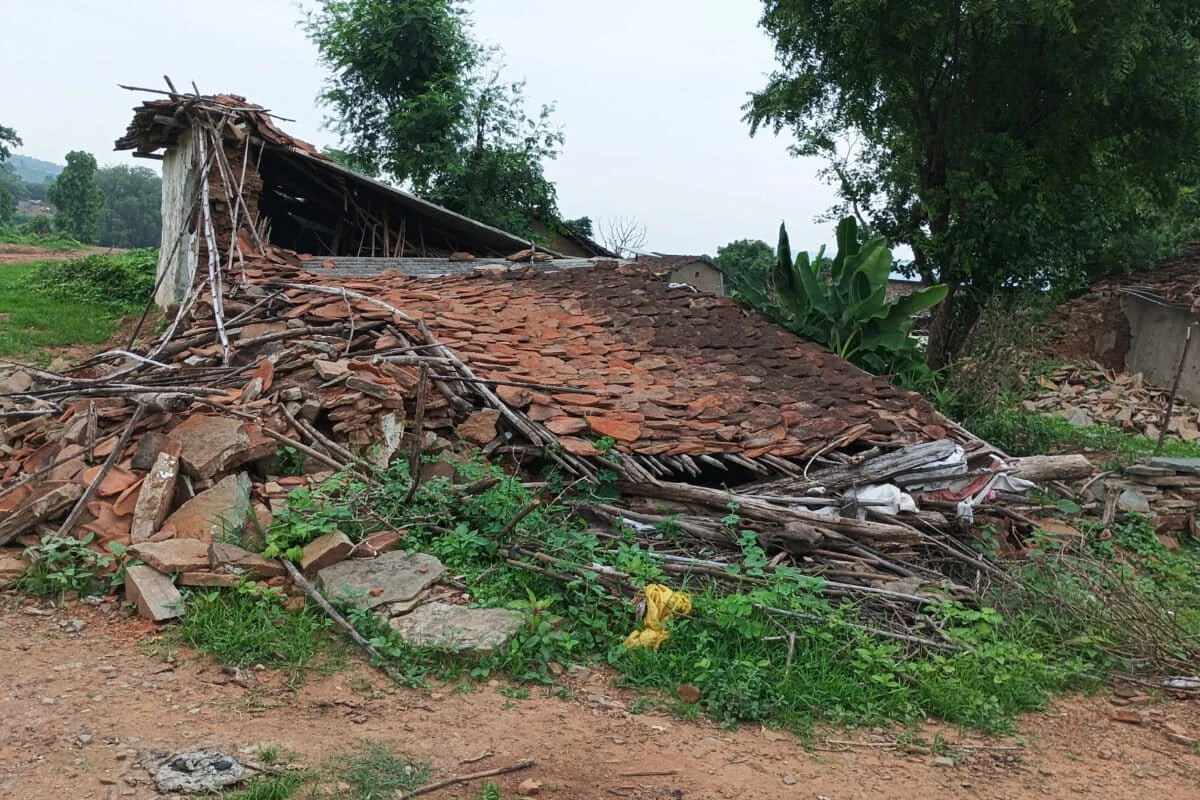
The Ken-Betwa Link Project is the first major initiative under India’s National Perspective Plan for the interlinking of rivers. It aims to transfer surplus water from the Ken River in Madhya Pradesh to the Betwa River in Uttar Pradesh to irrigate the drought-prone Bundelkhand region. However, the cost of this engineering marvel is not merely financial; it involves the acquisition of thousands of hectares of land across 21 villages—14 in Chhatarpur district and seven in Panna district.

While the Central Government maintains that compensation is being distributed according to the Right to Fair Compensation and Transparency in Land Acquisition, Rehabilitation and Resettlement (LARR) Act, 2013, the ground reality tells a story of administrative oversight, missing names, and undervalued assets.
Key Data Points:
- Total Affected Families: 7,193.
- Geographic Scope: 21 villages (Chhatarpur and Panna districts).
- Land Compensation Rate: ₹12.5 lakh ($15,000 approx.) per hectare, or the rate prescribed under the LARR Act, whichever is higher.
- Special Package: ₹12.5 lakh for each adult or a rehabilitation plot plus ₹7 lakh.
- Reported Disbursements: ₹84 crore for inhabited areas and ₹267 crore for private land distributed to date in Chhatarpur.
Chronology of Discontent: From Memoranda to the Pyre
The resistance to the KBLP has not been an overnight phenomenon. It has evolved through years of escalating desperation as villagers felt their voices were being ignored by the corridors of power in Bhopal and New Delhi.
- Early Stages (Pre-2023): The movement began with the submission of formal memoranda to local district collectors. Villagers sought clarity on the survey process and demanded a "land for land" rehabilitation model.
- The 2023 Escalation: In 2023, the movement took a more radical turn. Affected individuals staged the 18-day Chita Andolan (Funeral Pyre Protest), coupled with an indefinite hunger strike. This forced the administration to deploy staff to villages like Sukwaha and Kadwara to verify compensation lists.
- April 2024 Protests: Renewed demonstrations broke out as many families realized their names were absent from the final compensation rosters despite having lived on the land for generations.
- July 2024 – The Panchtatva Satyagraha: Beginning on July 4 at Kupi village, the Satyagraha sought to highlight the five elements (Panchtatva) being destroyed by the project.
- July 19, 2024: Police intervened to clear the protest site near the Barana River bridge, leading to the scenes of chaos evidenced by the abandoned footwear and destroyed protest symbols.
- August 2024: Following the protests, the Chhatarpur administration ordered a comprehensive reassessment and a second round of surveys in all 14 affected villages.
Supporting Data: The Human Faces of "Missing" Compensation
The bureaucratic process of land acquisition often reduces lives to ledger entries, but for the residents of Chhatarpur, these entries are riddled with errors.
The Case of Bhagwati Saur
Bhagwati Saur, 60, traveled 30 kilometers from Mainari village to join the July Satyagraha. She lives with her husband and six children in a five-room house, supported by five acres of land rich with mango, mahua, and guava trees. "We pleaded for fair compensation, taking our appeal from Chhatarpur to Bhopal," she says. "When we were not heard, we had to raise our voices." Despite her land being earmarked for the project, she claims she has received neither a formal notice nor a single rupee in compensation.

The Survey Gap
Ayodhya Ahirwar, 75, of Palkonha village, highlights a systemic failure in the survey methodology. "The survey should have been conducted door-to-door, but people were summoned to a single location," he explains. This "centralized" survey meant that those who were away working as migrant laborers or those unable to travel were simply left off the list. Ahirwar, who owns two acres, remains invisible to the compensation authorities.
Valuation Discrepancies
Even for those on the list, the valuation of assets remains a point of intense friction. Vinod Ahirwar of Kadwara village claims his house, which cost approximately ₹10 lakh to construct, was valued by government engineers at a mere ₹1.31 lakh. Similarly, Sonu Saur of Sukvaha village received ₹10 lakh for two acres, while the current market rate for adjacent land is hovering around ₹12 lakh per acre (roughly ₹30 lakh per hectare).
Official Responses: Reassessment and Promises
Under the pressure of sustained protests, the district administration has shifted from a stance of completion to one of reassessment.
Vijay Dwivedi, the Sub-Divisional Magistrate (SDM) of Bijawar tehsil, confirmed that while substantial funds have been disbursed—including ₹464 crore to 3,718 families—the process is far from over. "The data from the latest survey is currently being compiled. The report could be submitted in a few days," Dwivedi stated.

Collector Mrinal Meena recently utilized social media to announce that an additional ₹7.37 crore had been sanctioned for 59 individuals across five villages who were previously overlooked. The revenue team has been explicitly directed to ensure no "eligible beneficiary" is left out. However, the definition of "eligible" remains a bone of contention, particularly for those holding government-allotted land or those whose livelihoods depend on forest produce rather than deeded plots.
Implications: A Livelihood in Limbo
The Ken-Betwa Link Project represents a classic developmental dilemma. While it promises to quench the thirst of a parched region, it threatens to permanently impoverish the very people it displaces.
1. The Loss of Agrarian Identity
For families like the Saurs, the loss of mahua and mango trees is not just an environmental loss; it is the destruction of a seasonal economy. Mahua flowers provide a vital source of income for tribal and rural communities in Bundelkhand. Current compensation models largely focus on land acreage and "pukka" structures, often failing to account for the "standing wealth" of fruit-bearing trees and wells.
2. The "Land for Land" Demand
Dhruv Pandey, a surveyor associated with the movement, notes that the demand for "land for land" is paramount. "Many have no other means of livelihood besides farming," Pandey says. Cash compensation, often depleted by debt repayment or lack of financial literacy, rarely suffices to buy equivalent land elsewhere, leading to a cycle of landlessness and forced migration.

3. Environmental and Legal Precedents
The project also faces criticism for its impact on the Panna Tiger Reserve, as a significant portion of the core habitat will be submerged. Protesters are demanding that the "damage caused to water, forests, land, and the environment" be factored into the rehabilitation packages. They are calling for an independent inquiry into the irregularities of the survey process, citing a violation of the LARR Act 2013, which mandates social impact assessments and informed consent.
Conclusion: The Quiet Before the Next Storm
As the machinery continues to grind at the Barana River, the quiet currently prevailing in the villages of Chhatarpur is deceptive. The administration’s promise of a second survey has bought a temporary peace, but the fundamental demands of the villagers—fair market valuation, inclusion of all family members in "adult" packages, and the provision of alternative farmland—remain unresolved.
For the 7,000 families of Bundelkhand, the Ken-Betwa Link Project is not a map of progress, but a map of displacement. Until the "missing names" on the compensation lists are restored and the valuation reflects the true cost of a lost lifestyle, the shadows over the Barana River will continue to grow. The abandoned slippers near the bridge are not just trash; they are the footprints of a resistance that is likely to return if the upcoming survey report fails to deliver justice.
