

In a world increasingly captivated by the burgeoning power of artificial intelligence, with its titans issuing stark warnings about the potential for machines to surpass human control, the historic city of Venice offers a compelling counter-narrative. Through its vibrant embrace of handmade artistry and the enduring power of human intelligence, as showcased at events like the Venice Biennale and the Homo Faber exhibition, the city presents a powerful argument for the irreplaceable value of human agency. This sentiment is nowhere more eloquently expressed than at Homo Faber 2026, an extraordinary celebration of contemporary craftsmanship that unfolded across the island of San Giorgio Maggiore, under the visionary direction of British artist and scenographer Es Devlin.
The Dawn of Homo Faber 2026: A Testament to Human Ingenuity
Homo Faber 2026, meticulously curated and orchestrated, is more than just an exhibition; it is a profound affirmation of the slow, deliberate, and deeply skilled processes that define true craftsmanship. Spread across the island’s historic workshops, serene cloisters, an intricate labyrinth, a dazzling mirrored hall, and even a former swimming pool, the event spotlights the dedication of artisans who have devoted years, often lifetimes, to mastering their respective crafts. This biennial exhibition, a flagship initiative of the Michelangelo Foundation, serves as a vital platform for showcasing the pinnacle of contemporary artisanal achievement.

At the heart of this grand exposition lies a nuanced perspective on technology. Alberto Cavalli, Executive Director of the Michelangelo Foundation, articulated this vision in his opening address. Far from dismissing technological advancements, Cavalli positions technology as a tool, albeit one that must be wielded with discernment. "If you go to an artisan’s workshop, they have many tools," he explained, "but they will not use a hammer if they have to use, you know, scissors. Every tool has its own function." This analogy underscores a critical distinction: the point at which a tool ceases to be an aid and begins to supplant human creativity, intuition, and talent. Es Devlin, echoing this sentiment, emphasized that "artisan thought" is not merely an intellectual exercise but a deeply embodied experience, one that emanates from the very fingertips. In an interview with journalists, she eloquently stated the necessity of not only thinking with the cerebral cortex but also of "thinking through the body." This holistic approach to creation, where the physical act of making is intrinsically linked to intellectual and emotional expression, forms the philosophical bedrock of Homo Faber.
India’s Artisan Heritage Takes Center Stage
A significant and highly celebrated aspect of Homo Faber 2026 was the prominent showcasing of Indian craftsmanship. Supported by the JSW Foundation and the Jindal family, this collaboration provided a crucial lens through which to explore the richness and diversity of contemporary Indian artisans. Alberto Cavalli expressed his deep appreciation for this partnership, noting, "The collaboration with the JSW Foundation and the Jindal family has helped me approach contemporary Indian craftsmanship with a good eye. You can discover exquisite Indian craftsmanship that reveals its heritage without becoming folk. I have nothing against folk, but it’s not the Homo Faber way. I think tradition or heritage is not the worship of ashes, but the preservation of fire, to borrow from composer Gustav Mahler. And this is very important when you look at a country like India with a population that is very young, a country that is not a country but a continent with so many faces, cultures, identities, and that still expresses its identity through craft. This requires all of our respect."

This perspective highlights a crucial understanding of heritage: not as a static relic to be venerated, but as a dynamic force that continues to inform and inspire contemporary creation. India, with its vast population, multifaceted cultures, and deeply ingrained artisanal traditions, presented a compelling case for this preservation of "fire." The exhibition featured over 40 artists and ateliers from India, including prominent figures such as Ankon Mitra, Shalini Mithal, Gunjan Gupta, architect Rooshad Shroff, and designers Vikram Goyal and Tarun Tahiliani. These artisans, alongside numerous others, demonstrated the enduring relevance and global appeal of Indian crafts, often holding their own and at times even surpassing the artistry of their international counterparts.
Sangita Jindal, Chairperson of the JSW Foundation, articulated the foundation’s commitment to this vision: "Our karigars are, in every sense, India’s living heritage. It was this belief that led us to create the JSW Prize for Contemporary Craftsmanship: to celebrate their artistry and place Indian craftsmanship firmly on the global map. We meet at Homo Faber at a moment when the world speaks of little else besides AI, of machines that can write, design, even imagine. But no algorithm will replace the hand of a karigar, the patience behind a single perfected motif, the instinct passed down through generations." This powerful statement resonates deeply, underscoring the fundamental difference between algorithmic generation and the nuanced, embodied intelligence that characterizes human craftsmanship.

Es Devlin’s "An Island of Light": A Luminous Journey Through Craft
The fourth edition of Homo Faber, titled "An Island of Light," under Es Devlin’s artistic direction, was a breathtaking spectacle featuring approximately 700 exceptional objects, representing the skills of over 500 artisans from more than 70 countries, curated into 15 unforgettable installations. Visitors were invited to immerse themselves in a theatrical and multisensory experience, spending hours contemplating the intricate details of individual pieces or returning over several days to fully absorb Devlin’s masterful curation.
Among the many highlights, several installations stood out for their conceptual brilliance and aesthetic impact:

A Full Moon Rising: A Celestial Symphony of Global Craft
Installed in the evocative setting of the Fondazione Giorgio Cini’s former swimming pool, "A Full Moon Rising" was arguably the most iconic and visually arresting installation. Nico Daswani of the Michelangelo Foundation aptly described it as the installation one would seek out if "coming in from outer space." This monumental piece reinterprets the Korean moon jar as a universal symbol of craft. Handmade vessels crafted from ceramics, paper, glass, metal, and other diverse materials were meticulously arranged on a semicircular structure that gradually emerged from the water. The effect was a breathtaking illusion of a moon ascending over the Venetian lagoon, a celestial spectacle that brought together global artisanal traditions under a singular, luminous vision. The sheer scale and poetic beauty of this installation made it a prime candidate for social media sharing, capturing the imagination of visitors worldwide.
An Alphabet of Objects: Shadows of Skill and Time
"An Alphabet of Objects" offered a profound exploration of the indirect visibility of the human hand. Over 200 meticulously crafted objects were displayed on a kinetic structure, with backlighting casting their intricate silhouettes onto the surrounding walls. This created an effect akin to an ancient visual language, where the forms of vessels and sculptures transformed into abstract glyphs. The complexity of these shadows served as a poignant reminder of the human effort, precision, and artistry that went into their creation, making the maker’s presence felt even in their absence. This installation prompted contemplation on how form, shadow, and light can convey meaning and tell stories about human endeavor.

An Infinite Birdsong: A Kaleidoscope of Miniature Marvels
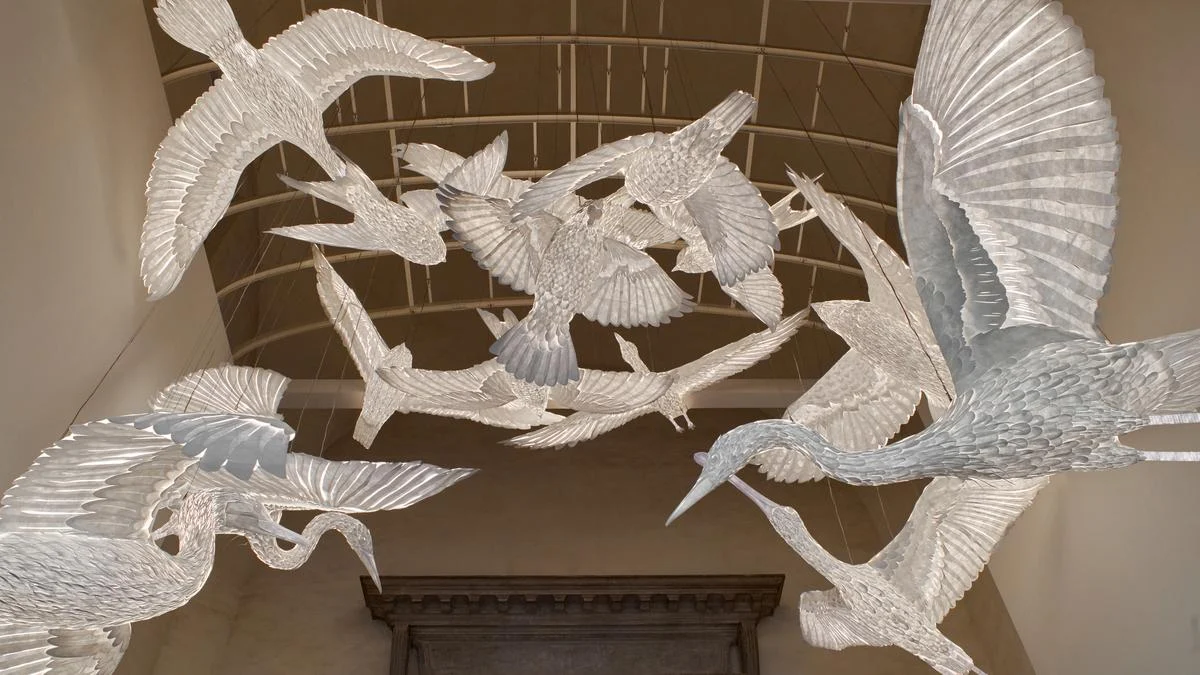
Stepping into "An Infinite Birdsong" was akin to entering a magical, mirrored realm. This enclosed environment featured an astonishing array of handmade birds and insects, many of which were jewel-like in their intricate detail and vibrant embellishments. The mirrored surfaces multiplied these delicate creations seemingly without end, creating a dizzying yet enchanting spectacle that evoked the boundless diversity and delicate beauty of the natural world, all rendered through the skilled hands of artisans. The immersive nature of this installation offered a moment of wonder and reflection on the meticulous detail that can be achieved through dedicated craftsmanship.
A Great Turning: A Kinetic Dialogue with History
"A Great Turning" presented an instantly recognizable and deeply symbolic image, one that visitors would frequently recall. Es Devlin’s enormous two-axis kinetic mirror mosaic, suspended and rotating over shallow water in the Palladian Cloister, engaged in a dynamic dialogue with its surroundings. The mosaic reflected the ancient architecture, the sky, and the sunlight back into itself, creating a constantly shifting panorama. This installation cleverly referenced Venice’s historical use of broken mirror fragments, seamlessly marrying modern mechanical ingenuity with the timeless serenity of the ancient monastery. The interplay of light, reflection, and movement made this a profoundly engaging and thought-provoking piece, capturing the essence of Venice’s enduring legacy.

A Feast of Light: A Symphony of Materials and Texture
The Palladian refectory was transformed into "A Feast of Light," a testament to the power of craft and careful curation. This installation presented an almost monochrome banquet table laden with an extraordinary array of materials: porcelain, glass, paper, textile, marble, mother-of-pearl, and even unexpected elements like Lego. All these diverse objects were unified and illuminated by a single, vertical shaft of light, drawing attention to the unique textures, forms, and subtle variations within each material. This display was a masterclass in showcasing the inherent beauty and expressive potential of different craft disciplines, highlighting how disparate elements can be brought together to create a harmonious and visually stunning whole.
The Enduring Significance of Human Agency
As Homo Faber 2026 drew to a close, the exhibition left an indelible mark, serving as a powerful reminder of what makes us uniquely human. In an era dominated by discussions of artificial intelligence and its potential to reshape our world, Venice, through its unwavering dedication to human craft, offered a beacon of hope. The event demonstrated that while technology can be a valuable tool, it cannot replicate the depth of human experience, the intuition honed through years of practice, or the emotional resonance embedded in an object made by hand.

The emphasis on "thinking through the body," the preservation of "fire" rather than the "worship of ashes," and the celebration of the "karigar’s hand" all point to a fundamental truth: that true innovation and enduring value often lie in the meticulous, the personal, and the deeply human. Homo Faber 2026 was not merely an exhibition of beautiful objects; it was a profound statement about the enduring power and essential nature of human creativity, skill, and agency in a world increasingly seeking to define itself through the lens of the artificial. The echoes of artisan thought, carried on the Venetian breeze, served as a powerful counterpoint to the digital hum, affirming that the future, while embracing innovation, must also cherish and champion the irreplaceable artistry of the human spirit.
