

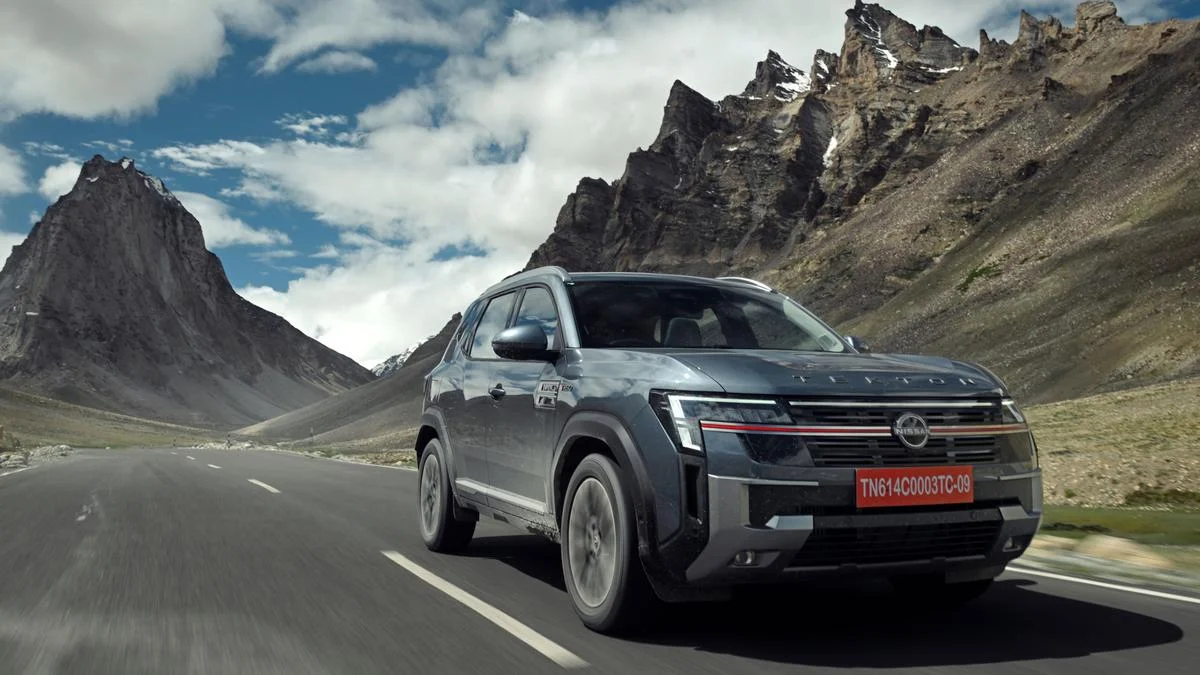
The Indian automotive landscape is currently witnessing a fierce battle in the mid-size SUV segment, a category that has become the crown jewel for manufacturers seeking both volume and prestige. Into this fray enters the Nissan Tekton, a vehicle that carries the heavy burden of revitalizing the Japanese brand’s fortunes in the subcontinent. While critics initially dismissed it as a mere exercise in badge engineering—a Renault Duster in a different suit—a comprehensive 700-kilometer expedition from the plains of Chandigarh to the oxygen-thin altitudes of Leh reveals a more nuanced story. The Tekton is not just a clone; it is a calculated reinterpretation of a proven mechanical foundation, aimed at a more discerning, lifestyle-oriented demographic.
Main Facts: The Tekton Identity
The Nissan Tekton is built upon the globally acclaimed CMF-B platform, shared with its alliance partner Renault’s Duster. However, Nissan has gone to significant lengths to distance the Tekton from its sibling through a "Premium Robust" design philosophy. The vehicle is positioned as a sophisticated alternative in a segment dominated by the Hyundai Creta, Kia Seltos, and Volkswagen Taigun.
Key Specifications at a Glance:
- Price Range: ₹10.49 lakh to ₹18.59 lakh (ex-showroom).
- Engine Options: 1.0L Turbo-Petrol (T160) and 1.3L Turbo-Petrol (T280).
- Performance: 163PS and 280Nm (T280 variant).
- Ground Clearance: 212mm.
- Safety: 5-star Bharat NCAP rating, 6 airbags standard.
- Cargo Capacity: 518-liter boot space.
The Tekton’s arrival signifies Nissan’s shift away from budget-conscious mass marketing toward a "value-premium" strategy. By leveraging the rugged underpinnings of the Duster and overlaying them with the aesthetic DNA of the legendary Nissan Patrol, the company hopes to capture buyers who desire off-road resilience without sacrificing urban elegance.
Chronology: From Concept to the Gates of Ladakh
The journey of the Tekton began with the Renault-Nissan-Mitsubishi Alliance’s renewed commitment to India, involving an investment of over ₹5,300 crore. The goal was to develop a localized version of the CMF-B platform that could handle the extreme diversity of Indian topography.
The Development Phase
Following the success of the Magnite, Nissan’s engineering teams in Chennai worked to "Nissanzie" the platform. This involved stiffening certain chassis points for better high-speed stability and redesigning the electrical architecture to support a more advanced suite of Advanced Driver Assistance Systems (ADAS).

The 700km Litmus Test
To prove the vehicle’s mettle, Nissan orchestrated an exhaustive drive starting from Chandigarh. The route served as a chronological progression of challenges:
- The Highway Sprint: The first 150km out of Chandigarh tested the T280 engine’s cruising ability and the effectiveness of the 6-speed Dual-Clutch Transmission (DCT).
- The Himalayan Ascent: Moving toward Manali, the focus shifted to torque delivery and cooling efficiency as the incline sharpened.
- The Broken Path: The final leg toward Leh, encompassing the high passes and the notorious "nullahs" (water crossings), put the 212mm ground clearance and suspension travel to the ultimate test.
This journey wasn’t merely a promotional event; it was the final validation of the Tekton’s claim to be a "go-anywhere" premium SUV.
Supporting Data: Engineering and Interior Sophistication
The Tekton’s differentiation strategy is rooted in its technical specifications and cabin experience.
Powertrain Dynamics
The T280 variant is the undisputed flagship of the range. Its 1.3-liter four-cylinder direct-injection turbo-petrol engine is a sophisticated unit, co-developed with Daimler. Delivering 163PS, it provides a power-to-weight ratio that rivals many entry-level luxury crossovers.
In terms of performance metrics:

- Acceleration: The manual variant hits 0-100kph in 9.51 seconds, while the DCT follows closely at 9.89 seconds.
- Efficiency: Despite the high power output, the manual returns a claimed 17.8kpl, with the DCT surprisingly higher at 18.5kpl due to optimized shift points.
However, the data also highlights a characteristic "turbo lag" below 1,800 RPM. On steep Himalayan hairpins, drivers must remain mindful of the gear selection to stay within the power band.
The "Purple" Cabin Revolution
Inside, Nissan has taken a bold aesthetic risk. Eschewing the industry-standard beige or "piano black" trims, the Tekton features deep purple detailing across the dashboard and door inserts. While polarizing, it provides a tactile and visual break from the monotony of the segment.
The tech stack is equally competitive:
- Infotainment: A 10.1-inch high-resolution touchscreen featuring "Google Built-in," allowing for native Google Maps and Assistant integration without needing a phone connection.
- Instrumentation: A 10.25-inch digital cluster that changes themes based on the "Light" or "Heavy" steering modes.
- Comfort: Ventilated front seats and a dual-zone climate control system proved essential as external temperatures fluctuated from 35°C in the plains to sub-zero near the Sarchu plains.
Chassis and Ride Quality
The most impressive data point discovered during the Leh drive was the suspension’s frequency-selective damping. The Tekton manages to filter out "chatter" from corrugated roads while maintaining enough stiffness to prevent the "boat-like" pitching often found in long-travel SUVs. This balance is critical for long-distance touring, where passenger fatigue is often caused by micro-vibrations from the road surface.
Official Responses and Market Positioning
Nissan India’s leadership has been vocal about the Tekton’s role in their portfolio. In various briefings, spokespersons have emphasized that the Tekton is not a "volume chaser" in the same vein as the Magnite, but rather a "brand shaper."

Addressing the "Badge Swap" Narrative
When questioned about the similarities to the Renault Duster, Nissan officials point to the 300+ unique parts in the Tekton, ranging from the exterior sheet metal to the NVH (Noise, Vibration, and Harshness) damping materials. "The platform is the skeleton, but the soul, the interface, and the driving dynamics are pure Nissan," a senior engineer noted during the Chandigarh-Leh drive.
The Safety Mandate
Nissan has also responded to the growing consumer demand for safety. By securing a 5-star Bharat NCAP rating before the official launch, the company is positioning the Tekton as a responsible choice for families. The inclusion of ADAS (Advanced Driver Assistance Systems) in the higher trims is a direct response to the features offered by the Hyundai Creta and MG Astor.
The Hybrid Omission
One area where the official response remains conservative is the lack of a hybrid powertrain. While competitors like Maruti Suzuki and Toyota offer strong hybrids, Nissan is betting on the efficiency of its small-displacement turbo-petrol engines. They argue that the complexity and cost of a hybrid system would have pushed the Tekton’s price beyond the ₹20 lakh mark, potentially alienating its core audience.
Implications: What the Tekton Means for the Indian Market
The launch of the Nissan Tekton has several far-reaching implications for the Indian automotive industry and the consumers within it.
1. The Death of the "Basic" SUV
The Tekton proves that even rugged, off-road capable vehicles can no longer afford to have "basic" interiors. The shift toward soft-touch materials, panoramic sunroofs, and 360-degree cameras in a vehicle designed for Leh indicates that the Indian consumer now demands luxury and capability in a single package.

2. Pressure on the Segment Leaders
For years, the Hyundai Creta has enjoyed a near-monopoly on the "premium mid-size" crown. The Tekton’s aggressive pricing (starting at ₹10.49 lakh) combined with its superior ground clearance and 5-star safety rating puts immense pressure on the leaders to justify their premium. The Tekton offers a more "mechanical" and "robust" feel that may peel away enthusiasts who find the Korean offerings too "car-like."
3. The Future of the Renault-Nissan Alliance
The success of the Tekton is a bellwether for the future of the Alliance in India. If the Tekton succeeds in carving out a premium niche while the Duster focuses on the rugged-value end of the market, it will provide a blueprint for how the two brands can coexist without cannibalizing each other’s sales.
4. Touring as a Lifestyle
By successfully navigating the Chandigarh-Leh corridor, the Tekton reinforces the trend of "overlanding" and long-distance road-tripping in India. Its 518-liter boot and composed highway manners suggest that the market is moving away from purely urban commuters toward vehicles that facilitate weekend escapes to the mountains or the coast.
Conclusion: A Calculated Leap of Faith
The Nissan Tekton is a product of strategic pragmatism. By using the Duster’s legendary "rough road" capability and dressing it in a suit inspired by the Patrol, Nissan has created a vehicle that feels at home both at a five-star hotel’s valet parking and on the rocky banks of the Indus River.
While the turbo lag and the absence of a hybrid option are legitimate points of contention, they are overshadowed by the vehicle’s sheer competence as a long-distance tourer. For the driver who views the road not just as a commute but as an invitation to explore, the Tekton offers a compelling blend of personality and performance. In the thin air of the Himalayas, where many vehicles struggle to breathe, the Tekton found its second wind, proving that there is still plenty of life—and innovation—left in the internal combustion SUV.

This report was compiled by Motorscribes, in association with The Hindu. For more automotive insights and detailed reviews, follow @motorscribes on Instagram.
