

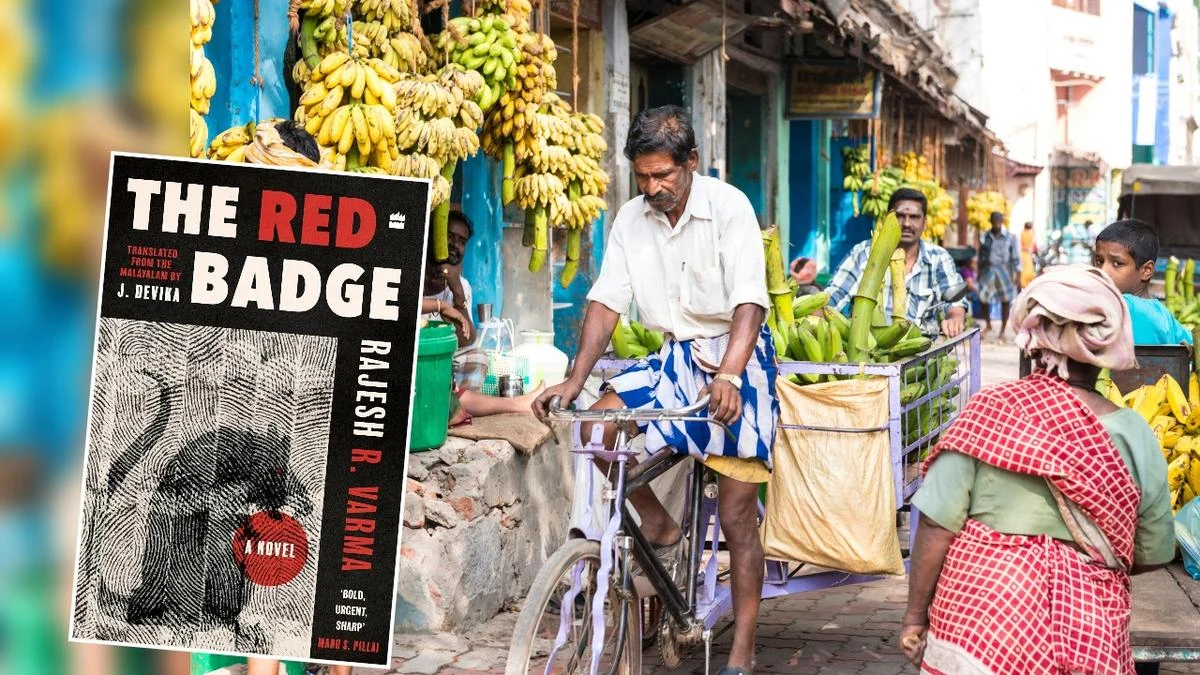
The landscape of contemporary literature is increasingly being defined by its ability to reflect the anxieties of the present through the distorted lenses of the past and the future. In 2023, Paul Lynch’s Booker Prize-winning Prophet Song gripped the global imagination by depicting a near-future Ireland descending into totalitarianism. However, years before Lynch’s chilling vision, Malayalam literature had already begun exploring similar terrains of dread. Rajesh R. Varma’s 2017 novel Chuvanna Badge—now masterfully translated into English by J. Devika as The Red Badge—stands as a seminal work of speculative fiction. It constructs an alternate history of 1970s Kerala, providing a searing critique of fascism, caste hubris, and the fragile nature of democratic coexistence.
Published by Harper Perennial, The Red Badge is more than a regional story; it is a universal cautionary tale. By reimagining the political trajectory of India’s southernmost state, Varma and Devika offer a profound meditation on how easily the "other" can be manufactured and how quickly a society can surrender its soul to the promise of a "Greater Nation."
Main Facts: A New Milestone in Indian Speculative Fiction
The Red Badge is set against the backdrop of 1974, a pivotal year in Indian history, just prior to the declaration of the Emergency. However, in Varma’s world, the threat does not come from the existing state apparatus alone but from a fictionalized northern fascist movement known as the "Vibhasis." This group, led by a charismatic and self-aggrandizing figure, seeks to unify India into "Vishala Bharatha" (Greater India), a monolithic entity that demands the erasure of regional identities, local languages, and dissenting thoughts.
The narrative is framed as a faux-autobiographical account by a protagonist named Rajesh, sharing the author’s name. This meta-fictional choice blurs the lines between memory and imagination, making the "phantom history" feel uncomfortably real. The English translation by J. Devika—a renowned academic and translator—captures the nuances of Kerala’s social stratification, ensuring that the political weight of the Malayalam original is preserved for a global audience.
The novel’s primary achievement lies in its "alternate history" format. Unlike traditional historical fiction that seeks to reconstruct the past, The Red Badge deconstructs it. It asks: "What if the darkest impulses of the 20th century—the concentration camps of the Third Reich and the forced sterilizations of the Indian Emergency—had converged in the lush, politically active landscape of Kerala?"

Chronology: From Middle-Class Aspirations to Totalitarian Reality
The story begins in the town of Tiruvalla in 1974. The protagonist, Rajesh, is a young boy from a middle-class Kshatriya family. His world is initially defined by the mundane anxieties of childhood: the transition to an English-medium school and the competitive pressure to excel.
The Symbol of the Red Badge
At his new school, Rajesh encounters Veeramani, a brilliant student from a socially marginalized background. Veeramani consistently wins the "Red Badge," an award given to the class topper. For Rajesh, the badge is not just a mark of academic success but a symbol of status that he feels entitled to by birth. His resentment toward Veeramani is fueled by a cocktail of class envy and caste prejudice. This localized conflict serves as a microcosm for the larger political shifts occurring in the state.
The Rise of the Vibhasis
As Rajesh struggles with his personal ambitions, the political climate of Kerala undergoes a violent transformation. The Vibhasis, a northern-based fascist regime, take control of the state. Their ideology is rooted in "Vishala Bharatha," a vision of an undivided, disciplined India. The takeover is not merely administrative; it is cultural. The regime begins to dictate what citizens wear, what they eat, and how they perceive their neighbors.
The Erosion of the Domestic Sphere
The novel brilliantly tracks the infiltration of fascist ideology into the home. Rajesh and his mother become ardent supporters of the Vibhasi regime, seduced by the rhetoric of national pride and order. The only voice of dissent is Rajesh’s father, whose skepticism creates a rift within the family. This domestic tension mirrors the fracturing of Kerala’s social fabric as the "old way of life" is systematically erased.
The Final Revelation
The chronology concludes with Rajesh achieving his goal—obtaining the Red Badge—only to find it a "pyrrhic victory." By the time he gains the status he craved, the world around him has become a nightmare of concentration camps and state-sponsored terror. The novel ends with a surreal intervention by a "Swami," allowing Rajesh to turn back the clock, yet leaving him haunted by a "phantom history" that functions as both a memory of what happened and a prophecy of what could return.

Supporting Data: Themes of Caste, Class, and "Othering"
To understand the impact of The Red Badge, one must look at the specific sociological data points Varma uses to build his world. The novel is a surgical examination of the inherent prejudices within the Malayali community.
The Mechanics of "Othering"
In a stroke of narrative genius, Varma chooses not to make a religious minority the primary target of the Vibhasi regime. Instead, the regime targets the Tamil population settled in Kerala. By choosing a linguistic and regional minority rather than a religious one, Varma delivers a chilling message: the machinery of fascism is flexible. It can target anyone who is "different," provided there is a pre-existing prejudice to exploit. The derogatory lens through which the Kerala middle class views Tamil laborers becomes the fuel for the Vibhasi’s persecution engine.
Caste Hubris and the Kshatriya Identity
The novel provides a detailed look at the Kshatriya caste in Kerala. While they hold a high social standing, the characters sense their traditional authority waning in a modernizing world. This "status anxiety" makes them prime recruits for a fascist movement that promises to restore "traditional values" and hierarchy. The demeaning language used by Rajesh’s family toward lower castes illustrates how caste pride acts as a gateway drug to totalitarianism.
Historical Parallels
Varma draws clear lines between his fictional regime and real-world horrors:
- Nazi Germany: The use of concentration camps and the systematic dehumanization of the "other."
- The Indian Emergency (1975-1977): The depiction of forced sterilizations and the suspension of civil liberties.
- Contemporary Echoes: The rhetoric of "Vishala Bharatha" and the charismatic leader mirror modern populist and nationalist movements globally, making the 2017 novel feel prescient in the mid-2020s.
Official and Critical Responses: The Translator’s Perspective
The English release of The Red Badge has been met with critical acclaim, particularly for J. Devika’s translation. In her translator’s note, Devika admits to feeling "jittery" while working on the text. Her unease stemmed from the novel’s uncanny accuracy in depicting the "caste and class hubris" she recognized in her own social environment.

Critics have noted that Devika’s translation does not sanitize the text; it retains the "raw, uncomfortable edges" of Varma’s prose. By bringing this work into English, Devika has allowed for a broader dialogue on how regional Indian literatures are tackling the rise of global authoritarianism.
Literary scholars have compared The Red Badge to the works of George Orwell and Margaret Atwood, noting that while it uses the tropes of dystopian fiction, its heart is firmly rooted in the specificities of South Indian social history. The "Red Badge" itself has been analyzed as a polysemic symbol: it represents academic merit, the blood of the persecuted, and the "brand" of a regime that demands total conformity.
Implications: A Cautionary Tale for a Modern India
The implications of The Red Badge extend far beyond the borders of Kerala. The novel serves as a psychological study of how "normal" people become complicit in extraordinary evil.
1. The Vulnerability of Democracy
The novel suggests that democracy is not a permanent state but a fragile agreement that can be dissolved by tapping into latent social prejudices. The ease with which the Vibhasis take over Kerala—a state known for its high literacy and political consciousness—is a warning that no society is immune to the charms of a strongman.
2. The Persistence of "Phantom History"
The concept of "phantom history" is perhaps the novel’s most significant contribution to the genre. It suggests that even if a fascist regime is defeated or "erased" from the timeline, the trauma and the psychological pathways it created remain. For Rajesh, the memory of the Vibhasi era is a permanent shadow, a reminder that the potential for such a future is always present in the prejudices of the past.

3. The Power of Speculative Fiction as Resistance
By imagining an alternate 1974, Varma provides a safe but harrowing space for readers to critique the present. The Red Badge demonstrates that speculative fiction is a vital tool for political resistance, allowing authors to bypass censorship and direct confrontation by placing their critiques in a "history that never was" or a "future that might be."
4. A Call for Introspection
Ultimately, the novel asks the reader to look inward. It challenges the "progressive" image of Kerala (and India at large) by highlighting the deep-seated casteism and parochialism that remain just beneath the surface. The "Red Badge" is not just something Rajesh wears; it is a mark of the hubris that exists within any dominant group that views its status as divinely ordained or naturally superior.
In conclusion, The Red Badge is a harrowing, essential addition to the canon of Indian literature. Through Rajesh R. Varma’s imaginative daring and J. Devika’s linguistic precision, the novel stands as a powerful reminder that the price of freedom is not just eternal vigilance against the state, but eternal vigilance against the prejudices within ourselves. As the "phantom history" of the Vibhasis continues to resonate with contemporary headlines, this book serves as both a mirror and a map, showing us where we have been and where we must never go again.
