

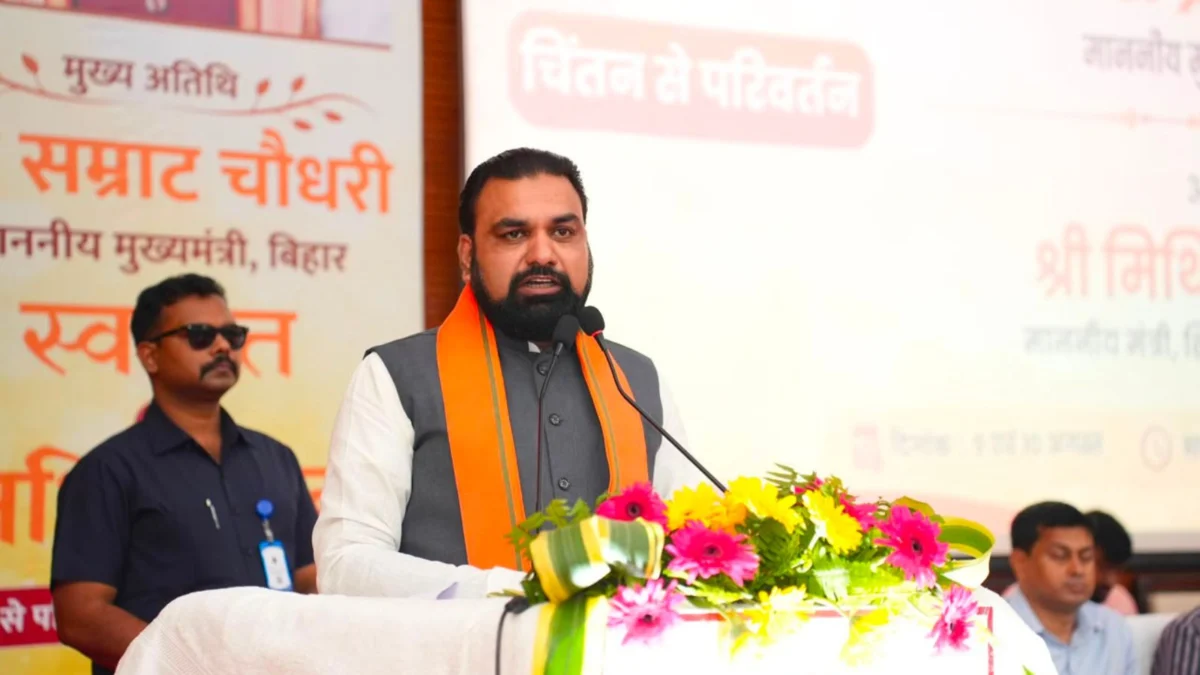
PATNA, BIHAR – The administration of Chief Minister Samrat Choudhary in Bihar finds itself under an unprecedented spotlight, battling a fierce political storm ignited by a series of harrowing sexual harassment cases that have recently surfaced across the state. Compounding the pressure from a vocal opposition, the government is now facing stark criticism from within its own ranks, signaling a deepening crisis of confidence in its ability to maintain law and order. The unfolding events have not only triggered widespread public outrage but have also raised serious questions about police efficacy, administrative accountability, and the safety of women and girls in the state.
The immediate catalyst for this escalating tension is a spate of videos depicting alleged sexual harassment and assault, which have gone viral on social media, drawing national attention to Bihar’s precarious security situation. While the Rashtriya Janata Dal (RJD)-led opposition has been relentless in its attacks, the most stinging rebuke came from BJP Rajya Sabha MP Shambhu Sharan Patel on Saturday, who publicly decried the "deteriorating law-and-order" and demanded a complete overhaul of the state’s top administrative and police brass. His candid remarks, including the damning assertion that "policing in Bihar has collapsed," underscore the gravity of the situation and the internal fissures emerging within the ruling National Democratic Alliance (NDA) government.
Chief Minister Samrat Choudhary, who also holds the crucial Home portfolio, bears direct responsibility for the state’s security apparatus. The mounting pressure, amplified by accusations of administrative ineptitude and a controversial incident involving the Chief Minister’s Office (CMO) in disclosing a victim’s identity, has pushed the government into a defensive corner, struggling to articulate a credible and effective response to the escalating crisis.
Chronology of Events: A Rapidly Unfolding Crisis
The current wave of outrage began to swell with a series of disturbing incidents, each quickly amplified by social media, painting a grim picture of public safety in Bihar.
The Jamui Incident: The Initial Spark
The week began with reports and a viral video detailing an alleged incident of sexual harassment in a hilly area on the outskirts of Jamui. The video showed youths surrounding and purportedly harassing two teenage students, an act that immediately sent shockwaves across the state. Police swiftly responded, apprehending three juveniles and arresting two individuals identified as Nandan Yadav and Hareram Yadav. In a dramatic turn, police reported that Nandan Yadav was shot in the leg while resisting arrest, an detail that further highlighted the tense nature of the crackdown. This incident quickly became a political flashpoint, with the opposition seizing on it to challenge the NDA government’s claims of improved law and order.
Samastipur Incidents: A Disturbing Pattern Emerges
Before the Jamui controversy could subside, two more deeply unsettling videos surfaced from Samastipur, adding fuel to the fire. The first of these depicted a girl allegedly being harassed, pulled by her hair, and subjected to abusive remarks by a group of youths on a bypass road, shockingly, in broad daylight. The swift public reaction compelled police to act promptly, leading to the arrest of four accused individuals who were subsequently sent to judicial custody. They were booked under relevant provisions of the Protection of Children from Sexual Offences (POCSO) Act, given the involvement of a minor, and the Information Technology Act, due to the video’s digital circulation.
Shortly thereafter, a third video, also reportedly from Samastipur and dating back to August 14, emerged. This video showed more people allegedly harassing another girl on a road under the Musrigharari police station limits. The police, demonstrating an increased sense of urgency, managed to identify four individuals and arrested one person, Dharmendra Sahni, within five hours of receiving information. The suspects in this case were booked under the newly enacted Bharatiya Nyaya Sanhita, alongside the POCSO Act and the Information Technology Act, marking an early application of the new criminal code.
The Banka Revelation: Older Incidents Resurface
Further deepening the public’s concern, another video from Banka gained traction, showing individuals harassing and assaulting a girl at the historic Mandar Hill tourist site. While the incident itself was later clarified by police to have occurred earlier, on June 3, its recent surfacing contributed to the cumulative pressure on the government. Police have since identified three suspects, noting that they are migrant labourers working outside Bihar, complicating immediate arrests but underscoring the ongoing investigative efforts.
Internal Dissent: Shambhu Sharan Patel’s Scathing Critique
The mounting external pressure reached a critical point with the outspoken criticism from within the ruling alliance. On Saturday, BJP Rajya Sabha MP Shambhu Sharan Patel launched a direct assault on the government’s handling of the law and order situation. In a stark statement to reporters, he declared, "Bihar mein policing charmara gayi hai" (policing in Bihar has collapsed), a phrase that resonated widely and highlighted a deep-seated frustration within the party.
Patel did not stop there. He went on to demand the immediate appointment of a new chief secretary and director general of police (DGP) to regain control over the state’s security apparatus, emphasizing the urgent need for a "thorough overhaul of the law-and-order situation." His rationale was clear: "Criminals no longer fear the law." To underscore his point, Patel recounted a personal and alarming experience where he called the Patna administration following an incident involving a girl, but the Senior Superintendent of Police (SSP) failed to pick up his call, and no FIR had been registered in the case. He expressed his frustration, stating, "My hands are tied as part of the ruling party, but the public gave us a mandate to deliver good governance and keep law and order intact. It is shameful whenever an atrocity happens to any daughter." His remarks served as a powerful testament to the perceived systemic failures from an insider’s perspective.
The CMO Controversy: Victim Identity Disclosure
Adding a layer of severe legal and ethical complexity to the crisis, the Chief Minister’s Office itself became embroiled in controversy. On Friday, it was revealed that a post on the official CMO handle contained a photograph of the sexual harassment victim from the Jamui incident. This act, widely condemned as a breach of privacy and a violation of the POCSO Act which strictly prohibits the disclosure of a minor victim’s identity, sparked immediate outrage from the opposition.
Leader of Opposition Tejashwi Prasad Yadav promptly demanded that the state police register an FIR against the Chief Minister for this lapse. He argued that "Under the law, neither the PM nor the CM is above accountability. Just as multiple individuals are facing charges in the Jamui case, the CM should also be booked under POCSO for disclosing the victim’s identity." Following this, RJD Pataliputra MP Misa Bharti formally lodged a complaint at the Sachivalaya police station against the CMO staff over the issue, signaling the opposition’s intent to pursue legal recourse against the highest office in the state.
Supporting Data and Broader Context: A State Under Scrutiny
Bihar has a complex history with law and order, often struggling with perceptions of inadequate governance and systemic challenges. While significant progress has been made in various sectors over the past two decades, the specter of crime, particularly against women, continues to haunt its political narrative. The current wave of incidents, amplified by the pervasive reach of social media, has thrust these underlying issues back into the public consciousness with renewed urgency.
The Role of Social Media: The rapid dissemination of these disturbing videos across platforms like X (formerly Twitter) and other messaging services has fundamentally altered the dynamics of public discourse and political accountability. Incidents that might once have remained localized or taken longer to reach public attention are now instantly global, creating an unprecedented level of scrutiny and pressure on authorities to act swiftly. While social media can be a powerful tool for justice, it also presents challenges, including the risk of misidentification, misinformation, and, as seen with the CMO incident, the inadvertent or negligent disclosure of sensitive information.
Legal Frameworks in Play: The cases under discussion involve several critical legal provisions designed to protect vulnerable populations and address modern forms of crime.
- The Protection of Children from Sexual Offences (POCSO) Act, 2012: This landmark legislation is specifically designed to protect children from sexual assault and harassment. Its stringent provisions include severe penalties for offenders and strict guidelines for maintaining the anonymity and privacy of victims, particularly minors, to prevent secondary victimization and stigmatization. The alleged violation of these provisions by the CMO is thus a matter of serious legal and ethical concern.
- The Information Technology (IT) Act, 2000: This act addresses cybercrimes and offenses related to digital data. Its invocation in these cases underscores the digital nature of the crime (recording and sharing videos) and the investigative challenges posed by online content.
- The Bharatiya Nyaya Sanhita (BNS), 2023: Recently enacted, the BNS is set to replace the Indian Penal Code (IPC) as the primary criminal code. Its application in one of the Samastipur cases signals the government’s intent to utilize new legal tools to combat crime, though its effectiveness in practice is yet to be fully assessed.
Underlying Socio-Economic Factors: While not directly addressed in the immediate news, the prevalence of such incidents often points to deeper socio-economic issues. Factors like youth unemployment, lack of recreational opportunities, digital illiteracy, and entrenched patriarchal attitudes in some regions can contribute to environments where such crimes may occur. The rapid spread of mobile phones and internet access in rural areas, without adequate education on responsible digital citizenship or awareness of legal consequences, can also exacerbate problems, leading to phenomena like "online reels" becoming a vehicle for harassment.
Official Responses and Government Stance: A Tightrope Walk
The Samrat Choudhary government, particularly with the Chief Minister holding the Home portfolio, is walking a tightrope between demonstrating effective action and fending off relentless criticism.
Police Actions and Defensive Posture: On the operational front, the police force has demonstrated a degree of responsiveness, especially following the widespread public outcry. Arrests have been made in multiple cases, some within remarkably short timeframes, such as the Samastipur incident where an arrest was made within five hours. The use of relevant sections of the POCSO Act, IT Act, and even the new Bharatiya Nyaya Sanhita indicates an effort to apply appropriate legal frameworks. However, these actions are overshadowed by the perception of a systemic breakdown, as highlighted by MP Shambhu Sharan Patel’s personal experience of police unresponsiveness. The contrast between swift action in high-profile cases and alleged inaction in others fuels public cynicism.
Chief Minister’s Limited Public Statements: Chief Minister Samrat Choudhary has maintained a relatively guarded public posture on the core issue of law and order, beyond general statements. The only reported comment attributed to him by BJP sources was an urging for people to "stay away from online reels and focus on real-life issues." This statement, while perhaps intended to promote responsible digital behavior, has been criticized by some as potentially deflecting from the government’s primary responsibility to ensure public safety and address the root causes of the harassment, rather than merely the medium through which some incidents are recorded or spread.
Internal BJP Response: BJP sources, while acknowledging the severity of the situation, have sought to frame the government’s efforts defensively. They "insisted that the state had intensified its crackdown on such social media posts," focusing on the digital aspect rather than a broader systemic reform. The public criticism from a Rajya Sabha MP like Shambhu Sharan Patel, however, reveals that this defensive stance is not uniformly accepted within the party. Patel’s demand for new top officials signifies a belief that the current leadership is failing, a rare public admission of such a grave administrative shortcoming from within the ruling establishment.
Implications and Future Outlook: A Critical Juncture for Bihar
The confluence of these events has placed the Bihar government at a critical juncture, with far-reaching implications across political, social, and administrative spheres.
Political Fallout and Electoral Impact: The immediate political implication is a significant blow to the Samrat Choudhary government’s image, particularly on the crucial issue of law and order. Good governance and security are often key electoral planks, and a perceived failure on this front can erode public trust and voter confidence. The opposition, led by Tejashwi Yadav, has skillfully capitalized on the crisis, using it to attack the government’s credibility and paint it as "inept." With upcoming elections on the horizon, including the Lok Sabha elections, this narrative could prove damaging. Furthermore, the internal dissent voiced by Shambhu Sharan Patel could signal broader unease within the NDA alliance, potentially leading to instability if the crisis is not effectively managed.
Social Fabric and Public Trust: Beyond politics, the surge in sexual harassment cases has profound social implications. It fosters an environment of fear and insecurity among women and girls, limiting their freedom of movement and participation in public life. The perceived collapse of "policing" and the alleged administrative non-responsiveness can severely erode public trust in law enforcement agencies and the justice system. This erosion of trust can lead to underreporting of crimes, vigilante justice, or a general sense of despair regarding personal safety. There is a growing demand for not just stricter enforcement but also broader societal change, including educational initiatives and cultural shifts to combat gender-based violence.
Administrative Challenges and Reforms: The demand for new leadership in the Chief Secretary and DGP roles points to a fundamental critique of the state’s administrative machinery. It suggests that merely reactive measures are insufficient and that systemic reforms are needed. This could include improving police responsiveness, enhancing investigative capabilities, ensuring strict adherence to victim protection laws like POCSO, and fostering greater accountability within the bureaucracy. The challenge for the government will be to move beyond piecemeal reactions to a comprehensive strategy that addresses both the symptoms and root causes of the deteriorating law and order situation.
In conclusion, the Samrat Choudhary government in Bihar faces a formidable challenge. The rapid succession of sexual harassment cases, coupled with strong condemnation from both the opposition and a prominent member of its own party, demands a robust and transparent response. The controversy surrounding the CMO’s handling of victim identity further complicates matters, adding legal and ethical dimensions to an already volatile situation. How the government navigates this crisis, restores public confidence, and ensures the safety and dignity of its citizens will define its legacy and significantly impact the political landscape of Bihar in the months and years to come.
