

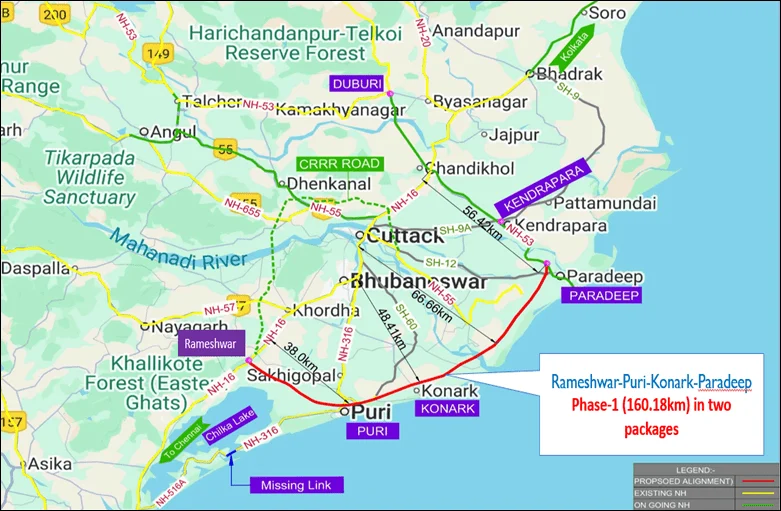
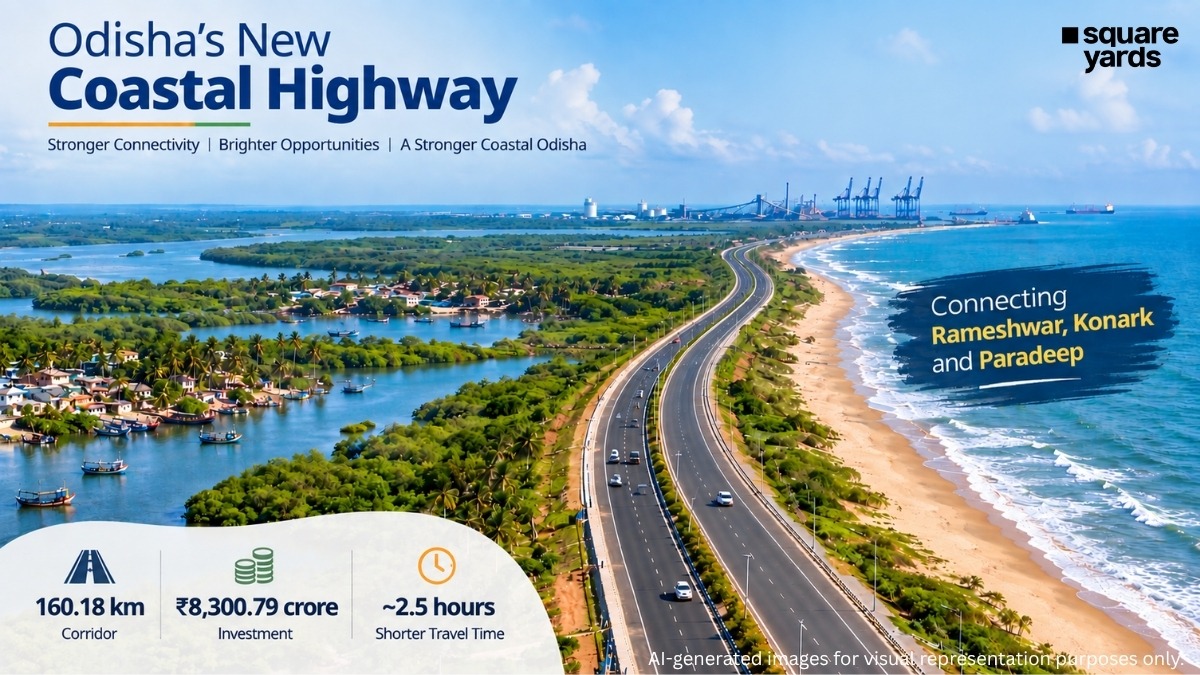
NEW DELHI – In a move set to fundamentally alter the logistical and economic landscape of eastern India, the Union Cabinet, chaired by Prime Minister Narendra Modi, has officially approved the development of the Odisha Coastal Highway Project. With a staggering investment of ₹8,300.79 crore, this ambitious infrastructure undertaking aims to bridge the gap between key coastal hubs, significantly reducing travel time and fostering a new era of industrial and tourism-led growth for the state of Odisha.
The project, sanctioned by the Cabinet Committee on Economic Affairs (CCEA), is designed as a strategic corridor spanning 160.18 kilometers. Connecting Rameshwar, Konark, and Paradeep, the highway is expected to serve as a vital lifeline for the region, alleviating the chronic congestion currently plaguing existing national highways and providing a high-speed alternative for both passenger and commercial traffic.
I. Main Facts: A Strategic Blueprint for Coastal Integration
The Odisha Coastal Highway is not merely a road project; it is a multi-modal connectivity catalyst. The project’s primary objective is to create a seamless transit route along the Bay of Bengal, traversing four critical districts: Khurda, Puri, Kendrapada, and Jagatsinghpur.
Key Project Specifications
- Total Length: 160.18 km.
- Total Estimated Cost: ₹8,300.79 crore.
- Connectivity Points: Rameshwar (near NH-16) to the port city of Paradeep via the world-renowned temple town of Konark.
- Time Savings: An estimated reduction of 2 hours and 30 minutes in travel time between Rameshwar and Paradeep.
- Design Speed: Engineered for speeds of up to 100 km/h.
- Construction Model: Hybrid Annuity Model (HAM).
The highway is divided into two distinct construction packages to ensure specialized handling of different geographical terrains. The first package encompasses a 79.40 km, four-lane access-controlled highway between Rameshwar and Konark. The second package involves an 80.78 km, two-lane highway with paved shoulders extending from Konark to the industrial powerhouse of Paradeep.
II. Chronology: From Congestion to Construction
The genesis of the Odisha Coastal Highway lies in the increasing inadequacy of the state’s current road network. For decades, NH-16 (formerly NH-5) has served as the primary artery for traffic moving through Bhubaneswar and Cuttack. However, the rapid urbanization of these twin cities has led to severe bottlenecks, with heavy long-haul trucks competing for space with local commuters.
Similarly, NH-316, which connects the state capital to Puri and Konark, has faced mounting pressure due to the explosion of religious tourism and roadside commercial developments. The need for a dedicated coastal route that bypasses these congested urban centers became a priority for both the State and Central governments.
The Roadmap to Implementation
- Project Conceptualization: Identified as a priority under the Bharatmala Pariyojana and subsequently integrated into the PM GatiShakti National Master Plan.
- Alignment Finalization: After rigorous environmental assessments and stakeholder consultations, a "fresh alignment" (Greenfield) approach was chosen for the majority of the corridor to minimize displacement and maximize speed.
- Cabinet Approval (September 2026): The CCEA provided the final financial and administrative nod, clearing the way for immediate execution.
- The Construction Window: The project is slated for a construction period of 2.5 years (30 months).
- Operational Phase: Following completion, the selected concessionaire will manage the operations and maintenance for a period of 15 years.
III. Supporting Data: The Economic and Technical Foundation
The financial and logistical architecture of the project reflects the government’s shift toward sustainable infrastructure development. By utilizing the Hybrid Annuity Model (HAM), the government balances the risk between the public and private sectors.
The HAM Advantage
Under the HAM framework, the National Highways Authority of India (NHAI) will contribute 40% of the project cost during the construction phase in the form of "milestone-based payments." The remaining 60% is raised by the private developer. This model is particularly effective as it ensures the developer focuses on quality and timely completion, given that their returns are tied to fixed annuity payments over 15 years rather than volatile toll collections.
Employment and Social Impact
Infrastructure projects of this magnitude are significant engines for job creation. The government’s projections for the Odisha Coastal Highway include:
- Direct Employment: 53 lakh man-days during the construction phase.
- Indirect Employment: 67 lakh man-days through supply chains, material procurement, and ancillary services.
Technical Alignment
A critical feature of this project is the "Greenfield" nature of the corridor. By building on a fresh alignment rather than widening existing roads, the project avoids the high costs and social friction associated with large-scale demolition in densely populated areas. Only a minor portion of Package 1 utilizes existing road footprints, ensuring that the 100 km/h design speed is not compromised by local encroachments.
IV. Official Responses: A Vision for National Integration
Government officials and representatives from the Ministry of Road Transport and Highways (MoRTH) have hailed the cabinet approval as a milestone for the "Purvodaya" vision—the holistic development of Eastern India.
A spokesperson from the Press Information Bureau (PIB) noted, "The Odisha Coastal Highway is a centerpiece of the PM GatiShakti National Master Plan. It is designed not just to move vehicles, but to move the economy. By linking nine economic nodes and five logistics nodes, we are creating a corridor of prosperity that will benefit farmers, fishermen, and industrialists alike."
The government has emphasized that the highway is strategically positioned to support:
- Paradeep Port: Enhancing the "last-mile" connectivity for one of India’s busiest ports.
- Astarang Port: Providing the necessary road infrastructure for the upcoming port facility.
- Puri Infrastructure: Integrating the proposed Sri Jagannath International Airport and the Puri Railway Station into a cohesive transport grid.
- Logistics Hubs: Direct access to the Multi-Modal Logistics Park (MMLP) in Jagatsinghpur.
State officials in Odisha have also expressed optimism, noting that the highway will act as a protective barrier and a swift evacuation route during the cyclone seasons that frequently impact the Odisha coastline.
V. Implications: Tourism, Trade, and Transformation
The long-term implications of the Odisha Coastal Highway extend far beyond reduced travel times. The project is expected to trigger a socio-economic transformation across the four districts it touches.
1. The Tourism Explosion
Odisha’s "Golden Triangle" (Bhubaneswar-Puri-Konark) is the backbone of its tourism industry. By providing a world-class, access-controlled highway to Konark and Puri, the state can attract a higher volume of international and high-spending domestic tourists. The highway will make the pristine beaches of the Odisha coast more accessible, potentially giving rise to new eco-tourism circuits and luxury beach resorts.
2. Boosting the Blue Economy
The highway will pass through several fishing clusters and special economic zones (SEZs). Improved connectivity means that perishable seafood products can reach processing centers and ports faster, reducing wastage and increasing the income of local fishing communities. The link to the Jagatsinghpur MMLP will further integrate these local industries into the global supply chain.
3. Industrial Synergies
With Paradeep Port at one end of the corridor, the highway becomes a critical artery for the movement of raw materials and finished goods. Industries in the steel, petrochemical, and fertilizer sectors located in the Jagatsinghpur-Paradeep belt will see a significant reduction in logistics costs, making "Made in Odisha" products more competitive in international markets.
4. Environmental and Disaster Resilience
While the project involves significant construction, the government has committed to high environmental standards. The fresh alignment is designed to minimize the impact on the delicate coastal ecosystem. Furthermore, the elevated nature of modern highway construction provides a robust infrastructure that can withstand storm surges and provide a reliable route for emergency services during natural disasters.
5. Urban Decongestion
By diverting long-distance freight traffic away from the Bhubaneswar-Cuttack urban corridor, the project will improve the quality of life for millions of city dwellers. Reduced traffic on NH-16 and NH-316 means lower carbon emissions in urban centers, fewer accidents, and faster daily commutes for local residents.
Conclusion: A Legacy Project for the East
The Odisha Coastal Highway Project represents a forward-thinking approach to nation-building. By investing ₹8,300.79 crore into a greenfield corridor, the Union Cabinet has signaled its commitment to unlocking the untapped potential of Odisha’s coastline.
As the bidding process moves into its final stages and ground-breaking approaches, the project stands as a testament to the power of integrated planning. From the spiritual shores of Puri to the industrial docks of Paradeep, this 160-km stretch of asphalt and concrete is set to become the foundation upon which Odisha’s future economic milestones are built. For the people of Odisha, the "road to the future" is no longer a metaphor—it is a tangible, multi-billion-rupee reality that promises to bring the world closer to their shores.
