

THIRUVANANTHAPURAM, KERALA — Standing before a green-painted house now secured with a rusted lock, 43-year-old Baby Titus gestures toward the relentless Arabian Sea. “This was our home,” she says. The structure, once a sanctuary for her family, is now a skeletal reminder of the land the ocean has reclaimed. Waves crash against the right side of the building with rhythmic violence. “The sea kept entering and receding,” Titus recalls. “It caused a short circuit inside. Eventually, you would get an electric shock wherever you touched the walls.”
Titus’s story is not an isolated tragedy but a symptom of a systemic environmental and humanitarian crisis unfolding at the southernmost tip of Kerala. In the Kulathoor grama panchayat of Thiruvananthapuram, the sea is no longer a source of life for the artisanal fishing community; it has become an encroaching predator. As the shoreline retreats, it is taking with it more than just bricks and mortar—it is eroding the social fabric, economic stability, and mental well-being of thousands.
Main Facts: A Community on the Edge
The coastal wards of Kulathoor—including Pozhipallivilakam, Mullassery, Kollamkode, Paruthiyoor, Pozhikara Beach, and Pozhiyoor—are witnessing a radical transformation of their geography. Historically, these villages were buffered by wide sandy beaches. Today, those buffers have vanished.

The Physical Toll
In many of these wards, what used to be a sprawling residential area of 100 rows of houses has been whittled down to just seven or eight. The remains of the engulfed homes, mingled with the granite boulders of largely ineffective seawalls, create a jagged, treacherous coastline. For the families who remain, life is a state of constant "ready-alert."
The Human Displacement
Baby Titus now lives in a rented two-bedroom house nearby, paying ₹2,000 a month—a significant burden for a family dependent on the unpredictable yields of the sea. Her husband, 45-year-old Thadhayoos, is an artisanal fisherman. His work requires him to be at sea during the night, the very time when the tide is highest and the risk to his family is greatest.
“Even when I am at sea, I can’t be at peace,” Thadhayoos says. “I keep worrying if the sea will enter the house and whether my wife and children will be safe.”

Chronology: Decades of Encroachment and the 2025 Surge
The crisis in Pozhiyoor has been decades in the making, characterized by a slow-motion disaster punctuated by moments of acute catastrophe.
- 1990s – Early 2000s: Residents report a noticeable shift in the tide line. Traditional methods of coastal protection, such as planting mangroves or small-scale stone bunds, began to fail as the frequency of high-intensity swells increased.
- 2010 – 2024: The rate of erosion accelerated. Scientific studies began to document a significant loss of land mass, with the "normal" erosion rate of five meters per year being doubled in the Pozhiyoor stretch.
- Early 2025: A medical camp led by Dr. Shreyas Susan Varghese in Pozhiyoor revealed a community in the throes of a mental health epidemic. Findings showed widespread symptoms of trauma and depression directly linked to displacement and environmental instability.
- September 28, 2025: A massive sea surge struck the coast. In a single evening, 40 houses in Pozhiyoor collapsed into the Arabian Sea. This event triggered a fresh wave of displacement, forcing families into overcrowded government schools used as temporary relief camps.
Supporting Data: The Science of Disappearing Land
The environmental crisis in Thiruvananthapuram is driven by a combination of natural climate variability and anthropogenic activities, such as port construction and offshore dredging, which disrupt the natural movement of sediment (longshore drift).
Erosion Rates
A 2022 study focusing on coastal changes in the region revealed startling statistics. Over a 14-year period, approximately 2.62 square kilometers of land were lost to erosion along the Thiruvananthapuram coast. While some areas experienced "accretion" (land gain), the net loss was devastating.

- Average Erosion: 5 meters per year.
- Pozhiyoor Erosion: 10.59 meters per year—the highest in the district.
The Psychological Data
The Centre for Development Studies (CDS) published a policy dialogue on coastal families displaced by disasters, noting that the "persistent sense of fear" creates a unique form of psychological distress.
Dr. Shreyas Susan Varghese, the psychiatrist who led the 2025 medical camp, notes that the trauma is compounded by a "genetic predisposition to depression" in some families, which is then triggered by the loss of their primary asset: their home. "Displacement became an additional trigger for their psychological distress," Varghese explains. "Relocation disrupted their most important sources of social and emotional support."
Official Responses: The Punargeham Scheme
The Kerala government’s primary vehicle for addressing this crisis is the Punargeham project. This coastal rehabilitation scheme targets fisher families living within 50 meters of the shoreline—the high-risk "no-man’s-land" of the Kerala coast.

Mechanics of the Scheme
- Financial Assistance: Beneficiaries are eligible for up to ₹10 lakh to purchase land and construct a house.
- Flat Complexes: For those unable to find land, the government has constructed multi-story flat complexes. The Niravu Flats in Karode Panchayat is one such example, housing 128 families relocated from Kulathoor.
Challenges in Implementation
While Punargeham provides physical safety, critics and social workers argue it lacks a holistic approach to "human" safety.
- Distance: The Niravu Flats are located seven kilometers from the coast. For a fisherman, this distance adds significant commuting costs and complicates the logistics of maintaining boats and nets.
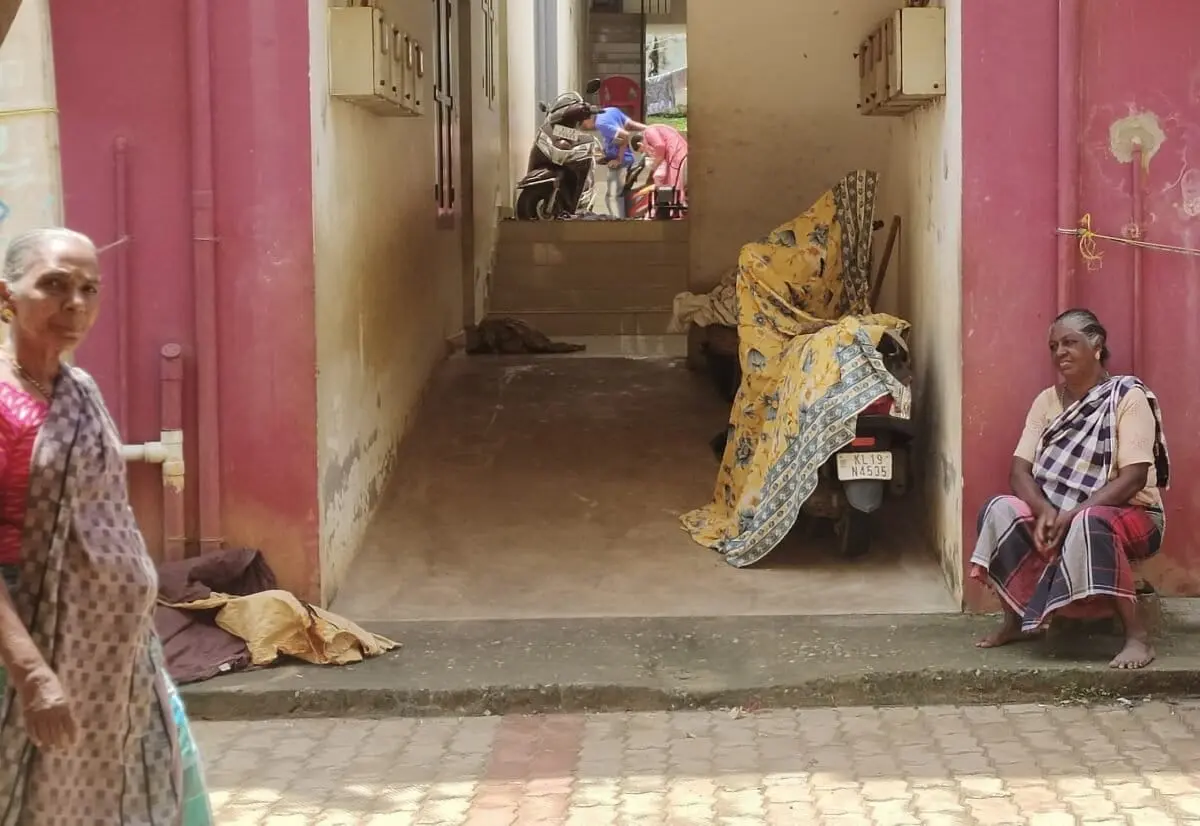
- Livelihood Loss: In coastal villages, the beach is a workspace. Elderly women traditionally collect and cure fish (prawns and small fry) on the sand. In a third-floor flat, this livelihood—and the income it generates—is impossible to sustain.
- Resentment: Social worker Magline Philomina points out that the "uneven rehabilitation" has created friction. Those who could afford to supplement the government grant moved to better locations, while the poorest were funneled into flats, leading to feelings of abandonment and social stratification.
Implications: Ecological Grief and the Loss of Identity
The move from the shoreline to the hinterlands is more than a change of address; it is a severance of identity. Anthropologist Claudia Lang, who specializes in "ecological grief," argues that the beach was a "commons"—a space for football, community ceremonies, and collective labor.
The "Medical Ward" Effect
Jose Thobias, 42, a resident of Niravu Flats, describes his new life as one of profound isolation. “Earlier, my friends and I would play cricket or football at the beach in the evenings. It was fun,” he says. “But this place feels like a medical ward. I spend most of my free time sitting here with my mobile phone, scrolling through reels. I feel lonely here.”

This loneliness is a clinical symptom of the disruption of "place-attachment." When a community is uprooted, the informal safety nets—the neighbor who watches the children, the friend who shares the day’s catch—disintegrate.
The Role of Faith and the Church
In these predominantly Catholic villages, the parish church (such as Kollamkode or Paruthiyoor) serves as the gravitational center of social life. For the elderly, like 60-year-old Jenovi Thobias, the relocation has made the church inaccessible.
“If it were before, I could at least go to church and find some solace,” Jenovi says, citing knee pain that prevents her from walking the long distance from the flats.
Recognizing this, the church has stepped into the void left by the state. Father Davidson, the vicar of Kollamkode, has mobilized 150 volunteers to identify residents struggling with mental health. The parish’s “Santhwana Project,” launched in collaboration with Thiruvananthapuram Jubilee Hospital, provides professional counseling to families, attempting to treat the "ecological grief" that seawalls cannot prevent.

Conclusion: Toward a Holistic Recovery
The crisis in Pozhiyoor demonstrates that "environmental repair" and "psychological repair" are inseparable. Moving a family from a collapsing house to a concrete flat solves the immediate threat of drowning, but it does not address the slow death of a culture and a vocation.
As the Arabian Sea continues its inland march, the official response must evolve. Future rehabilitation efforts must consider:
- Spatial Justice: Ensuring relocated communities have access to common spaces that mimic the social functions of the beach.
- Economic Continuity: Providing dedicated spaces for fish curing and net repair in inland housing projects.
- Mental Health Integration: Making psychological support a standard part of disaster relief, rather than an afterthought handled by NGOs or religious bodies.
For Baby Titus, Jose Thobias, and the hundreds of families still waiting for a secure home, the roar of the ocean is a reminder of what has been lost. Repairing their lives requires more than a roof; it requires a recognition that for the people of the coast, the sea is not just a neighbor—it is their soul. To save the community, the state must find a way to preserve their connection to the water, even as they are forced to retreat from its edge.
