

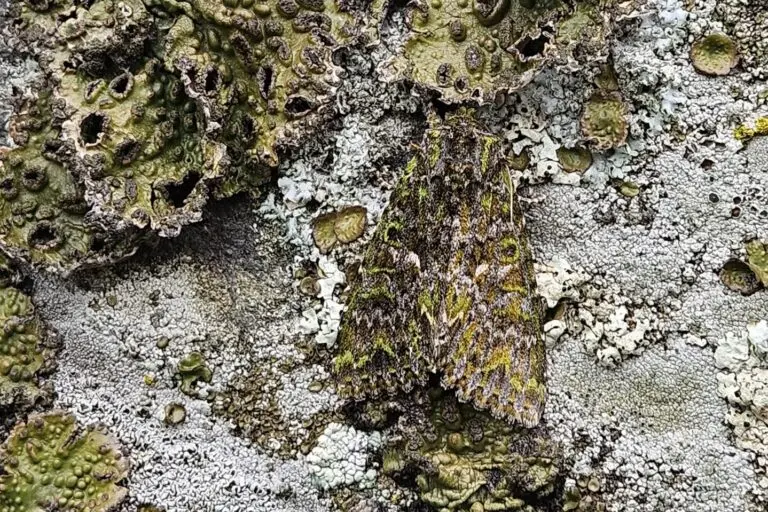
In the rugged, windswept heights of the Himachal Pradesh Himalayas, nature has long been engaged in a silent arms race of survival. A recent scientific discovery has shed light on a remarkable instance of evolutionary adaptation, marking the first known record of a moth utilizing the umbilicate lichen, Lasallia pertusa, as a specialized camouflage background.
This finding, documented in the prestigious journal Arthropod-Plant Interactions, offers a rare glimpse into the complex ecological relationships existing at high altitudes. The discovery was made at an elevation of approximately 3,200 meters within the Kugti Wildlife Sanctuary, located in the Chamba district of Himachal Pradesh. While the interplay between insects and their environments is a cornerstone of evolutionary biology, this specific association challenges previous understandings of how different lichen growth forms contribute to animal survival strategies.
Main Facts: A Masterpiece of Natural Deception
The crux of the discovery lies in the relationship between a moth from the Noctuidae family and the lichen Lasallia pertusa. For decades, lepidopterists and ecologists have documented moths mimicking crustose lichens (those that grow flat against surfaces like a coat of paint) or bark-dwelling species. However, the use of an "umbilicate" lichen—a growth form characterized by being attached to its substrate at a single central point—represents a significant expansion of the known visual environments used by insects for crypsis.
Lasallia pertusa is a foliose lichen, meaning it possesses flat, leaf-like lobes. What makes it particularly unique as a camouflage background is its perforated and highly irregular thallus (vegetative body). This complex, "holey" texture creates a visually heterogeneous environment that is incredibly difficult for predators to scan.
The moth involved belongs to the Noctuidae family, commonly known as "owlet moths." This family is one of the largest in the Lepidoptera order, known for their robust bodies and generally nocturnal habits. In this instance, the moth was found resting directly on the lichen, which was growing on exposed rock surfaces. The visual match was so precise that the moth’s silhouette was effectively neutralized, reducing its contrast against the irregular, perforated backdrop of the L. pertusa.
Chronology: From the High Peaks to the Scientific Record
The journey toward this publication began in the summer of 2025. In the high-altitude region of Duggi, within the Kugti Wildlife Sanctuary, researchers were conducting field surveys of the local flora and fauna.
- July 2025: During a field expedition at an elevation of 3,200 meters, Sanjay Kumar Uniyal and his team observed a peculiar visual phenomenon on a rock face. Upon closer inspection, what appeared to be a part of the lichen thallus was identified as a resting moth.
- Late 2025 – Early 2026: The team engaged in a rigorous identification process. While the lichen was easily identified as Lasallia pertusa due to its distinct morphology, the moth presented a greater challenge. Because no physical specimen was collected at the time—relying instead on high-resolution photography and expert examination—the moth could only be definitively identified to the family level (Noctuidae).
- Mid-2026: The findings were compiled into a formal study titled to reflect the novel association between the insect and the umbilicate lichen.
- Publication: The paper was officially published in the journal Arthropod-Plant Interactions, providing the scientific community with the first documented evidence of this specific crypsis strategy.
Supporting Data: The Mechanics of Crypsis and Lichen Morphology
To understand the significance of this discovery, one must delve into the mechanics of "crypsis." Crypsis is a form of camouflage where an organism matches its background to avoid detection by predators. Unlike "mimicry," where an animal looks like another specific object (like a leaf or a twig), crypsis involves blending into the general visual texture of the environment.
The Role of Lasallia pertusa
The lichen Lasallia pertusa offers a unique advantage for crypsis. Most camouflage studies focus on "simple" backgrounds like smooth bark or flat rocks. However, L. pertusa is:
- Umbilicate: Its single-point attachment allows the edges of the lichen to lift, creating shadows and depth.
- Perforated: The "pertusa" in its name refers to the holes or perforations in its body. This creates a "broken" visual field.
- Irregular: The color and texture vary across the thallus, ranging from greyish tones to darker, shadowed areas.
For a Noctuidae moth, which often possesses mottled brown, grey, or silver wing patterns, this background is ideal. The moth’s wing patterns overlap with the lichen’s irregular perforations and shadows, a tactic known as "disruptive coloration." This breaks up the moth’s outline, making it nearly impossible for a predator to distinguish the insect’s shape from the lichen’s lobes.
Environmental Context
The study highlights that these interactions occur in "visually heterogeneous environments." At 3,200 meters, the landscape is a mosaic of bare rock, hardy lichens, mosses, and sparse alpine vegetation. In such an exposed environment, the pressure from visual predators—primarily high-altitude birds and lizards—is immense. Any slight advantage in blending into the background can be the difference between survival and predation.
Official Responses and Expert Perspectives
Sanjay Kumar Uniyal, one of the lead authors of the study and a prominent researcher with Mongabay-India connections, emphasized the broader evolutionary implications of the find.
"While we have seen moths mimicking lichens for centuries—the classic example being the Peppered Moth during the Industrial Revolution—this specific association with Lasallia pertusa is a first," Uniyal stated. "It tells us that even inconspicuous lichens, which many might overlook as mere ‘spots on a rock,’ are fundamental components of the survival strategy for alpine fauna."

Uniyal also noted a limitation in the current data: the lack of a physical specimen. "The identification was based on photographs and expert consultation. While we are confident in the Noctuidae classification, the specific species remains a mystery for now. This highlights the difficulty of high-altitude research where collecting specimens is not always feasible or permitted."
Regarding the evolutionary aspect, Uniyal shared that this discovery might suggest a long-term co-evolutionary process. "This might have an evolutionary consequence which can only be understood through further studies. We need to know if this moth species specifically seeks out L. pertusa or if this is a facultative (optional) association."
Other experts in the field of entomology have noted that the study, while observational, sets the stage for experimental biology. The paper itself admits a caveat: it was an observation of a natural state, not an experimental test using "clay models" or "predator-prey simulations" to prove exactly how much the camouflage increases survival rates.
Implications: Biodiversity, Evolution, and Conservation
The discovery of this moth-lichen association has far-reaching implications for several fields of science:
1. Expanding the Scope of Camouflage Research
By documenting the use of umbilicate and foliose lichens, the study pushes scientists to look beyond the "standard" backgrounds of bark and crustose lichens. It suggests that the complexity of an organism’s background is just as important as the color match.
2. High-Altitude Biodiversity
The Kugti Wildlife Sanctuary is a vital corridor for Himalayan biodiversity. Discoveries like this underscore how much of the "micro-world" in these regions remains unmapped. As climate change shifts alpine treelines and alters the distribution of lichen species, the animals that depend on them for camouflage may find themselves increasingly exposed.
3. Lichens as Bio-Indicators and Habitat Pillars
Lichens are notoriously sensitive to air quality and temperature changes. If Lasallia pertusa populations were to decline due to environmental stressors, the ripple effect would touch the Noctuidae moths that rely on them for protection. This highlights the "interconnectedness" of ecosystems—where a fungus-and-alga symbiosis (the lichen) provides the primary defense mechanism for a complex insect.
4. Future Evolutionary Studies
The "evolutionary consequence" mentioned by Uniyal opens the door for genomic studies. Scientists may eventually look for "industrial melanism" style adaptations in these high-altitude moths, determining if their wing patterns have specifically evolved to match the unique perforations of the Lasallia genus.
Conclusion: The Unseen Threads of the Alpine Web
The observation of a Noctuidae moth hidden against the perforated thallus of Lasallia pertusa is more than a mere curiosity of natural history. It is a reminder that in the vastness of the Himalayas, survival often depends on the smallest details.
This record from the Chamba district serves as a call to action for further high-altitude research. It demonstrates that our understanding of insect-plant (and insect-lichen) interactions is still in its infancy. As researchers continue to explore the heights of the Kugti Wildlife Sanctuary, they are likely to find that the rocks and lichens of the mountains are not just a backdrop, but a complex stage where the drama of evolution plays out in shades of grey, silver, and shadow.
The moth, remaining unnamed for now, continues its silent existence at 3,200 meters—a testament to the power of nature to hide its most delicate creations in plain sight.
