

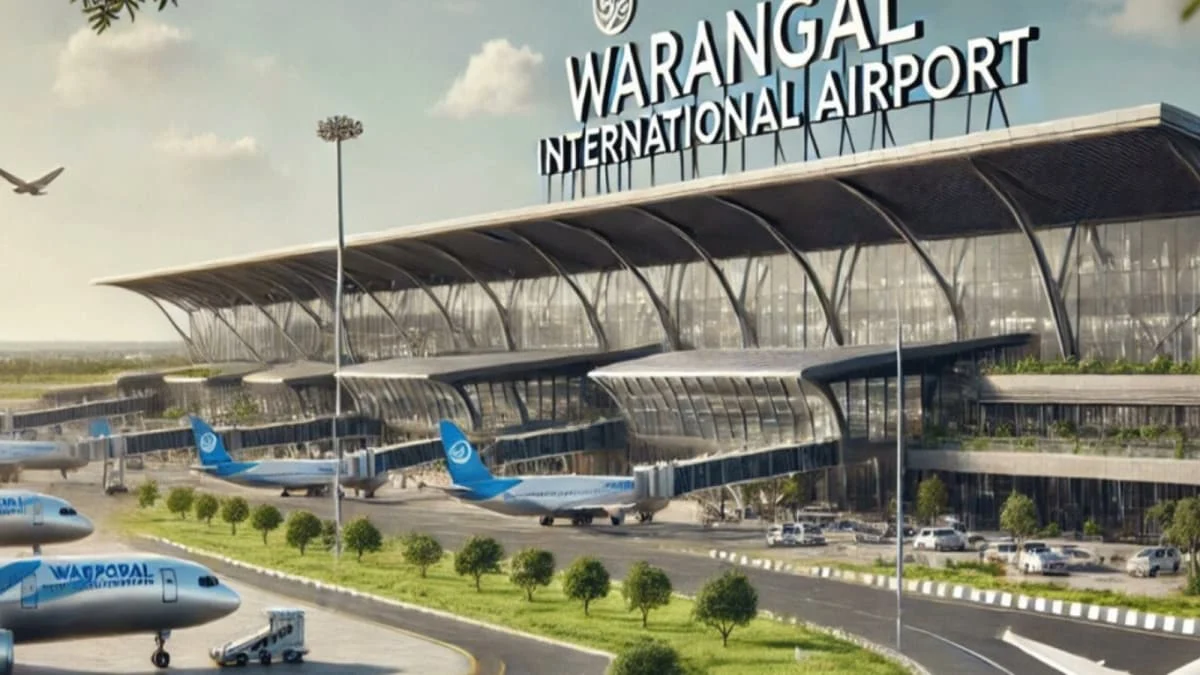
WARANGAL, TELANGANA – In a move that signals a transformative shift for regional connectivity in Southern India, the proposal for Telangana’s second commercial airport at Warangal has advanced into a critical regulatory phase. The Airports Authority of India (AAI) has officially initiated the process to secure environmental clearance for the project, a move that brings the long-dormant Mamnoor airfield closer to becoming a modern aviation hub.
The development, marked by the release of comprehensive tender documents for environmental consultancy, outlines an ambitious vision: a "smart" terminal capable of handling hundreds of passengers, a robust 2.5-kilometer runway, and an architectural philosophy that blends cutting-edge technology with the rich cultural heritage of the Kakatiya dynasty.
Main Facts: The Blueprint for a Modern Aviation Hub
The proposed airport at Warangal is not merely a renovation of an old airstrip but a complete overhaul designed to meet international standards for domestic aviation. According to the latest project specifications released by the AAI, the facility is being designed to act as a secondary gateway to the state, relieving pressure on Hyderabad’s Rajiv Gandhi International Airport (RGIA).
Key Project Specifications:
- Runway Dimensions: The project includes the construction and reinforcement of a 2.5-km (2,500-meter) runway, capable of accommodating narrow-body aircraft such as the Airbus A320 and Boeing 737 series, which are the workhorses of Indian domestic carriers.
- Terminal Capacity: The terminal is designed to manage a peak-hour flow of approximately 850 passengers. This capacity ensures that the airport can handle multiple flight movements simultaneously without congestion.
- Infrastructure Footprint: The domestic terminal building will span approximately 6,800 square meters. It is designed as a "one-and-a-half-level" structure, fully air-conditioned and optimized for energy efficiency.
- Environmental Oversight: The AAI is currently selecting a consultant to prepare an Environmental Impact Assessment (EIA). This consultant will be responsible for obtaining the necessary clearances within a strict six-month window and will continue to monitor compliance for three years post-clearance.
Chronology: The Road to Resurrecting Mamnoor
The journey of the Warangal airport is one of historical legacy meeting modern economic necessity. To understand the significance of the current progress, one must look at the timeline of the Mamnoor airfield.
1. The Nizam Era (Pre-1947)
The airfield at Mamnoor was originally established during the era of the Last Nizam of Hyderabad, Mir Osman Ali Khan. At the time, it was one of the largest airfields in undivided India, serving as a strategic hub for both civil and military purposes. However, following the integration of Hyderabad into the Indian Union, the airfield fell into relative disuse for commercial purposes.
2. Post-Telangana Formation (2014–2022)
Following the creation of the state of Telangana in 2014, the demand for a second airport gained political momentum. Successive state governments identified Warangal—the state’s second-largest city—as the ideal candidate. However, progress was stalled by the "150-kilometer rule," a contractual clause in the agreement with GMR (the operators of Hyderabad Airport) that prohibited the operation of another commercial airport within a 150-km radius.
3. Policy Breakthroughs (2023–2024)
The Telangana government intensified negotiations with the Ministry of Civil Aviation and GMR. A breakthrough was reached when the state government agreed to provide additional land (approximately 253 acres) required for the runway expansion and promised to address the logistical hurdles.
4. The Current Phase (May 2026)
The AAI’s issuance of the tender for environmental clearance marks the transition from "proposal" to "execution." This stage is critical as it involves the Administrative Staff College of India’s specific guidelines for airport environmental safety, ensuring that the project is sustainable and compliant with national ecological standards.
Supporting Data: Technical Excellence and Passenger Experience
The AAI has emphasized that the Warangal airport will be a "Smart Airport," utilizing automation to streamline the passenger journey. The data supporting the design choices highlights a focus on efficiency and inclusivity.
Advanced Passenger Facilities
The terminal will feature a suite of self-service technologies designed to reduce wait times:
- Self-Check-In Kiosks: Multiple kiosks will be installed to allow passengers to print boarding passes and baggage tags independently.
- Baggage Handling: A state-of-the-art baggage conveyor system integrated with X-ray scanners will ensure both speed and security.
- Digital Integration: The terminal will be equipped with high-speed Wi-Fi, digital flight information display systems (FIDS), and automated queue management tools.
Inclusivity and Accessibility
In accordance with the Ministry of Civil Aviation’s "Sugamya Bharat" (Accessible India) guidelines, the airport is designed to be barrier-free.
- Tactile Flooring: For visually impaired travelers, the terminal will feature tactile paths from the entry points to the boarding gates.
- Mobility Support: Ramps, dedicated elevators, and specialized washroom facilities will be available for Persons with Reduced Mobility (PRM).
- Communication Aids: Visual and auditory signaling systems will cater to passengers with hearing or speech impairments.
Security Infrastructure
Security remains a cornerstone of the AAI’s design. The facility will house:
- Multi-Layered Screening: Dedicated frisking booths with door-frame metal detectors (DFMD) and hand-held metal detectors (HHMD).
- Surveillance: A 24/7 CCTV command center monitoring the entire perimeter and terminal interior.
- Bureau of Civil Aviation Security (BCAS) Compliance: All operational frameworks are being built to align with the latest anti-terror and safety protocols.
Official Responses: A Collaborative Vision
The progress of the Warangal airport has been met with positive responses from both state and federal authorities, reflecting a rare alignment of political and administrative will.
The Airports Authority of India (AAI):
In their tender documentation, the AAI stated that the project is a priority under the regional connectivity scheme. "The selection of a consultant for the Environmental Impact Assessment is a procedural milestone that ensures the project moves forward without legal or ecological delays. We are committed to creating a facility that reflects the growth of Telangana," an official source noted.
Telangana State Government:
State officials have highlighted the economic necessity of the project. The Chief Minister’s office has previously indicated that the expansion of the "IT corridor" into tier-2 cities like Warangal is dependent on air connectivity. The state has been proactive in land acquisition, recently fast-tracking the handover of land parcels to the AAI to ensure the 2.5-km runway can be accommodated.
Administrative Staff College of India (ASCI):
The ASCI has formulated the specific guidelines that the environmental consultant must follow. These guidelines are tailored to the unique topography and climate of the Deccan plateau, ensuring that the airport’s water management, noise pollution, and carbon footprint are managed according to international best practices.
Implications: Beyond the Runway
The construction of the Warangal airport carries profound implications for the socio-economic landscape of Telangana.
1. Economic Decentralization
For decades, Hyderabad has been the sole engine of Telangana’s growth. The Warangal airport will act as a catalyst for decentralization. By providing direct air access, the city can attract multinational corporations, particularly in the IT and textile sectors (given the presence of the Kakatiya Mega Textile Park).
2. Boosting the Tourism Circuit
Warangal is the heart of Telangana’s heritage. With the Ramappa Temple being a UNESCO World Heritage site and the Thousand Pillar Temple attracting thousands of pilgrims and historians, an airport will significantly increase international and domestic tourist footfall. Travelers who currently endure a 3-to-4-hour drive from Hyderabad will now be able to fly directly into the region.
3. Educational and Medical Hub
Warangal is home to prestigious institutions like NIT Warangal and several major medical colleges. Air connectivity will facilitate better faculty exchange, student recruitment, and the development of "medical tourism," where patients from neighboring states can fly in for specialized treatments.
4. Real Estate and Infrastructure
The "Airport Effect" is expected to trigger a real estate boom in the Mamnoor and wider Warangal area. Improved road connectivity to the airport, the development of hotels, and the rise of logistics hubs are anticipated, creating thousands of indirect jobs for the local population.
5. Cultural Representation
Perhaps most uniquely, the AAI’s requirement to integrate regional art into the design ensures that the airport will serve as a cultural ambassador. By using local artisans to create installations that reflect the "Perini Sivatandavam" (an ancient dance form) and Kakatiya architecture, the airport will provide a sense of place that modern, sterile terminals often lack.
Conclusion
The initiation of the environmental clearance process for the Warangal airport is more than a bureaucratic step; it is the beginning of a new chapter in Telangana’s story. As the AAI moves to finalize the EIA and begins the transition to physical construction, the eyes of the aviation industry and the local populace remain fixed on Mamnoor. If executed according to the current ambitious plans, the "Smart Terminal" at Warangal will not only be a feat of engineering but a bridge connecting the glorious past of the Kakatiyas to the high-tech future of modern India.
