

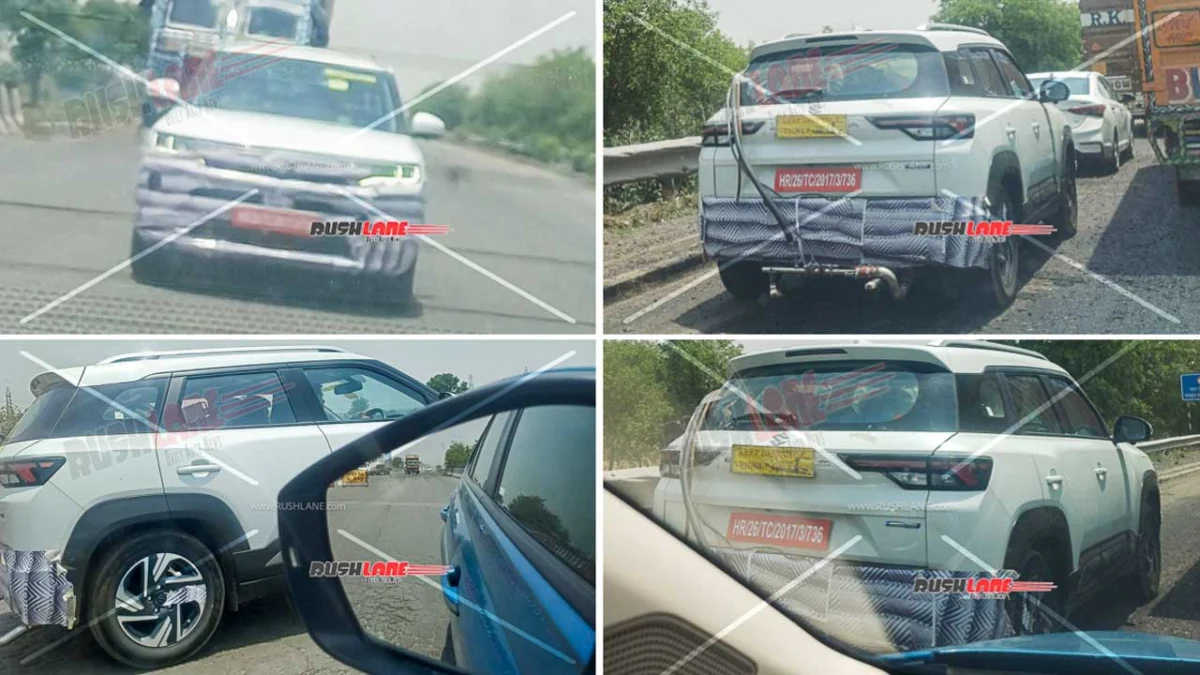
The Indian automotive landscape is bracing for a significant shift as Maruti Suzuki, the nation’s largest carmaker, begins intensive testing for the 2026 facelift of its crown jewel, the Brezza. Recently captured in high-definition spy shots on the Western Peripheral Expressway near Delhi, the test mules have revealed more than just aesthetic updates. The presence of sophisticated emission-testing apparatus (PEMS – Portable Emissions Measurement System) suggests that Maruti Suzuki is not merely "polishing" the exterior but is likely re-engineering the heart of the SUV to reclaim dominance in the hyper-competitive sub-4-meter segment.
Main Facts: The Evolution of a Segment Leader
The Maruti Suzuki Brezza has long been a titan of the Indian roads. Since its inception as the Vitara Brezza, it has consistently occupied the top rungs of the sales charts, frequently battling the Tata Nexon and Hyundai Venue for the title of India’s best-selling SUV. However, the latest sightings of the 2026 facelift indicate a strategic pivot that could redefine its value proposition.
1. The Emission Testing Revelation
The most striking detail of the recent spy shots, credited to enthusiast Hardik N, is the inclusion of external emission-testing equipment. In the world of automotive development, a simple facelift—usually involving plastic body parts and lighting signatures—rarely requires rigorous real-world emission monitoring. The presence of these sensors strongly indicates the introduction of a new or significantly modified powertrain.

2. The Quest for Tax Efficiency
Currently, the Brezza is powered by a 1.5L K15C naturally aspirated petrol engine. While reliable, this engine places the Brezza in a higher tax bracket because it exceeds the 1.2L displacement limit for "small cars" under Indian GST regulations. Industry insiders speculate that the 2026 model may finally adopt a 1.2L engine or the 1.0L Boosterjet turbo-petrol engine to take advantage of lower excise duties, potentially lowering the entry price for consumers.
3. Aesthetic and Technological Overhaul
Beyond the hood, the 2026 Brezza facelift showcases a refined design language. Key observations from the test mule include:
- Revised Front Fascia: A cleaner, more integrated upper grille design.
- ADAS Integration: A visible radar housing in the front bumper, signaling the arrival of Level 2 Advanced Driver Assistance Systems.
- Enhanced Lighting: New triangular housings for fog lamps and a more aggressive "bull bar" style silver element on the bumper.
- Improved Utility: Provisions for an underbody CNG tank setup, similar to the "twin-cylinder" or underbody technology seen in newer Maruti and Toyota models, aimed at maximizing boot space.
Chronology: From Diesel Dominance to Petrol Pragmatism
To understand the importance of the 2026 facelift, one must look at the Brezza’s decade-long journey in the Indian market.

- 2016 – The Birth of an Icon: Maruti Suzuki launched the Vitara Brezza exclusively with a 1.3L DDiS diesel engine. It revolutionized the segment with its "SUV-ish" stance and Maruti’s legendary service backing.
- 2020 – The Petrol Pivot: With the onset of BS6 emission norms, Maruti Suzuki made the bold (and controversial) decision to axe diesel engines entirely. The Brezza transitioned to the 1.5L K15B petrol engine.
- 2022 – The Second Generation: The "Vitara" prefix was dropped, and the SUV was rebranded simply as the "Brezza." It gained a sunroof, a 360-degree camera, and the K15C DualJet engine, but it remained penalized by the 1.5L tax bracket.
- 2024-2025 – The Testing Phase: Spy shots begin to emerge of a facelifted version. Initial sightings focused on cosmetic changes, but the mid-2024 sightings on the Western Peripheral Expressway confirmed the start of powertrain calibration.
- 2026 – Anticipated Launch: The facelift is expected to hit showrooms in early 2026, marking a decade of the Brezza nameplate.
Supporting Data: The Math Behind the Displacement
The primary driver behind the rumored engine change is the Indian taxation structure for automobiles. Under current regulations, cars under 4 meters in length are taxed based on their engine displacement:
| Engine Type | Displacement Limit | GST + Cess Rate (Approx.) |
|---|---|---|
| Petrol | < 1,200cc | 29% |
| Diesel | < 1,500cc | 31% |
| Petrol (Current Brezza) | 1,500cc | 43% to 45% |
By using a 1.5L engine in a sub-4m car, Maruti Suzuki currently pays a tax penalty of roughly 14% to 16% compared to its rivals like the Tata Nexon (1.2L Turbo) or the Hyundai Venue (1.2L NA / 1.0L Turbo).
Potential Powertrain Candidates:
- 1.2L Z-Series Engine: Debuting in the new Swift, this three-cylinder unit focuses on high fuel efficiency. While it may seem underpowered for an SUV, a micro-hybrid or turbocharged version could be in the works.
- 1.0L Boosterjet: Currently found in the Fronx, this engine produces 100 PS and 147 Nm of torque. It fits the tax bracket perfectly and offers the "punch" SUV buyers desire.
- Updated 1.5L K15C: There is a possibility that Maruti is simply refining the existing engine to meet even more stringent "Phase 3" RDE (Real Driving Emissions) norms, though this wouldn’t solve the tax issue.
Official Responses and Industry Sentiment
As per standard corporate policy, Maruti Suzuki has remained tight-lipped regarding the specifics of the 2026 Brezza. When queried about the recent spy shots, a company spokesperson stated, "We do not comment on future product plans or speculative reports. Maruti Suzuki remains committed to introducing technologies that provide the best balance of performance, safety, and fuel efficiency for the Indian consumer."

However, industry analysts suggest that the move is inevitable. "Maruti has watched the competition use turbocharged 1.2L engines to offer more features at a similar price point," says an independent automotive consultant. "By downsizing the engine, Maruti can either lower the price to aggressive levels or absorb the cost of adding premium features like ADAS and ventilated seats without making the car significantly more expensive than the current top-end variants."
Implications: A High-Stakes Game for 2026
The 2026 Brezza facelift is more than just a mid-cycle refresh; it is a defensive and offensive maneuver in a segment that accounts for nearly 25% of all passenger vehicle sales in India.
1. Democratizing Safety (ADAS)
The inclusion of radar housing suggests that Maruti is ready to bring ADAS to its volume-sellers. If the Brezza launches with Level 2 ADAS (including Autonomous Emergency Braking and Lane Keep Assist), it will force competitors to standardize these features across more variants, raising the safety floor for the entire segment.

2. The "Boot Space" Revolution
One of the biggest criticisms of the Brezza CNG was the loss of luggage space due to the large cylinder. By adopting the underbody tank technology (likely a twin-cylinder setup), Maruti could make the Brezza CNG the most practical "green" SUV in its class, appealing to long-distance travelers and families.
3. Market Share Dynamics
If Maruti successfully transitions to a 1.2L or 1.0L Turbo engine, the resulting price correction could be between ₹50,000 to ₹80,000 at the ex-showroom level. This would allow the Brezza to undercut the Tata Nexon and Mahindra XUV 3XO, potentially leading to a massive consolidation of market share.
4. Impact on the 1.5L Portfolio
If the Brezza moves away from the 1.5L engine, it raises questions about the future of that engine in Maruti’s lineup. It is likely that the 1.5L unit will be reserved for larger vehicles like the Ertiga, XL6, and Grand Vitara, further differentiating the "B-segment" from the "C-segment."

Conclusion
The 2026 Maruti Suzuki Brezza facelift represents a sophisticated blend of regulatory navigation and consumer-centric innovation. By subjecting the vehicle to rigorous emission testing now, Maruti is ensuring that when the new SUV arrives, it won’t just look different—it will be a more efficient, tech-forward, and economically competitive version of an Indian legend. As the test mules continue to rack up kilometers on the Western Peripheral Expressway, the rest of the industry will undoubtedly be watching with bated breath.
