

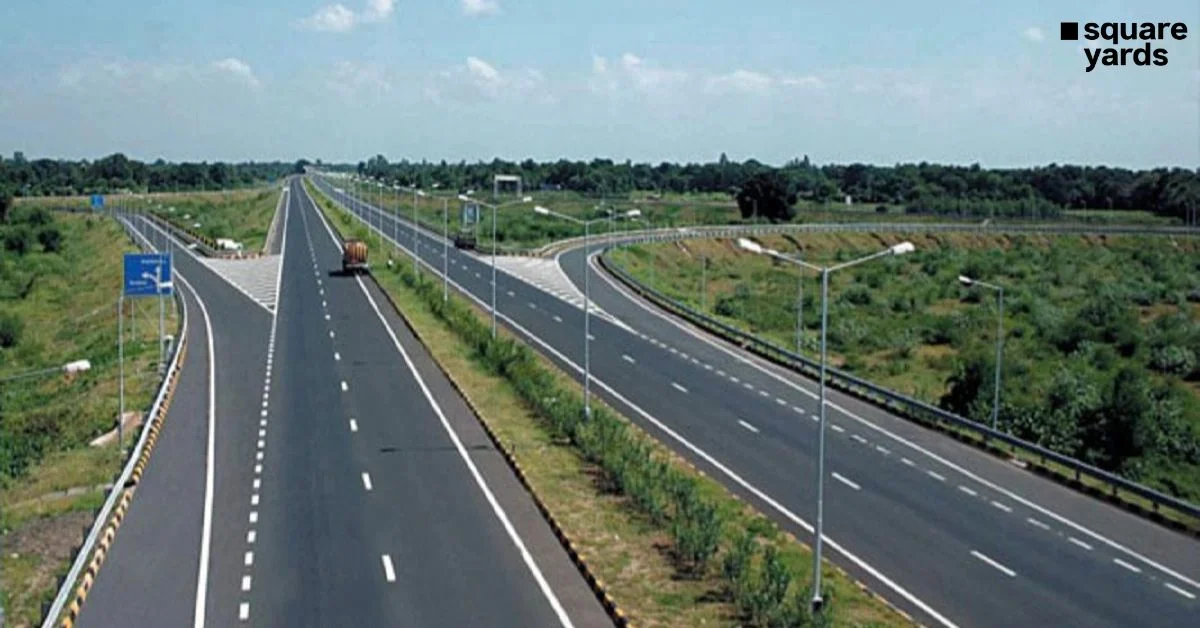
The landscape of Northern India is on the precipice of a tectonic shift. While the nation’s infrastructure narrative is often dominated by the sheer volume of highway construction, certain projects transcend the definition of mere civil engineering. The Delhi-Amritsar-Katra (DAK) Expressway is one such enterprise. Stretching across 670 kilometers of the Indo-Gangetic plain and into the Himalayan foothills, this expressway is evolving from a blueprint into a catalyst for regional re-alignment, industrial migration, and a significant repricing of real estate.
As the National Highways Authority of India (NHAI) nears the completion of critical stretches, the project is no longer just a promise of faster travel; it is becoming an active economic corridor that is already beginning to influence land values and investment strategies across three states and a union territory.
I. Main Facts: The Anatomy of a Mega-Project
The Delhi-Amritsar-Katra Expressway is a flagship project under the Bharatmala Pariyojana, designed to provide high-speed connectivity between the national capital and the spiritual and economic hubs of Punjab and Jammu & Kashmir.
Engineering and Capacity
The project is a 670-km long, four-lane (expandable to eight) access-controlled expressway. It is divided into two parts: a 397-km greenfield section connecting Delhi to Katra via Nakodar and Gurdaspur, and a brownfield section that branches off to Amritsar. Designed for a speed limit of 120 km/h, the expressway is engineered to drastically reduce transit times:
- Delhi to Amritsar: Reduced from 8 hours to 4 hours.
- Delhi to Katra: Reduced from 14 hours to 6 hours.
Strategic Nodes
The expressway traverses through several key industrial and religious hubs, including Bahadurgarh (Haryana), Sangrur, Ludhiana, Jalandhar, Amritsar (Punjab), and Kathua, Samba, Jammu, and Katra (J&K). By bypassing congested urban centers, the route facilitates a seamless flow of goods and pilgrims, effectively shrinking the distance between the National Capital Region (NCR) and the northernmost reaches of the country.
Current Milestone: The Balsua-Raya Stretch
The NHAI recently confirmed that the section from Balsua in Punjab to the Ring Road at Raya is structurally complete. This 100-kilometer stretch is strategically vital as it spans the border between Punjab and Jammu & Kashmir. In a move to facilitate religious tourism, authorities have signaled their intent to open this specific portion to Amarnath Yatra pilgrims by June, providing a high-speed alternative to the traditionally congested arterial roads.
II. Chronology: From Inception to Revised Deadlines
The trajectory of the DAK Expressway has been a study in ambition meeting administrative and environmental reality.
- 2019-2020: The project was conceptualized and approved as part of the Bharatmala Pariyojana, with an initial estimated cost of approximately 250 billion rupees. The original completion target was set for October 2023.
- 2021-2022: Land acquisition began in earnest across Haryana and Punjab. However, the project immediately faced headwinds in Punjab, where farmer protests and disputes over compensation rates slowed the handover of land to the NHAI.
- 2023: The deadline was pushed to 2025 as construction in the Jammu and Kashmir section faced geological challenges and disruptions caused by the security requirements of "Operation Sindhoor." Heavy monsoon rains and subsequent flooding in the 147-km J&K stretch further hampered progress.
- 2024 (Present): Physical progress on several packages, particularly those involving major river bridges over the Ravi, Ujh, Tarnah, and Basantar, has reached 85% to 95%. While the Balsua-Raya section is ready, the NHAI has officially acknowledged that the December 2026 deadline is no longer tenable for the entire corridor.
- The Future Horizon: March 2027 is now the internal target for the majority of the project, though Union Minister Nitin Gadkari has suggested that full, phased operationalization could extend into early 2028.
III. Supporting Data: The Cost of Progress
The scale of the DAK Expressway is reflected in its escalating financial and physical data. The project has seen a significant budget expansion, primarily due to rising raw material costs, increased land compensation, and the complexities of building high-capacity bridges in flood-prone zones.
Financial Escalation
The total project cost has climbed from the initial estimate of 250 billion rupees to approximately 389 billion rupees—an increase of over 55%. This escalation highlights the premium the government is willing to pay to ensure the strategic connectivity of the northern border regions.
Real Estate Benchmarks
As the expressway moves closer to completion, property values in the vicinity of planned interchanges have begun to appreciate. Current market data reveals a baseline that investors are watching closely:
- Amritsar: Average property prices stand at ₹7,126/sq. ft., with premium plots near the expressway route seeing higher asking rates.
- Ludhiana: A major industrial hub, Ludhiana currently averages ₹7,296/sq. ft.
- Malerkotla-Sangrur: These regions, traditionally agricultural, are seeing a spike in interest for logistics and warehousing, with average prices around ₹8,148/sq. ft.
Engineering Progress
The project involves the construction of several "mega-bridges." The Devak bridge near AIIMS Vijaypur is already operational, serving as a proof-of-concept for the expressway’s ability to handle heavy traffic loads even before the full corridor is linked.
IV. Official Responses and Administrative Hurdles
The government’s stance on the DAK Expressway remains one of high priority, tempered by a realistic assessment of ground-level challenges.
Union Minister Nitin Gadkari has frequently cited the DAK Expressway as a "game-changer" for the economy of Jammu and Kashmir. In recent statements, the Ministry of Road Transport and Highways (MoRTH) emphasized that while delays are regrettable, the quality of construction and the safety of the mountainous stretches cannot be compromised for the sake of speed.
NHAI Officials have pointed to "force majeure" events, including the 2023 floods in Northern India, as primary reasons for the revised timeline. They also highlight the difficulty of obtaining railway clearances for Over-Bridges (ROBs), which require intricate coordination with the Ministry of Railways.
In Punjab, the state government has been in a delicate negotiation with local landholders. The NHAI has, at various points, threatened to cancel certain packages if land acquisition was not expedited, leading to a renewed push by state authorities to resolve pending litigation and compensation disputes.
V. Implications: The "Ripple Effect" on Economy and Real Estate
The completion of the DAK Expressway will do more than just shave hours off a road trip; it will fundamentally alter the economic geography of North India.
1. The Real Estate "Sweet Spot"
Historically, the most significant appreciation in land value occurs in the "window of anticipation"—the period between the visible progress of a road (like the Balsua-Raya opening) and its final inauguration. Investors are currently targeting land near interchanges. A property five kilometers from an expressway exit is essentially part of a new "commuter zone," whereas land twenty kilometers away remains rural.
2. The Logistics and Warehousing Boom
The Ludhiana-Malerkotla-Sangrur belt is poised to become the logistics backbone of the North. With the expressway feeding directly into the Ludhiana-Delhi-Kolkata Industrial Corridor, this region will likely see a massive influx of investment in cold storage, distribution centers, and "just-in-time" manufacturing facilities.
3. Religious Tourism as an Economic Engine
Amritsar and Katra are two of the most visited destinations in India. By making these cities a comfortable day-trip or a weekend getaway from Delhi, the expressway will necessitate a massive expansion in the hospitality sector. We can expect a surge in demand for hotel rooms, branded resorts, and "second home" developments in the cooler climes of the Jammu foothills.
4. The Commuter Shift
The "four-hour logic" is a psychological threshold. Once Amritsar is only four hours from Delhi, it becomes a viable satellite for businesses and families who want to escape the congestion of the NCR while maintaining professional ties to the capital. This could lead to a "reverse migration" of affluent professionals moving back to Punjab, bolstered by high-speed connectivity.
5. Early Organic Adoption
The most telling indicator of the expressway’s value is the fact that residents of Ludhiana and Barnala are already using incomplete stretches to save 25% on fuel and time. This "organic adoption" proves that the demand for this infrastructure is not theoretical—it is immediate. Even without fuel stations or rest areas, the time-saving value proposition is high enough to draw traffic today.
Conclusion: The Road Ahead
The Delhi-Amritsar-Katra Expressway is a project of national significance that has survived the trials of land disputes, funding escalations, and environmental catastrophes. While the full completion may have shifted to 2027 or 2028, the opening of the Balsua-to-Raya stretch serves as a definitive signal to the market.
For the homebuyer, the industrialist, and the long-term investor, the message is clear: the corridor is no longer a "future project"—it is an unfolding reality. Those who recognize the shift in geography before the final ribbon-cutting will likely be the ones who reap the most significant rewards of this infrastructure-led transformation.
