

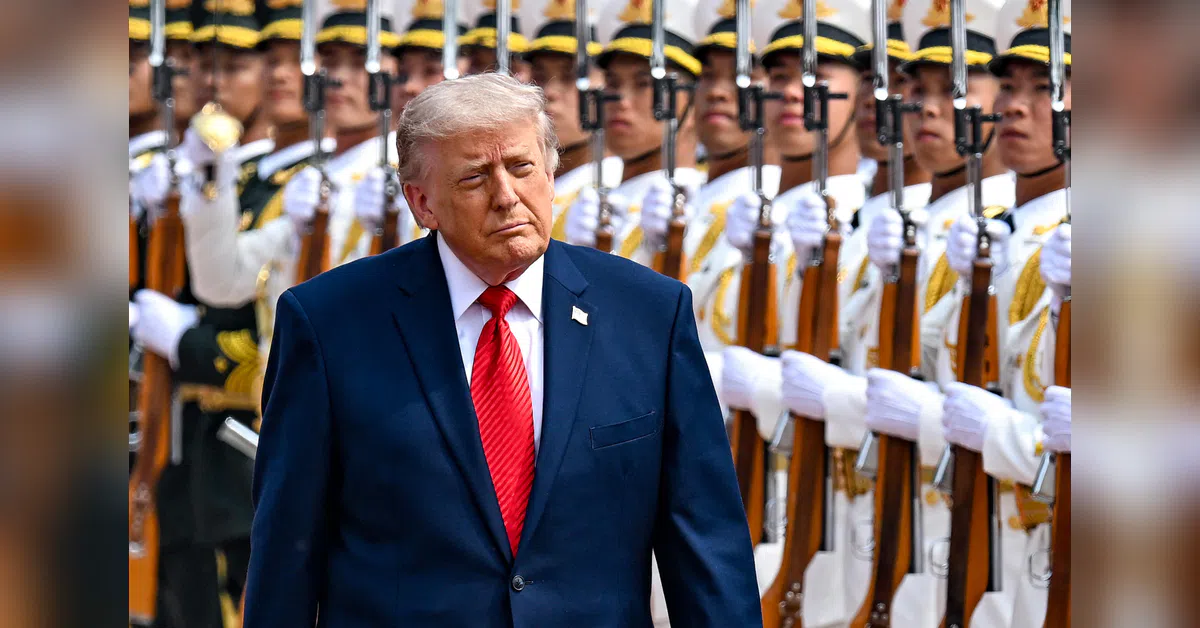
Washington D.C. / Beijing – In a dramatic pronouncement following a high-stakes two-day visit to China, then-US President Donald Trump signaled a potential, profound reorientation of Washington’s long-standing policy towards Taiwan. Speaking candidly in an interview with Fox News, Trump declared that the United States was not looking to "travel 9,500 miles to fight a war" over Taiwan’s independence, a statement that immediately sent ripples through diplomatic circles and raised urgent questions about the future of America’s carefully calibrated doctrine of strategic ambiguity.
The President’s remarks, delivered with characteristic bluntness, represent a significant departure from the traditionally nuanced language employed by US leaders regarding Taiwan’s status. They not only underscored the immense logistical and military challenges of defending the island but also explicitly cautioned Taiwan against pursuing formal independence, a move Beijing considers a red line. This unexpected candor from the Oval Office threatened to upend the delicate balance that has preserved peace and stability in the Taiwan Strait for decades, forcing a re-evaluation of US commitments and regional security dynamics.
A New Chapter in Cross-Strait Rhetoric: Main Facts Unveiled
During his post-visit interview, President Trump left little room for misinterpretation regarding his personal perspective on the Taiwan question. His primary concern, he articulated, was the potential for the United States to be drawn into a distant and costly conflict. "I’m not looking to have somebody go independent and we’re supposed to travel 9,500 miles to fight a war. I’m not looking for that. I want them to cool down. I want China to cool down," Trump stated, encapsulating a desire for de-escalation that seemingly prioritized avoiding military confrontation over explicitly endorsing Taiwan’s self-determination.
He further elaborated on the deep-seated importance of Taiwan to Chinese President Xi Jinping, recalling their previous interactions. "It has always been his most important thing from the day I knew him years ago. It’s always been the biggest thing for him, Taiwan," Trump recounted, acknowledging Beijing’s unwavering stance on the issue. This recognition of China’s core national interest was paired with a belief that the People’s Republic would accept the current "status quo" as long as Taiwan did not declare independence. "If you kept it the way it is, I think China is going to be okay with that. We are not looking to have somebody say let’s go independent because the United States is backing us," he added.
Crucially, Trump asserted that Taiwan’s leadership was actively "moving towards independence" under the presumption of Washington’s military backing. "They are going independent because they want to get into a war, and they figure they have the United States behind them. I would like to see it stay the way it is," he claimed, shifting a degree of responsibility for potential conflict onto Taiwan itself. These statements represent a marked rhetorical pivot, potentially signalling a more transactional and less ideologically driven approach to one of the world’s most sensitive geopolitical flashpoints.
A High-Stakes Trip and Its Aftermath: A Chronological Overview
The genesis of these provocative statements lies in President Trump’s "high-stakes" two-day visit to China, a trip aimed at addressing a myriad of complex bilateral issues, including trade imbalances, North Korea’s nuclear ambitions, and regional security. While the official readouts of the meetings emphasized areas of cooperation and mutual understanding, the post-visit interview provided an unfiltered glimpse into the private discussions and Trump’s personal takeaways regarding the Taiwan issue.
The timing of Trump’s comments is critical. Coming directly after face-to-face discussions with President Xi Jinping, they suggest either a direct influence from the Chinese leader’s arguments or a strategic calculation by Trump to de-escalate tensions in the Strait as a concession or a means to secure other diplomatic gains. Xi Jinping, during his discussions with Trump, had explicitly reiterated Beijing’s firm and consistent position on Taiwan. According to a statement released by the Spokesperson of the Ministry of Foreign Affairs of China, Xi stressed that the Taiwan question remains the "most important issue" in China-US relations.
"President Xi stressed to President Trump that the Taiwan question is the most important issue in China-U.S. relations. If it is handled properly, the bilateral relationship will enjoy overall stability. Otherwise, the two countries will have clashes and even conflicts, putting the entire relationship in great jeopardy," the statement read, laying bare the profound significance Beijing attaches to the matter. Xi further underscored the irreconcilability of "Taiwan independence" with cross-Strait peace, describing them as "as irreconcilable as fire and water," and positing that "safeguarding peace and stability across the Taiwan Strait is the biggest common denominator between China and the U.S."
These Chinese statements, delivered during the bilateral meetings, provide the immediate contextual backdrop against which Trump’s subsequent remarks must be understood. They reveal the immense pressure applied by Beijing on Washington regarding Taiwan, and Trump’s Fox News interview appears, at least superficially, to reflect an absorption of or strategic response to this pressure.
The Bedrock of Policy: Supporting Data and Historical Context
To fully grasp the magnitude of Trump’s comments, it is essential to understand the long-standing framework of US policy towards Taiwan: strategic ambiguity. This doctrine, in place since the late 1970s, purposefully leaves open the question of whether the United States would militarily intervene if China were to attack Taiwan. Its genius lies in its dual deterrence: it aims to dissuade Beijing from invading Taiwan by keeping open the possibility of US military intervention, while simultaneously discouraging Taiwan from unilaterally declaring independence by not guaranteeing intervention.
This policy is intricately linked to the "One China" policy, under which the United States officially acknowledges the People’s Republic of China’s position that there is only one China and Taiwan is part of it. However, the US simultaneously maintains robust unofficial relations with Taiwan through the Taiwan Relations Act (TRA) of 1979. The TRA commits the US to providing Taiwan with "arms of a defensive character" and to "maintain the capacity of the United States to resist any resort to force or other forms of coercion that would jeopardize the security, or the social or economic system, of the people on Taiwan." This carefully crafted diplomatic tightrope has been the cornerstone of stability in the region.
Trump’s pronouncements, by explicitly stating a reluctance to "fight a war" for Taiwan’s independence, introduce a degree of strategic clarity that paradoxically undermines the very ambiguity designed to maintain peace. While the Trump Administration’s own 2025 National Security Strategy, as recorded in US Congressional records, reaffirmed that "deterring a conflict over Taiwan" remains a priority and that the United States "does not support any unilateral change to the status quo in the Taiwan Strait," the President’s personal rhetoric casts a long shadow over these official policy declarations.
Taiwan itself is a democratic, self-governing entity with a population of over 23 million people. It boasts a vibrant economy, most notably its dominance in the global semiconductor industry through Taiwan Semiconductor Manufacturing Company (TSMC), a critical supplier of advanced chips essential for everything from smartphones and artificial intelligence to defense systems. The island’s strategic location in the first island chain further amplifies its geopolitical significance, serving as a vital bulwark against potential Chinese expansion into the Pacific. For China, Taiwan represents an unfinished civil war and an integral part of its national territory, the "core of core interests," whose "reunification" is a non-negotiable historical imperative.
Official Responses and Unofficial Interpretations
The immediate "official response" from the US side came directly from President Trump himself in the Fox News interview, an unusual conduit for such a significant policy signal. Unlike carefully worded statements from the State Department or National Security Council, Trump’s remarks were raw, personal, and seemingly unscripted. This directness, while characteristic of his communication style, magnified the uncertainty surrounding actual US policy.
From Beijing’s perspective, Xi Jinping’s reiteration of Taiwan as the "most important issue" and his stark warning about potential "clashes and even conflicts" if mishandled, were the official Chinese responses communicated directly to the US President. These statements, later publicized by the Chinese Foreign Ministry, underscored China’s unwavering determination on the issue and its readiness to escalate if Taiwan were to declare independence. The fact that Trump’s post-visit remarks appeared to align, at least in part, with Beijing’s desire to deter Taiwanese independence could be interpreted by China as a partial diplomatic victory or a sign of increasing leverage.
Domestically within the United States, Trump’s statements elicited a range of reactions. While some of his supporters might view it as a pragmatic, "America First" approach to foreign policy, prioritizing US interests and avoiding costly foreign entanglements, others, particularly foreign policy hawks and proponents of a strong US stance in the Indo-Pacific, expressed deep concern. They argued that such explicit statements could weaken deterrence, embolden Beijing, and undermine trust among US allies in the region who rely on American security assurances. There was no immediate clarification or walk-back from other senior administration officials, allowing Trump’s words to hang in the air, shaping perceptions of US intent.
Geopolitical Ripples: Profound Implications for the Future
The implications of President Trump’s statements are multi-layered and far-reaching, potentially reshaping the geopolitical landscape of the Indo-Pacific and beyond.
Implications for US Credibility and Alliances:
The most immediate concern is the potential erosion of US credibility among its regional allies. Countries like Japan, South Korea, the Philippines, and Australia, all of whom have their own complex relationships with China and rely on the US security umbrella, might interpret Trump’s remarks as a sign of wavering commitment. If the US signals a reluctance to defend a democratic partner like Taiwan, questions will inevitably arise about its willingness to stand by other treaty allies in the face of Chinese assertiveness. This could lead to a frantic search for alternative security arrangements or, conversely, a greater capitulation to Beijing’s demands.
Implications for Taiwan’s Security and Sovereignty:
For Taiwan, Trump’s comments are particularly unsettling. While the US National Security Strategy officially supports "deterring a conflict over Taiwan" and "does not support any unilateral change to the status quo," the President’s personal remarks could be perceived as a softening of resolve. This could undermine the confidence of Taiwan’s government and its populace, making them feel more vulnerable. Simultaneously, it might encourage elements within Taiwan who advocate for a more cautious approach to independence, fearing that overt moves could lead to abandonment by Washington. The accusation that Taiwan’s leadership was "going independent because they want to get into a war" is also likely to be met with strong rebuttal from Taipei, which consistently maintains its commitment to the status quo and peaceful resolution.
Implications for China’s Regional Ambitions:
Conversely, Beijing might view Trump’s statements as an encouraging sign. A perceived weakening of US resolve could embolden China to increase its military pressure on Taiwan, step up its grey-zone tactics, or even accelerate its timetable for "reunification." While China’s ultimate goal remains unchanged, a perceived shift in the US calculus could influence the means and timeline by which Beijing pursues its objectives. It could also reinforce China’s narrative that the US is a declining power unwilling to pay the cost for its commitments abroad.
The Future of Strategic Ambiguity:
Trump’s comments have undeniably injected a degree of strategic clarity into the historically ambiguous US stance. While some analysts have long argued for abandoning strategic ambiguity in favor of strategic clarity (explicitly stating the US would defend Taiwan), Trump’s version of clarity appears to lean towards non-intervention in certain scenarios, which is precisely the outcome strategic ambiguity was designed to prevent. This raises fundamental questions about whether the doctrine can survive such direct presidential challenges and what its erosion means for regional stability.
Economic and Global Stability:
Beyond military and diplomatic concerns, the potential for conflict in the Taiwan Strait carries catastrophic economic implications. Taiwan’s pivotal role in the global semiconductor supply chain means that any disruption, let alone a full-scale conflict, would trigger a worldwide economic crisis, far surpassing the impact of previous supply chain shocks. Trump’s "America First" lens, prioritizing the avoidance of US military costs, might not fully account for the immense economic devastation that would ensue globally from a conflict over Taiwan, indirectly harming American prosperity as well.
A New Precedent for US Foreign Policy?
Finally, Trump’s remarks raise questions about the broader trajectory of US foreign policy. His "America First" doctrine often emphasized a reluctance for costly overseas engagements, a skepticism towards traditional alliances, and a preference for bilateral deal-making. His Taiwan comments fit this mold, suggesting a transactional approach where the perceived direct cost to the US might outweigh broader strategic considerations or ideological commitments to democratic partners. This approach could set a precedent for how future US administrations might weigh their commitments in other hotspots around the globe.
In conclusion, President Trump’s post-China visit remarks on Taiwan represent more than just a rhetorical flourish. They reflect a potentially profound shift in the US’s approach to one of the world’s most dangerous flashpoints, challenging decades of carefully constructed policy. By openly questioning the rationale for military intervention and cautioning Taiwan against independence, Trump injected unprecedented uncertainty into the delicate balance of power in the Taiwan Strait. The repercussions of these statements will continue to unfold, testing the resilience of alliances, the resolve of nations, and the very foundations of peace and stability in the Indo-Pacific.
