

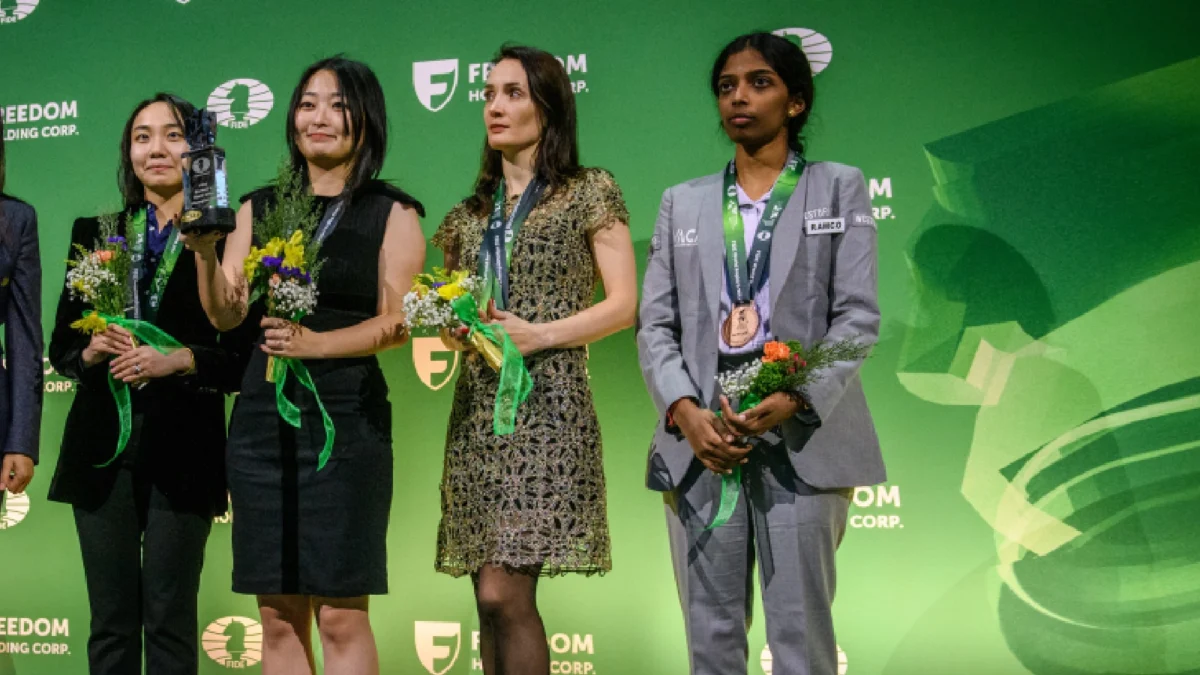
NEW YORK, May 16, 2026 – The chess world is buzzing with anticipation as the Women’s World Chess Championship draws closer, pitting reigning five-time champion Ju Wenjun of China against India’s rising star Rameshbabu Vaishali. Adding significant weight to the pre-match discourse, legendary Grandmaster Judit Polgar, widely considered the strongest woman to ever play chess, has offered her expert analysis, unequivocally naming Ju Wenjun as the clear favorite to defend her title for a record sixth time. Polgar’s endorsement underscores the monumental challenge awaiting Vaishali, emphasizing the need for substantial improvement to contend with the seasoned champion.
Polgar’s remarks, shared through an interview with FIDE, the international chess federation, highlight the critical role of experience in high-stakes encounters such as a World Championship match. "Well, it’s a very tough match and very interesting. Ju Wenjun already has experience playing in World Championship matches. She’s very tough, very much ready for long games, and the big experience is something that matters a lot," Polgar stated, outlining the formidable qualities that have cemented Ju’s dominance.
The Hungarian maestro acknowledged Vaishali’s burgeoning talent but stressed the steep learning curve she faces. "For Vaishali, it will be a very big challenge, and I think she will have to improve quite a bit to be ready for the World Championship match. Well, let’s see if experience will win or the younger generation," she mused, setting the stage for a compelling narrative of veteran wisdom versus youthful ambition. When pressed for her ultimate pick, Polgar reiterated, "Well, experience is always something that matters a lot, and in this case also, it’s clearly Ju Wenjun who is the favourite."
This highly anticipated championship, slated for late 2026 or early 2027, promises to be a captivating spectacle, representing a clash of generations and playing styles, with the weight of national expectations resting on both competitors.
The Main Facts: A Clash of Titans and Generations
At its core, the upcoming Women’s World Chess Championship is more than just a battle for a coveted title; it’s a narrative rich with contrasting profiles and compelling storylines. On one side stands Ju Wenjun, the embodiment of consistent excellence and steely resolve, a player who has meticulously built a legacy over nearly a decade. Her reign since 2018 has been marked by a relentless pursuit of perfection and an unyielding ability to perform under immense pressure. Her five successful title defenses are a testament to her profound understanding of championship match dynamics, her psychological fortitude, and her comprehensive chess skill across all phases of the game.
Her opponent, Rameshbabu Vaishali, represents the vibrant new wave of Indian chess talent. Her journey to the challenger’s seat is a Cinderella story in itself. As the lowest-rated and lowest-seeded participant at the recently concluded Candidates Tournament in Cyprus, Vaishali defied all expectations, navigating a field of elite grandmasters to emerge victorious. This triumph was not merely a stroke of luck but the culmination of years of dedicated effort, marked by significant successes in other major international tournaments. Her victory signals a shift, a challenge to the established order, and an exciting prospect for the future of women’s chess.
Judit Polgar’s pronouncement, therefore, is not just an opinion but an expert assessment from a player who redefined what was possible for women in chess. Polgar’s own career, spent competing and excelling against the world’s absolute top male grandmasters, gives her an unparalleled perspective on the mental and strategic demands of elite-level chess, particularly in championship formats. Her prediction, favoring Ju Wenjun’s experience, is a sobering reminder of the chasm that often exists between strong tournament play and the unique crucible of a world championship match.
The match will also carry significant geopolitical and cultural implications. China has long been a powerhouse in women’s chess, with a conveyor belt of champions, and Ju Wenjun is the latest and arguably most dominant figure in this lineage. India, on the other hand, is experiencing an unprecedented chess boom, fueled by a generation of young prodigies, many of whom hail from Chennai, including Vaishali and her younger brother, the phenomenal R Praggnanandhaa. This championship thus becomes a proxy battle for national chess supremacy, intensifying the global interest in the contest.
Chronology of Dominance and Ascent
Ju Wenjun’s Uninterrupted Reign
Ju Wenjun’s path to becoming one of the most formidable figures in women’s chess began well before her first world title. Born in Shanghai in 1991, she showed early promise, achieving the Grandmaster title in 2009. Her rise through the ranks was steady, marked by consistent performances in various FIDE Grand Prix events and other prestigious tournaments.
Her first taste of the World Championship crown came in 2018. In a closely contested match against fellow Chinese Grandmaster Tan Zhongyi, Ju emerged victorious, claiming the title. What followed was an extraordinary display of resilience and strategic mastery.
- 2018 (second championship of the year): Following a change in FIDE’s championship cycle, Ju had to defend her title later that same year in a knockout format in Khanty-Mansiysk, Russia. She successfully navigated the challenging format, defeating Russian Grandmaster Kateryna Lagno in the final to retain her crown. This back-to-back triumph within months cemented her status as a force to be reckoned with.
- 2020: Ju faced her compatriot Aleksandra Goryachkina in a highly anticipated match held across Shanghai and Vladivostok. The match was a grueling affair, tied after the classical games and going into a rapid playoff, where Ju’s nerves of steel and quick thinking ultimately prevailed, securing her third title.
- 2021 (Women’s World Cup victory): While not a World Championship match, Ju’s victory at the Women’s World Cup further showcased her dominance and versatility in different formats.
- 2023: Her most recent defense saw her face another strong Chinese contender, Lei Tingjie, in a match held in Shanghai and Chongqing. Again, Ju demonstrated her championship mettle, successfully defending her title and proving her continued reign at the pinnacle of women’s chess.
Throughout these defenses, Ju has consistently showcased a blend of deep positional understanding, precise tactical execution, and an almost unflappable demeanor under pressure. Her ability to reset and refocus after difficult games, as highlighted by Grandmaster Pentala Harikrishna, is a hallmark of her championship pedigree.
Vaishali Rameshbabu: From Prodigy’s Sister to World Challenger
Rameshbabu Vaishali’s journey into the spotlight has been equally compelling, though following a different trajectory. Hailing from Chennai, India, a city that has become a hotbed for chess talent, Vaishali grew up alongside her younger brother, R Praggnanandhaa, who himself became one of the youngest Grandmasters in history. For years, Vaishali was known primarily as "Praggnanandhaa’s sister," a formidable talent in her own right, but often overshadowed by her sibling’s rapid ascent.
However, Vaishali has steadily carved out her own unique identity and legacy. Her dedication to chess, evident from a young age, began yielding significant results on the international stage.
- 2015: Vaishali won the World Youth Chess Championship U14 girls’ title.
- 2017: She followed this up with another gold, winning the World Youth Chess Championship U17 girls’ title.
- 2021: Vaishali achieved the coveted Grandmaster title, a significant milestone that firmly placed her among the global elite.
- 2022-2023: She had back-to-back victories at the FIDE Grand Swiss tournament, an incredibly strong open tournament that serves as a qualifier for the Candidates. Winning this event once is remarkable; doing it twice consecutively underscored her consistent strength and ability to perform under pressure against a diverse field of strong players.
- 2024 (Toronto Candidates): Vaishali continued her impressive run, finishing joint second at the prestigious Candidates Tournament, signaling her readiness for the absolute top tier.
- 2026 (Cyprus Candidates): This was her breakthrough moment. Entering as the lowest-rated and lowest-seeded player, Vaishali played with an audacious yet mature style, displaying incredible resilience and strategic depth. Her victory was a stunning upset, a testament to her profound growth and unwavering belief in her abilities. This triumph not only earned her the right to challenge Ju Wenjun but also captured the imagination of the chess world, particularly in India.
Vaishali’s ascent is not just a personal achievement but a symbol of the burgeoning chess talent in India, particularly among women. Her success provides immense inspiration for a new generation of players looking to emulate her journey from a promising junior to a world championship challenger.
Supporting Data: A Deep Dive into Performance Metrics and Psychological Fortitude
The assessment by Judit Polgar, favoring Ju Wenjun, is rooted in concrete data points and the nuanced psychological aspects of championship chess.
The Experience Factor: Ju Wenjun’s Track Record
Ju Wenjun’s statistics paint a clear picture of a champion who thrives under pressure. Her FIDE rating has consistently hovered around the 2550-2570 mark, placing her among the top women players globally for years. However, it’s not just her rating but her performance in the most critical moments that distinguishes her.
- Match Play Prowess: World Championship matches are fundamentally different from open tournaments. They are grueling, often multi-game affairs where endurance, psychological resilience, and the ability to adapt to a single opponent’s style are paramount. Ju has demonstrated this repeatedly across five successful defenses. She has faced different challenges – from the direct confrontational style of Tan Zhongyi to the tactical ingenuity of Lei Tingjie and the sheer fighting spirit of Goryachkina – and emerged victorious each time.
- Psychological Strength: Pentala Harikrishna, a former India No. 1 and a highly respected Grandmaster, eloquently captured this facet of Ju’s game. "Even if you’re strong, a world championship match is a different beast. Her experience from four previous title defences helps, but what’s remarkable is her sustained intensity against younger, hungry opponents like [Aleksandra] Goryachkina and Lei [Tingjie]," he told The Indian Express in 2025. This "sustained intensity" speaks volumes about her mental preparation and capacity to withstand prolonged periods of high-stress competition.
- Ability to Reset: Harikrishna further elaborated on Ju’s remarkable ability to compartmentalize and recover from setbacks. "We were trailing after the first six games, and though she had chances in the second half, she kept missing them. Yet, miraculously, she’d arrive fresh for the next round. People at press conferences often asked me how tired she looked, but I knew that’s just how she was built," he recalled. This capacity to detach from past results and approach each new game with a clear mind is an invaluable asset in a championship match, where momentum shifts can be brutal.
These attributes are not easily acquired; they are honed through years of top-level competition and, crucially, repeated exposure to the unique demands of championship match play.
Vaishali’s Ascendance: Momentum and Potential
Vaishali’s recent surge, culminating in her Candidates victory, cannot be overstated. Her current FIDE rating, while lower than Ju’s, has been on a sharp upward trajectory. Her performances in events like the FIDE Grand Swiss, which she won twice consecutively, indicate a player who is not only capable of winning strong tournaments but also possesses the endurance required for multi-round events.
- Candidates Performance: Her triumph in Cyprus, where she was the lowest-rated participant, is perhaps the most compelling evidence of her potential. To outperform higher-rated and more experienced players in such a high-stakes qualifier demonstrates a remarkable blend of tactical sharpness, strategic depth, and mental toughness. She showcased an aggressive yet calculated approach, often outmaneuvering her opponents in complex positions.
- Playing Style: Vaishali’s games often feature dynamic and imaginative play. She is known for her willingness to take risks and explore unconventional lines, which can be both a strength and a potential vulnerability against a rock-solid opponent like Ju. Her ability to generate complications and thrive in messy positions could be a key factor in trying to unsettle the champion.
- Youthful Energy: The "younger generation" aspect highlighted by Polgar is a double-edged sword. While youth brings boundless energy, fresh ideas, and less accumulated pressure from past championship failures, it also lacks the specific experience of navigating a World Championship match. Vaishali has not yet faced the psychological gauntlet of a one-on-one, multi-game match against a reigning champion.
The statistical comparison, therefore, points to Ju’s proven ability in the championship format versus Vaishali’s undeniable momentum and potential. The ELO rating difference, while significant, does not fully encapsulate the unique challenges of a World Championship match.
Official Responses and Expert Opinions
Judit Polgar’s pronouncement is the most significant expert opinion to date regarding the upcoming championship. Her voice carries immense authority within the chess community. Polgar, who broke countless barriers in her career, including becoming the youngest Grandmaster at the time (surpassing Bobby Fischer’s record) and being the only woman to reach the world’s top 10, understands the nuances of elite chess like few others. Her perspective as someone who competed directly against the likes of Kasparov and Karpov makes her assessment particularly insightful.
The International Chess Federation (FIDE) has been instrumental in organizing the Women’s World Chess Championship cycle, and their public statements generally maintain neutrality, focusing on the fairness and integrity of the competition. However, the release of Polgar’s video by FIDE itself suggests an acknowledgement of the weight her opinion carries and its ability to generate public interest. The FIDE tweet featuring Polgar’s comments further amplifies this, framing the match as a compelling "clash" between two formidable players.
While specific official responses from the Chinese Chess Association or the All India Chess Federation regarding Polgar’s prediction haven’t been widely publicized, their focus will undoubtedly be on supporting their respective players. The Chinese Chess Association will likely emphasize Ju Wenjun’s experience and track record, while the All India Chess Federation will rally behind Vaishali, highlighting her recent incredible form and the national pride she embodies.
Beyond Polgar, other chess experts and commentators have begun to weigh in. Many echo Polgar’s sentiment regarding Ju’s experience, while others point to Vaishali’s dynamic play and the unpredictable nature of chess. The general consensus acknowledges Ju’s formidable standing but also expresses excitement for Vaishali’s fresh challenge. The narrative of "experience vs. youth" is a recurring theme, fueling discussions across chess forums and media outlets.
Implications: Shaping the Future of Women’s Chess
The outcome of the Ju Wenjun vs. Rameshbabu Vaishali World Championship match will have profound implications, not just for the players involved but for the broader landscape of women’s chess and the global chess community.
Impact on Indian Chess
For India, a Vaishali victory would be nothing short of historic. It would mark the first time an Indian woman has held the undisputed Women’s World Chess Championship title, a monumental achievement that would further cement India’s status as a global chess superpower. Such a triumph would undoubtedly ignite a fresh wave of enthusiasm for chess, particularly among young girls, providing a powerful role model and inspiring countless aspiring players. The "Praggnanandhaa and Vaishali" story would become even more legendary, showcasing the potential of siblings from the same family reaching the absolute pinnacle of the sport. Even a strong, competitive showing from Vaishali, regardless of the ultimate outcome, would significantly elevate her profile and further boost the burgeoning chess scene in India.
Impact on Chinese Chess
For China, Ju Wenjun’s continued dominance would reaffirm their unparalleled strength in women’s chess. A record sixth title defense would solidify her legacy as arguably the greatest woman player of her generation, and among the greatest of all time. It would also signal the continued health and depth of the Chinese chess program, which consistently produces world-class talent. While a loss would be a setback, China’s system is robust enough to produce new contenders, but Ju’s reign is a source of immense national pride and a benchmark for excellence.
The "Experience vs. Youth" Narrative and Global Interest
The central theme of "experience vs. the younger generation," as articulated by Polgar, resonates deeply with sports fans beyond the confines of chess. This timeless narrative draws in a wider audience, creating a compelling human interest story. A victory for Ju would underscore the enduring value of seasoned expertise and psychological mastery, while a Vaishali triumph would celebrate the dynamism, fearlessness, and raw talent of youth. This clash of archetypes is crucial for generating mainstream media attention and attracting new fans to the sport.
Future of Women’s Chess
Regardless of the victor, the match promises to showcase the incredible talent and competitive spirit present in women’s chess today. The fact that a player like Vaishali, initially an underdog, could fight her way to challenge the reigning champion speaks volumes about the increasing competitiveness and depth of the women’s circuit. Such high-profile matches are vital for promoting women’s chess, increasing prize funds, and encouraging more female participation at all levels.
The championship is not just a competition; it is a platform. It highlights the intellectual rigor, strategic brilliance, and mental fortitude required to excel at the highest echelons of chess. Judit Polgar’s early verdict adds a layer of anticipation and expectation, framing the match not just as a contest, but as a potential turning point in the storied history of women’s world chess. The world waits to see whether the wisdom of experience or the fire of youth will ultimately prevail.
