

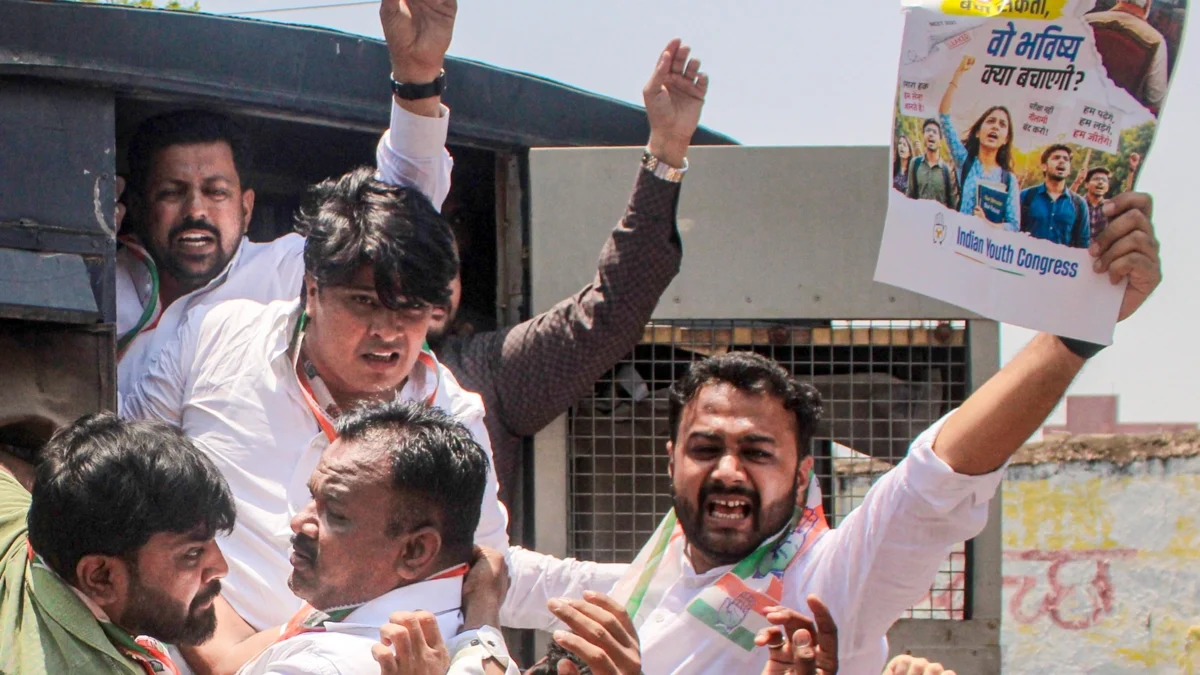
New Delhi, May 19, 2026 – In the wake of the burgeoning National Eligibility cum Entrance Test (NEET-UG) paper leak scandal, a powerful parliamentary committee has announced a comprehensive review of the National Testing Agency’s (NTA) reform implementation. The Standing Committee on Education, Women, Children, Youth and Sports, under the leadership of Congress leader Digvijaya Singh, will delve into the efficacy of measures recommended by a high-level panel to overhaul the NTA, a body that has increasingly come under fire for its handling of critical national examinations.
The committee’s decision signals a significant escalation of oversight on the NTA, a crucial but beleaguered institution responsible for conducting a multitude of entrance examinations for higher education and professional courses. The impending review comes at a critical juncture, as public trust in the integrity of these examinations erodes with each unfolding detail of the NEET-UG irregularities.
Key Developments and Committee Mandate
The parliamentary committee’s renewed focus on the NTA’s performance is a direct response to the widespread outrage and demands for accountability following the alleged paper leak in the NEET-UG 2026 examination. The committee has summoned Vineet Joshi, Secretary in the Ministry of Education’s Department of Higher Education, and Pradeep Kumar Joshi, Chairperson of the NTA, for a crucial appearance on May 21st. This session is expected to be a no-holds-barred examination of the NTA’s operational procedures, its susceptibility to malpractices, and the steps taken – or not taken – to fortify its examination processes.
At the heart of the committee’s review lies the implementation status of a comprehensive report submitted in 2024. This report was the outcome of a seven-member expert committee, meticulously chaired by former ISRO chief K. Radhakrishnan. This earlier committee was itself a consequence of a previous NEET-UG paper leak in 2024, underscoring a disturbing pattern of recurrent failures. The Radhakrishnan committee had meticulously outlined a series of recommendations aimed at strengthening the NTA’s structural and operational capabilities, with the overarching goal of ensuring the seamless and secure conduct of public examinations. The current parliamentary committee’s mandate is to ascertain whether these vital recommendations have been translated into tangible reforms or remain mere bureaucratic pronouncements.
A History of Concerns: Past Reports and Financial Oversight
The parliamentary committee’s involvement is not new. A report presented to Parliament last year, which reviewed the functioning of autonomous bodies and institutions including the NTA and the National Assessment and Accreditation Council (NAAC), had already voiced significant concerns about the NTA’s performance. The report had unequivocally stated that the NTA "has not inspired much confidence." This damning assessment was accompanied by stark financial figures that raised further questions.
The NTA, in the last six years preceding that report, had amassed a substantial revenue of Rs 3,512.98 crore, while its expenditures amounted to Rs 3,064.77 crore, leaving a surplus of Rs 448 crore. The parliamentary panel had strongly recommended that this considerable financial surplus be strategically deployed to enhance the NTA’s in-house capabilities for conducting examinations. Furthermore, the committee had advocated for a robust strengthening of its regulatory and monitoring mechanisms for third-party vendors and agencies contracted for examination-related services. The current review will likely scrutinize how this financial prudence has been translated into enhanced security and administrative competence, or if it has instead become a source of criticism for being underutilized in crucial areas.
Political Fallout and Privilege Notice
The escalating crisis has also spilled into the political arena, with serious repercussions for the Union Education Minister, Dharmendra Pradhan. In a significant development, Jairam Ramesh, the Congress chief whip in the Rajya Sabha, has formally moved a privilege notice against Minister Pradhan. The notice alleges that the minister’s remarks at a press conference following the NEET-UG 2026 paper leak have "lowered the dignity of Parliament."
The controversial statements were made last week when Minister Pradhan was questioned about the concerns previously raised by the Parliamentary Standing Committee in its report. In his response, the minister reportedly stated, "I will not go by the opinion of the parliamentary committee. I will go by the recommendation of the Radhakrishnan committee… I will proceed based on facts; we won’t talk about assumptions. In political tones… I will respond in Parliament… The parliamentary standing committee has Opposition members. They write in a certain way, you also know that."
This dismissive attitude towards the parliamentary committee’s findings, particularly the suggestion that its reports are influenced by partisan politics, has drawn sharp criticism. Digvijaya Singh, the committee chairman, publicly condemned the minister’s statement on X (formerly Twitter), calling it "deeply disturbing and highly condemnable." Singh highlighted that of the 30 Members of Parliament serving on the committee, 17 are from the ruling BJP itself, underscoring the bipartisan nature of the committee’s previous reports on the NTA. He further pointed out that both reports concerning the NTA – Report 364 and Report 371 – were adopted unanimously by the committee, which includes members from various political parties. Singh emphasized that the committee’s recommendations even incorporated a reiteration of the K. Radhakrishnan Expert Committee’s findings. He concluded by stating that the minister’s refusal to acknowledge the Parliamentary Standing Committee constitutes a dismissal of his own party’s MPs and the established bipartisan traditions of the Indian Parliament.
Chronology of Events and Mounting Pressure
The current crisis surrounding the NEET-UG 2026 examination and the NTA’s role can be traced through a series of critical junctures:
- 2024: A NEET-UG paper leak incident necessitates the formation of a seven-member expert committee headed by former ISRO chief K. Radhakrishnan. This committee is tasked with recommending reforms to strengthen the NTA.
- 2024 (Later): The Parliamentary Standing Committee on Education, Women, Children, Youth and Sports presents a report reviewing autonomous bodies, including the NTA. This report expresses a lack of confidence in the NTA and recommends the utilization of its financial surplus for capability building and vendor oversight.
- May 2026 (Early): Allegations of a paper leak surface regarding the NEET-UG 2026 examination, leading to widespread protests and demands for a thorough investigation.
- May 2026 (Mid): The Union Education Minister, Dharmendra Pradhan, addresses a press conference, making remarks that are later criticized for demeaning the Parliamentary Standing Committee.
- May 19, 2026: The Parliamentary Standing Committee announces its decision to review the implementation of the NTA reform report and the ongoing NEET-UG paper leak investigation.
- May 21, 2026: Vineet Joshi (Secretary, Department of Higher Education) and Pradeep Kumar Joshi (Chairperson, NTA) are scheduled to appear before the parliamentary committee.
- May 20, 2026: Jairam Ramesh, Congress chief whip in the Rajya Sabha, moves a privilege notice against Union Education Minister Dharmendra Pradhan.
This timeline highlights a recurring pattern of examination irregularities and a reactive approach to reform. The current parliamentary review aims to break this cycle by demanding accountability and ensuring that past recommendations are not merely relegated to dusty official records.
Supporting Data and NTA’s Financial Standing
The NTA’s financial health, as highlighted in previous parliamentary reports, presents a complex picture. The agency’s substantial revenue generation over six years, coupled with a significant surplus, raises questions about resource allocation. While the exact figures for the most recent financial year may not be publicly available, the trend of accumulating funds with a considerable surplus suggests that financial constraints are unlikely to be the primary impediment to robust reform.
The key concern, therefore, shifts to the effectiveness of the NTA’s operational architecture, its internal security protocols, its vendor management systems, and its overall capacity to prevent and detect malpractices. The Rs 448 crore surplus, as previously noted, was intended for enhancing the NTA’s capabilities and regulatory oversight. The current review will seek to ascertain how this surplus has been utilized and whether it has demonstrably contributed to improved examination integrity. The committee will likely probe into investments made in technology, personnel training, and the development of robust anti-cheating mechanisms.
Official Responses and the Path Forward
The summoning of top officials from the Ministry of Education and the NTA by the Parliamentary Standing Committee represents a crucial official response to the public outcry. This move signifies the gravity with which the committee views the alleged NEET-UG paper leak and the systemic issues at the NTA. The scheduled appearance of Vineet Joshi and Pradeep Kumar Joshi is an opportunity for them to present their case, explain the NTA’s current functioning, and detail the steps being taken to address the ongoing scandal.
However, the controversy surrounding Minister Dharmendra Pradhan’s remarks casts a shadow over the official narrative. His perceived dismissal of the parliamentary committee’s authority and his questioning of its political neutrality have created a rift that could complicate the ongoing investigation and reform efforts. The privilege notice against him further amplifies the political dimension of the crisis.
The implications of this parliamentary scrutiny are far-reaching. A rigorous review by the committee could lead to:
- Mandatory Implementation of Reforms: The committee’s findings and recommendations could carry significant weight, potentially compelling the government and the NTA to expedite and rigorously implement necessary reforms.
- Structural Overhaul: If the review uncovers deep-seated systemic flaws, it could advocate for a significant structural overhaul of the NTA, potentially including changes in its leadership, governance, and operational framework.
- Increased Transparency and Accountability: The committee’s proceedings and eventual report are likely to be made public, fostering greater transparency in the NTA’s functioning and holding the agency and the ministry accountable for their actions and inactions.
- Public Confidence Restoration: A thorough and impartial review, leading to concrete and visible improvements, could be instrumental in restoring public confidence in the integrity of national examinations, which is paramount for the aspirations of millions of students.
- Potential for Legal and Administrative Action: Depending on the severity of the findings, the committee’s report could also pave the way for administrative actions against individuals found responsible for negligence or misconduct, and potentially influence future policy decisions regarding examination conduct.
As the parliamentary committee prepares to dissect the NTA’s performance, the nation watches with bated breath. The integrity of India’s higher education system hinges on the ability of its examination bodies to conduct fair, transparent, and secure tests. This review represents a critical moment for the NTA to demonstrate its commitment to reform and for the government to reaffirm its dedication to upholding the meritocratic principles that underpin educational aspirations. The outcome of this parliamentary inquiry will undoubtedly shape the future of examinations in India and the credibility of the institutions that administer them.
