

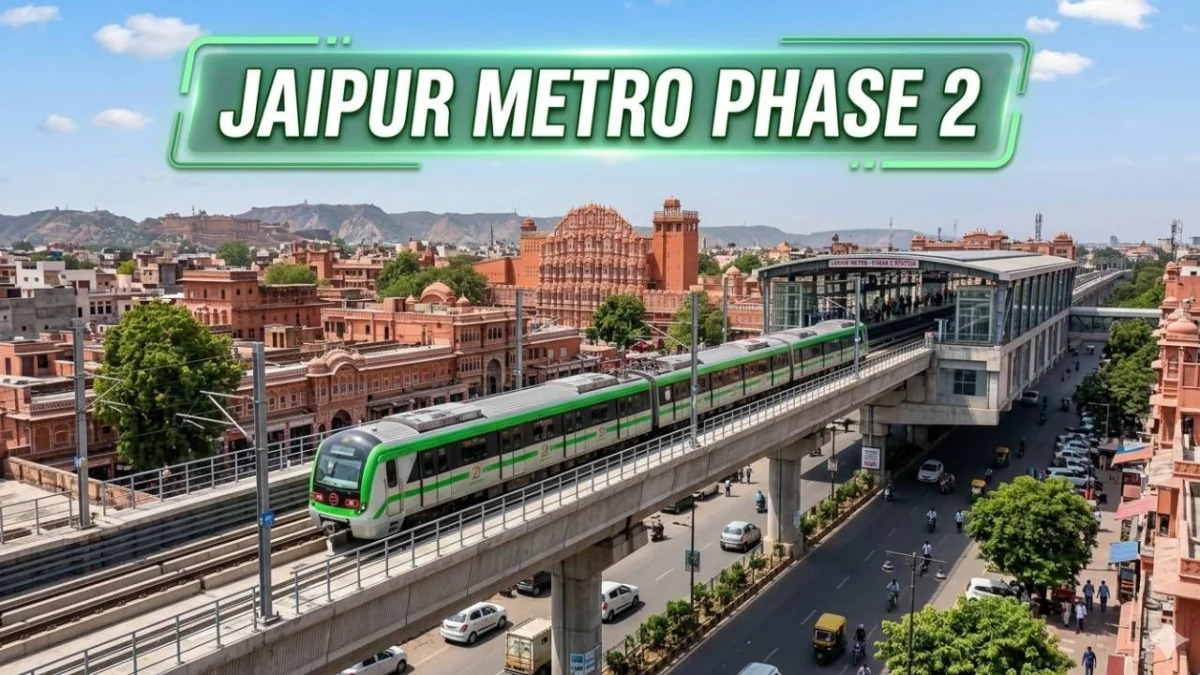
The Pink City is standing on the precipice of a massive infrastructural evolution. For years, the residents of Jaipur have navigated an increasingly congested urban landscape, particularly along the arterial Tonk Road and the rapidly expanding northern suburbs. While the existing East-West corridor (the Pink Line) provided a foundational step toward modern mass transit, it left the city’s primary growth axis—the North-South corridor—largely unserved. The recent formal approval and commencement of Jaipur Metro Phase 2 represent not just an engineering project, but a strategic overhaul of the city’s mobility, economy, and real estate landscape.
This 42.80-kilometre expansion is poised to redefine how Rajasthan’s capital functions, connecting the industrial outskirts of the south to the residential hubs of the north, while seamlessly integrating the Jaipur International Airport into the urban fabric.
I. Main Facts: The Blueprint of Phase 2
Jaipur Metro Phase 2 is designed to be the "Orange Line" of the city, serving as the backbone of the metropolitan area’s transit system. Unlike Phase 1, which focused on the historical and central business districts, Phase 2 addresses the long-distance commuting needs of a city that is sprawling outward.
Technical Specifications and Scale
The project is characterized by its sheer scale and the complexity of its integration into a historic yet modernizing city.
- Total Distance: 42.80 kilometres, making it one of the longest single-phase metro expansions in North India.
- Station Count: A total of 36 stations are planned, strategically placed to maximize catchment areas in both high-density residential zones and commercial hubs.
- The Financial Layout: The project carries a massive price tag of approximately Rs 13,037 crore. This investment is a tripartite effort involving the State Government of Rajasthan, the Central Government of India, and significant credit lines from international development banks.
- The Hybrid Design: To balance cost-efficiency with urban preservation, the route utilizes a mix of elevated and underground tracks. While the majority of the line is elevated to reduce construction time and costs, the tracks will descend underground near the Jaipur International Airport and through high-congestion zones to ensure safety and preserve the city’s aesthetic integrity.
The Route Map: From Todi Mod to Prahladpura
The Phase 2 corridor effectively bisects the city from the northern tip to the southern industrial periphery:
- The Northern Sector: Starting at Todi Mod on Sikar Road, the line serves Vidhyadhar Nagar and Ambabari. This area has long suffered from "bumper-to-bumper" traffic as it serves as a primary entry point for commuters from the Sikar and Bikaner directions.
- The Central Interchange: The line moves through Pani Petch and the Collectorate toward Government Hostel. The most critical junction is Chandpole, which serves as the interchange station between the existing Pink Line and the new Orange Line. This allows passengers to switch from East-West to North-South travel with a single ticket.
- The Institutional and Medical Hub: The route passes through the heart of the city’s services, including SMS Hospital and Narayan Singh Circle, ensuring that the city’s largest medical facility is accessible to everyone without the need for private transport.
- The Southern Industrial Belt: The southern leg runs down Tonk Road, passing Durgapura, the B2 Bypass, Sanganer, and the Sitapura Industrial Area, finally terminating at Prahladpura.
II. Chronology: From Blueprint to Groundbreaking
The journey of Jaipur Metro Phase 2 has been one of bureaucratic endurance and strategic revisions. For nearly a decade, the project remained in a state of "planning limbo" as various administrations debated the route, the feasibility of underground sections, and the funding models.
- 2011-2014: Initial conceptualization of a North-South corridor was proposed alongside Phase 1. However, due to the high estimated costs of underground tunneling, the project was put on the back burner.
- 2018-2021: Several Detailed Project Reports (DPRs) were revised. The Rajasthan Metro Rail Corporation (JMRC) sought to optimize the route to ensure it passed through the most high-traffic areas while keeping costs manageable.
- 2023: The project received a renewed push with the state government prioritizing urban infrastructure to match Jaipur’s status as a burgeoning tech and tourism hub. The final blueprint for the 42.80 km stretch was officially cleared.
- 2024 (Current Status): The project has moved from the "mythical" stage to active implementation. JMRC has adopted a "phased implementation within a phase" strategy. Instead of a blanket start, they have prioritized a 12-kilometre southern stretch from Prahladpura toward Sitapura.
- The Immediate Future: A contract worth approximately Rs 918 crore has already been awarded for this priority section. Groundwork for the main maintenance yard in the south is currently underway.
III. Supporting Data: The Real Estate and Economic Surge
The announcement and commencement of Phase 2 have acted as a catalyst for the Jaipur real estate market. Historically, metro connectivity in Indian tier-1 and tier-2 cities has led to an immediate appreciation in property values, and Jaipur is no exception.
Property Appreciation Trends
Market data indicates that property prices in key areas along the proposed Phase 2 route have already surged by 15% to 20%.
| Area | Market Impact & Outlook | Primary Beneficiaries |
|---|---|---|
| Pratap Nagar & Sitapura | High demand for rental housing and PG accommodations. | Students and IT Professionals |
| Jagatpura (Vicinity) | Surge in high-rise residential societies and luxury apartments. | Mid-to-High income families |
| Tonk Road & B2 Bypass | Transformation into a prime commercial and retail corridor. | Retailers, Corporates, Showrooms |
| Sikar Road & Todi Mod | Rapid development of budget and mid-range housing projects. | First-time homebuyers |
The "Goldmine" Effect in Sitapura
Sitapura and Pratap Nagar are home to hundreds of educational institutions and the city’s largest industrial and IT parks. Currently, thousands of students and workers rely on expensive auto-rickshaws or time-consuming bus routes. The Metro is expected to reduce commuting costs by up to 60% for these demographics. Consequently, rental yields for property owners in these areas are projected to increase significantly as the "walk-to-metro" factor becomes a premium selling point.
IV. Official Responses and Technical Challenges
The Rajasthan Metro Rail Corporation (JMRC) and state officials have emphasized that Phase 2 is not just about moving people, but about "future-proofing" the city.
Addressing the Airport Challenge
One of the most complex engineering feats of Phase 2 is the connection to Jaipur International Airport. Officials noted that the track requires a specific curvature near Sanganer to avoid interference with flight paths and radar systems.
- Underground Integration: To comply with aviation safety standards and to avoid disrupting the airport’s operations, the stations serving the airport terminals will be entirely underground. This ensures that travelers can move from the terminal to the metro platform without ever leaving a climate-controlled environment.
Government Vision
State officials have framed the project as a move toward a "Green Jaipur." By providing a viable alternative to private vehicles on Tonk Road—one of the city’s most polluted corridors due to idling traffic—the Metro is expected to significantly lower the city’s carbon footprint. The integration of international bank loans also brings a level of global oversight, ensuring that environmental and safety benchmarks are strictly met.
V. Implications: A Lifestyle and Economic Upgrade
The completion of Jaipur Metro Phase 2 will mark a fundamental shift in the lifestyle of the average Jaipurite. The implications extend far beyond simple transit.
1. The End of the "Tonk Phatak" Bottleneck
For decades, the Tonk Phatak area has been synonymous with traffic frustration. Phase 2 provides a bypass to this congestion, allowing a commuter to travel from the southern suburbs to the city centre in less than 25 minutes—a journey that currently takes over an hour during peak times.
2. Boosting the "Tourism Economy"
Jaipur is a cornerstone of India’s Golden Triangle tourist circuit. By linking the airport directly to the city centre and the existing Pink Line (which serves the historic Walled City), the Metro makes Jaipur a more "tourist-friendly" destination. International and domestic travelers will no longer be at the mercy of fluctuating cab prices or traffic jams, potentially increasing the time and money they spend at local attractions.
3. Commercial Decentralization
The Metro is expected to trigger a shift in commercial activity. With easy connectivity, businesses that were previously clustered in the expensive and crowded C-Scheme or Malviya Nagar areas may move further south or north, leading to a more balanced distribution of economic activity across the city.
4. Environmental and Health Benefits
With a target completion date of September 2031, the project aims to take thousands of cars and two-wheelers off the road. For a city that experiences extreme summer temperatures, the availability of an air-conditioned, reliable, and affordable mass transit system is a critical public health improvement.
Conclusion: The 2031 Vision
While the full operational deadline is set for September 2031, the "Metro Effect" is already visible in Jaipur’s urban planning and real estate valuations. The Rajasthan Metro Rail Corporation’s strategy to open the southern section (Tonk Road to Sitapura) by 2029-2030 ensures that the city will begin reaping the benefits of this investment well before the final ribbon is cut.
Jaipur Metro Phase 2 is more than just tracks and stations; it is the skeletal structure upon which the future of the Pink City will be built. It bridges the gap between the historic charm of the North and the industrial ambition of the South, ensuring that as Jaipur grows, it remains a livable, breathable, and efficient metropolis. For the residents currently "losing their minds" in traffic, the light at the end of the tunnel is finally visible—and it is a metro train.
