

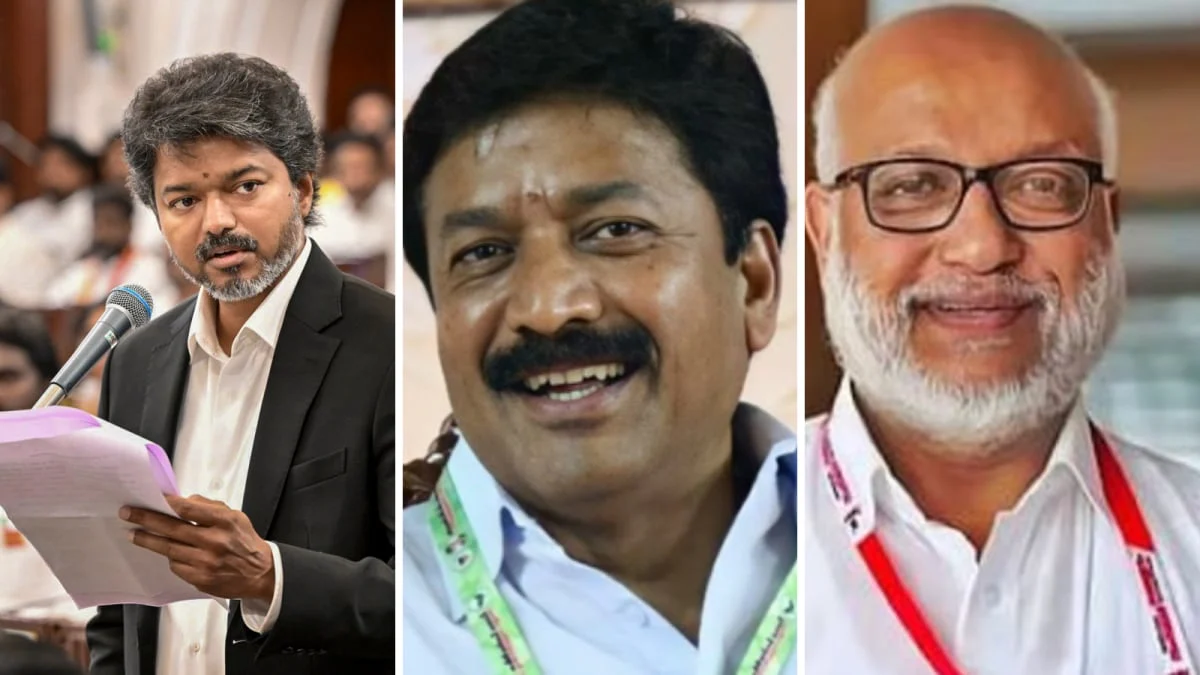
CHENNAI, Tamil Nadu – May 20, 2026 – Tamil Nadu’s nascent government, led by actor-politician Chief Minister Vijay and his Tamilaga Vetri Kazhagam (TVK) party, finds itself navigating a precarious political landscape barely weeks after assuming power. A significant point of contention emerged today as Minister for Sports Development, Aadhav Arjuna, firmly refuted swirling reports that a rebel faction of the All India Anna Dravida Munnetra Kazhagam (AIADMK) would be inducted into the state cabinet. This denial comes on the heels of a stern warning from a crucial coalition partner, the Communist Party of India (Marxist) (CPM), which threatened to reconsider its support if any AIADMK factions were to join the government or its cabinet.
The controversy highlights the delicate balance of power within the newly formed alliance, which relies heavily on the support of multiple parties and independent legislators. The CPM’s explicit threat underscores the ideological and electoral promises that underpin the current coalition, particularly the mandate against the established Dravidian parties, DMK and AIADMK. Minister Arjuna’s categorical dismissal of the cabinet inclusion as "only speculation" signals an attempt by the TVK leadership to assuage its allies and maintain stability in these critical early days of governance.
The unfolding drama underscores the inherent complexities of coalition politics in Tamil Nadu, a state accustomed to decades of two-party dominance. Chief Minister Vijay’s meteoric rise and the TVK’s unexpected electoral success have ushered in an era of political fluidity, but also one fraught with the challenges of consensus-building and managing diverse expectations among alliance partners. The ongoing discussions around cabinet formation, alongside the vocal dissent from the CPM, suggest that the TVK government’s journey will likely be marked by continuous negotiations and strategic maneuvering to preserve its mandate and ensure its longevity.
A Fragile Mandate: The Chronology of TVK’s Ascent and Alliance Formation
The current political unease is rooted in the dramatic events of the May 4 Assembly election and the subsequent formation of the TVK government. Vijay’s entry into the political arena had long been anticipated, but his party’s performance exceeded all expectations, fundamentally altering the electoral landscape of Tamil Nadu. The TVK emerged as the single largest force, securing 108 seats in the 234-member House, a remarkable feat that shattered the traditional duopoly of the DMK and AIADMK. However, this impressive tally still left the TVK 10 seats short of the crucial majority mark of 118, setting the stage for intense post-poll negotiations.
The days following the election were characterized by a flurry of political activity as various parties vied for influence and position. The TVK, under Vijay’s leadership, successfully forged a coalition that brought together disparate political entities. Key to securing the required numbers was the backing of the Indian National Congress, which contributed five seats to the alliance. Further support came from the Left parties, including the CPM, the Viduthalai Chiruthaigal Katchi (VCK), and the Indian Union Muslim League (IUML). This diverse grouping helped Vijay bolster his numbers, reaching a comfortable position ahead of the critical trust vote scheduled for May 13.
The confidence motion, however, proved to be more than just a procedural hurdle; it exposed deep-seated divisions within the primary opposition, the AIADMK. While the party’s chief, Edappadi K Palaniswami (EPS), had explicitly opposed extending support to the nascent TVK government, a significant faction of AIADMK legislators openly defied the party whip. A total of twenty-four AIADMK MLAs broke ranks, casting their votes in favour of the TVK government. This unexpected cross-voting pushed Chief Minister Vijay’s total count to a commanding 144 lawmakers, ensuring the government’s survival but simultaneously creating a new layer of political complexity.
The rebellion within the AIADMK immediately triggered disciplinary proceedings against the dissident MLAs, including potential action under the stringent anti-defection law. More critically for the TVK, the support from these rebel legislators, particularly after reports surfaced of Chief Minister Vijay meeting with them ahead of the floor test, became a source of significant unease for some of its coalition partners, most notably the CPM. This historical context provides the backdrop against which the current warnings and denials are playing out, highlighting the delicate balancing act required to maintain the stability of the multi-party alliance.
The CPM’s Red Line: Upholding Mandate and Clean Governance
The Communist Party of India (Marxist) has been unequivocal in its stance, drawing a clear "red line" regarding the inclusion of any AIADMK faction into the TVK government or its cabinet. CPI(M) Chief M.A. Baby and other party leaders have articulated their concerns with strong political and ideological justifications, emphasizing that such a move would be a direct betrayal of the people’s mandate and a compromise on the TVK’s core promises.
"We are supporting the TVK government based on a clear understanding that the people of Tamil Nadu have overwhelmingly voted against both the DMK and the AIADMK," stated a senior CPM leader, echoing the sentiments expressed by M.A. Baby. "Including any faction of the AIADMK, whether rebels or otherwise, in the TVK government will be going directly against this mandate. The electorate rejected the established political order, and the TVK, as the new entrant, was seen as an alternative. To then embrace elements of the very party the people voted out would be a fundamental breach of trust."
Beyond the electoral mandate, the CPM has also raised serious concerns about the TVK’s foundational promise of "clean governance." The party argues that the AIADMK, having been in power for extended periods, carries with it a legacy that might conflict with the TVK’s declared commitment to transparency and ethical administration. "The TVK campaigned on a platform of bringing a new era of clean and corruption-free governance to Tamil Nadu," the CPM elaborated. "The presence of AIADMK elements, even a rebel faction, in the coalition or the cabinet could be perceived by the public as a dilution of this promise. It could raise questions about the government’s integrity and its commitment to breaking from past practices."
Furthermore, the CPM’s support for the TVK government is also pragmatic, driven by a strategic imperative to prevent political instability that could inadvertently benefit the Bharatiya Janata Party (BJP). "We are supporting the TVK not just out of ideological alignment, but also because Tamil Nadu is not ready for another poll," the CPM statement highlighted. "We absolutely do not want the BJP to make a rear entry into the state’s governance through Governor’s rule, which could be a consequence of a collapsed government or prolonged instability. Our support is conditional on the government upholding its principles and not creating situations that could lead to such outcomes." This aspect reveals a broader national political calculation influencing the regional dynamics in Tamil Nadu, where the BJP has long sought to expand its footprint.
The CPM’s firm position puts significant pressure on Chief Minister Vijay, forcing him to choose between consolidating support from the AIADMK rebels – who provided crucial votes during the trust motion – and maintaining the cohesion of his current, ideologically aligned coalition partners. The "reconsider support" warning is not merely rhetorical; it signals a potential withdrawal that could plunge the fledgling TVK government into a fresh crisis, forcing it to seek alternative arrangements or even face another confidence vote.
Official Responses: Denial, Deliberation, and Dispatch
In response to the escalating political temperature, Tamil Nadu Minister for Sports Development Aadhav Arjuna stepped forward to address the media, aiming to quell the rumors and reassure the coalition partners. Speaking on Wednesday, Minister Arjuna categorically denied the reports of the AIADMK rebel faction joining the state Cabinet.
"We have spoken to our allies, including the CPM, and have cleared the air," Minister Arjuna stated. "The notion of the AIADMK rebel faction joining the Cabinet is purely speculation. There is no truth to these reports." His firm denial aims to project an image of a unified government adhering to its alliance agreements and not succumbing to external pressures or internal temptations. The minister’s assertion that discussions have taken place with the CPM suggests an active engagement by the TVK leadership to manage alliance concerns and prevent a full-blown crisis.
Regarding the much-anticipated swearing-in of the remaining cabinet ministers and the finalization of portfolios, Minister Arjuna indicated that Chief Minister Vijay would make the official announcements in due course. "The Chief Minister will announce the dates for the swearing-in when the time is right," he confirmed, emphasizing that the decision rests with the state’s top leader. This approach suggests a deliberate, measured process rather than a rushed expansion of the cabinet.
Further clarifying the administrative progress, Minister Arjuna informed the press that the comprehensive list detailing the portfolios of all ministers has already been submitted to the Governor. He added that the official Gazette notification regarding these assignments was expected to be published today itself. "The ministers have indeed taken charge after the initial swearing-in ceremony," he explained, "however, the specific portfolios and their final allocations have not been officially finalized or publicly declared yet. That process is now with the Governor, and the Gazette notification will make it official." This update provides insight into the procedural steps underway, distinguishing between ministers taking their oath and the formal assignment of their governmental responsibilities.
The official responses from Minister Arjuna are clearly designed to manage expectations, calm nervous allies, and project an image of control and deliberation within the new administration. By dismissing the AIADMK rebel induction as "speculation" and affirming ongoing communication with coalition partners, the TVK aims to defuse the immediate crisis and consolidate its internal strength.
Implications: Navigating the Treacherous Waters of Coalition Governance
The ongoing political developments carry significant implications for the stability and future trajectory of Chief Minister Vijay’s TVK government. The public warning from a key ally like the CPM highlights the inherent fragility of a multi-party coalition, especially one that emerged from a fractured mandate and relies on diverse ideological partners.
Coalition Stability: The most immediate implication is on the stability of the TVK-led alliance. The CPM’s "reconsider support" threat is not to be taken lightly. Should the CPM decide to withdraw its support, the TVK government would lose a significant bloc of votes, potentially reducing its majority and making it vulnerable to future confidence motions or legislative challenges. This could force the TVK to seek new allies or make further concessions to existing ones, complicating its policy agenda. Maintaining coalition unity will require continuous dialogue, negotiation, and perhaps even sacrifices from the TVK to uphold the promises made to its partners.
Vijay’s Leadership Test: For Chief Minister Vijay, this early challenge is a crucial test of his leadership and political acumen. He must demonstrate his ability to manage a complex political alliance, balance competing demands, and maintain the trust of his coalition partners while simultaneously delivering on the TVK’s electoral promises. How he navigates this situation will define his initial tenure and set the tone for his government’s future. His decision on cabinet formation, particularly regarding the AIADMK rebels, will be scrutinized heavily by allies and the public alike.
Future of AIADMK Rebels: The fate of the 24 AIADMK rebel MLAs remains uncertain. While they provided critical support during the trust vote, their potential inclusion in the cabinet is now a major sticking point. If the TVK government bows to CPM pressure and excludes them, these rebels could find themselves in a political limbo – ostracized by their parent party (facing anti-defection proceedings) and potentially without a formal role in the new administration. This could lead to a new independent bloc or compel them to seek rapprochement with the AIADMK, further complicating the opposition landscape. Conversely, if Vijay were to include them despite the warnings, it risks alienating his core allies.
AIADMK’s Internal Dynamics: The rebellion has already triggered disciplinary action within the AIADMK, led by Edappadi K Palaniswami. The continued spotlight on these rebels, and their potential integration into the government, will exacerbate internal fissures within the AIADMK. It could solidify the split, leading to a more fragmented opposition, or paradoxically, if the rebels are left out in the cold, it might strengthen EPS’s hand in reasserting control over the party.
Precedent for Future Governance: The manner in which this situation is resolved will set a precedent for future coalition governance in Tamil Nadu. The TVK’s emergence has broken the traditional two-party system, making multi-party alliances more likely in the future. The current challenges will serve as a valuable lesson in managing such diverse coalitions, emphasizing the need for clear agreements, consistent communication, and a shared vision to ensure stability and effective governance.
In conclusion, the denial of AIADMK rebel cabinet inclusion, spurred by the CPM’s unequivocal warning, underscores the intricate and often turbulent nature of coalition politics. Chief Minister Vijay’s government, still in its infancy, faces the delicate task of balancing the political debts owed to those who ensured its survival with the ideological commitments and trust of its foundational allies. The coming days will reveal whether this initial political storm can be successfully weathered, allowing the TVK to consolidate its power and focus on its governance agenda, or if it portends a more challenging and unstable road ahead for Tamil Nadu’s new political order.
