

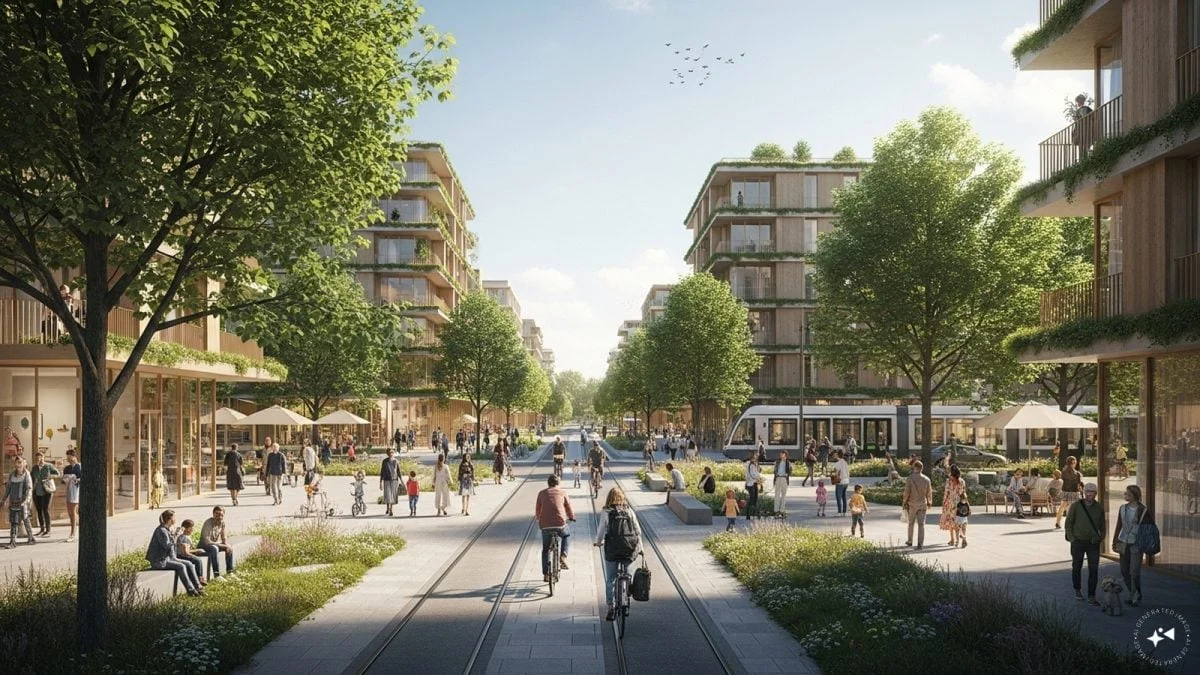
BENGALURU – For decades, the narrative of Bengaluru has been one of paradox: a global powerhouse of silicon and software, yet a city physically strangled by its own success. The "Silicon Valley of India" has become synonymous with grueling commutes, fragmented infrastructure, and an urban sprawl that has historically favored the northern and eastern corridors. However, a monumental shift is on the horizon.
The Karnataka government has officially greenlit the revival of the Greater Bengaluru Innovation and Tech City (GBIT), a colossal 7,481-acre integrated township designed to be India’s first AI-centric urban ecosystem. Aiming to harmonize work, life, and leisure within a single, sustainable footprint, GBIT represents a bold attempt to decouple economic growth from the urban decay that has plagued the metropolis for years.
I. Main Facts: A Blueprint for the Next Century
The Greater Bengaluru Innovation and Tech City is not merely a residential layout or an industrial park; it is a meticulously planned "meta-city" located in the Ramanagara taluk of the South Bengaluru district. With an estimated project cost of ₹18,104 crore, the township is poised to become the largest AI-focused hub in the nation.
Key Project Specifications:
- Total Area: 7,481 acres.
- Location: Spanning nine villages, including Byramangala, Hosur, and Mandalahalli.
- Core Philosophy: The "Work, Live, Play" model.
- Sustainability Goal: Zero-carbon, zero-waste, and zero-traffic.
- Primary Focus: Artificial Intelligence (AI), Machine Learning (ML), and Data Analytics.
- Governing Body: The project is being spearheaded by the newly energized Greater Bengaluru Development Authority (GBDA).
The vision is to create a self-contained ecosystem where high-tech professionals can live within walking distance of their offices, children can attend world-class schools within the same perimeter, and families can access premier healthcare and recreational facilities without ever having to navigate the infamous traffic of the Outer Ring Road.
II. Chronology: From Stagnation to Strategic Revival
The journey of GBIT is a testament to the complexities of Indian urban planning. While the project sounds like a futuristic vision of the 2020s, its roots stretch back over a decade.
2010–2012: The Initial Concept
The idea for a massive tech city outside the main urban sprawl was first proposed nearly 15 years ago. At the time, the state government recognized that the rapid expansion of Electronic City and Whitefield was reaching a saturation point. However, due to political transitions, land acquisition hurdles, and shifting economic priorities, the project remained "on paper," gathering dust in administrative archives.
2015–2023: The Era of Urban Crisis
During this period, Bengaluru’s traffic congestion became a global talking point. The city’s expansion moved aggressively northward toward the Kempegowda International Airport (KIA), leaving the southern and western regions relatively underutilized for tech infrastructure. The lack of integrated planning led to the current "commuter nightmare," where employees often spend 2-4 hours daily in transit.
2024–2026: The Great Revival
Recognizing that the city was at a breaking point, the Karnataka government decided to revive the stalled GBIT project. The revival is part of a broader strategy to decentralize Bengaluru’s growth. By designating the land in Ramanagara as a development zone and completing preliminary acquisition work, the state has cleared the most significant hurdle. The government is currently in the process of appointing an international project management consultancy (PMC) through a global tendering process to oversee the execution phase.
III. Supporting Data: The Three Pillars of GBIT
The GBIT master plan is structured around three distinct yet interconnected pillars, each designed to address a specific failure of traditional urban development.
1. The Work Pillar: The AI Business District
At the heart of the township lies a Central Business District (CBD) built to global standards. Unlike existing tech parks that often lack cohesive identity, this district is tailored specifically for the AI economy.
- Innovation Hubs: Dedicated zones for AI, Robotics, and Data Science.
- Startup Incubators: Subsidized spaces for early-stage tech ventures.
- Corporate Campuses: Large-scale plots for multinational tech giants to build custom headquarters.
2. The Live Pillar: Smart Civic Infrastructure
The residential component of GBIT is designed to move beyond the "apartment complex" mentality.
- AI-Enabled Utilities: Smart grids for electricity and water management will use predictive algorithms to ensure zero downtime and waste.
- Integrated Services: High-tech schools, multi-specialty hospitals, and government service centers will be woven into the residential fabric.
- Walkability: The layout ensures that no resident is more than a 15-minute walk or cycle from essential services.
3. The Play Pillar: Culture and Recreation
To prevent the township from becoming a "concrete jungle," the plan allocates significant space for leisure.
- Environmental Preservation: Approximately 950 acres have been reserved for lakes and green buffer zones, serving as the city’s "lungs."
- Sports Infrastructure: Plans include an international cricket stadium and Olympic-standard training facilities, positioning the city as a future hub for sports tourism.
- Cultural Hubs: Theaters, public parks, and art galleries will be distributed throughout the nine villages to foster a sense of community.
IV. Connectivity and Logistics: Bridging the Distance
One of the primary criticisms of satellite townships is their isolation from the metropolitan core. GBIT addresses this through a multi-modal connectivity strategy.
The Metro Connection
A critical component of the revival is the integration of the Bengaluru Metro’s Phase 3 expansion. By extending the metro line toward Bidadi, the government aims to place GBIT within a 30-to-40-minute commute from central Bengaluru. This rail link is essential for ensuring that the township remains part of the city’s economic bloodstream rather than becoming a secluded enclave.
Road Networks
The township will have direct, high-speed access to:
- NH-275 (Bengaluru-Mysuru Expressway): Facilitating rapid movement between the two major cities.
- NH-209: Enhancing connectivity to the southern hinterlands.
- NICE Road: Providing a bypass to bypass the city’s inner-core traffic.
The Second Airport Debate
In a move that underscores the long-term ambition of GBIT, the state government is exploring the possibility of a second international airport for Bengaluru. Proposed locations include the Kanakapura Road and the Nelamangala-Kunigal Road corridor. If situated in the south, this airport would serve GBIT directly, offering international tech professionals and cargo a seamless entry point that avoids the cross-city trek to Devanahalli.
V. Official Responses: The Government’s Vision
State officials have been vocal about why GBIT is a "now or never" necessity for Karnataka. According to representatives from the Greater Bengaluru Development Authority, the project is a response to the "haphazard growth" of the last two decades.
"We cannot keep adding floors to a building with a weak foundation," one senior urban planning official stated. "GBIT is a new foundation. We are taking the pressure off Electronic City and Whitefield and moving it to a region that has the space to grow correctly from day one. This is not just about technology; it’s about the quality of human life."
The government has also emphasized that GBIT will be a "Zero-Carbon" project. By utilizing AI to manage energy consumption and prioritizing non-motorized transport (NMT) within the township, the state hopes to set a global benchmark for sustainable urbanization in developing nations.
VI. Implications: A Paradigm Shift for India’s Urban Future
The successful implementation of GBIT carries profound implications for the socio-economic landscape of Southern India.
1. Economic Decentralization
For decades, Bengaluru’s wealth has been concentrated in specific corridors. GBIT will shift the economic center of gravity toward the south, sparking a real estate and commercial boom in Ramanagara and surrounding districts. This will lead to more balanced regional development and create thousands of local jobs beyond the tech sector.
2. A Template for Smart Cities
While many "Smart City" projects in India have focused on retrofitting existing infrastructure, GBIT is a "greenfield" project. It provides a blank canvas to implement the latest in urban tech—from automated waste collection to AI-managed traffic flow—without the constraints of legacy systems.
3. Environmental Impact
By dedicating nearly 1,000 acres to water bodies and green zones, GBIT challenges the notion that industrialization must come at the cost of the environment. The "zero-traffic" model within the residential zones could significantly reduce the carbon footprint of the city’s professional class.
4. Real Estate Evolution
The "Work, Live, Play" model is expected to disrupt the traditional real estate market. As professionals increasingly value time and wellness over prestige locations, the demand for integrated townships like GBIT is likely to soar, potentially lowering the astronomical rents in Bengaluru’s overcrowded central districts.
Conclusion
The revival of the Greater Bengaluru Innovation and Tech City marks a turning point in the evolution of Karnataka’s capital. After 15 years of dormancy, the project returns not just as a solution to traffic, but as a bold statement on the future of work and life in the age of Artificial Intelligence. If the government can navigate the complexities of execution and international consultancy, GBIT may well become the blueprint for how the world’s fastest-growing economies build the cities of tomorrow. For the residents of Bengaluru, it offers something more immediate: the hope of a city that finally works as efficiently as the technology it produces.
