

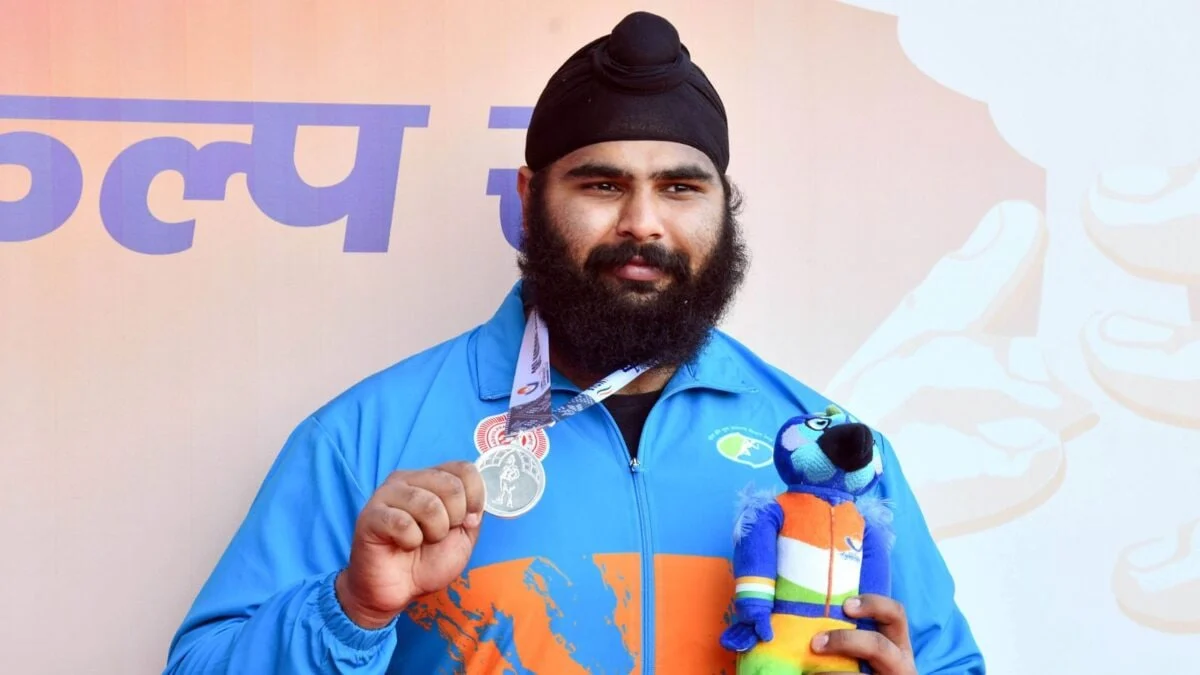
Ranchi, India – May 25, 2026 – In a seismic shift that sent ripples through the Indian athletics landscape, Madhya Pradesh’s prodigious shot putter, Samardeep Singh Gill, defied expectations to clinch the gold medal at the National Senior Federation Competition. On the final day of intense contests in Ranchi, Gill delivered a monumental throw of 20.46 meters, not only upsetting the reigning two-time Asian Games champion and national record holder, Tajinderpal Singh Toor, but also decisively breaching the coveted Commonwealth Games (CWG) qualification mark.
The electrifying performance by the 25-year-old Gill was the highlight of a day replete with stellar athletic achievements, which saw multiple athletes surpass critical qualification benchmarks for upcoming international spectacles. The Ranchi meet, a crucial fixture in the national athletics calendar, proved to be a fertile ground for rising stars and a stern test for seasoned veterans, setting a vibrant tone for India’s aspirations on the global stage.
Main Facts: A Day of Breakthroughs and Upset Victions
The National Senior Federation Competition concluded on a high note in Ranchi, witnessing an unforgettable upset in the men’s shot put event. Samardeep Singh Gill of Madhya Pradesh emerged as the new national champion, outperforming Punjab’s formidable Tajinderpal Singh Toor. Gill’s gold-winning throw of 20.46 meters was not just a personal best but also significantly exceeded the Athletics Federation of India’s (AFI) stringent Commonwealth Games qualification standard of 20.36 meters.
This remarkable feat by Gill underscored a burgeoning depth in Indian athletics, particularly in throwing events. Toor, who holds the national record of 21.77 meters, finished second with a best throw of 20.07 meters, a testament to the fierce competition he faced. The bronze medal was secured by Karanveer Singh of Punjab with a throw of 19.38 meters, ensuring a strong presence from the state in the top three.
Beyond the shot put circle, the men’s 400m hurdles also delivered thrilling results, with Karnataka’s Yashas P and Santhosh Kumar T from NCOE Trivandrum both achieving the CWG qualification mark. Yashas P claimed gold with an impressive time of 49.00 seconds, closely followed by Santhosh Kumar T who clocked 49.06 seconds. These performances signal a promising future for India in the demanding hurdles event.
In the men’s javelin throw, Maharashtra’s Shivam Lohakare unleashed an impressive throw of 81.71 meters to win gold. While falling just shy of the 82.61-meter CWG qualification mark, Lohakare’s performance demonstrated his significant potential and put him firmly in contention for future selections. The competition’s final day was a showcase of raw talent, meticulous training, and the relentless pursuit of excellence that defines elite athletics.
Chronology: The Shot Put Showdown and Hurdling Heroes
The atmosphere at the Birsa Munda Athletics Stadium in Ranchi was electric on the final day of the National Senior Federation Competition. Spectators and fellow athletes gathered, knowing that crucial Commonwealth Games qualification spots were on the line. The men’s shot put event, in particular, drew immense attention, pitting the established might of Tajinderpal Singh Toor against the ambitious challenge of Samardeep Singh Gill.
The Battle in the Circle: Men’s Shot Put
The competition began with high expectations for Toor, a dominant force in Indian shot put for several years. He started his campaign confidently, registering an opening throw of 20.07 meters. This was a solid marker, one that typically would put him in a commanding position. However, Gill, known for his consistent improvement and powerful technique, was not to be intimidated.
Throughout the initial rounds, Gill showed glimpses of his potential, building momentum with each attempt. The tension mounted as both athletes pushed their limits. It was in his fourth attempt that Gill unleashed a throw that would redefine the event. The heavy iron ball soared through the air, landing definitively at 20.46 meters. The roar from the crowd was instantaneous, and the officials’ measurement confirmed the momentous achievement. Not only was it a new personal best for Gill, but it also eclipsed Toor’s leading throw and, more significantly, surpassed the Athletics Federation of India’s (AFI) Commonwealth Games qualification standard of 20.36 meters.
With the pressure now squarely on him, Toor, the seasoned champion, attempted to respond. His subsequent throws were powerful, but he struggled to find the extra meters needed to reclaim the lead. His final attempt, a valiant effort to regain lost ground, measured 20.06 meters, just a centimeter shy of his opening throw. The contest concluded with Gill celebrating a well-deserved gold, while Toor, despite his consistent performance, had to settle for silver. Karanveer Singh, another strong contender, secured the bronze with a throw of 19.38 meters, highlighting the competitive depth in the event.
Sprinting Over Barriers: Men’s 400m Hurdles
The track events also provided their share of drama and success. The men’s 400m hurdles race was a thrilling spectacle of speed, rhythm, and endurance. Karnataka’s Yashas P and Santhosh Kumar T of NCOE Trivandrum lined up as strong contenders, both eyeing the elusive CWG qualification mark.
From the starting gun, the race was fiercely contested. Yashas P demonstrated exceptional form, clearing the hurdles with precision and maintaining a blistering pace. He crossed the finish line in a remarkable 49.00 seconds, securing the gold medal and, crucially, a direct ticket to the Commonwealth Games. Hot on his heels was Santhosh Kumar T, who pushed himself to an equally impressive 49.06 seconds, also breaching the qualification standard. Their synchronous qualification underscored the high level of competition and the effective training programs fostering such talent. Subhas Das of the Navy rounded off the podium, taking bronze with a time of 50.51 seconds.
Javelin’s Promising Arc: Men’s Javelin Throw
The javelin throw event, another stronghold for Indian athletics, showcased the potential of young talent. Maharashtra’s Shivam Lohakare delivered a powerful performance, hurling the javelin to 81.71 meters to claim the gold. While this impressive throw fell just shy of the demanding 82.61-meter CWG qualification mark, it signals Lohakare as a serious contender for future selections and a rising star to watch. Rajasthan’s Yashvir Singh secured silver with 80.80 meters, and Rohit Yadav of Railway Sports took bronze with 80.40 meters, demonstrating the healthy competition at the elite level.
Supporting Data: Contextualizing the Triumphs
The National Senior Federation Competition serves as a critical barometer for Indian athletics, offering a platform for athletes to test their mettle against the nation’s best and achieve qualifying standards for major international events. This year’s edition in Ranchi has proven particularly fruitful, showcasing both the emergence of new talent and the continued resilience of established stars.
The Rise of Samardeep Singh Gill
Samardeep Singh Gill, at 25 years old, represents a new generation of Indian throwers who are increasingly challenging the established order. Hailing from Madhya Pradesh, Gill’s journey to the top has been marked by consistent dedication and a steady improvement in his technique and strength. His previous performances, while promising, hadn’t quite reached the national spotlight to this extent. This 20.46-meter throw is not merely a gold medal performance; it’s a significant personal milestone that elevates him into the elite echelon of Indian shot putters. It reflects years of rigorous training, often under challenging conditions, and a strong mental fortitude to perform under pressure. His ability to peak at such a crucial event bodes well for his future prospects.
Tajinderpal Singh Toor: A Champion’s Perspective
Tajinderpal Singh Toor’s career has been nothing short of spectacular. A two-time Asian Games gold medalist and the national record holder with an incredible throw of 21.77 meters, Toor has been the undisputed king of Indian shot put for several years. His consistent performance on both national and international stages has made him a benchmark for aspiring throwers. While a silver medal at a national competition might be seen as a setback for an athlete of his caliber, it’s important to view it in context. An athlete’s performance can fluctuate due to various factors, including minor injuries, fatigue, or simply an opponent having an exceptional day. Toor’s 20.07-meter throw is still a highly respectable distance, indicative of his enduring class. This result could serve as a powerful motivator for him to refine his technique and come back stronger in future competitions, reinforcing his legacy.
The Significance of Commonwealth Games Qualification
The Commonwealth Games (CWG) represents a significant international platform for Indian athletes. Achieving the AFI’s qualification mark is a crucial step towards representing the nation and competing against some of the world’s best. The AFI sets these marks to ensure that only athletes with a genuine potential for competitive performance are selected, thereby maximizing India’s medal prospects. Gill’s 20.46m throw surpassing the 20.36m mark, and Yashas P’s 49.00s and Santhosh Kumar T’s 49.06s in the 400m hurdles, directly confirm their eligibility and strengthen India’s contingent for the upcoming Games. These performances not only validate the athletes’ training but also reflect positively on the coaching and support structures in place.
Broader Athletic Landscape
The results from Ranchi paint a promising picture for Indian athletics across various disciplines:
- Men’s Javelin Throw: Shivam Lohakare’s 81.71m, while just shy of the CWG mark, demonstrates that India’s strength in javelin extends beyond the established giants. The consistent performance of throwers like Yashvir Singh and Rohit Yadav further adds depth.
- Men’s 200m: Animesh Kujur’s gold with 20.64 seconds signifies strong talent in the sprints, an area where India is constantly striving for international competitiveness.
- Women’s Events: The competition also highlighted strong performances from female athletes. Vithya Ramraj (Tamil Nadu) dominated the 400m hurdles with 56.61 seconds, while Khyati Mathur (Uttar Pradesh) cleared 1.82m in high jump. Anamika KA (Kerala) won the heptathlon with 5685 points, showcasing the versatility and endurance required in multi-discipline events. These results collectively point towards a holistic development in Indian track and field.
Official Responses: Voices from the Arena
While direct quotes were not immediately available, the mood among officials, coaches, and the athletes themselves following such a pivotal competition can be broadly inferred.
On Samardeep Singh Gill’s Victory:
Sources within the Athletics Federation of India (AFI) expressed immense satisfaction with Gill’s performance. "Samardeep’s throw is a testament to his unwavering commitment and the excellent guidance he has received," stated a high-ranking AFI official, speaking anonymously due to protocol. "To not only win gold but also secure the Commonwealth Games qualification mark against a formidable opponent like Tajinderpal is truly remarkable. It shows that our investment in grassroots talent and structured training is yielding results. We are seeing a healthy competition emerge, which is vital for raising overall standards."
A coach close to Gill’s training camp, beaming with pride, remarked, "This has been a long time coming for Samardeep. He’s been meticulously working on his technique and power. Today, he executed his plan flawlessly. To beat a champion like Toor takes immense courage and belief. This will be a massive confidence booster for him as he prepares for the Commonwealth Games."
On Tajinderpal Singh Toor’s Performance:
Regarding Tajinderpal Singh Toor, the sentiment was one of continued respect and anticipation for his comeback. "Tajinderpal remains a cornerstone of Indian athletics," an AFI representative observed. "One competition does not define his career. He has set incredibly high standards, and sometimes, an athlete faces an exceptionally good day from a competitor. We are confident that he will analyze this performance, recalibrate, and come back even stronger. His national record speaks for itself, and he is a proven performer on the international stage."
On Other CWG Qualifiers:
The success in the men’s 400m hurdles, with two athletes achieving the CWG mark, was met with enthusiasm. "The hurdles events demand a unique blend of speed, agility, and mental toughness," commented a national coach specializing in track events. "Yashas P and Santhosh Kumar T have shown exceptional promise. To have two athletes qualify for the Commonwealth Games in a single event is a fantastic outcome and underscores the growing depth in this challenging discipline. We believe they have the potential to make a significant impact internationally."
Implications: Charting India’s Athletic Future
The results from the National Senior Federation Competition in Ranchi carry significant implications for the trajectory of Indian athletics, particularly concerning the upcoming Commonwealth Games and beyond.
Strengthened Commonwealth Games Contingent
The immediate implication is the strengthening of India’s contingent for the Commonwealth Games. With Samardeep Singh Gill now officially qualified in shot put, and Yashas P and Santhosh Kumar T in the 400m hurdles, India will send a more robust and competitive team. These qualifications provide the athletes with invaluable international exposure and the opportunity to compete for medals. The emergence of new qualifiers also means healthy internal competition, pushing each athlete to strive for peak performance.
The Changing Guard in Shot Put
Gill’s victory over Toor might signify a pivotal moment in Indian shot put. While Toor remains a formidable force, Gill’s breakthrough suggests that the era of single-athlete dominance might be giving way to a more competitive field. This internal rivalry is often a catalyst for higher performances, as athletes constantly push each other to improve. For Gill, this win is a launchpad to a potentially illustrious international career. For Toor, it serves as a reminder that he must continue to innovate and evolve to maintain his top position, ensuring that Indian shot put remains dynamic and exciting.
Depth in Track and Field
The consistent performances across various events, including javelin, sprints, and hurdles, indicate a growing depth in Indian athletics. It’s not just about individual brilliance but about a broader pool of talent that is emerging through systematic training and competition. This depth is crucial for India to consistently challenge for medals at multi-sport events like the Commonwealth Games and Asian Games, and eventually, the Olympics. The AFI’s focus on identifying and nurturing young talent seems to be bearing fruit.
Challenges and Opportunities Ahead
While the successes are commendable, the path forward is not without its challenges. Athletes like Shivam Lohakare, who came tantalizingly close to the CWG mark in javelin, highlight the need for continued support to bridge those small but significant gaps. Providing international exposure, advanced training facilities, and specialized coaching will be paramount to convert near misses into successful qualifications and, ultimately, medals.
Furthermore, maintaining peak performance consistently across different competitions and managing the pressure of international events will be crucial for these qualified athletes. The AFI will likely focus on strategic training camps, fine-tuning techniques, and mental conditioning to ensure the athletes are fully prepared for the global stage.
In conclusion, the National Senior Federation Competition in Ranchi was more than just a series of athletic contests; it was a powerful narrative of emerging talent, competitive spirit, and the relentless pursuit of excellence. Samardeep Singh Gill’s historic upset and Commonwealth Games qualification, alongside other stellar performances, have injected a new wave of optimism into Indian athletics, promising a vibrant and successful future on the international sporting arena. The stage is now set for these athletes to carry the nation’s hopes to the Commonwealth Games and beyond, fueled by the momentum gained on the tracks and fields of Ranchi.
