


New Delhi, India – July 13, 2026 – Jannik Sinner, the formidable Italian maestro, etched his name deeper into tennis history on Sunday, July 12, 2026, by clinching his second consecutive Wimbledon men’s singles title. In a pulsating four-set thriller that captivated Centre Court for nearly four hours, Sinner overcame a relentless Alexander Zverev, the German powerhouse, with a final score of 6-7 (7-9), 7-6 (7-2), 6-3, 6-4. The victory not only cemented the 24-year-old’s reign at the pinnacle of men’s tennis but also marked his 100th Grand Slam match win, a testament to his burgeoning dominance and unwavering consistency.
The final, a clash of titans boasting two of the sport’s most potent serves and devastating groundstrokes, lived up to its billing as a modern classic. Sinner, who had endured a challenging season marked by a surprising second-round exit at the French Open, found redemption on the hallowed grass of SW19. His triumph underscored a remarkable return to form, fueled by rigorous preparation and an almost philosophical perspective on the pressures of Grand Slam success. For Zverev, despite the agonizing defeat, his performance represented a career-best run at Wimbledon, showcasing an elevated grass-court game that promises future contention.
The Unyielding Ascent: Main Facts of Sinner’s Triumph
Jannik Sinner’s victory at the 2026 Wimbledon Championships was more than just a title; it was a powerful statement of intent and resilience. Securing back-to-back crowns at the sport’s most prestigious Grand Slam, Sinner has firmly established himself as the undisputed king of grass and arguably the leading figure in men’s tennis. The final against Alexander Zverev was a grueling, physically and mentally demanding encounter that stretched over three hours and forty-six minutes, pushing both athletes to their absolute limits.
Sinner’s path to victory was paved with an extraordinary display of his signature attributes: an unassailable first serve, impeccable returning, and an uncanny ability to turn defense into offense with breathtaking speed and precision. As Novak Djokovic had astutely observed after his semi-final defeat to the Italian, "You cannot attack Jannik Sinner’s first serve." This maxim proved prophetic, as Sinner consistently held firm under immense pressure, particularly in the critical second and third sets.
For Alexander Zverev, the runner-up finish was a bitter pill but also a significant milestone. Entering the final with a daunting nine-match losing streak against Sinner, and a known historical struggle on grass, Zverev defied expectations by pushing the defending champion to four intense sets. He showcased an aggressive, front-foot game plan, delivering powerful groundstrokes and serving with venom, managing to snatch the opening set in a thrilling tie-break. This performance, despite the loss, undoubtedly marked his best ever showing at Wimbledon and demonstrated a clear evolution in his grass-court prowess.
The match statistics underscored the fine margins that separated the two gladiators. A mere six break points were generated throughout the entire contest, with the first break of serve arriving only after 34 games had been played. This rarity of breaks speaks volumes about the serving dominance of both players and the sheer intensity of their exchanges. Sinner’s ultimate triumph, achieved through a blend of tactical brilliance and steely resolve, now positions him as the benchmark for consistency and excellence in the modern era of tennis, even as the tennis world eagerly anticipates the return of his burgeoning rival, Carlos Alcaraz.
A Battle of Wills: The Chronology of the Final
The atmosphere on Centre Court was electric, a palpable anticipation hanging in the air as Jannik Sinner and Alexander Zverev stepped onto the hallowed turf. The narrative was rich with subplots: Sinner’s quest for a second successive title, his mental recovery from a recent Grand Slam disappointment, and Zverev’s mission to finally break his duck against the Italian and claim a maiden Wimbledon title after his best ever run on grass.
Pre-Match Buildup: Rivalry and Redemption
Entering the final, the head-to-head record between Sinner and Zverev loomed large, with Sinner holding a commanding lead, including a perfect 9-0 record in their last nine encounters. Zverev, despite his formidable talent, had struggled to find answers against the Italian’s relentless game. However, his journey to the final had been impressive, demonstrating a newfound comfort and aggression on grass, dispelling previous notions of it being his weakest surface. Sinner, meanwhile, had navigated a challenging draw with characteristic composure, eager to put his French Open exit behind him and reaffirm his status as world number one.
First Set Drama: Zverev’s Breakthrough
The blockbuster final opened with a statement of intent: a corker of a 22-shot rally for the second point, immediately setting the tone for a match defined by sustained aggression and incredible athleticism. From the outset, the importance of service-return patterns became glaringly apparent, with both players renowned for their clinical serving prowess. Zverev, surprisingly, began with a slight edge, finishing off his service games with greater ease and generating more pressure on Sinner’s serve than vice-versa.
The set was a serve-dominated affair, with neither player ceding an inch. Sinner earned the first break point opportunity in the eighth game, following Zverev’s first double fault of the match. However, uncharacteristically, the Italian sprayed a forehand wide, squandering the golden chance. With the score locked, the set inevitably spiraled into a tie-break. The serve-athon continued, with both players trading powerful blows. Zverev painstakingly eked out a set point, only for Sinner to unleash a majestic drop shot, followed by a breathtaking forehand pass to save it. The world’s top-ranked player then blasted an ace down the line, but Zverev returned the favor immediately. A powerful forehand set up Zverev’s second set point, and another searing shot down the line converted it. "Sascha" bent his knees, letting out a primal roar, a guttural release of emotion. He had done it – taken a set off Sinner for the first time in seven face-offs, a significant psychological breakthrough. The crowd erupted, sensing a true contest.
Second Set Resilience: Sinner Strikes Back
Having taken the first set, Zverev carried that momentum into the second. The 29-year-old, who had risen to world No. 2 ahead of the absent Carlos Alcaraz on Sunday, took an insulin injection after Game 5 of the second set – a routine procedure for his Type 1 diabetes. Crucially, this had no discernible bearing on Zverev’s gameplay, as he continued to serve and strike with intensity.
However, Sinner, a player defined by his unyielding spirit, refused to buckle. At 4-5 and again at 5-6, the Italian found himself serving to stay in the second set, moments that could have swung the match decisively. He responded with supreme composure, finding the baseline corners repeatedly and unleashing potent serves to stay alive. As the set wore on, Zverev, despite landing an impressive 85% of his first serves compared to Sinner’s 55%, began to show fleeting signs of faltering in his ball-striking. Sinner, ever the opportunist, needed no second invitation. He swiftly turned defense into attack, revving up his returns and succeeding strokes with increased aggression. The set, mirroring the first, moved to a tie-break. This time, however, Sinner dominated, playing with unerring accuracy and intensity, leveling the match by winning the tie-break 7-2. The roar from the Italian fans was deafening; their champion had regained his footing.
Third Set Turnaround: The First Break
The third set began with renewed vigor from both sides, the stakes higher than ever. It took a remarkable 2 hours and 40-odd minutes for Sinner to generate his first break point of the match. The moment arrived in the seventh game, a pivotal juncture. As Sinner pressured, Zverev’s rear foot slipped, causing him to fall scarily on the grass. In a display of exemplary sportsmanship, Sinner immediately crossed the net to help his opponent back to his feet.
Despite the momentary concern, Zverev recovered from the fall, but the opportunity, once presented, slipped away. His game, though still powerful, lacked the same unwavering precision. A crucial double fault from Zverev ultimately gifted Sinner the match’s first break of serve, a momentous breakthrough after 34 games of unbroken service. With the psychological advantage firmly in his grasp, Sinner capitalized, consolidating the break and swiftly wrapping up the third set 6-3. The momentum had decisively shifted.
Fourth Set Coronation: Sinner’s Triumph
The third set break proved to be the beginning of the end for Zverev’s challenge. While the German remained competitive in the fourth set, battling for every point, Sinner had tasted blood. His confidence surged, his movement became even more fluid, and his shots found their marks with increasing regularity. He maintained relentless pressure on Zverev’s serve, forcing errors and dictating play.
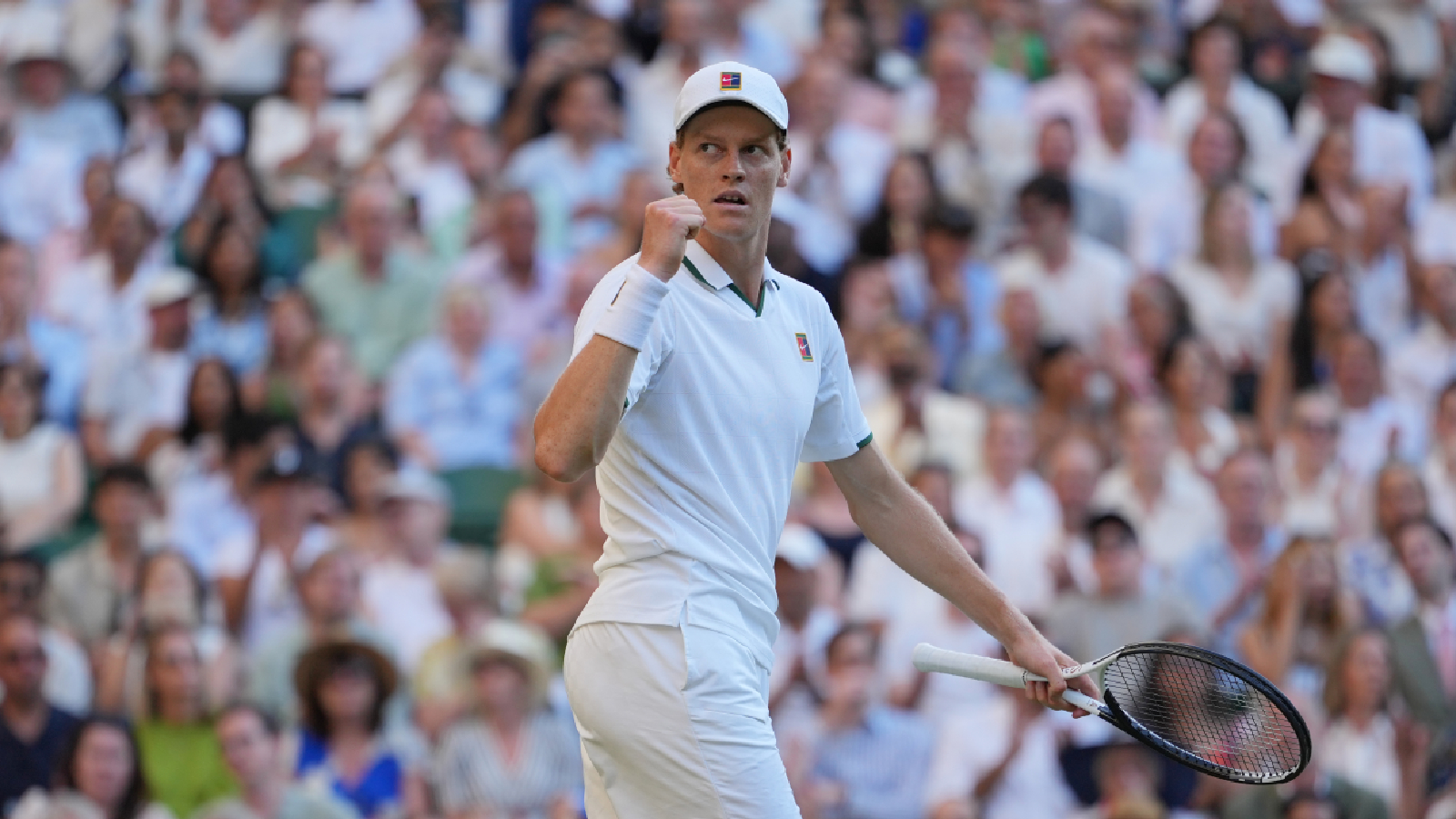
With the finish line in sight, Sinner conjured his 58th winner of the match, a perfectly placed shot that sealed the victory. As Zverev’s final return sailed long, the Italian sank to the hallowed turf, his arms outstretched in triumph. The scoreboard read 6-7 (7-9), 7-6 (7-2), 6-3, 6-4, marking not just his second Wimbledon title but also his 100th Grand Slam match win – a dual milestone that underscored his exceptional talent and consistent performance at the sport’s highest level. The Centre Court faithful rose in a standing ovation, acknowledging not only the champion but also the epic battle they had just witnessed.
Unpacking the Dominance: Supporting Data and Analysis
Jannik Sinner’s second Wimbledon title was a culmination of tactical brilliance, physical prowess, and profound mental fortitude. The statistics and observations from the final paint a clear picture of a champion who thrives under pressure and possesses a game uniquely suited for the modern era.
The Unassailable Serve and Return
The bedrock of Sinner’s success was, as Novak Djokovic aptly noted, his first serve. Throughout the tournament, and particularly in the final, Sinner’s first serve was a weapon of mass destruction – fast, accurate, and possessing enough spin to generate difficult returns. Opponents found it nearly impossible to gain any purchase on it, allowing Sinner to dictate the rhythm of points and frequently earn free points. This dominance on serve was complemented by an equally potent return game. Sinner returned supremely, often turning defense into immediate offense, neutralizing Zverev’s powerful first serves and forcing the German into uncomfortable positions from the outset of rallies.
All-Court Mastery and Strategic Finesse
Beyond the raw power, Sinner showcased a nuanced all-court game. His counter-slugging was exemplary, absorbing Zverev’s heavy groundstrokes and redirecting them with interest, often finding acute angles that pulled Zverev out of position. Crucially, Sinner’s drop shot was a thing of beauty and a potent tactical weapon. He deployed it judiciously, particularly when Zverev was deeply positioned, wrong-footing his opponent and creating easy winners or forcing weak replies. One such majestic drop shot famously saved a set point in the first set tie-break, showcasing not just skill but also nerves of steel.
Mental Fortitude Under Duress
Perhaps the most significant aspect of Sinner’s performance was his mental resilience. After the disappointment of the French Open, many wondered how he would respond. He answered emphatically. In the final, he remained "unruffled" even when Zverev played at an incredibly high level, holding firm each time he needed to. Serving to stay in the second set twice, he found baseline corners and big serves when it mattered most, demonstrating the composure of a seasoned champion. This mental toughness was instrumental in turning the tide after losing the tight first set.
The Numbers Game
The final was defined by its scarcity of break points – only six in total across 3 hours and 46 minutes. The fact that the first break of serve arrived after 34 games underscores the serving dominance of both players and the relentless pressure they exerted on each other. Sinner’s ability to convert his opportunities when they arose, and to fend off Zverev’s, was key. His 100th Grand Slam match win is not merely a number but a testament to his consistent presence and performance at the sport’s most demanding events, highlighting a career trajectory aimed squarely at the top. While Zverev landed 85% of his first serves in the second set, he still lost it in a tie-break, illustrating Sinner’s superior returning and ability to capitalize on the slightest dip in his opponent’s game. Sinner’s 58 winners against a top-tier opponent in a Grand Slam final speaks volumes about his aggressive yet controlled offensive game.
Zverev’s Evolved Grass Game
Despite the loss, Zverev’s performance was a landmark moment for his career on grass. Historically, he has struggled on the surface, but his run to the final showcased significant improvements. He fought fire with fire, packing a greater punch in his groundstrokes and serving with vengeance. His ability to take a set off Sinner for the first time in many encounters, and to push him to four sets, confirms that his grass-court game has evolved. This bodes well for his future prospects at Wimbledon and other grass-court events, suggesting he has finally overcome his "known deficiency" on the surface.
Echoes from the Champions: Official Responses and Reflections
The aftermath of a Grand Slam final often provides a window into the minds of the athletes, revealing the sacrifices, pressures, and perspectives that define their journey. Jannik Sinner’s post-match comments were particularly insightful, offering a mature and balanced view of his monumental achievement.
Sinner’s Poignant Perspective
For Sinner, the Wimbledon triumph was more than just another trophy; it was a profound validation following a challenging period. "Winning Wimbledon was only a great outcome of some good preparation and big sacrifice after he hunkered down for tough training days at Monaco," he reflected. This statement underscores the immense dedication required at the elite level, highlighting the unseen hours of toil that precede moments of glory.
Perhaps most striking was Sinner’s philosophical take on Grand Slam success and failure. "There is no failure if you don’t win a Grand Slam. These are very very rare days. Now I’ve had five in my whole life. We talk about five Grand Slams but at the end of the day these are just five days out of so many other days." This perspective, coming from a player who has already achieved so much at a young age, speaks volumes about his mental strength and ability to maintain a healthy outlook amidst intense pressure. It’s a reminder that even for the best, Grand Slam victories are exceptions, not the rule, and the vast majority of a player’s life is spent in preparation and competition outside of these pinnacle events. He further insisted that he "never took making a Slam final for granted," emphasizing his humility and respect for the competitive landscape.
The Italian also looked to the future, acknowledging the broader tennis ecosystem. "We hope Carlos is coming back because tennis needs him," Sinner stated, referring to the absent Carlos Alcaraz. This comment highlights not only the mutual respect among the top players but also the excitement and anticipation surrounding their burgeoning rivalry, which promises to define the next era of men’s tennis. Sinner’s own season, six months in without a Grand Slam title despite Alcaraz’s absence, had felt incomplete, underscoring his personal need for this Wimbledon triumph to bring his year "back on track."
Djokovic’s Prescient Observation
The prescience of Novak Djokovic’s comments after his semi-final defeat to Sinner cannot be overstated. "You cannot attack Jannik Sinner’s first serve," Djokovic had pithily declared, after suffering "a good old blowout" at the hands of the Italian virtuoso. This observation, made by one of the greatest returners of all time, provided a blueprint for understanding Sinner’s dominance and proved to be a critical factor in the final. It highlighted the sheer quality and unreadability of Sinner’s serve, which consistently bailed him out of trouble and laid the foundation for his offensive game.
Zverev’s Undeniable Effort
While specific quotes from Alexander Zverev were not provided in the original dispatch, his performance spoke volumes. His roar after taking the first set was a visceral expression of breakthrough, of overcoming a significant psychological barrier against Sinner. Despite the ultimate defeat, Zverev’s demeanor throughout the match, his relentless fight, and his ability to push Sinner to four sets, demonstrated a champion’s spirit. He covered himself in glory, performing his best grass-court tennis yet and proving that he belongs at the very top, ready to challenge for Grand Slam titles. His continued management of Type 1 diabetes, evident in his mid-match insulin injection, further highlighted his dedication and professionalism in balancing health with elite athletic performance.
The Dawn of a New Era: Implications and Future Outlook
Jannik Sinner’s second consecutive Wimbledon title is more than just a personal triumph; it carries significant implications for the landscape of men’s tennis, solidifying his position and foreshadowing compelling rivalries for years to come.
Sinner’s Reign: The New Benchmark
With back-to-back Wimbledon crowns, Jannik Sinner has firmly established himself as the sport’s new benchmark. His consistent performance at Grand Slams, coupled with his world number one ranking, signals a sustained period of dominance. The question is no longer if Sinner will win more Grand Slams, but how many. His blend of power, precision, mental fortitude, and evolving all-court game makes him a formidable opponent on any surface, but particularly on grass where his serve and flatter groundstrokes are devastatingly effective. His second Wimbledon title brings his Grand Slam tally to an impressive number for his age, positioning him as a potential multi-major champion. The era of the "Next Gen" truly taking over from the "Big Three" is now unequivocally here, with Sinner at its forefront.
The Looming Sinner-Alcaraz Rivalry
Sinner himself acknowledged the importance of Carlos Alcaraz’s return, stating, "We hope Carlos is coming back because tennis needs him." This sentiment encapsulates the anticipation surrounding what promises to be the sport’s defining rivalry for the next decade. Alcaraz’s absence from this year’s Wimbledon due to injury left a void, but his return will undoubtedly ignite a thrilling competition with Sinner. These two young titans, with their contrasting yet equally exciting styles, are poised to push each other to even greater heights, creating compelling narratives and breathtaking matches that will captivate fans worldwide. Their rivalry will not only elevate their individual games but also inject immense energy and interest into the sport, much like the iconic rivalries of previous generations.
Zverev’s Grand Slam Quest and Grass-Court Evolution
For Alexander Zverev, the Wimbledon final, despite being a loss, marked a significant step forward. His best-ever performance on grass, culminating in a Grand Slam final, demonstrates a clear evolution in his game on the surface. He has proven he can contend at Wimbledon, dispelling past doubts about his grass-court capabilities. The challenge now for Zverev is to translate this consistent high-level performance into a Grand Slam title. His battle with Type 1 diabetes, managed professionally and without apparent impact on his elite play, also serves as an inspiration. If he can maintain this improved grass-court form and continue to refine his game, a major title may well be within his grasp, perhaps even at Wimbledon in the future.
The Enduring Allure of Wimbledon
Wimbledon, with its rich history and unique traditions, remains the pinnacle of tennis achievement. Sinner’s back-to-back titles further solidify his legacy within the tournament’s storied annals. The quality of the final, the drama, and the sheer athleticism on display underscore the enduring appeal of the event. As tennis continues to evolve, Wimbledon maintains its status as a sacred ground where legends are forged and new eras are inaugurated. Sinner’s victory is a chapter in this ongoing narrative, a testament to the pursuit of excellence and the thrill of competition on sport’s grandest stages. The tennis world, having witnessed this epic showdown, eagerly awaits the next chapter of this unfolding golden era.
