

BENGALURU — As humanity stands on the precipice of becoming a multi-planetary species, the focus of the global scientific community has intensified on our nearest neighbor: Mars. Often regarded as a "dead" planet, recent data and historical re-evaluations suggest that Mars is a world of dynamic transitions, hosting the solar system’s most extreme geography and a complex climatic history. From the oxidized dust that gives the planet its signature hue to the looming possibility of a Martian ring system, the "Red Planet" remains the most vital laboratory for understanding planetary evolution and the potential for life beyond Earth.
Main Facts: The Anatomy of a Rusty Giant
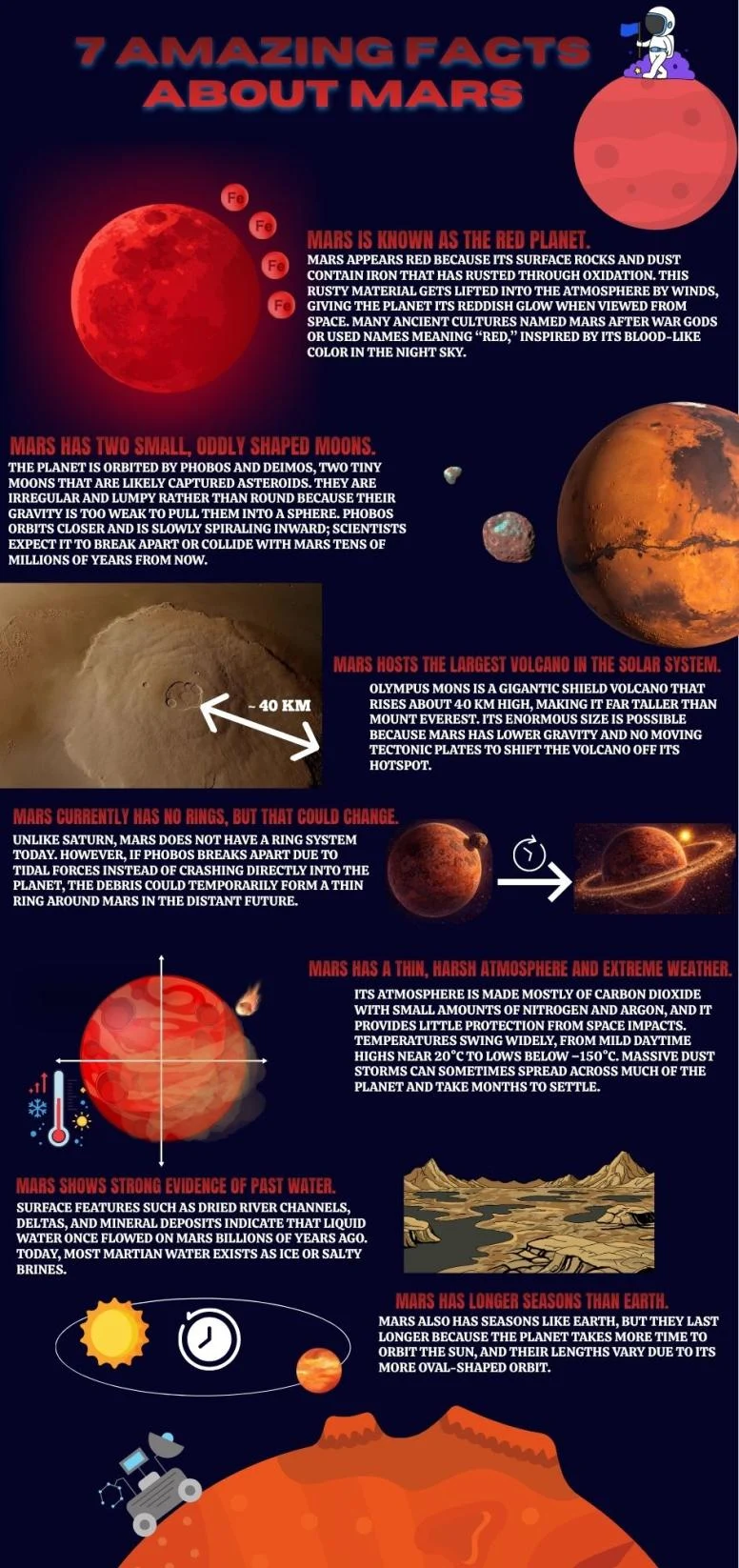
The defining characteristic of Mars is its striking ochre appearance. This is not merely a surface-level aesthetic but a testament to the planet’s chemical history. Mars appears red because its surface rocks and dust contain high concentrations of iron that have undergone oxidation—essentially, the entire planet has "rusted." This fine, silty material is frequently lofted into the thin atmosphere by global dust storms, creating a reddish haze that has captivated human observers since antiquity. Ancient civilizations, from the Babylonians to the Romans, associated this blood-like color with gods of war, a nomenclature that persists today.
Beyond its color, the Martian landscape is dominated by record-breaking geological features. Chief among these is Olympus Mons, a shield volcano that dwarfs any mountain found on Earth. Standing at approximately 25 kilometers (nearly 16 miles) high and spanning an area roughly the size of Arizona, Olympus Mons is nearly three times the height of Mount Everest. Its immense size is a direct result of Martian geology: unlike Earth, Mars lacks active tectonic plates. On Earth, as plates move over stationary volcanic "hotspots," chains of smaller volcanoes (like the Hawaiian Islands) are formed. On Mars, the crust remains stationary, allowing a single volcano to erupt for billions of years, piling lava higher and higher in a low-gravity environment.
Equally fascinating are the Martian moons, Phobos and Deimos. Unlike Earth’s large, spherical Moon, these two satellites are small, lumpy, and irregularly shaped, bearing a closer resemblance to asteroids than traditional moons. Scientific consensus suggests they were likely captured by Mars’ gravity from the nearby asteroid belt. However, their future is precarious. Phobos, the larger of the two, orbits remarkably close to the Martian surface and is slowly spiraling inward. Astronomers predict that in 30 to 50 million years, Phobos will either crash into the planet or be torn apart by tidal forces, potentially giving Mars a temporary ring system similar to Saturn’s.

Chronology: From Myth to Robotic Exploration
The human relationship with Mars has evolved through distinct phases of observation and discovery:
- Ancient Era (Pre-17th Century): Mars was tracked by naked-eye astronomers. Its retrograde motion and red tint made it a focal point for astrology and early planetary mathematics.
- The Telescopic Revolution (1610–1900s): Galileo Galilei first observed Mars through a telescope in 1610. By the late 19th century, Giovanni Schiaparelli and Percival Lowell popularized the idea of "canals" on Mars, sparking a century of speculation about Martian civilizations.
- The Space Race and Flybys (1960s): NASA’s Mariner 4 provided the first close-up images of the Martian surface in 1965, shattering the "canal" myth and revealing a cratered, moon-like wasteland.
- The Landing Era (1970s–1990s): The Viking 1 and 2 missions in 1976 performed the first successful landings and conducted biological experiments to search for life, yielding inconclusive but tantalizing results.
- The Rover Renaissance (2004–Present): The deployment of Spirit, Opportunity, Curiosity, and most recently, Perseverance, has transitioned Martian study from "observation" to "in-situ laboratory science." These rovers have confirmed the presence of past liquid water and organic molecules.
- The Future (2030s and Beyond): Current timelines from NASA and private entities like SpaceX aim for the first human footfalls on Mars, alongside the ambitious Mars Sample Return (MSR) mission.
Supporting Data: Atmospheric Instability and Seasonal Flux
The Martian environment is a study in extremes, supported by rigorous atmospheric data collected by orbiters like MAVEN and the Hope probe. The atmosphere is incredibly thin—less than 1% of Earth’s atmospheric pressure—and is composed of 95% carbon dioxide, 2.7% nitrogen, and 1.6% argon.
Temperature and Weather Dynamics:
Because the atmosphere is so thin, it cannot retain heat effectively. This leads to massive diurnal temperature swings. On a "summer" day at the equator, temperatures might reach a comfortable 20°C (68°F), but at night, they can plummet to below -150°C (-238°F). Furthermore, Mars experiences global dust storms. Driven by solar heating, these storms can envelop the entire planet for months, blocking out the sun and posing significant risks to solar-powered machinery.
Orbital Mechanics and Seasons:
Mars possesses an axial tilt of about 25 degrees, very similar to Earth’s 23.5 degrees. Consequently, Mars experiences four seasons. However, because a Martian year (one orbit around the Sun) lasts 687 Earth days, these seasons are nearly twice as long as Earth’s. Additionally, Mars has a significantly more elliptical (oval-shaped) orbit than Earth. This means its distance from the sun varies more dramatically, causing the lengths of the seasons in the northern and southern hemispheres to be noticeably unequal.
The Water Paradox:
Data from the Mars Reconnaissance Orbiter (MRO) has provided definitive evidence of dried river channels, ancient lake beds (such as Jezero Crater), and mineral deposits like hematite that only form in the presence of water. While liquid water cannot exist for long on the surface today due to low pressure, billions of years ago, Mars likely had a thicker atmosphere and a vast northern ocean. Today, the planet’s water is locked away as ice in the polar caps or as "briny" permafrost beneath the surface.

Official Responses and Scientific Perspective
Leading planetary scientists emphasize that Mars is not just a destination for exploration, but a mirror for Earth’s own climate future. In a recent briefing, representatives from the Indian Space Research Organisation (ISRO)—which successfully reached Mars with its Mangalyaan mission—noted that studying the loss of the Martian atmosphere is crucial for understanding how planetary habitability is maintained or lost.
"Mars is a cautionary tale written in the rocks," says Dr. Aishwarya Rao, a planetary geologist. "By studying how a planet with once-flowing rivers became a frozen desert, we gain invaluable data on atmospheric escape and the long-term stability of greenhouse gases. This research directly informs our climate models on Earth."
NASA’s Jet Propulsion Laboratory (JPL) has also highlighted the importance of the "Mars Sample Return" program. Officials state that bringing actual Martian soil back to Earth is the only way to confirm whether the organic compounds found by rovers are biological or geological in origin. "We are moving from the ‘Follow the Water’ phase to the ‘Seek Signs of Life’ phase," a JPL spokesperson confirmed.
Implications: The Bridge to Multi-Planetary Life
The study of Mars has profound implications for the future of the human race. If evidence of past life is found, it would suggest that life is a common occurrence in the universe, provided the right conditions exist. If Mars is found to have been sterile despite its early Earth-like conditions, it would suggest that the "spark" of life is much rarer than we hope.
Furthermore, the localized shifts in our understanding of Martian weather and water resources are rewriting the rules for urban survival—not just on Mars, but on Earth. For instance, the technology being developed to extract oxygen from the Martian CO2 atmosphere (the MOXIE experiment) and the methods for recycling water in closed-loop systems are already finding applications in sustainable "smart cities" and water-stressed regions on Earth, such as the southern Indian urban centers currently facing dramatic rainfall shifts.

As we look toward the 2030s, the "Red Planet" serves as both a challenge and a beacon. Whether it becomes a "Plan B" for humanity or remains a pristine scientific preserve, Mars continues to push the boundaries of our technological and philosophical limits. The "rusty" world, with its towering volcanoes and disappearing moons, is no longer a distant light in the night sky; it is the next chapter in the history of Earth.
Quick Reference: Mars vs. Earth
- Diameter: Mars is about 53% the size of Earth.
- Gravity: 38% of Earth’s gravity (You could jump 3x as high).
- Day Length: A "Sol" is 24 hours and 39 minutes.
- Distance: Average of 225 million kilometers from Earth.
- Moons: 2 (Phobos, Deimos) vs. 1.
