

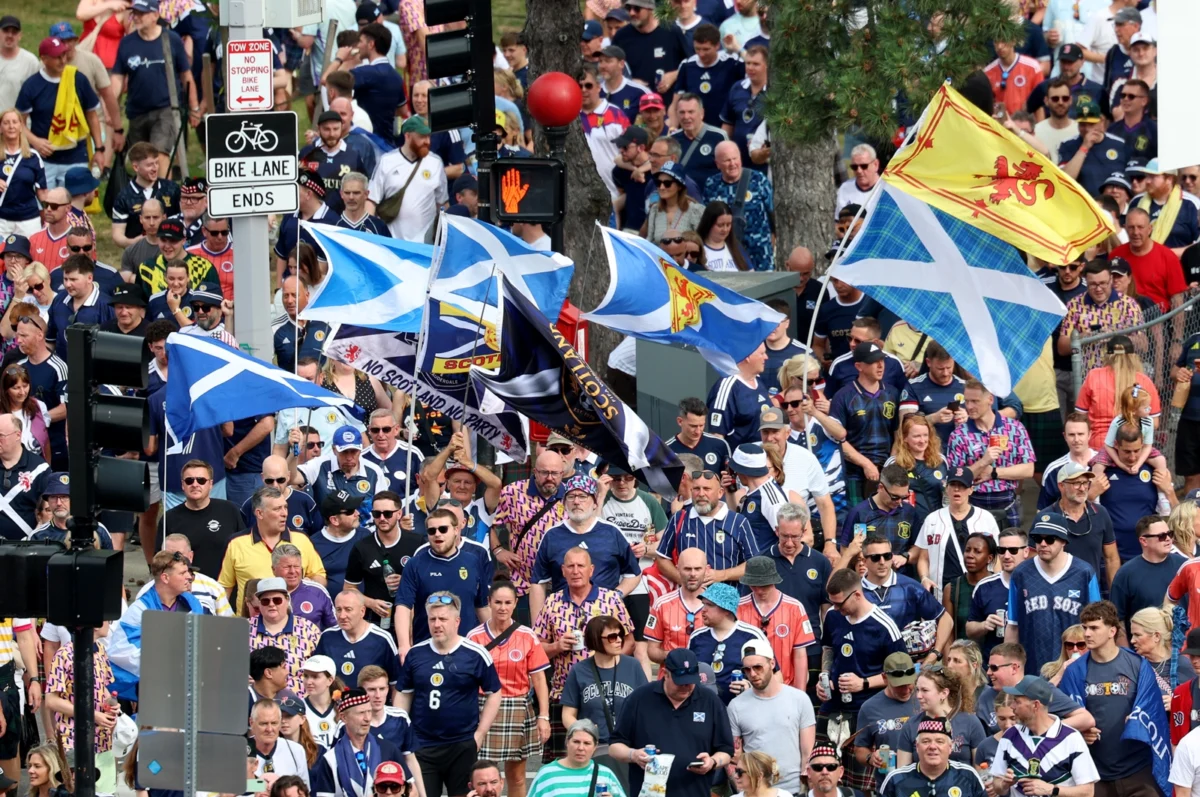
BOSTON, MA – June 25, 2026 – Miles away in Miami, the Scottish national football team faced a crushing 3-0 defeat against Brazil, severely denting their FIFA World Cup knockout stage aspirations. But in Boston, a city that had hosted the Tartan Army for a whirlwind week of group stage matches against Morocco and Haiti, the disappointment was profound, tinged with a deep sense of loss for a spirit that had utterly captivated its populace. The vibrant, kilt-clad legions of Scottish supporters had so completely won the hearts of Bostonians that Mayor Michelle Wu formalized the city’s affection by signing a letter of intent to forge a sister city relationship with Glasgow, Scotland.
This unprecedented civic embrace, unfolding over six extraordinary days, saw a city traditionally steeped in baseball, basketball, and American football fall head over heels for the unbridled passion and camaraderie of Scotland’s most fervent fans. What began as a World Cup stopover quickly blossomed into a profound cultural exchange, leaving an indelible mark on Boston’s urban landscape and its collective memory.
The Unforgettable Arrival: A Kilted Invasion of Boston
The story began with the arrival of approximately 50,000 Scottish fans descending upon Boston for their two crucial group stage fixtures. From the moment they disembarked, the city was enveloped in a kaleidoscope of tartan and the resonant, unmistakable drone of bagpipes. Public squares, historic cobblestone streets, and even the city’s robust public transport system were transformed into impromptu stages for singalongs and spontaneous celebrations. The sheer volume and palpable enthusiasm of the Tartan Army were unlike anything Boston had witnessed, turning an ordinary June week into a vibrant, living spectacle.
"You came for the World Cup, but gave us something more," declared a full-page tribute in the Boston Globe after Scotland’s final group game in the city against Morocco. The heartfelt message continued: "For a week, you turned train stations into singalongs, Fenway into a football ground, and an ordinary June into something we will be talking about for years. The World Cup will move on. So will the songs, but we will never forget the joy you brought to our city." This sentiment perfectly encapsulated the city’s astonishment and gratitude, recognizing that the Tartan Army had delivered not just football support, but an unforgettable cultural phenomenon.
Chronology of a Cultural Conquest
The week unfolded as a series of unforgettable moments, each further cementing the Scots’ place in Bostonian affections.
Early June 2026: Preparations were underway for Boston’s role as a FIFA World Cup host city. Local businesses braced for an influx of international tourists, though few could have predicted the scale of the Scottish impact.
June 14, 2026: The Tartan Army made its grand procession to Fenway Park, the venerable home of the Boston Red Sox. Ahead of a scheduled baseball game between the Red Sox and the Texas Rangers, thousands of kilt-clad Scots marched through the city, filling the stands of the iconic stadium. What transpired was a stunning spectacle, as Fenway, usually echoing with the crack of a bat, reverberated with Scottish chants and songs. The atmosphere was described as electric, elevating the experience beyond anything many of the fans, or local observers, had ever known. Red Sox president Sam Kennedy eloquently summarized the experience in a letter to the Scotland Football Association: "What happened at Fenway Park on June 14th was something none of us will forget. We knew the Tartan Army was coming. We did not fully understand what that meant until we saw it."
Mid-June 2026: Scotland played its group stage matches against Haiti and Morocco in Boston. While the results on the pitch were secondary to the camaraderie and celebration off it, the fans’ unwavering support and vibrant presence continued to define the city’s experience. Between games, the Tartan Army integrated seamlessly with locals, sharing stories, exchanging shirts, and extending invitations for dinner and drinks, fostering an atmosphere of genuine goodwill.
June 20, 2026: As the Tartan Army prepared to depart Boston for Miami, the farewell was bittersweet. Social media platforms buzzed with messages of thanks from the fans to their Boston hosts, and vice-versa. The official Tartan Army Group posted on X (formerly Twitter): "New England – it has been an absolute pleasure. Across Boston, Providence, Newport and many towns in between you’ve welcomed us with open arms and unbelievable hospitality, and we can’t thank you enough. As we begin our journeys to South Florida, we hope it’s not goodbye, but… see you again soon."
June 25, 2026: The news arrived from Miami of Scotland’s defeat to Brazil, effectively ending their World Cup journey. In Boston, the mood was one of shared melancholy, a collective sigh for a team that had given so much joy, even in defeat, to a city far from home. It was on this day that Mayor Michelle Wu’s letter of intent for a Glasgow-Boston sister city relationship was officially confirmed, a lasting testament to the week’s profound impact.
Supporting Data: A City Transformed
The impact of the Tartan Army’s visit extended far beyond mere sentiment, creating tangible economic and cultural shifts within Boston.
Economic Boom for Local Businesses
The sheer volume of visitors translated into an unprecedented boom for Boston’s hospitality sector. Local establishments, anticipating a busy World Cup period, found themselves utterly unprepared for the Scottish thirst. Boston Beer Co. reported astonishing figures, stating that in just four days, the Tartan Army consumed the equivalent of four times the company’s entire 4th of July sales. Devon Savage, a representative from Boston Beer, told NBC Boston: "From Thursday to Sunday, the Tartan Army drank four times as much Boston Lager as we run through on a typical four-day holiday stretch like 4th of July. We had to schedule an emergency delivery on Saturday morning just to keep up."
The experience was mirrored across the city. Haven, a popular Scottish pub in Jamaica Plain, managed to exhaust an astonishing 65 kegs – each holding approximately 10 gallons – within six days. Thomas Mathew, an Indian bartender at Boston’s Public Tavern, recounted a week unlike any he had ever seen. "We had stocked up anticipating the tourists, but never imagined we would run totally dry," he explained. "The day after the Haiti match, we totally ran out of beer. The shops usually shut around midnight, but they were here till morning. It was fun." Mathew, who admitted he hadn’t watched any of Scotland’s games, found himself a devoted fan of the supporters themselves, missing their "lyrical English" and "lilting music." This personal account underscored the profound and direct economic and cultural impact on individual workers and businesses.
Beyond pubs, hotels reported full occupancy, restaurants saw significant upticks in patronage, and souvenir shops quickly adapted to the demand for tartan-themed merchandise, often selling out of items like kilts, scarves, and miniature bagpipes. The economic footprint of the Tartan Army was a clear and measurable benefit, injecting millions of dollars into the local economy during their brief stay.

A Wave of Goodwill and Charitable Giving
The Tartan Army also demonstrated a remarkable generosity, donating $10,000 to Hasbro Children’s Hospital. This act of kindness resonated deeply with Bostonians, showcasing the philanthropic spirit often overshadowed by the boisterous reputation of football fans. It highlighted the positive community engagement that characterized their visit, moving beyond mere revelry to genuine civic contribution.
The "Traffic Cone" Tradition: A New Bostonian Quirk
Perhaps one of the most visible and humorous legacies of the Scottish visit was the widespread adoption of the "traffic cone" tradition. Rooted in a Scottish prank dating back to the 1970s, where revelers placed a cone on the statue of Arthur Wellesley, the Duke of Wellington, this playful act was quickly embraced in Boston. The Tartan Army initiated the trend by placing a traffic cone atop the statue of Boston Celtics legend Bill Russell outside City Hall. The sight proved so infectious that thousands of locals, and even official figures, followed suit.
Mayor Michelle Wu herself confessed to participating, admitting: "I think we may see some lingering traditions from their visit, and I have to admit, I also put a cone on Bill Russell’s head outside City Hall. So, it’s been fun." Even venerable statues of Benjamin Franklin and Abraham Lincoln were not spared, testament to the widespread adoption of this lighthearted, uniquely Scottish quirk, now firmly ingrained in Bostonian humor.
Official Responses and Enduring Proposals
The Scottish invasion elicited a range of enthusiastic and often humorous responses from Boston’s civic and sporting leaders, underscoring the deep impression left by the Tartan Army.
Sister City Initiative: Forging a Lasting Bond
Mayor Michelle Wu’s signing of a letter of intent to make Glasgow and Boston sister cities stands as the most significant official gesture. Sister city programs are designed to promote cultural, educational, and economic ties between cities in different countries. This move reflects a desire to formalize the spontaneous bond that developed, envisioning future exchanges and collaborations that could benefit both municipalities. It speaks volumes about the warmth of the reception and the perceived value of such a partnership.
Sporting Icons Weigh In
The impact was also felt deeply within Boston’s powerful sports establishment. Robert Kraft, the influential owner of the New England Patriots, has reportedly petitioned the NFL to consider playing a regular season game at Glasgow’s Hampden Park. Such a move would be unprecedented and would further solidify the transatlantic sporting connection sparked by the Tartan Army’s visit.
Similarly, the Boston Red Sox, through their president Sam Kennedy, expressed profound admiration for the Scottish fans’ ability to transform Fenway Park, highlighting how a typically American sporting venue was infused with a unique, international footballing fervor.
Political Playfulness and Policy Debates
Even Massachusetts Governor Maura Healey joined the spirit of the week, engaging with a Scottish podcaster and playfully "signing" what she called an executive order declaring haggis legal in Massachusetts. While she clarified the next morning that it was a joke – haggis, made from sheep’s heart, liver, and lungs, has been banned under federal food regulations since 1971 – the incident sparked a real-world petition on Change.org. The petition, titled "Legalize Haggis in Massachusetts," reflects the lasting, albeit whimsical, impact of the cultural exchange on local discourse.
Adding to the calls for a lasting connection, Massachusetts Senator Paul Feeney went further, proposing that the Tartan Army should return to Foxborough, the home of the Patriots, every year. This ambitious suggestion, while perhaps impractical, underscores the profound desire among local leaders to maintain the vibrant energy and goodwill generated by the Scottish fans. Another petition has also emerged, calling to "Build a Tartan Army statue on the waterfront," illustrating the public’s desire for a permanent tribute to their unforgettable guests.
Implications: A Future Forged in Friendship
The departure of the Tartan Army and the subsequent defeat of the Scottish team in Miami brought a wave of melancholy to Boston, but also a lingering hope. The possibility of Scotland progressing as one of the best eight third-placed teams, which could have led to another match in Boston, was dashed by the Brazil result. Yet, the fervent desire for their return remains undimmed.
"We will never forget the week," reflected Jimmy Chang, who runs a popular restaurant in Boston’s Chinatown. He sighed, echoing a city’s collective sentiment: "I feel gutted for the fans with the way the team played." His words capture the unique blend of sadness for the team’s exit and profound gratitude for the fans’ presence. The whole of Boston would undoubtedly echo his sentiment and "live on a prayer" for another opportunity to host the Tartan Army.
The implications of this extraordinary week are multifaceted. The sister city initiative promises a formal framework for future cultural, educational, and economic exchanges between Glasgow and Boston, potentially leading to new partnerships and shared ventures. The proposed NFL game in Hampden Park, if realized, would be a testament to the powerful cross-cultural appeal of sport and fan engagement.
More broadly, the visit served as a powerful reminder of how major sporting events can transcend competition, fostering genuine human connections and cultural understanding. The Tartan Army’s friendly, passionate, and generous spirit not only brought an economic boost to Boston but also gifted the city an unforgettable experience, a new set of inside jokes, and a lasting appreciation for Scottish culture.
As Boston looks back on that magical week in June 2026, it remembers not just football matches, but a vibrant, kilt-wearing, bagpipe-playing phenomenon that momentarily transformed its identity. The Tartan Army may have left, but their legacy of joy, camaraderie, and unexpected friendship will undoubtedly echo through the streets of Boston for years to come, solidifying a unique bond between two cities across the Atlantic.
