

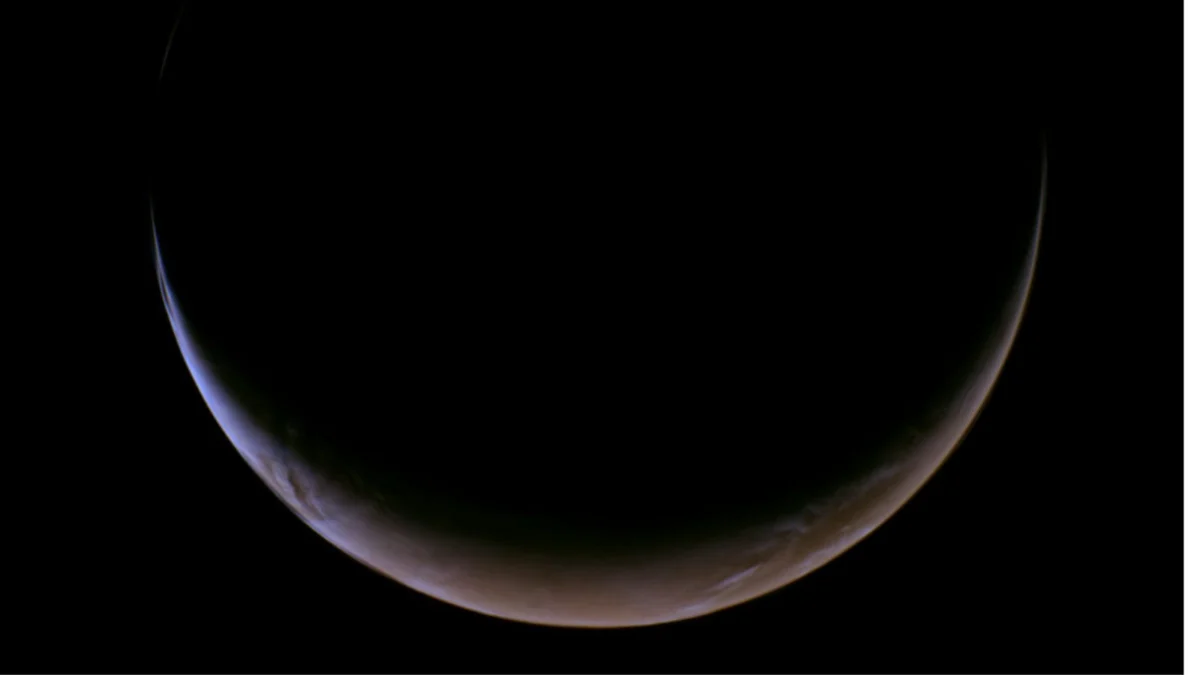
PASADENA, CA — In a significant milestone for deep-space exploration, NASA’s Psyche spacecraft has successfully executed a high-precision gravity-assist maneuver around Mars. The flyby, which occurred on May 15, 2026, not only provided the necessary kinetic energy to propel the probe toward the outer reaches of the asteroid belt but also yielded a suite of breathtaking scientific imagery, including a rare "crescent" perspective of the Red Planet.
The maneuver marks the halfway point in a nearly six-year journey. By utilizing the Martian gravitational field, the spacecraft gained a vital velocity boost, ensuring it remains on track for its 2029 rendezvous with its namesake, the metal-rich asteroid 16 Psyche.
Main Facts: A Precision Maneuver in Deep Space
The Psyche mission, managed by NASA’s Jet Propulsion Laboratory (JPL), achieved its closest approach to Mars at a distance of approximately 4,609 kilometers (2,864 miles) from the planet’s surface. This "slingshot" maneuver is a cornerstone of orbital mechanics, allowing spacecraft to trade a small portion of a planet’s orbital momentum for a significant increase in its own velocity without the need for additional chemical propellant.
Key Technical Achievements of the Flyby:
- Velocity Gain: The Martian gravity provided a boost of approximately 1,000 miles per hour (1,609 km/h) relative to the Sun.
- Orbital Reorientation: The spacecraft’s trajectory was shifted by approximately one degree, aligning it perfectly for its long-distance cruise to the main asteroid belt.
- Imaging Success: Using its Multispectral Imager, the spacecraft captured thousands of high-resolution images, including a striking view of Mars as a thin crescent. This perspective was made possible by the "high phase angle" of the approach—a position where the spacecraft looks back toward the Sun, seeing only a sliver of the planet’s illuminated dayside.
- Geological Observations: Detailed shots were taken of the Huygens crater, a massive double-ringed impact basin, and the rugged, crater-scarred terrain of the Martian southern highlands.
Chronology: The Journey from Earth to the Belt
The successful Mars flyby is the latest chapter in a mission that has been years in the making. To understand the significance of this week’s events, one must look at the timeline of the Psyche mission:
October 2023: The Launch
Psyche launched from NASA’s Kennedy Space Center atop a SpaceX Falcon Heavy rocket. The launch was the culmination of over a decade of planning and several years of technical delays related to flight software testing. Once in space, the craft deployed its massive cross-shaped solar arrays and began its long trek using solar electric propulsion.
2023–2025: Deep Space Cruise and DSOC Testing
During the first two years of flight, the mission team focused on commissioning the spacecraft’s instruments. This period included successful tests of the Deep Space Optical Communications (DSOC) experiment—a laser-based communication system designed to transmit data at rates significantly higher than traditional radio waves.
May 15, 2026: The Martian Gravity Assist
The spacecraft entered the Martian sphere of influence. This was a "passive" maneuver in terms of fuel usage but an "active" one for the navigation team. The spacecraft’s multispectral imagers were powered on to calibrate the cameras and capture opportunistic science data of the Martian atmosphere and surface.
2026–2029: The Final Leg
Following the boost from Mars, Psyche is now on a direct heading for the main asteroid belt between Mars and Jupiter. It will travel a total of 3.6 billion kilometers (2.2 billion miles) by the time it reaches its destination.
Summer 2029: Arrival and Science Operations
The spacecraft is scheduled to enter the orbit of Asteroid 16 Psyche in August 2029. It will spend 26 months orbiting the body at various altitudes to map its surface and determine its composition.
Supporting Data: The Physics and Technology of the Mission
The Psyche mission represents a triumph of engineering, utilizing technologies that push the boundaries of how we explore the solar system.
Solar Electric Propulsion (SEP)
Unlike traditional rockets that burn chemical fuel in short, powerful bursts, Psyche uses Hall-effect thrusters. These thrusters use electricity generated by the spacecraft’s solar panels to ionize xenon gas. The resulting ions are accelerated by an electric field, creating a gentle but constant thrust. While the force is roughly equivalent to the weight of a business card in your hand, over months and years, it can accelerate a spacecraft to incredible speeds. The Mars flyby was essential because even SEP requires a gravitational "nudge" to reach the high-energy orbits of the outer asteroid belt.
The Multispectral Imager
The images captured during the flyby were taken with a pair of identical cameras equipped with filters that allow the team to see in both visible and near-infrared light. While the "crescent Mars" photo is aesthetically stunning, the images of the southern highlands provide valuable calibration data. By photographing known Martian features like the Huygens crater, engineers can verify the focus, light sensitivity, and color accuracy of the cameras before they reach the asteroid.
The Deep Space Network (DSN)
The maneuver was monitored via the Deep Space Network, a global array of giant radio antennas. By measuring the "Doppler shift"—the slight change in the frequency of the radio signal as the spacecraft moved toward and then away from Earth—navigators could calculate Psyche’s position and speed with centimeter-level precision.
Official Responses: Precision in Execution
The mood at NASA’s Jet Propulsion Laboratory was one of measured triumph as the data confirmed a successful flyby.
"Although we were confident in our calculations and flight plan, monitoring the DSN’s Doppler signal in real time during the flyby was still exciting," said Don Han, the mission navigation lead at JPL. "The precision required to pass within a specific window of the Martian atmosphere while moving at thousands of miles per hour cannot be overstated. Mars did exactly what we asked it to do: it gave us the energy we needed to reach our target."
NASA officials noted that the "crescent" imagery was a planned "bonus" of the mission. Because the spacecraft’s trajectory took it behind Mars relative to the Sun, the cameras were perfectly positioned to capture the atmospheric glow and the stark contrast of the Martian limb.
"Every time we fly past a planet, it’s a chance to test our hardware in a real-world environment," a NASA spokesperson added. "The clarity of the images of the southern highlands confirms that the multispectral imager is in peak condition for the primary mission at 16 Psyche."
Implications: Why 16 Psyche Matters
The successful flyby of Mars is merely a means to an end. The ultimate goal—Asteroid 16 Psyche—is one of the most intriguing objects in our solar system.
A Window into Earth’s Core
Scientists believe that 16 Psyche may be the exposed nickel-iron core of a "protoplanet." In the early, chaotic days of the solar system, planet-sized bodies were frequently involved in high-velocity collisions. It is hypothesized that a series of massive impacts stripped away the rocky outer crust and mantle of a developing planet, leaving behind its metallic heart.
Because humans cannot travel to the Earth’s core—the heat and pressure are far too intense—studying 16 Psyche is the closest we can get to visiting the center of our own world. If the asteroid is indeed a core, it will provide unprecedented data on how planets form and "differentiate" into layers of crust, mantle, and core.
Rethinking Planetary Formation
If the mission finds that 16 Psyche is not a core, it could be even more revolutionary. Some theories suggest it could be a type of primordial material that never melted, or a "rubble pile" of metallic fragments. Regardless of the outcome, the data collected will force astronomers to rewrite the textbooks on how the building blocks of the solar system evolved.
Economic and Resource Potential
While NASA’s mission is strictly scientific, the composition of 16 Psyche has sparked interest in the burgeoning field of space mining. Estimates of the asteroid’s value—based on its potential content of iron, nickel, and precious metals like gold and platinum—range into the quadrillions of dollars. While the technology to harvest these resources does not yet exist, the Psyche mission will provide the first high-resolution "prospecting" map of a metallic world, offering insights into the resource wealth of our solar neighborhood.
Conclusion: Onward to the Metal World
With Mars now in its rearview mirror, the Psyche spacecraft has entered a "quiet" phase of its mission. For the next three years, it will continue to glide through the void, its ion thrusters glowing with a faint blue light as it steadily climbs away from the Sun.
The images of the Martian crescent serve as a poignant reminder of how far humanity’s robotic emissaries have traveled. As Psyche leaves the inner solar system behind, it carries with it the hopes of scientists seeking to uncover the secrets of planetary birth—secrets hidden in a 200-kilometer-wide ball of metal drifting in the dark.
The world now waits for 2029, when this intrepid explorer will finally reach its destination and pull back the curtain on a world unlike any we have ever seen.
