

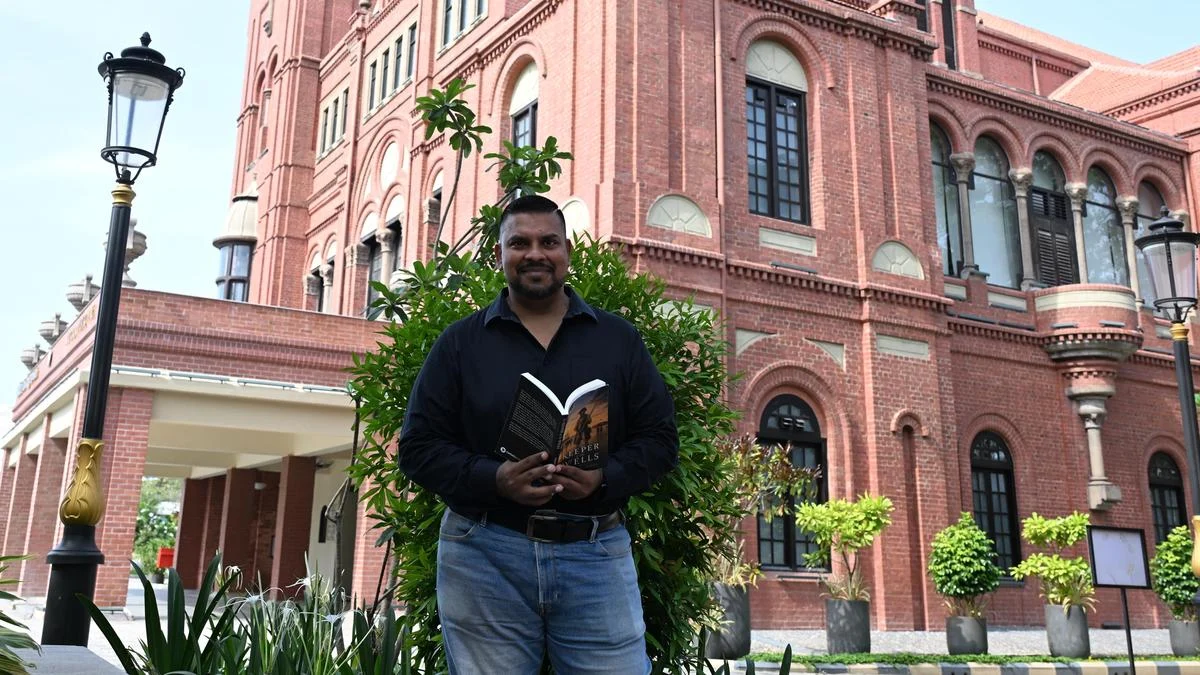
Chennai, India – On a sweltering July morning, amidst the verdant embrace of bird-of-paradise flowers, the venerable Victoria Public Hall stands as a testament to enduring Romanesque architecture. It is within these hallowed grounds, recently revitalized, that a narrative as rich and layered as the city’s history itself unfolds. This is not merely a setting for an interview, but the very backdrop that graces the opening pages of Zhayynn James’s debut novel, The Keeper of the Wells. Published by Notion Press, the book embarks on an ambitious, centuries-spanning, continent-traversing family saga, commencing a hundred years ago in colonial Madras and weaving its way through Europe before returning to the city on the cusp of the Second Anglo-Mysore War (1780-84).
At its heart, The Keeper of the Wells is a captivating tapestry of European and Indian powers at play, the fierce battles for the Carnatic, and the lives lived both within and beyond the imposing ramparts of Fort St. George. This kaleidoscopic narrative is inextricably bound by the story of John Nicholas, an Irishman whose lineage, and the significant legacy bequeathed by the East India Company for his pivotal role in saving the city’s inhabitants from a dire fate, forms the novel’s compelling core.
The Genesis of a Saga: From Landscape to Literature
Zhayynn James, a second-generation landscape architect and an award-winning wildlife photographer whose striking work has graced the pages of National Geographic and BBC Wildlife Magazine, brings a unique perspective to his literary debut. Raised in the burgeoning outskirts of Chennai, in Adambakkam, his childhood was a vibrant immersion in nature. "It was a childhood spent running wild among sparrows, frogs and trees, peppered with a robust dose of Anglo-Indian optimism," James recalls, his voice imbued with the nostalgia of an era. His educational journey, spanning institutions like St. Bede’s, Madras Christian College, and the University of New South Wales, has undoubtedly shaped his multifaceted understanding of the world.

However, even amidst the idyllic expanse of his youth, James harbored a deeper sense of his family’s heritage. "My mother, Marlene, was a Nicholas, and it was her parents who told me stories of an Irishman who saved Madras from the machinations of Hyder Ali and how we were descended from that stock," he explains. "I’m the eighth generation." These ancestral tales, recurring during family gatherings and particularly poignant at funerals where the extensive Nicholas clan was constantly being introduced and identified, began to coalesce into a singular narrative. It was at the funeral of his grand-aunt Kitty that the profound and "inextricable link the Nicholas family shared with an old Madras neighbourhood – the Seven Wells" truly crystallized for him.
The Unearthing of a Legacy: A Quest for Historical Truth
In his twenties, James recognized the widening chasm between the generations that held these oral histories and his own, which struggled to retain them. He felt a pressing urgency to act, lest this significant family legacy fade into obscurity, unacknowledged even as a footnote in Chennai’s rich history. This dawning realization, coupled with a series of serendipitous encounters, propelled him towards the arduous yet rewarding task of writing The Keeper of the Wells.
The first pivotal moment was his meeting with S. Muthiah, the esteemed chronicler of old Madras. Muthiah, a repository of the city’s past, directed James to a trio of seminal historical works: H.D. Love’s Vestiges of Old Madras, J.C. Molony’s A Book of South India, and Muthiah’s own Madras Rediscovered. These books corroborated the existence of the Nicholas family as the hereditary "Custodians of the Seven Wells." This locality in North Madras, known for its strategically sunk wells, was instrumental in supplying fresh water to Fort St. George, thereby establishing the region’s first piped water system under British rule.

The second crucial discovery was the Nicholas Square at St. Roque’s Cemetery in Washermanpet. This hallowed ground serves as the final resting place for generations of Nicholas family members, a tangible link to his ancestors and their enduring presence in the city. The third, and perhaps most personal, catalyst was the unwavering encouragement of his wife, Vaishali. Her thoughtful gift of a DSLR camera, enabling him to pursue his passion for photography, and her constant companionship during his research, spurred him to complete the book in time for his 50th birthday – a milestone that would forever mark the realization of this lifelong ambition.
A "Faction" of Facts and Fiction: Weaving the Narrative
The book’s launch at the Victoria Public Hall was a grand affair, graced by a distinguished panel of experts. Historian Sriram V, publisher-filmmaker Harry MacLure, and writer Ranjitha Ashok, with Sujatha Giri expertly moderating, all lauded the novel’s significance. Sriram V eloquently articulated the importance of such a work, stating, "Creating a romantic interest in history will draw more readers to it. From here they may go onto research but ‘faction’ (a portmanteau of fact and fiction) books such as these ignite the imagination." He further elaborated on Nicholas’s historical role, citing Molony’s account of Nicholas saving the water supply during "the stormy days of Hyder Ali’s conquest" and his subsequent appointment as "Custodian of the Seven Wells." The title and emoluments associated with this esteemed position, he noted, were bestowed upon the family for an impressive 125 years.
Harry MacLure highlighted the vital, often unsung, Anglo-Indian contribution to India’s historical fabric, while Ranjitha Ashok emphasized the novel’s adept integration of intimate family moments within a grand historical sweep. Zhayynn James himself shared his journey, describing how, after decades of living with the compelling family narrative, he finally committed it to paper in October 2025, completing the manuscript in April of the current year.

The Architect of Adventure: Inspiration and Intricacies
James’s literary influences are as diverse as his life experiences. He draws inspiration from the swashbuckling tales of authors like Bernard Cornwell and Louis L’Amour, renowned for their vivid portrayals of heroic protagonists and captivating damsels in distress. This influence is evident in the novel’s adventurous spirit and its inclusion of a compelling love story. "Madras was a cosmopolitan city even in the 1700s with its mix of Luso-Indians, British, Telugus and Tamils. Beyond the city on the brink of war, I wanted a nuanced and layered love story," James explains.
A particularly fascinating anecdote passed down through generations, which James has woven into the narrative, tells of John Nicholas etching the map of a fort where he was held prisoner onto his thumbnail – a testament to his resourcefulness and resilience. This meticulous attention to detail, combined with a "racy pace but with a touch of old-world charm and a vocabulary that seems to have fallen off the map," imbues the book with a unique and memorable quality. The battle scenes, in particular, are described as a "masterclass in detail and atmosphere," demonstrating James’s ability to transport the reader directly into the heart of historical conflict.
The Research: A Deep Dive into the Past
The narrative’s formidable energy stems from James’s extensive and meticulous research. He embarked on a deep dive into the past, poring over church records alongside his mother at St. Francis Xavier’s Church on Broadway and St. Mary’s Co-Cathedral on Armenian Street. His research extended to the hallowed halls of the British Library in London and countless hours spent trawling the internet. "The oldest physical record was from the 1840s," he states.

His gratitude extends to the wider Nicholas family diaspora. "I also am indebted to all the Nicholases, about 40-odd now, around the world," he expresses. He specifically mentions Nigel, a distant cousin discovered during his research, who "willingly shared the information he had gathered." The validation of his quest came when "every date mentioned matched with history," though he notes the intriguing common practice of Indian spouses being simply recorded as "Indo-Brit."
The writing process itself was a testament to James’s dedication. He penned the novel in cafes, during breaks from his professional commitments, and late into the night. He writes with an inherited sensibility, channeling the spirit of an ancestor who arrived on these shores seeking "escape, survival and redemption."
The Enduring Legacy of Seven Wells
The Seven Wells, a locale steeped in history and the very heart of the Nicholas family’s legacy, continues to exist, albeit in a changed form. Shrouded in shrubbery, with only one functioning well, it stands as a silent witness to the passage of time. Yet, its survival is undeniable – as a bustling neighborhood, a distinct pincode, the subject of a compelling family saga, and now, a meticulously crafted book. It stands as a testament to one man’s profound dedication to preserving and illuminating his family’s integral role in shaping the rich tapestry of Madras’s history. The Keeper of the Wells is more than just a novel; it is a meticulously researched, passionately told, and beautifully rendered tribute to a forgotten chapter of colonial India, ensuring that the echoes of the past resonate for generations to come.
