

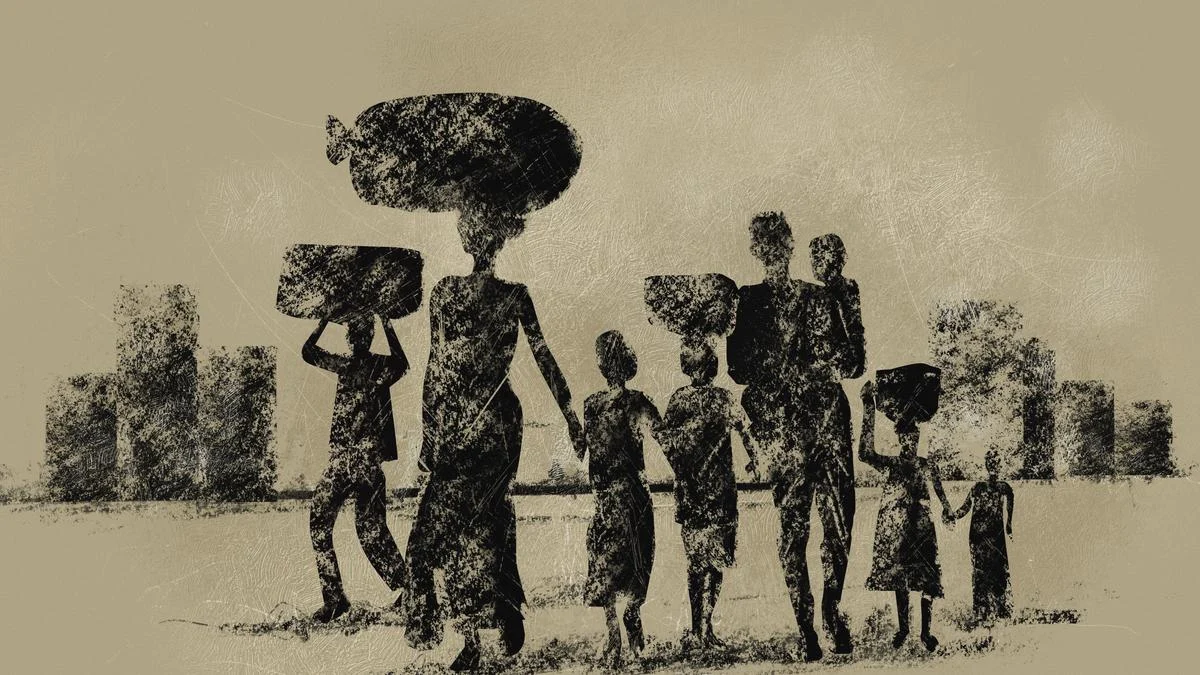
The story of Bengali food is often painted with broad strokes of shimmering rivers, abundant fish, and the generosity of fertile soil. While these elements are undeniably foundational, a deeper, more poignant narrative lies beneath the surface – a tale etched not on fertile earth, but on dusty railway platforms, within the nascent walls of refugee colonies, and in the enduring ingenuity of those who arrived with little more than the indelible imprint of memory. This is the story of Bengali cuisine, a vibrant tapestry woven from threads of loss, resilience, and remarkable adaptation, profoundly shaped by the cataclysmic events of the 1947 Partition.
The Scars of Partition: A Culinary Exodus
When millions were forcibly displaced during the Partition of India in 1947, those traversing the newly drawn borders from East Bengal (now Bangladesh) into West Bengal faced an unimaginable upheaval. They did not carry heirloom utensils or precious sacks of treasured ingredients. Their journeys were characterized by an enforced lightness, a consequence of having no choice but to leave behind everything familiar. What endured, however, proved far more resilient and impossible to confiscate: a profound culinary memory bank, meticulously accumulated over generations. The food they painstakingly recreated in their new, often precarious, homes became a living testament to their experiences – a chronicle of loss, a testament to adaptation, and an unwavering symbol of survival.
Food researcher Amrita Bhattacharya, whose work with her husband, academic Amit Sen, through their farm-to-table supper club, "Handpicked by Amrita," illuminates these forgotten culinary legacies, emphasizes this point. "People came with very little," she states. "What they carried was memory and a legacy of food." These inherited food traditions, born from necessity and imbued with the spirit of survival, have irrevocably altered the landscape of Bengali kitchens, infusing them with new dimensions and an unexpected depth.

Ingenuity in Scarcity: The Birth of Zero-Waste Cuisine
Across the sprawling refugee settlements that mushroomed around Kolkata and other parts of West Bengal, the act of cooking transformed into a vital exercise in survival. Families, often with limited resources and the gnawing uncertainty of income, were tasked with nourishing growing children. From these profound constraints emerged a culinary philosophy that modern food culture now laudably celebrates as sustainable and zero-waste.
This was not a conscious embrace of environmentalism, but rather an act of profound ingenuity born from desperation. Vegetable peels, once discarded, found their way into elaborate preparations, transforming into savory dishes. The humble stems of spinach were transformed into one culinary creation, while the leaves were meticulously prepared into another. A single pumpkin could yield multiple distinct recipes, showcasing its versatility. Even the water left behind after the curdling of milk to make chhana (paneer) was not wasted; it was consumed, often as a nourishing broth. Rice starch, known as fyan, was skillfully tempered with spices and served as a fortifying meal for children, a testament to their resourcefulness.
"What we now call zero-waste cooking was often the ingenuity of people trying to feed a family with very little," Amrita explains. "They were not thinking in terms of sustainability. They were operating with very little and used creativity to survive." Many of these resourceful preparations have since become so deeply embedded within the fabric of Bengali food culture that their poignant origins are often overlooked. Yet, they stand as powerful reminders of a time when thousands of families were compelled to rebuild their lives from the ground up, starting with the most fundamental act of sustenance.

Beyond Dried Fish: Unpacking the Nuances of East Bengali Cuisine
Popular narratives often tend to reduce the rich culinary heritage of East Bengal to a limited set of ingredients, most notably dried fish or shutki. Amrita Bhattacharya argues that such assumptions significantly oversimplify a far more expansive and nuanced history. The true, deeper influence, she contends, lies in a distinct style of cooking characterized by a profound sense of restraint.
Amrita traces this subtle yet significant sensibility through her own family history. Her grandparents, who hailed from the Pabna-Rajshahi region of what is now Bangladesh, exemplified this minimalist approach to cooking fresh fish. Rather than elaborate frying or heavy gravies, their fish dishes were often gently simmered with turmeric, salt, and green chilies, enhanced by a light tempering. Prawns were frequently boiled and enjoyed simply with rice. Delicate river fish found their way into thin, clear broths that allowed the inherent flavor of the fish to take center stage.
This approach stands in stark contrast to many contemporary Bengali kitchens, where richer gravies and more robust seasoning have become increasingly commonplace. The minimalist elegance of East Bengali cooking, born from a deep respect for the ingredients and a scarcity of resources, offered a different, yet equally profound, culinary perspective.

A New Frontier: Bengal and the Andamans
The far-reaching consequences of Partition extended to the remote Andaman Islands, where thousands of Bangladeshi refugees were resettled. Among these displaced communities were many Namasudra families, whose ingrained agricultural and fishing skills made them suitable candidates for life in this unfamiliar frontier landscape. Here, they encountered an environment radically different from the one they had left behind.
Communities accustomed to the bounty of freshwater fish suddenly had to adapt to a world dominated by seafood. Their resilience shone through as they learned to fish in the intricate network of creeks and backwaters, identify a host of edible leaves, and navigate an ecosystem entirely alien to their prior experiences.
"It was a different kind of struggle," notes Amrita. "People had to learn which plants could be eaten, which could be dangerous, and how to survive in a completely new landscape."

The culinary traditions of Bengali settlers in the Andamans, particularly in many of the older villages, often retain a closer connection to the East Bengal of decades past than to present-day West Bengal. In these isolated settlements, fish curries and prawn dishes are frequently boiled in coconut milk, often featuring only a subtle touch of phoron (a tempering of five spices: cumin, fenugreek, fennel, black mustard, and nigella) and a simple seasoning. Meat dishes, too, often eschew the yogurt and dairy-based enrichments that have become prevalent elsewhere. This adherence to older, simpler cooking methods speaks to the enduring power of culinary memory and the specific environmental and social conditions of their new home.
As East Bengali refugees gradually settled across West Bengal, their food traditions began to intermingle with local ingredients and established culinary habits. Over time, distinct regional traditions began to merge, forging new flavors that belonged authentically to neither side of the newly formed border, creating a unique hybrid cuisine.
Echoes of the North: Partition’s Impact on Punjab
The seismic impact of Partition was not confined to Bengal; it irrevocably transformed food cultures across northern India, most notably in Punjab. Communities migrating from Pakistan’s Rawalpindi and Peshawar brought with them deeply ingrained culinary traditions that would, in time, profoundly influence everything from the now-ubiquitous chicken tikka to the very culture of roadside dhabas.

Amrita highlights the evolution of the sanjha chulha, or community oven, a common feature in villages across undivided Punjab. "It was largely managed by women," she explains. "Families would prepare dough at home and gather around a shared oven. After Partition, that community structure changed and eventually evolved into the tandoor culture associated with dhabas." This shift from communal cooking to individualistic enterprise reflects broader societal changes brought about by Partition.
In Bengal, Punjabi settlers, in turn, gradually adapted to local ingredients. Their community kitchens began to incorporate regional vegetables and cooking styles. Dishes that once relied on a specific set of greens started appearing with Bengal’s distinctive lal shaak (red spinach) and kalmi shaak (water spinach). This culinary exchange, flowing in both directions, enriched the gastronomic landscape of both communities.
Across the Bay: Bengal’s Burmese Connection
In the decades surrounding the Second World War, a significant number of Bengalis returned from Burma under circumstances that bore a striking resemblance to the refugee journeys of Partition. Settling in areas such as Kolkata’s Barasat and Subhashgram, they carried with them culinary traditions acquired across the Bay of Bengal, adding another layer to the diverse culinary tapestry of Bengal.

Their influence can still be observed in dishes like mohinga, Myanmar’s beloved fish and noodle soup. Even today, variations of this fish-based broth can be found in neighborhoods historically associated with former Burmese settlements. Families continue to prepare khao suey at home, and the distinctive ceramic bowls made of Chinese clay, once integral to these meals, remain treasured heirlooms, connecting generations to this culinary legacy.
The Unseen Contribution: Ethnobotanical Knowledge
Amrita Bhattacharya believes that another, perhaps even more overlooked, refugee contribution lies in the realm of ethnobotanical knowledge: an intimate and profound understanding of edible plants, leaves, and greens. The unique ecology of East Bengal fostered a deep familiarity with a vast array of leafy vegetables and aquatic plants, knowledge that transcended borders and significantly influenced how ingredients were utilized and valued.
This inherited wisdom manifested in creative culinary practices. Fish scales, for instance, were transformed into crisp snacks rich in collagen and calcium. Ageing coconuts, rather than being discarded, were ingeniously repurposed into delectable fritters. Multiple varieties of dal evolved into complex and cherished delicacies.

The Lingering Taste of Migration
Every fish broth, every peel fritter, and every humble bowl of rice starch now carries the indelible imprint of a journey. The trains that once transported millions of displaced souls have long ceased their arrivals, but the profound migrations that reshaped Bengal continue to linger, subtly yet undeniably, at the dining table. The story of Bengali food is not just about the land and its bounty; it is a testament to the indomitable human spirit, its capacity for adaptation, and the enduring power of memory to nourish not just the body, but also the soul. The echoes of these journeys are savored with every bite, a constant reminder of resilience and the rich, complex history that continues to define Bengali cuisine.
