


New Delhi | July 10, 2026
In a significant shift reflecting the nation’s accelerating digital transformation, Computer Engineering has firmly established itself as India’s most sought-after engineering discipline. The latest comprehensive data from the All India Survey on Higher Education (AISHE) for the academic year 2023-24 reveals an unprecedented surge in student enrollment and graduate output for Computer Engineering and its allied fields, underscoring a nationwide pivot towards careers in software development, artificial intelligence (AI), and the burgeoning digital economy. This trend not only reshapes the preferences of aspiring engineers but also signals a critical alignment between educational pathways and the evolving demands of the global and Indian job markets.
The AISHE report, a cornerstone for understanding the contours of higher education in India, paints a vivid picture of this evolving academic landscape. Across all levels – undergraduate, postgraduate, integrated programs, MPhil, and PhD – a total of 46,33,868 students are pursuing Engineering and Technology courses. Within this vast cohort, Computer Engineering stands out with an overwhelming enrollment of approximately 18,40,900 students, commanding a substantial 39.7% share of the total engineering student body. This dominance highlights a clear preference among students for disciplines that are directly contributing to and benefiting from India’s rapid technological advancement.
The Rise of the Digital Engineer: A Look at the Data
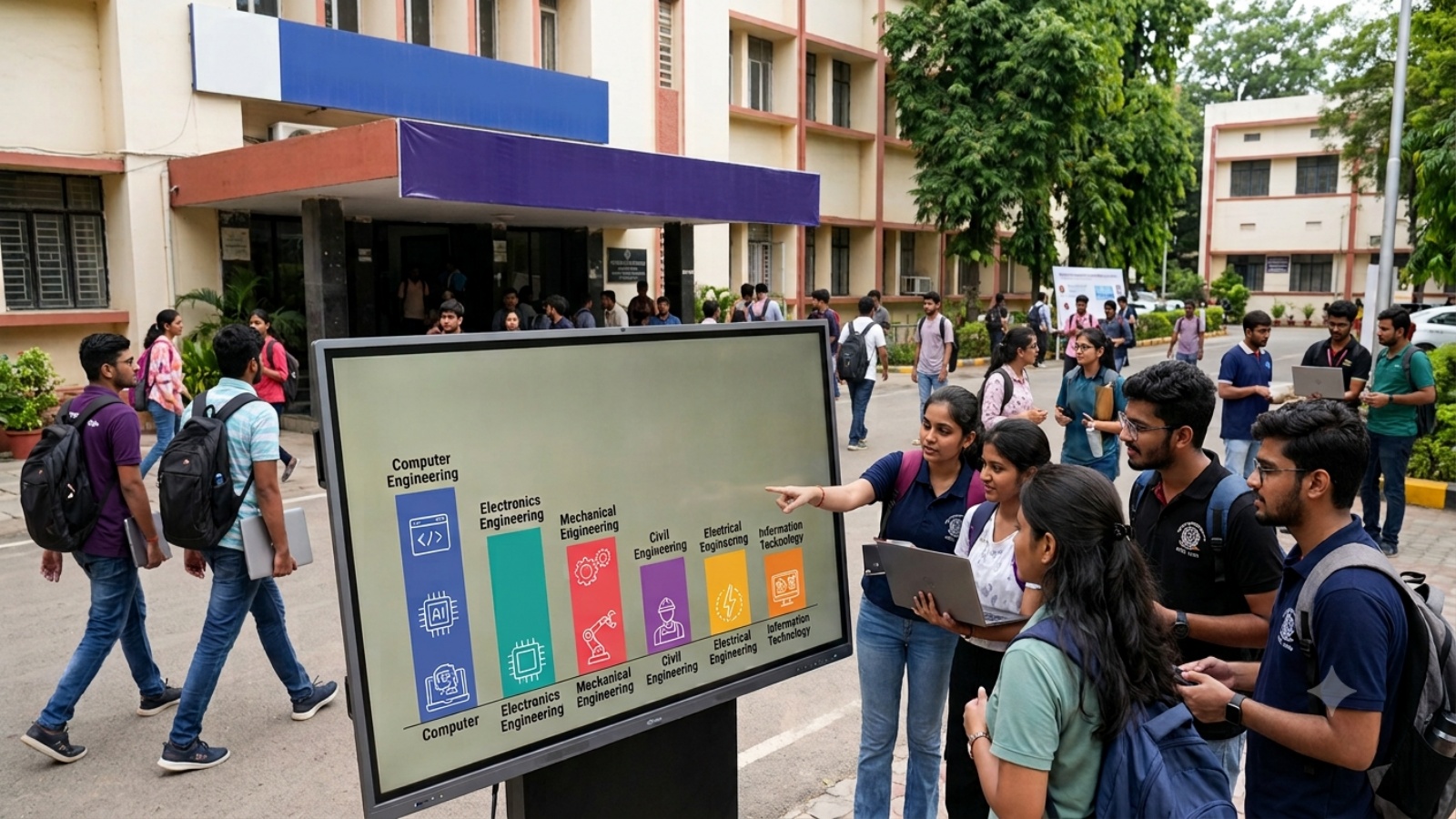
The sheer scale of enrollment in Computer Engineering is further emphasized when compared to other established engineering branches. Following closely behind, Electronics Engineering secures the second position with an enrollment of 5,70,400 students, accounting for 12.3% of the total. Traditional giants like Mechanical Engineering, Civil Engineering, and Electrical Engineering, while still significant, now trail in terms of sheer student numbers, with enrollments of 4,44,200 (9.6%), 3,60,300 (7.8%), and 3,36,200 (7.3%) respectively. Information Technology, another digitally-focused discipline, also features prominently with 2,39,300 students (5.2%). Newer, highly specialized fields like Artificial Intelligence & Machine Learning and Artificial Intelligence & Data Science, though smaller in absolute numbers, show promising growth, with enrollments of 53,600 (1.2%) and 51,600 (1.1%) respectively, indicating a forward-looking approach to emerging technologies.
The trend is not merely confined to admissions; it is strongly reflected in the output of graduates as well. In the academic year 2023-24, Computer Engineering proudly produced 2,62,408 graduates at the undergraduate level. This figure represents a remarkable 31.5% of the total 8,33,808 Engineering and Technology graduates nationwide. This means that nearly one in every three engineering graduates emerging from Indian institutions is equipped with skills in Computer Engineering, ready to contribute to the nation’s tech-driven growth.
In contrast, Mechanical Engineering saw 1,13,390 undergraduate pass-outs (13.6%), followed by Electronics Engineering with 1,11,242 (13.3%), Civil Engineering with 88,839 (10.7%), and Electrical Engineering with 72,062 (8.6%). While these numbers are substantial and represent vital contributions to infrastructure and manufacturing sectors, they highlight the clear shift in student aspirations towards the digital realm.
Historical Context: A Gradual but Decisive Shift
The dominance of Computer Engineering is not an overnight phenomenon but a culmination of years of evolving economic priorities and technological advancements. Historically, branches like Mechanical and Civil Engineering were the bedrock of India’s industrialization and infrastructure development. Students gravitated towards these disciplines as they offered direct pathways into established sectors like manufacturing, construction, and public works. The early days of India’s economic liberalization in the 1990s also saw a rise in the importance of Electrical and Electronics Engineering, driven by the growth in power generation and the nascent electronics industry.
However, the dawn of the 21st century, marked by the explosive growth of the internet and digital technologies, began to subtly, then overtly, alter this landscape. The rise of the IT services sector in India, particularly in cities like Bangalore, Hyderabad, and Pune, created a massive demand for skilled software professionals. This demand translated into increased enrollment in Computer Science and Engineering programs, often offering lucrative career opportunities.
The subsequent explosion of mobile technology, cloud computing, and more recently, the transformative potential of Artificial Intelligence and Machine Learning, has only amplified this trend. Government initiatives like ‘Digital India’ have further spurred the adoption of technology across sectors, creating a virtuous cycle where educational institutions adapt their offerings to meet this escalating demand. The AISHE data from 2023-24 is a clear indicator that this shift has reached a tipping point, with Computer Engineering now unequivocally leading the pack.
The Driving Forces: Economic Transformation and Global Trends
The surge in Computer Engineering enrollment is inextricably linked to the phenomenal growth of India’s digital economy. The country has emerged as a global hub for IT services, software development, and increasingly, for AI innovation. This has created a robust job market with high demand for graduates proficient in programming, data analysis, cybersecurity, AI, and machine learning.
Supporting this observation, LinkedIn’s AI Labour Market Report 2026 highlights India as the world’s fastest-growing market for AI engineering hiring, with a staggering 59.5% year-on-year increase. This trend is projected to continue, with the World Economic Forum’s Future of Jobs Report 2025 identifying AI and Machine Learning Specialists, Big Data Specialists, and cybersecurity professionals among India’s fastest-growing occupations through 2030. The educational choices of students are a direct reflection of these promising career trajectories.
Furthermore, the increasing preference for Computer Engineering is also evident in the admission patterns at premier engineering institutions. Top-ranking candidates at the Indian Institutes of Technology (IITs), National Institutes of Technology (NITs), and leading state and private engineering colleges are increasingly opting for Computer Science and its allied branches. This trend is a powerful indicator of the perceived prestige, intellectual challenge, and career prospects associated with these fields.
Implications for India’s Future: Innovation, Workforce, and Global Competitiveness
The overwhelming preference for Computer Engineering has profound implications for India’s future development and its standing on the global stage.
- Accelerated Innovation: A large pool of highly skilled computer engineers will undoubtedly fuel innovation across various sectors. This can lead to the development of new technologies, disruptive business models, and a more digitally integrated society.
- Skilled Workforce for the Digital Age: India will be better equipped to meet the demands of the global digital economy, attracting further investment in technology and R&D. This will also help bridge the skill gap in emerging areas like AI and data science.
- Economic Growth and Job Creation: The growth in the IT and digital sectors is a significant contributor to India’s GDP. A larger, more specialized workforce will further bolster this economic engine and create high-value employment opportunities.
- Addressing the Talent Crunch: While the demand for traditional engineers remains, the focus on computer engineering will help alleviate the critical talent crunch in the rapidly expanding tech sector.
- Rethinking Curriculum and Pedagogy: Educational institutions will need to continuously adapt their curricula to keep pace with the rapid evolution of technology. This includes incorporating emerging areas like quantum computing, advanced AI ethics, and specialized cybersecurity domains. Faculty development and investment in cutting-edge research infrastructure will be crucial.
- Balancing Specialization with Foundational Knowledge: While specialization is important, there is also a need to ensure that graduates have a strong foundational understanding of core engineering principles. This will allow them to adapt to future technological shifts and contribute to interdisciplinary problem-solving.
- Ensuring Inclusivity: Efforts must be made to ensure that this shift towards Computer Engineering does not inadvertently marginalize students interested in other vital engineering disciplines. Promoting the relevance and future prospects of traditional branches through updated curricula and industry collaborations will be essential.
The AISHE report’s findings on higher education enrollment overall also paint a picture of sustained demand for technical and professional education. With overall higher education enrollment reaching a record 4.5 crore students in 2023-24, and STEM disciplines alone crossing the one-crore mark, India is clearly investing in its human capital. The clear dominance of Computer Engineering within this landscape signifies a nation strategically positioning itself for a future defined by technology and innovation. As India continues its ambitious journey of economic and technological advancement, the rise of the computer engineer is not just a trend; it is a foundational element of its future success.
