

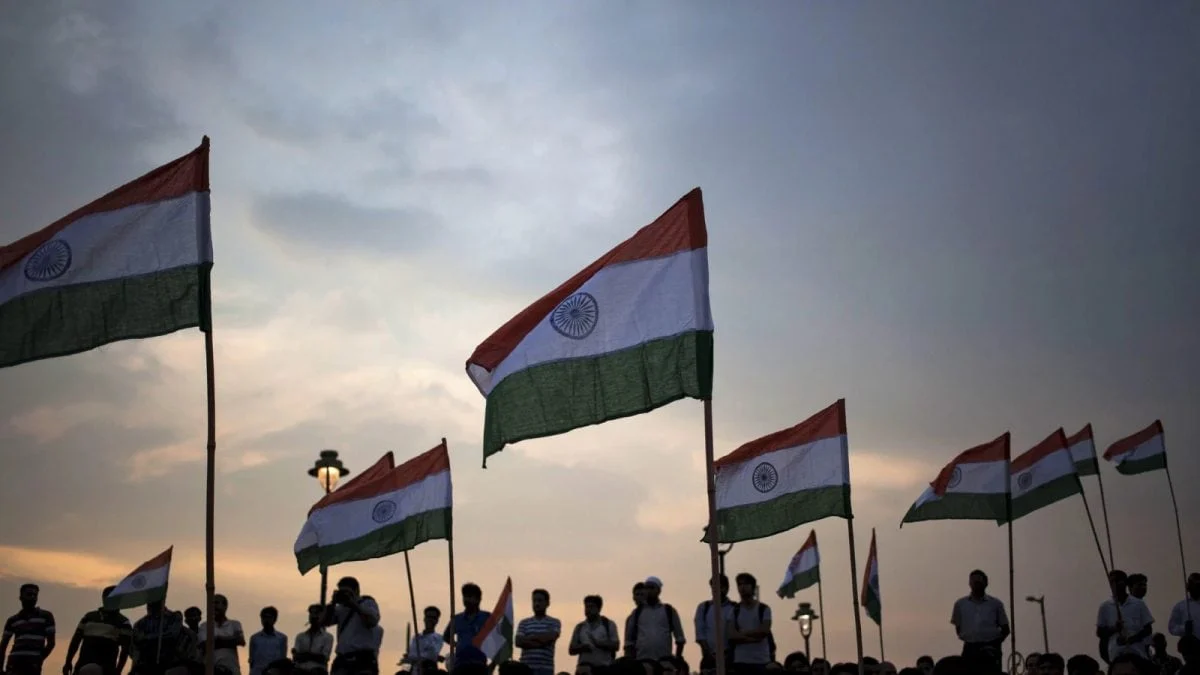
New Delhi, India – May 21, 2026 – India, a nation celebrated for its vibrant cultural tapestry and intricate federal structure, is currently navigating a dramatic flashpoint over the symbolic power and mandated sequencing of its patriotic melodies. A seemingly innocuous issue—the order and compulsory singing of national and regional anthems—has ignited fierce political and constitutional debates in two distinct corners of the country: Tamil Nadu and West Bengal. These simultaneous controversies underscore the delicate balance between national unity and regional identity, revealing how deeply embedded cultural symbols are within India’s political landscape.
At the heart of the storm is ‘Vande Mataram,’ India’s revered national song, whose status and placement are now central to a heated discourse. In West Bengal, a new directive from the Directorate of Madrasa Education, under the BJP-led state government, has made the singing of ‘Vande Mataram’ compulsory during morning assemblies in madrasas, aligning them with the uniform code previously mandated for all state schools. Simultaneously, in Tamil Nadu, a high-profile swearing-in ceremony of the newly formed government led by actor-politician Joseph C Vijay has become the stage for a protocol war. For the second time in days, ‘Vande Mataram’ was performed before the state invocation song, ‘Tamil Thaai Vaazhthu,’ triggering furious reactions from regional parties and placing the complex legal hierarchy governing India’s patriotic music squarely in the national spotlight.
This dual controversy is not merely about a sequence of songs; it delves into fundamental questions of federalism, cultural autonomy, religious freedom, and the assertion of political authority. It highlights how India’s "political playlist" can become a powerful battleground for competing ideologies and identities, transforming a simple audio track into a significant marker of a deeper, ongoing struggle for the nation’s soul.
The Flashpoint in Tamil Nadu: A Ceremony Marred by Protocol
The southern state of Tamil Nadu, known for its fierce linguistic and cultural pride, has become a key arena for this symbolic confrontation. The recent controversy erupted during a crucial political event, casting a shadow over the inauguration of the new government.
The Swearing-in Ceremony and the ‘Reordering’
The immediate trigger for the uproar was a high-profile swearing-in ceremony at the Lok Bhavan, marking the official commencement of the new government led by actor-politician Joseph C Vijay. During this event, and notably for the second time within a span of days, the national song, ‘Vande Mataram,’ was played before ‘Tamil Thaai Vaazhthu,’ the state’s official invocation song. This structural reordering, though seemingly minor, was perceived as a profound slight by many regional parties and cultural outfits.
Traditionally, in Tamil Nadu, ‘Tamil Thaai Vaazhthu’ holds a pre-eminent position at state functions, often serving as the ceremonial opener. Its placement after ‘Vande Mataram’ was immediately interpreted by critics as a deliberate attempt to diminish the state’s cultural and linguistic identity in favour of a perceived national imposition. The move by Joseph C Vijay’s government, seen by some as an accommodation to federal advisories, was viewed by regionalists as a "symbolic retreat" and a direct erosion of state autonomy. The reaction was swift and furious, with political commentators and cultural activists debating whether this represented a shift in the state’s long-standing assertion of its unique identity.
Tamil Thaai Vaazhthu: More Than Just a Song
To understand the intensity of the reaction, one must appreciate the profound significance of ‘Tamil Thaai Vaazhthu’ (Invocation to Mother Tamil) in Tamil Nadu. Penned by Manonmaniam Sundaram Pillai, this hymn is far more than a mere state anthem; it is considered a vital emblem of regional sovereignty, linguistic pride, and a historical assertion of Dravidian identity. Officially declared the state song in 2021, its status reflects decades of language-based identity politics that have shaped Tamil Nadu’s unique political trajectory.
For Tamilians, ‘Tamil Thaai Vaazhthu’ encapsulates a deep reverence for the Tamil language, which is often personified as a divine mother. The song evokes a sense of ancient heritage, literary richness, and a distinct cultural lineage that many believe stands on par with, if not superior to, other national narratives. Therefore, its placement in a ceremonial sequence is not a trivial matter but a highly charged political statement. When a state anthem, particularly one with such deep cultural roots, is pushed behind the national song at a swearing-in ceremony, it is interpreted by regional alliances not merely as adherence to federal protocol but as a direct challenge to, or even a subordination of, Tamil identity. This perception fuels the narrative that the state’s distinctiveness is being diluted by a centralising force, sparking intense emotional and political backlash.
West Bengal’s Madrasa Mandate: Uniformity vs. Conscience
Concurrently, a different facet of the ‘Vande Mataram’ debate is unfolding in West Bengal, where the issue revolves around compulsion and religious freedom rather than mere sequencing. The directive in question raises fundamental constitutional questions about the extent of state power in mandating patriotic expressions within specific educational institutions.
The Directive and Its Scope
In West Bengal, the Directorate of Madrasa Education, operating under the newly installed BJP-led government, has issued a blanket directive making the singing of ‘Vande Mataram’ compulsory during morning assemblies. This order brings madrasas—traditional Islamic educational institutions—under a uniform code that was previously mandated for all other state schools. The government defends this move as a measure to ensure educational uniformity and foster a sense of national integration across all types of institutions receiving state aid.
The directive, however, has been met with significant apprehension and criticism from various quarters, including minority rights groups, Islamic scholars, and opposition parties. Critics argue that while promoting national symbols is commendable, making their active recitation compulsory in religious institutions like madrasas without considering potential conscientious objections could infringe upon fundamental rights. This move is seen by some as part of a broader agenda to homogenize cultural practices and potentially undermine the distinct character of minority educational institutions.
A Constitutional Conundrum: Freedom of Religion
The West Bengal mandate lands directly in a highly complex constitutional grey zone, challenging the limits of state authority in enforcing patriotic expressions. The legality of such a directive is significantly complicated by a landmark 1986 Supreme Court precedent: the Bijoe Emmanuel v. State of Kerala case.
In that historic verdict, the apex court unequivocally ruled that forcing a student to actively sing the National Anthem against their conscientious religious beliefs violates the fundamental right to freedom of conscience and religion, as guaranteed under Article 25 of the Indian Constitution. The court held that if students show due respect by standing up when the anthem is played, their refusal to sing cannot be construed as disrespect, especially if it stems from genuine religious conviction. This judgment set a crucial precedent, affirming the individual’s right to abstain from active participation in practices that conflict with deeply held religious beliefs, even in the context of national symbols. The West Bengal government’s directive, by making ‘Vande Mataram’ compulsory, appears to run counter to the spirit and letter of this Supreme Court ruling, potentially opening it up to judicial challenge on grounds of infringing Article 25.
The Historical Nuances of Vande Mataram
Further complicating the West Bengal mandate, and indeed the broader debate surrounding ‘Vande Mataram,’ are the historical nuances and sensitivities associated with the song itself. While ‘Vande Mataram’ played a monumental role in India’s independence movement, inspiring countless freedom fighters, its later stanzas contain complex iconographic references that have historically sparked theological debates among minority communities, particularly Muslims.
To address these concerns and maintain secular harmony, a significant compromise was reached in 1937, long before India’s independence. This historic agreement recommended singing only the first two stanzas of ‘Vande Mataram’ at public gatherings, as these stanzas are devoid of the more controversial imagery. The subsequent stanzas, which invoke Hindu deities and imagery, have been a point of contention for those who view them as conflicting with their monotheistic beliefs. The West Bengal directive, if it implies the singing of the full song or fails to acknowledge this historical compromise, risks alienating minority communities and further exacerbating religious sensitivities, moving beyond a simple act of patriotism into a realm of cultural and religious imposition.
The Legal Tapestry: Anchoring India’s Patriotic Melodies
The ongoing controversies in both Tamil Nadu and West Bengal necessitate a deeper understanding of the legal and constitutional framework that governs India’s national and state symbols. This framework, established decades ago, provides the official guidelines, yet its interpretation remains a source of contention.
Dr. Rajendra Prasad’s Definitive Decree (1950)
The foundational legal status of India’s patriotic music dates back to a historic ruling passed by the Constituent Assembly of India on January 24, 1950. Presiding over the session, India’s first President, Dr. Rajendra Prasad, delivered a definitive statement that established the legal framework for the nation’s patriotic music. He declared that while Rabindranath Tagore’s ‘Jana Gana Mana’ would serve as the official National Anthem, Bankim Chandra Chattopadhyay’s historic freedom hymn, ‘Vande Mataram,’ which had played an unparalleled role in galvanizing the Indian independence movement, "shall be honoured equally with the National Anthem and shall have equal status with it."
This presidential decree established ‘Vande Mataram’ as India’s official National Song, granting it a unique, sacred constitutional position distinct from standard regional or state anthems. This ‘equal status’ is crucial; it means that while ‘Jana Gana Mana’ is the anthem for ceremonial occasions, ‘Vande Mataram’ carries an equivalent weight of national significance and patriotic reverence. This distinction is often cited by federal authorities and proponents of its precedence, arguing for its elevated position over any state-specific invocation.
Ministry of Home Affairs Guidelines: Federal Precedence
The ongoing friction in Chennai, concerning the sequencing of songs, stems from a direct clash between long-standing regional convention and explicit federal advisory protocols. According to guidelines and historical state protocols issued by the Ministry of Home Affairs (MHA), national symbols possess absolute precedence at all formal constitutional and state functions.
When multiple anthems or invocation songs are performed, the national song or national anthem must anchor the official sequence. Traditional state protocol often dictates that a state invocation song, such as ‘Tamil Thaai Vaazhthu,’ functions as a localized cultural invocation. Therefore, if played at the very start of a ceremony, it should precede the broader national symbols, or otherwise give way to the mandatory closing codes which typically feature the national anthem.
From the perspective of "federal sticklers," pushing a state anthem behind the national song at a swearing-in ceremony is viewed as a strict and necessary adherence to national precedence, upholding the constitutional hierarchy of symbols. However, regional parties interpret this reordering as a direct erosion of state identity, a subtle but potent act of cultural subordination. They argue that while the national song holds importance, it should not automatically override established state traditions, particularly when state identity is intrinsically linked to linguistic and cultural expressions. This clash highlights the tension between a unitary framework of national identity and the diverse, pluralistic realities of India’s federal structure.
Broader Implications: Federalism Under Strain
The ‘Vande Mataram’ controversies, while focused on specific songs and their protocols, are symptomatic of deeper, systemic tensions within India’s federal framework. They underscore the challenges of balancing national cohesion with profound regional diversity.
The Delicate Texture of Indian Federalism
The reason a simple audio track can trigger such a massive political storm lies in the delicate texture of Indian federalism. India is not a monolithic entity but a union of diverse states, each with its own language, culture, history, and political narrative. The Constitution attempts to balance a strong center with significant state autonomy, but this balance is constantly tested, particularly in matters of cultural expression and identity.
In states like Tamil Nadu, with a deeply rooted history of language-based identity politics, state symbols are not mere formalities; they are perceived as vital emblems of regional sovereignty and cultural pride. Any perceived attempt to diminish these symbols, whether through reordering or compulsory imposition, is interpreted as an assault on the state’s distinct identity and autonomy. This makes the "sequence of a song" a high-stakes assertion of political authority and a battleground for competing visions of India.
Political Motives and Identity Politics
Beyond the legal and historical arguments, the current ‘Vande Mataram’ rows are imbued with significant political motives and are deeply intertwined with identity politics. For the BJP, which leads the central government and is increasingly making inroads into states like West Bengal, promoting ‘Vande Mataram’ and national symbols is often part of a broader strategy to project a unified national identity rooted in a specific cultural nationalism. Making its singing compulsory in madrasas, for instance, can be seen as an attempt to integrate minority institutions into a national mainstream, aligning with the party’s ideological emphasis on cultural assimilation and a Hindutva narrative.
Conversely, for regional parties in states like Tamil Nadu, defending the precedence of ‘Tamil Thaai Vaazhthu’ or protesting the perceived imposition of national symbols is a crucial act of electoral and ideological self-preservation. It allows them to champion state autonomy, linguistic pride, and regional distinctiveness, which are core tenets of their political platforms. The newly formed government of Joseph C Vijay finds itself in an intense political dilemma: accommodating federal advisories by placing ‘Vande Mataram’ at the ceremonial apex risks alienating its regional base, while defying such protocols could lead to friction with the central government. In this context, the sequence of a song becomes a potent symbol in the ongoing dance of power between the center and the states, and a reflection of the differing interpretations of what constitutes "Indianness."
The Future of India’s Symbolic Landscape
The current controversies raise significant questions about the future of India’s symbolic landscape. Will these debates lead to clearer, more universally accepted guidelines for the use and sequencing of national and state symbols? Or will they exacerbate cultural wars, leading to further legal challenges and increased polarization?
The challenge lies in finding a harmonious way to acknowledge and celebrate both the national identity that binds India together and the rich tapestry of regional identities that constitute its strength. Ignoring regional sentiments in the name of national unity risks alienating significant populations, while excessive regionalism can undermine the spirit of national cohesion. The ‘Vande Mataram’ rows serve as a powerful reminder that in a diverse democracy like India, even seemingly small cultural gestures can carry immense political weight, reflecting deeper anxieties about identity, power, and belonging.
Conclusion: Harmony or Discord in India’s Symphony?
The ‘Vande Mataram’ rows in Tamil Nadu and West Bengal represent more than just a dispute over musical arrangements; they are a microcosm of the enduring struggle to define India’s identity in the 21st century. This battle over India’s "political playlist" exposes the delicate fault lines within its federal structure, where the assertion of national unity often collides with deeply entrenched regional pride and constitutional guarantees of individual freedom.
As the political discourse intensifies and potential legal challenges loom, the nation grapples with the fundamental question of how to choreograph its diverse symphony. Can India maintain a harmonious balance, allowing its myriad cultural expressions to flourish while upholding the symbols that unite its vast populace? Or will these symbolic clashes deepen existing divides, transforming the very melodies meant to inspire patriotism into anthems of discord? The resolution of these controversies will not only shape the future of India’s national and state symbols but also provide a critical barometer for the health and resilience of its unique federal democracy.
