

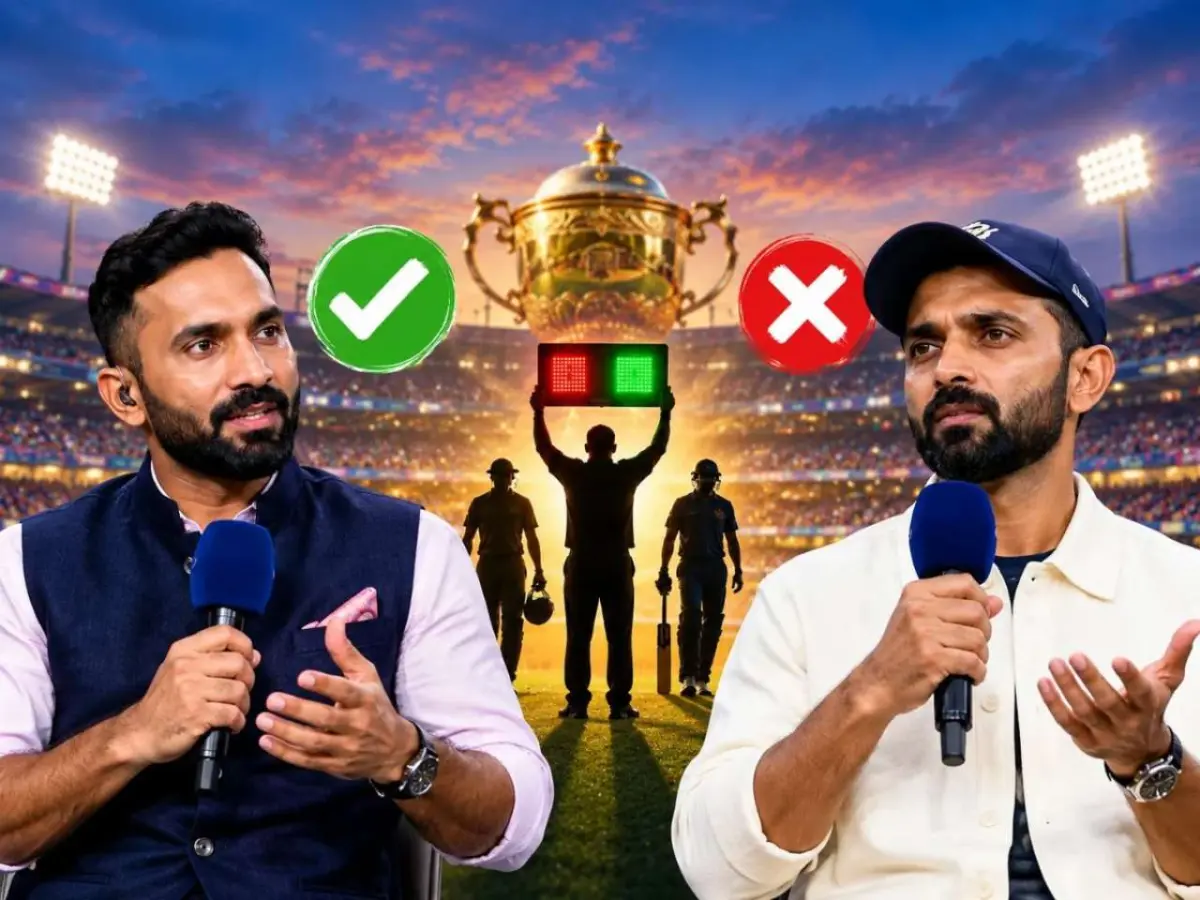
MUMBAI, INDIA – October 10, 2026 – As the cricketing world begins to cast its gaze towards the Indian Premier League (IPL) 2027 season and the impending mega auction, a contentious debate has reignited over the future of the ‘Impact Player’ rule. At the heart of this discussion are two prominent figures of Indian cricket: Dinesh Karthik, former India wicketkeeper and currently the Royal Challengers Bengaluru’s batting coach and mentor, and Ajinkya Rahane, former India captain and a seasoned IPL campaigner. Their contrasting views on the controversial regulation highlight a deeper philosophical divide within the league regarding strategic innovation, player development, and the very spirit of T20 cricket.
Karthik advocates for the rule’s continuation through at least IPL 2027, citing concerns about fairness and the mid-cycle disruption it would cause to franchise planning. Conversely, Rahane has emerged as a vocal critic, demanding the immediate abolition of a rule he believes fundamentally undermines the development of crucial all-rounders in Indian cricket and offers little genuine benefit. This high-stakes debate not only influences team strategies for upcoming seasons but also carries significant implications for the long-term health of Indian cricket’s talent pipeline.
The Genesis of a Game-Changer: A Chronology of the Impact Player Rule
The ‘Impact Player’ rule, a significant tactical innovation, was introduced by the Board of Control for Cricket in India (BCCI) and the IPL Governing Council ahead of the IPL 2023 season. Its inception marked a pivotal moment in the league’s evolution, aiming to add an extra layer of strategic depth and excitement to the already high-octane T20 format. The rule allows teams to substitute one player from a list of four nominated players during an innings, provided the substitution is made before the end of the 14th over, and the substituted player cannot take any further part in the match. The core idea was to enable teams to optimize their playing XI based on match situations, conditions, and tactical needs, effectively creating a 12-player game rather than the traditional 11.
Key Timelines:
)
- Prior to IPL 2023: The rule was officially unveiled, following its successful trial in the Syed Mushtaq Ali Trophy (SMAT), India’s domestic T20 competition. This introduction came after the IPL 2022 mega auction had concluded, meaning franchises for the 2023 and 2024 seasons had largely built their squads without this specific rule in mind.
- IPL 2023 Season: The rule’s debut season saw mixed reactions. While it undoubtedly led to higher scoring games and dramatic comebacks, it also immediately sparked conversations about its impact on player roles, particularly all-rounders. Teams frequently used it to bring in an extra specialist bowler when bowling second, or an extra batter when chasing a formidable total.
- IPL 2024 Season: The rule continued, and its strategic implications became more ingrained. Franchises, now more accustomed to its nuances, began to fine-tune their squad construction and in-match tactics to leverage its advantages. However, the murmurs of discontent, particularly from players concerned about the all-rounder dilemma, grew louder.
- Current Debate (Late 2026): With the IPL 2027 season on the horizon and a major mega auction slated for early 2027, the debate has intensified. The existing IPL cycle, governed by the player retention and auction rules set in place, extends to 2027. This timing makes any decision about the Impact Player rule particularly critical, as it would directly influence how franchises approach the next major squad overhaul. The rule, initially heralded as a game-changer for its potential to inject dynamism, now finds itself at the centre of a fundamental re-evaluation.
Dinesh Karthik’s Stance: Prudence Over Immediate Change
Dinesh Karthik, a veteran of numerous IPL seasons and now a strategic mind behind one of the league’s most popular franchises, offers a pragmatic perspective on the Impact Player rule. While acknowledging its imperfections, Karthik firmly believes that the rule should remain in place until at least the conclusion of the current IPL cycle, which is after the IPL 2027 season and the subsequent mega auction. His primary argument hinges on the principle of fairness and the significant investments made by franchises based on existing regulations.
In a recent interview with Cricbuzz, Karthik articulated his reasoning with clarity. He pointed out that franchises meticulously construct their rosters with the understanding that they can deploy a 12-player unit, thanks to the Impact Player provision. Changing this rule mid-cycle, especially ahead of a major event like the 2027 season which precedes the next mega auction, would be "inequitable" and create an "unfair advantage" for certain teams. "When you pick a team, you’re picking a team based on 12 players that you’re going to use," Karthik explained. "Now, suddenly, if you make it 11, there could be a team which is not as strong as a 12-player unit but much better as an 11-player one, and that creates an unfair advantage." Such a sudden shift, he argues, could render certain player acquisitions and strategic decisions made by franchises obsolete, potentially leading to financial losses and competitive imbalances.

Karthik is not oblivious to the rule’s most significant drawback: its perceived detrimental effect on the development of Indian all-rounders. He openly conceded that the Impact Player rule has "constrained India’s capacity to nurture all-rounders," a concern echoed widely across the cricketing fraternity. The ability to substitute a specialist often negates the need for a player who can contribute with both bat and ball, thereby reducing opportunities for multi-skilled cricketers.
However, Karthik’s support for its temporary continuity is rooted in a broader philosophy of rule implementation. He advocates that fresh regulations should debut at the commencement of a new cycle – typically following a mega auction – and be discontinued only after that cycle concludes. This approach provides stability and predictability for franchises, allowing them to plan their long-term strategies and player investments with confidence. Removing a rule that has been in effect for multiple seasons, and on which current squad compositions are built, would, in his view, be disruptive and unjust.
)
Reflecting on the rule’s initial impact, Karthik noted its early success. "When it first came on (the Impact Player rule), it was very good because there were high-scoring games and a lot of teams were almost chasing those totals down." The rule, by allowing teams to bolster their batting or bowling at critical junctures, indeed contributed to more thrilling contests and higher totals, which was a stated objective. Yet, he also observed a shift in its effectiveness: "But strangely, this last season, there were not too many close games… It just felt like one team scored a lot, and the other team ended up chasing it down. And if you look at how the Impact Player rule has impacted the IPL, it was quite positive at the start. But slowly and steadily, it started losing the charm and the reason why it was there." This suggests that while the rule still facilitates high scores, its ability to create nail-biting finishes and truly enhance the ‘entertainment quotient’ might be diminishing, hinting at a potential over-reliance or saturation effect. Despite this, his core message remains: any change must align with the established IPL cycles. "It is something they could do away with after the end of this season," he concluded, referring to the 2027 season, thereby reinforcing his call for a structured approach to rule modifications.
Ajinkya Rahane’s Vehement Opposition: A Call for All-Rounder Revival
In stark contrast to Karthik’s measured approach, Ajinkya Rahane, a former captain for franchises like Kolkata Knight Riders and Rajasthan Royals, has voiced unequivocal opposition to the Impact Player rule, demanding its immediate elimination from the IPL. Rahane’s stance is not merely a preference but a strong conviction, deeply rooted in his concern for the future of Indian cricket, particularly the dwindling breed of genuine all-rounders.
)
"I think it should be taken out," Rahane unequivocally stated in an interview with Cricbuzz. He joins a growing chorus of cricketers, coaches, and pundits who believe the rule, despite its initial appeal, has become a significant impediment to the natural evolution of players. His primary contention is that the Impact Player rule "undermines the development of all-rounders in Indian cricket and serves no beneficial purpose."
Rahane’s argument is multi-faceted. Firstly, he highlights the crucial role all-rounders play, not just in T20 cricket but for the national team across formats. In a format where every run and every wicket counts, a player who can contribute significantly with both bat and ball offers invaluable balance and flexibility to a team. The Impact Player rule, by allowing teams to bring in a specialist batter or bowler as needed, reduces the pressure on players to develop dual skills. Why nurture an all-rounder if you can simply substitute a pure batter for a pure bowler, depending on the match situation? This strategic convenience, Rahane argues, inadvertently discourages the grooming of multi-talented cricketers. "All-rounders are going out of the game, especially in the IPL. And I am a firm believer that you’ve got to develop your all-rounders. From the Indian team’s point of view, all-rounders are really important. So the impact player rule should be taken out."
)
Secondly, Rahane revealed a significant detail about the sentiments within the league’s leadership. "I remember last year, before the IPL captains’ meeting, most of the captains said they don’t want the impact player rule." This revelation underscores that the opposition to the rule is not just an isolated viewpoint but a widely held sentiment among those who lead teams on the field and are directly responsible for tactical decisions and player management. The fact that team captains, who are at the sharp end of strategy, largely opposed it, adds considerable weight to the argument for its removal.
Finally, Rahane provided a compelling, practical example of how the rule distorts the competitive balance and undermines the efforts of bowlers. He recounted scenarios where teams, having lost early wickets and struggling at low scores, were able to recover dramatically thanks to the extra batter provided by the Impact Player rule. "See, why I feel we should take it out is because last year, I don’t want to take any team’s name, but a few teams were probably at 90/7, 100/7, and they ended up getting 200 because of that one impact (rule), one extra batter with that." This observation highlights how the rule can negate the advantage gained by bowlers who have performed exceptionally well to put the opposition under pressure. It effectively offers a lifeline that, in Rahane’s view, is unearned and unfair to the bowlers. His call is clear: "give some advantage to bowlers, and also all-rounders should be involved in the games thoroughly. They should take it out." For Rahane, the purity of the contest and the holistic development of cricketers should take precedence over what he perceives as an artificial enhancement to the game.
)
Supporting Data and Broader Perspectives
The debate surrounding the Impact Player rule extends beyond the views of individual players, touching upon strategic shifts, statistical trends, and the fundamental philosophy of T20 cricket. While precise, publicly available "supporting data" from the IPL Governing Council is rare, anecdotal evidence and observed trends offer significant insights.
Statistical and Strategic Impact:
)
- Elevated Scoring: The most evident impact has been the surge in average team scores. IPL seasons post-2023 have consistently seen higher run rates and a greater frequency of 200+ totals. The ability to replace a struggling batter or a bowler who has completed their quota with a specialist hitter has undoubtedly contributed to this. While exciting for fans, this also raises questions about the balance between bat and ball.
- Reduced Bowler Influence: Conversely, some argue that the rule has diminished the impact of specialist bowlers. With an extra batting option available, teams are less likely to collapse, making it harder for bowlers to run through a side. This could lead to a scenario where aggressive, wicket-taking bowling is de-prioritized in favour of containment, or simply that the impact of early wickets is diluted.
- Specialization vs. Versatility: The rule overtly encourages specialization. Franchises can now afford to pick pure batters who may not be agile fielders or part-time bowlers, and pure bowlers who are not expected to contribute with the bat. This directly impacts the value placed on all-rounders, whose primary utility lies in their dual skill set.
- Tactical Depth: From a coach’s perspective, the rule offers unparalleled tactical flexibility. Captains can delay crucial decisions, such as who bats at number 7 or who bowls the death overs, until well into the game, reacting to real-time match situations. This makes for dynamic, on-the-fly decision-making, adding a chess-like element to the game. However, it also removes some of the traditional pressures of building a perfectly balanced 11-man squad from the outset.
- Player Roles: The rule has led to the emergence of ‘Impact Player specialists’ – players who are explicitly brought in for specific roles (e.g., a death-overs bowler or a pinch-hitter). While this provides opportunities for some, it also means certain players might only get to bat or bowl, reducing their overall match involvement and development.
Wider Cricketing Concerns:
- National Team Impact: The biggest concern, repeatedly voiced, is the long-term impact on India’s national team. Historically, India has struggled to produce a consistent pipeline of genuine fast-bowling all-rounders. The Impact Player rule, by making all-rounders less essential in the IPL, could further exacerbate this issue, leaving the national selectors with a shallower pool of multi-skilled players.
- "Purity" of the Game: Traditionalists argue that the rule deviates from the fundamental spirit of cricket, where 11 players compete in all aspects of the game. The ability to substitute a player feels less like a contest of skill and more like a tactical workaround, blurring the lines of what constitutes a ‘playing XI’.
- Fan Engagement: While high scores are generally entertaining, some fans appreciate the strategic depth of traditional cricket, where a team’s ability to navigate tough situations with a fixed XI is part of the allure. The Impact Player rule, for some, might diminish the drama of a batting collapse or a bowler’s heroic comeback with limited support.
Other players and coaches have also weighed in. While some praise its strategic novelty, many echo Rahane’s concerns about all-rounder development. The sentiment appears to be leaning towards a re-evaluation, especially given the impending mega auction.
)
Official Responses and Future Implications
The Board of Control for Cricket in India (BCCI) and the IPL Governing Council are the ultimate arbiters of the Impact Player rule’s fate. As of late 2026, their official stance appears to be one of careful consideration, navigating the complex interplay of commercial interests, player welfare, and the integrity of the game. Rahane’s comment about the existing "guidelines or rules, they have it till 2027" suggests that the rule is contractually or structurally tied to the current IPL cycle. This aligns with Karthik’s argument for maintaining continuity until the cycle concludes, likely after the 2027 season and before the subsequent mega auction.
Factors Influencing the Decision:
)
- Franchise Investments: The BCCI must consider the significant financial and strategic investments made by franchises based on the current rules. A sudden change could lead to disgruntled owners and potential legal challenges if it severely impacts squad balance.
- Player Feedback: The collective voice of IPL captains and players, as highlighted by Rahane, cannot be ignored. Player well-being and development are crucial for the league’s long-term sustainability.
- Fan Appeal and Broadcast Value: The rule was introduced to enhance entertainment. The BCCI will evaluate whether it genuinely adds value for broadcasters and fans or if its novelty has worn off, as Karthik suggested.
- Impact on Indian Cricket: This is arguably the most critical long-term factor. The IPL is not just a commercial league; it is the primary feeder system for the Indian national team. Any rule that demonstrably harms the development of key player types, such as all-rounders, will eventually impact India’s international competitiveness.
- Global Precedent: While the IPL is a trendsetter, governing bodies often look at how similar innovations (e.g., X-Factor in BBL, though different) have fared in other leagues.
Implications for the IPL 2027 Mega Auction:
The decision regarding the Impact Player rule will have profound implications for the IPL 2027 mega auction, which is expected to be a watershed moment for team restructuring.
)
- If the Rule Continues (as Karthik suggests): Franchises will continue to build ’12-player’ squads, prioritizing specialists and perhaps investing less in genuine all-rounders who might command higher prices. This would maintain the current strategic landscape.
- If the Rule is Scrapped (as Rahane demands): This would necessitate a radical shift in team-building philosophy. All-rounders, especially Indian ones, would see their value skyrocket at the auction. Franchises would have to scout and bid aggressively for players who can perform both roles effectively, as they would no longer have the luxury of in-match substitutions to cover deficiencies. This could lead to a more traditional, balanced approach to squad construction, potentially changing the dynamics of the auction entirely.
- A Modified Rule: A third possibility is that the BCCI might introduce a modified version of the rule, perhaps with stricter conditions (e.g., only for specific player types, or earlier substitution deadlines) to address some of the criticisms while retaining an element of strategic flexibility. This could be a middle ground to appease both sides of the debate.
The BCCI’s decision, expected to be announced closer to the mega auction, will be one of the most anticipated announcements in the lead-up to the 2027 season, fundamentally shaping the league’s competitive and developmental trajectory.
The Great Debate: Striking a Balance
The Impact Player rule represents a classic dilemma between innovation and tradition, between strategic enhancement and foundational cricketing principles. On one side, proponents, like Karthik, acknowledge its initial success in boosting excitement and advocate for procedural fairness in its removal, emphasizing the contractual obligations and planning cycles of franchises. On the other, staunch opponents, led by Rahane, decry its detrimental effect on player development, particularly all-rounders, and question its long-term value to the game.
)
The core tension lies in striking a balance. Does the strategic depth and heightened scoring potential offered by the Impact Player rule outweigh the concerns about all-rounder development and the perceived dilution of the traditional 11-player contest? Is the IPL’s role primarily to entertain and innovate, or does it also carry a significant responsibility for nurturing the future talent of Indian cricket?
The debate is not merely academic; it has real-world consequences for the careers of countless young cricketers aspiring to play for India, for the financial strategies of multi-million dollar franchises, and for the viewing experience of millions of fans worldwide. The IPL, renowned for its dynamism and willingness to experiment, now faces a crucial decision that will define its direction for the next cycle and beyond.
)
Conclusion
As the IPL 2027 season approaches, the fate of the Impact Player rule hangs in the balance, a symbol of the league’s continuous evolution and the challenges that come with it. The contrasting yet equally valid arguments put forth by Dinesh Karthik and Ajinkya Rahane encapsulate the complexity of the issue. While Karthik champions a pragmatic, cycle-based approach to rule changes, prioritizing fairness to franchises, Rahane passionately advocates for the rule’s immediate removal, driven by a profound concern for the development of Indian all-rounders.
The BCCI and IPL Governing Council are tasked with a weighty decision, one that must carefully weigh strategic innovation against the long-term health of Indian cricket’s talent pool, while also considering commercial implications and fan engagement. The outcome will not only redefine team strategies for the upcoming mega auction and the 2027 season but will also send a clear message about the league’s priorities and its vision for the future of T20 cricket. The cricketing world watches with bated breath to see whether the ‘Impact Player’ will continue to be a part of the IPL’s tactical fabric or be relegated to the annals of cricketing experiments.
