

New Delhi, India — Kia India has officially ignited the next phase of its "Green Mobility" roadmap, releasing a cryptic yet high-impact teaser across its social media platforms. The short video, which oscillates between the acronyms HEV (Hybrid Electric Vehicle) and BEV (Battery Electric Vehicle), carries the provocative tagline: “The future is knocking. One clue. More than one possibility.”
This strategic communication confirms what industry insiders have long suspected: Kia is moving beyond a singular focus on internal combustion engines (ICE) and niche luxury EVs. By simultaneously teasing hybrid and fully electric technologies, the South Korean automaker is preparing a pincer movement to capture both the burgeoning mass-market EV segment and the premium, efficiency-conscious SUV market.
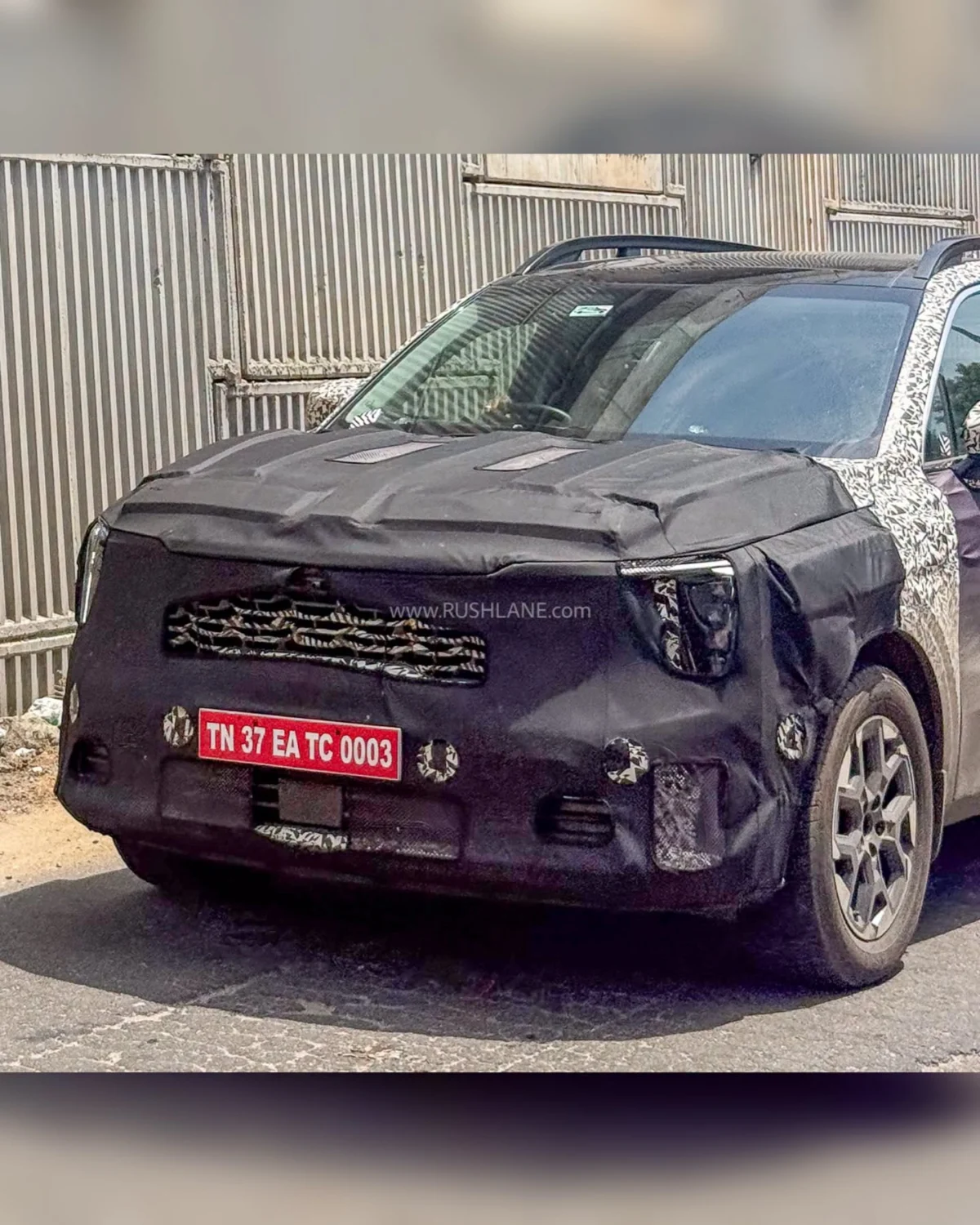
Based on recent sightings of camouflaged test mules and global product pipelines, the industry consensus points toward the imminent arrival of the Kia Syros EV and the Kia Sorento Hybrid. This dual-pronged approach comes at a pivotal moment for Kia, coinciding with the company’s strongest financial and sales performance since its Indian debut in 2019.
I. Main Facts: The Dual-Path Strategy
The teaser represents a significant shift in Kia India’s portfolio management. Historically, the brand has relied on high-performance ICE vehicles like the Seltos and Sonet, while its EV presence was restricted to the premium CBU (Completely Built-Up) EV6 and the recently introduced flagship EV9.

1. The Syros EV: The Mass-Market Disruptor
The "BEV" portion of the teaser almost certainly refers to the Kia Syros EV. Positioned to sit between the Sonet and the Seltos in terms of price point, the Syros is expected to be Kia’s first "born-in-India" mass-market electric SUV. Unlike the EV6, which targets the luxury buyer, the Syros EV is designed for the volume segment, aiming to challenge the dominance of the Tata Nexon EV and the Mahindra XUV3XO EV.
2. The Sorento Hybrid: The Premium Efficiency Play
The "HEV" acronym marks a major milestone: Kia’s entry into the Indian hybrid space. The Sorento Hybrid, a global bestseller, has been spotted testing on Indian soil multiple times in 2024 and 2025. By introducing a self-charging hybrid (SHEV), Kia is targeting the "range anxiety" demographic—buyers who want the fuel economy of an electric motor without the infrastructure dependencies of a plug-in vehicle. The Sorento will likely serve as Kia’s flagship ICE-derived product, bridging the gap between the Seltos and the luxury EV9.
II. Chronology: From Spy Shots to Social Media Teasers
The journey toward this announcement has been marked by a series of calculated leaks and sightings that have built anticipation over the last 18 months.
- Early 2024: Initial Sorento Sightings
The first heavily camouflaged units of the Kia Sorento were spotted on the outskirts of Hyderabad and Chennai. Initial speculation suggested a diesel-only launch, but the presence of "Eco Hybrid" badges on international test mules quickly shifted the narrative toward an electrified powertrain. - Late 2024: The "Clavis/Syros" Development
Reports emerged of a new project codenamed "AY." This vehicle was designed to be a "tall-boy" SUV with a boxy silhouette. While initially thought to be only an ICE vehicle, test mules featuring charging ports on the front fenders confirmed a parallel EV development. - June 2026: Record-Breaking Sales
Kia India reported its highest-ever monthly sales in June 2026, dispatching 24,552 units—a 19% year-on-year growth. This provided the financial confidence to greenlight the more expensive hybrid and EV projects. - July 2026: The "HEV/BEV" Teaser
Kia releases the official teaser, moving the conversation from "if" these vehicles are coming to "when" they will be launched.
III. Supporting Data: Market Positioning and Specifications
To understand the impact of these launches, one must look at the technical and economic landscape they will inhabit.

The Kia Syros EV: Technical Expectations
The Syros EV is expected to leverage a modified version of the K2 platform, optimized for battery placement.
- Design: A "boxy" aesthetic inspired by the Kia Soul and EV9, maximizing interior headroom.
- Features: A centerpiece "Trinity" display—a 30-inch combined screen for the instrument cluster and infotainment.
- Safety: Level 2 ADAS (Advanced Driver Assistance Systems) including autonomous emergency braking and lane-keep assist.
- Pricing: Estimated between Rs 12 lakh and Rs 18 lakh (ex-showroom), placing it in the heart of the Indian EV transition.
The Kia Sorento Hybrid: The Flagship Dimensions
The Sorento is a D-segment SUV that brings a level of sophistication previously unseen in Kia’s Indian ICE lineup.
- Dimensions: Length of 4,815 mm and a wheelbase of 2,815 mm.
- Configuration: Offered in 6-seat (captain seats) and 7-seat variants.
- Powertrain: Internationally, the Sorento Hybrid utilizes a 1.6-liter turbocharged petrol engine paired with a 44.2 kW electric motor, producing a combined 230 hp.
- Competitors: It will square off against the Skoda Kodiaq, Volkswagen Tayron, and the Toyota Fortuner. However, its hybrid powertrain gives it a unique edge in fuel efficiency over the ladder-frame Fortuner.
Sales Performance Context
Kia’s aggressive expansion is backed by robust data. In the first half of 2026 (H1), Kia India posted its best-ever performance, driven by:
- Sonet & Seltos: Contributing to over 70% of total volume.
- Carens: Maintaining a steady 15% share in the MPV segment.
- Growth: A 19% YoY increase in June 2026, significantly outperforming the industry average of 7-9%.
IV. Official Responses and Strategic Vision
While Kia India executives have remained tight-lipped about the specific launch dates, their recent corporate statements reflect a "New Energy Vehicle" (NEV) priority.

In a recent press briefing following the June sales report, Kia India leadership emphasized that the company is "no longer just an SUV maker, but a mobility solutions provider." A spokesperson noted, "Our strategy for India is aligned with the global ‘Plan S’—where we transition from internal combustion to electric. However, we recognize that the Indian market is diverse. Some customers are ready for full electric (BEV), while others require the flexibility of a hybrid (HEV). We will cater to both."
Analysts suggest that Kia’s decision to include HEV technology is a response to the Indian government’s ongoing internal debates regarding GST cuts for hybrids. By having a product ready in the HEV space, Kia is positioned to capitalize on any favorable tax shifts that currently benefit only pure EVs.
V. Implications: Reshaping the Indian Automotive Hierarchy
The introduction of the Syros EV and Sorento Hybrid has far-reaching implications for the Indian market and Kia’s competitors.
1. Pressure on Tata and Mahindra
Tata Motors currently holds over 70% of the Indian EV market. The Syros EV, with Kia’s reputation for "feature-loaded" cabins and superior fit-and-finish, represents the most significant threat to Tata’s dominance to date. If Kia can price the Syros aggressively, it could disrupt the current status quo in the sub-20 lakh EV segment.

2. The "Death of Diesel" in Premium Segments
As emission norms (BS7 and beyond) become stricter, diesel engines in premium SUVs are becoming increasingly expensive to produce. The Sorento Hybrid offers a "clean" alternative that provides the high torque and low running costs of a diesel without the regulatory baggage. This could force competitors like Toyota and MG to accelerate their own hybrid or electric flagship programs.
3. Strengthening the "Premium" Brand Image
By launching the Sorento, Kia is moving up the value chain. This allows the brand to command higher margins and compete directly with European luxury brands in the entry-level space. It transitions Kia from a "value-for-money" brand to an "aspirational-tech" brand.
4. Infrastructure vs. Efficiency
The dual-launch strategy acknowledges the reality of Indian infrastructure. The Syros EV will appeal to urban dwellers with home charging, while the Sorento Hybrid will appeal to long-distance travelers and buyers in Tier-2 and Tier-3 cities where the charging grid remains sparse.
Conclusion
Kia India’s latest teaser is more than just a marketing gimmick; it is a declaration of intent. By embracing both HEV and BEV technologies, Kia is hedging its bets against a volatile energy market and a transitioning consumer base. Whether it is the mass-market Syros EV or the premium Sorento Hybrid, the "future" Kia is talking about is one where the consumer doesn’t have to choose between sustainability and practicality. As the company continues its record-breaking sales run, these two new additions may well be the catalysts that propel Kia into the top three automakers in India.
