

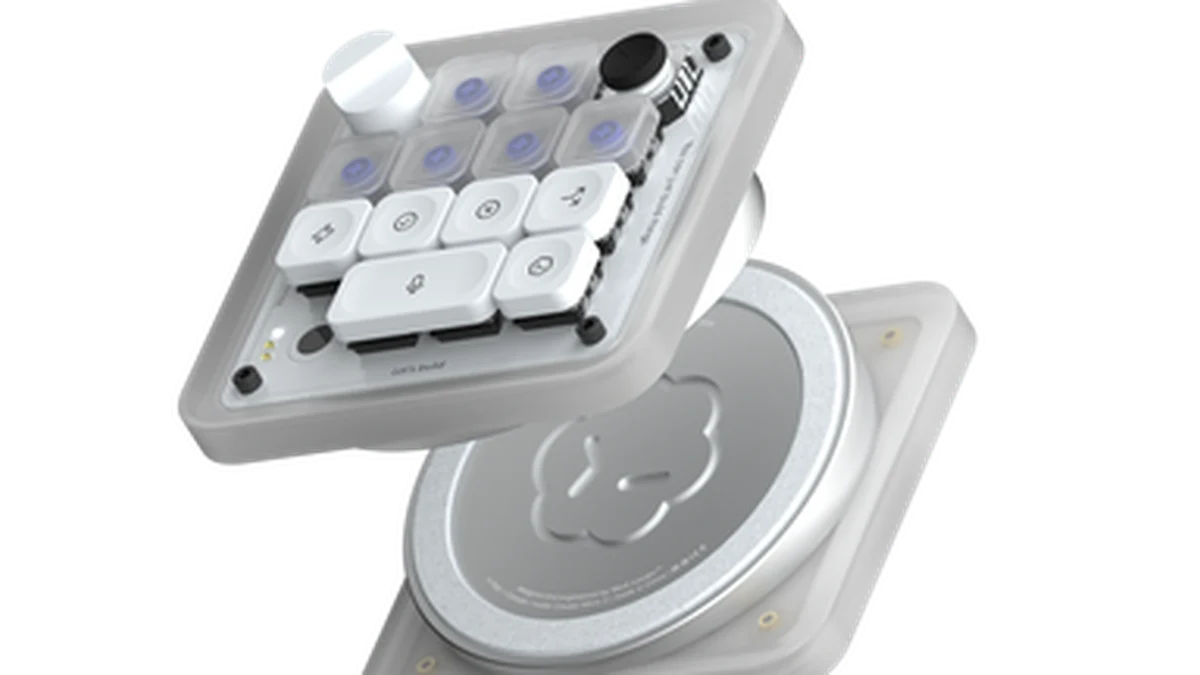
San Francisco, CA – July 16, 2026 – In a significant strategic move signaling its burgeoning ambitions beyond pure software, artificial intelligence powerhouse OpenAI has officially launched its inaugural hardware product: the kbd-1.0-codex-micro, affectionately dubbed the "Codex Micro." This specialized mini-keyboard, meticulously crafted in collaboration with renowned boutique hardware manufacturer Work Louder, is designed to empower users of OpenAI’s advanced coding AI, Codex, offering a tactile and intuitive interface for controlling sophisticated agentic AI actions.
The unveiling of the Codex Micro marks a pivotal moment for OpenAI, traditionally known for its groundbreaking large language models like GPT and its generative AI applications. Priced at $230 for pre-order, this compact yet powerful device is not merely a peripheral; it represents OpenAI’s initial foray into integrating its cutting-edge AI directly with physical tools, aiming to streamline the workflow of developers and "vibe-based coders" alike. This launch comes at a particularly interesting juncture for the company, as it navigates both rapid expansion and a high-profile legal battle with tech titan Apple.
Main Facts: Bridging AI and Tactile Control
The Codex Micro, a testament to the growing convergence of software intelligence and physical interaction, is a compact, purpose-built keyboard tailored for an increasingly specialized demographic: coders leveraging OpenAI’s Codex. At its core, the device aims to translate the complex, often abstract commands of agentic AI into tangible, immediate actions, thereby enhancing productivity and user experience.
Developed in partnership with Work Louder, a company celebrated for its ergonomic and customizable input devices, the Codex Micro is far from a generic macro pad. It integrates a thoughtful array of buttons, a versatile joystick/dial, and dynamic RGB lighting options, all geared towards providing granular control over AI processes within the Codex environment. Users can leverage these controls to monitor active AI chats, track the intricate activities of AI agents through live RGB feedback, and map their most frequently used actions for instant execution.
A notable design choice offers users a preference between "silent" and "clicky" mechanical keys, catering to varied tactile preferences among developers. OpenAI CEO Sam Altman, known for his direct engagement with product development, publicly expressed his own leaning, stating, "amazing to me that some people want the silent version," playfully highlighting the often-vocal preferences within the coding community. This attention to detail underscores a user-centric design philosophy, aiming to make the interaction with AI as seamless and personalized as possible.
Functionally, the joystick and dial components are central to the device’s utility. Coders, regardless of their training background, can utilize the joystick for common Codex tasks such as debugging errors or refactoring code. More innovatively, the dial allows for real-time adjustment of the AI’s "reasoning level" at specific points in time – a feature that promises to revolutionize how developers interact with and fine-tune AI-driven code generation and analysis. The device boasts broad compatibility, supporting both Mac and Windows operating systems, and includes a "Codex Icon Keyset" with 32 additional keycaps, alongside standard warranty and support.
Crucially, OpenAI has clarified that the Codex Micro is distinct from the highly anticipated, screen-free smart speaker project reportedly being developed in collaboration with former Apple design luminary Jony Ive. That more consumer-oriented device, according to a Bloomberg report, is envisioned as a companion AI, leveraging ChatGPT’s capabilities in a more ambient and conversational manner. This distinction highlights a multi-pronged hardware strategy for OpenAI, targeting both professional and general consumer markets.
Chronology: OpenAI’s Evolving Hardware Narrative
OpenAI’s journey into hardware is not an overnight pivot but rather a logical extension of its rapid growth and evolving strategic vision. Founded in 2015 as a non-profit research organization dedicated to ensuring artificial general intelligence (AGI) benefits all of humanity, the company has since transformed into a commercial entity, propelled by massive investments and the unprecedented success of its generative AI models.
2015-2022: Research and API Dominance: For its initial years, OpenAI focused primarily on fundamental AI research, developing groundbreaking models like GPT-3 and DALL-E. Its commercial strategy revolved around offering these powerful models via APIs, allowing developers and businesses to integrate AI capabilities into their own applications. The launch of Codex in 2021 marked a significant step towards specialized AI, demonstrating the potential for AI to assist in complex tasks like code generation and completion.
Late 2022: ChatGPT’s Breakthrough: The public release of ChatGPT in November 2022 ignited a global AI frenzy, catapulting OpenAI into the mainstream consciousness. This period saw a massive influx of users, pushing OpenAI to scale its infrastructure and refine its user-facing products. The exponential adoption of ChatGPT underscored the demand for more intuitive and accessible AI interaction.
2203-2024: Expanding Ecosystem and Strategic Partnerships: Post-ChatGPT, OpenAI began exploring ways to embed its AI more deeply into daily workflows. This included plugins for ChatGPT, custom GPTs, and increasing integration with enterprise solutions. Discussions around dedicated AI hardware began to surface, driven by the realization that software alone might not fully unlock the potential of AI. Reports of collaborations, particularly with Jony Ive, began circulating, signaling a serious intent to enter the hardware space. The idea was to create devices that offered a more direct, unmediated experience with AI, moving beyond the traditional screen-based interactions of smartphones and computers.
July 2026: The Codex Micro Unveiling: The launch of the Codex Micro represents the culmination of these evolving strategies. It’s a calculated first step into a physical product, targeting a niche but highly influential segment: developers. The partnership with Work Louder is strategic, leveraging a company known for its expertise in high-quality, specialized input devices, thus ensuring a robust and well-regarded product for OpenAI’s debut. This careful, targeted entry contrasts with the broader, more ambitious rumored Jony Ive project, suggesting a phased approach to hardware diversification.
The timing of this launch, amidst an ongoing legal dispute with Apple, also adds another layer to OpenAI’s narrative. While not directly related to the legal proceedings, it highlights OpenAI’s determination to forge its own path and expand its influence across the tech ecosystem, even as it faces challenges from established giants.
Supporting Data: A Deep Dive into the Codex Micro’s Capabilities
The Codex Micro isn’t just a keyboard; it’s a specialized control surface engineered to optimize the interaction between human developers and OpenAI’s powerful Codex AI. Its design and features are meticulously thought out to address the unique demands of coding, debugging, and iterative development in an AI-assisted environment.
Ergonomics and Build Quality:
The choice to partner with Work Louder is significant. Work Louder has built a reputation for crafting high-quality, customizable mechanical keyboards and macro pads that appeal to enthusiasts and professionals. This collaboration ensures that the Codex Micro is not just a functional tool but also a durable and satisfying device to use. The "mini" form factor suggests a compact design, likely intended to fit seamlessly into any developer’s desk setup without occupying excessive space, making it an ideal companion to a full-sized keyboard.
Tactile Feedback and User Preference:
The inclusion of both "silent" and "clicky" key options speaks directly to the varied preferences within the mechanical keyboard community. "Clicky" switches provide distinct auditory and tactile feedback, which some developers find satisfying and helpful for typing accuracy and confirmation. "Silent" switches, conversely, are preferred by those who work in shared environments or simply prefer a quieter experience. Sam Altman’s playful comment underscores that this is a detail that genuinely matters to the target audience, reflecting an understanding of developer culture.

Agentic AI Control – The Core Innovation:
The true innovation of the Codex Micro lies in its ability to facilitate "agentic AI actions." In the context of Codex, "agentic" refers to AI systems that can execute multi-step tasks, make decisions, and learn from interactions, often with a degree of autonomy. The keyboard’s controls are designed to provide direct human oversight and intervention at critical junctures.
- Joystick for Navigation and Execution: The joystick can be imagined as a rapid-action tool for common coding operations. For instance, when Codex suggests a code refactoring, the joystick could allow a developer to quickly accept, reject, or modify parts of the suggestion. In debugging, it might enable swift navigation through error logs or step-through code execution guided by AI insights. This provides a fluid, non-mouse, non-keyboard method for interacting with AI outputs.
- Dial for "Reasoning Level" Adjustment: This feature is particularly intriguing. The "reasoning level" could pertain to several aspects of Codex’s behavior:
- Verbosity of Suggestions: A higher reasoning level might prompt Codex to provide more detailed explanations, alternative solutions, or deeper contextual analysis, while a lower level might offer concise, direct code snippets.
- Aggressiveness of Refactoring: For code refactoring, adjusting the reasoning level could dictate how aggressively Codex attempts to optimize or restructure code, allowing the human to balance between radical changes and minor improvements.
- Confidence Threshold: It might also relate to the AI’s confidence in its suggestions. A developer could turn the dial to request suggestions only when the AI is highly confident, or conversely, to explore more speculative but potentially innovative solutions.
This level of dynamic control offers an unprecedented degree of collaboration between human and AI, moving beyond simple prompt-response interactions.
Live RGB Feedback:
The integration of live RGB lighting is not merely aesthetic; it serves a crucial functional purpose. As AI agents execute tasks, the keyboard’s lighting could provide real-time visual cues:
- Status Indicators: Different colors could signify whether an agent is active, idle, processing, or encountering an error.
- Chat Monitoring: Flashing lights might indicate new AI chat messages or when an agent requires human input.
- Progress Tracking: A progress bar effect could visually represent the completion status of a complex AI task.
This visual feedback loop helps developers stay informed about the AI’s state without constantly diverting their attention to a screen, fostering a more intuitive and ambient awareness of the AI’s activities.
Customization and Ecosystem:
The ability to map "most-used actions onto the controls" is standard for macro pads but gains new significance when integrated with an AI agent. Developers can personalize their workflow, assigning specific AI commands (e.g., "explain this function," "generate unit tests," "optimize for performance") to physical buttons, effectively creating a personalized AI co-pilot interface. The inclusion of the "Codex Icon Keyset" further emphasizes this customization, allowing users to visually brand their keyboard to their specific use case.
Target Audience: "Trained and Vibe-Based Coders":
OpenAI’s description of its target audience is both inclusive and insightful. "Trained coders" refers to professional developers with formal education and experience, who would appreciate the precision and efficiency offered by the Codex Micro. "Vibe-based coders," a more contemporary term, likely refers to self-taught developers, hobbyists, or those who approach coding with a more intuitive, experimental style. The device aims to cater to both, suggesting that its interface is powerful enough for experts yet accessible enough for those less formally trained, lowering the barrier to entry for advanced AI-assisted coding.
Official Responses: Sam Altman’s Endorsement and OpenAI’s Vision
OpenAI’s official statements regarding the Codex Micro consistently emphasize its role in enhancing the human-AI collaboration paradigm, particularly in the demanding field of software development. The company frames the device not just as a new product, but as a commitment to optimizing the interface between its powerful AI models and the users who stand to benefit most from them.
Sam Altman’s direct involvement, highlighted by his preference for "clicky" keys, serves as a powerful endorsement. It signals that this hardware venture is not a mere peripheral experiment but an initiative backed by the highest echelons of OpenAI’s leadership. Altman’s comment, while seemingly lighthearted, reflects a deeper understanding of developer culture and the importance of tactile feedback in productivity tools. It conveys an image of a company deeply attuned to the nuances of user experience, even for niche products.
OpenAI’s explanation that the mini-keyboard allows users to "monitor active chats, track agent activities though live RGB feedback, and map their most-used actions onto the controls" articulates a clear vision: to make AI agents more transparent, controllable, and integrated into the daily workflow. The ability for both "trained and vibe-based coders" to utilize the joystick for tasks like debugging or refactoring, and the dial for adjusting "reasoning level," underscores OpenAI’s commitment to creating tools that are both powerful and accessible. This approach suggests a belief that physical interfaces can unlock new dimensions of human-AI interaction that purely software-based solutions might struggle to achieve.
Essentially, OpenAI is communicating that the Codex Micro is a step towards making AI agents less like black boxes and more like highly interactive, responsive partners, where human input and control remain paramount. It’s about empowering the user to direct the AI with greater precision and immediacy, fostering a more symbiotic relationship in the creative and problem-solving processes of coding.
Implications: A Strategic Chess Move in the AI Landscape
The launch of the Codex Micro carries significant implications for OpenAI, the broader AI industry, and the future of human-computer interaction. It’s a strategic move that signals diversification, a deepening commitment to user experience, and a potential recalibration of OpenAI’s long-term market positioning.
OpenAI’s Strategic Diversification:
By entering the hardware market, OpenAI is demonstrating a clear intent to expand beyond its core software and API offerings. This move positions the company as a full-stack AI entity, capable of not just developing groundbreaking models but also creating the physical conduits through which users interact with them. This diversification can lead to:
- Enhanced User Lock-in: By offering a bespoke hardware solution, OpenAI can create a more integrated and sticky ecosystem for its users, making it more challenging for them to switch to competing AI platforms.
- Control Over User Experience: Hardware provides a level of control over the user experience that software alone cannot. OpenAI can optimize the entire interaction pipeline, from the AI model to the physical input device, ensuring a seamless and intuitive experience.
- New Revenue Streams: While the Codex Micro is a niche product, it opens the door to future hardware endeavors, potentially unlocking significant new revenue streams beyond API access.
The Broader AI Hardware Trend:
OpenAI’s move is part of a larger industry trend where AI companies are increasingly exploring dedicated hardware. Players like Humane with its AI Pin, Rabbit with the R1, and even Google with its Pixel line are all attempting to embed AI more deeply into daily life through specialized devices. These initiatives are driven by several factors:
- Reducing Friction: Dedicated hardware can often reduce the friction associated with accessing AI, moving beyond the need to open apps on smartphones or navigate complex UIs.
- Contextual Awareness: Specialized devices can integrate sensors and form factors that allow AI to be more contextually aware of the user’s environment and needs.
- Differentiating Experiences: In a crowded AI software market, hardware offers a tangible way for companies to differentiate their offerings and create unique user experiences.
The Codex Micro, while specific to developers, fits into this trend by creating a more direct and efficient interface for a powerful AI.
The Jony Ive Project and Long-Term Ambitions:
The distinction between the Codex Micro and the rumored Jony Ive collaboration is crucial. The Codex Micro is a targeted, professional tool, while the Jony Ive project (a screen-free smart speaker) is likely aimed at a broader consumer market, envisioning AI as a constant companion. This suggests a two-pronged hardware strategy for OpenAI:
- Professional Tools: Niche, high-value devices for specific user segments (like developers).
- Consumer Devices: Broad-appeal products designed to integrate AI seamlessly into everyday life.
This dual approach indicates OpenAI’s serious long-term commitment to hardware and its aspiration to become a pervasive presence across various facets of human interaction with AI.
The Apple Legal Feud – A Complicating Factor:
The launch of the Codex Micro occurs against the backdrop of a significant legal dispute with Apple, where OpenAI is accused of trade secret theft – allegations that OpenAI vehemently denies. This legal battle adds a layer of complexity and potential irony to OpenAI’s hardware debut:
- Competitive Dynamics: Apple, a company synonymous with iconic hardware design and a burgeoning AI strategy, is now in direct legal opposition to OpenAI, which is venturing into hardware itself. This could intensify competition in the future, particularly if OpenAI’s consumer hardware ambitions materialize.
- Strategic Independence: The feud with Apple, a dominant platform holder, might accelerate OpenAI’s drive for greater independence. By developing its own hardware, OpenAI can reduce its reliance on existing ecosystems and platforms, potentially mitigating future conflicts or restrictive policies from tech giants.
- Perception and Trust: While the legal proceedings are ongoing, such disputes can impact public perception. OpenAI’s continued innovation, even amidst legal challenges, might be seen as a sign of resilience and unwavering focus on its mission. However, the allegations themselves could cast a shadow, particularly if they are not swiftly resolved.
Future Outlook:
The Codex Micro is likely just the beginning. Its success will undoubtedly inform OpenAI’s future hardware development. We could see:
- More Specialized Developer Tools: Other AI-specific peripherals for designers, data scientists, or content creators.
- Ecosystem Expansion: Integration with other OpenAI products beyond Codex.
- Evolution Towards Consumer AI: Learning from niche products to refine designs and user experiences for mass-market consumer devices, eventually leading to the realization of projects like the Jony Ive collaboration.
Ultimately, OpenAI’s entry into hardware with the Codex Micro is a bold declaration of intent. It signifies a future where AI isn’t just an abstract service but an integral, tangible part of our tools and daily lives, and OpenAI is positioning itself to lead that transformation from both the software and hardware fronts. The ongoing legal skirmish with Apple, far from deterring this ambition, appears to be hardening OpenAI’s resolve to carve out its own destiny in the rapidly evolving landscape of artificial intelligence.
