

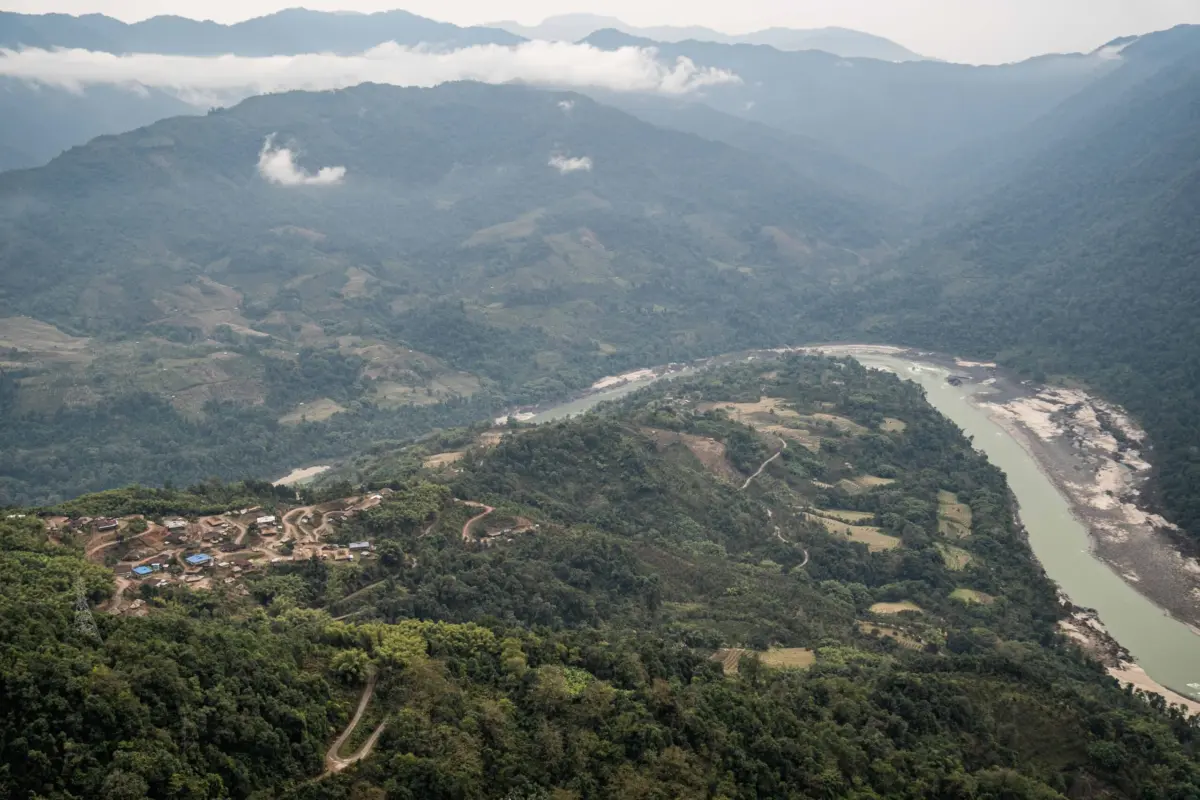
ARUNACHAL PRADESH — The serene, emerald waters of the Siang River, which have for centuries sustained the indigenous Adi people of Arunachal Pradesh, have become the backdrop for a deepening conflict between state-led developmental ambitions and grassroots indigenous resistance. On October 4, 2024, the year-long peaceful demonstrations against the proposed Siang Upper Multipurpose Project (SUMP) reached a violent breaking point. In the village of Uggeng, police and paramilitary forces allegedly launched a lathi charge against protesters, marking a significant escalation in a struggle that pits the Indian government’s strategic energy goals against the existential fears of local communities.
The SUMP, a massive 11,000-megawatt (MW) hydroelectric initiative, is being framed by New Delhi as a "national project" essential for both energy security and strategic defense. However, for the residents of the Siang and Upper Siang districts, the dam represents a looming catastrophe—one that threatens to submerge ancestral lands, disrupt delicate ecosystems, and erase a way of life.
Main Facts: The Scope of the Conflict
The Siang Upper Multipurpose Project is one of the most ambitious engineering feats ever proposed in the Eastern Himalayas. If completed, it would be among the largest dams in the world. The project’s primary objectives, according to the state government, are threefold: generating massive amounts of renewable energy, regulating the perennial floods that devastate the downstream plains of Assam, and acting as a strategic "water shield" against upstream Chinese dam construction on the Yarlung Tsangpo (the Tibetan name for the Siang).
Despite these stated benefits, the local opposition is nearly monolithic. The primary point of contention currently centers on the Pre-Feasibility Report (PFR). Protesters have consistently blocked government officials and surveyors from entering the region to conduct the PFR, arguing that allowing the study is the first step toward inevitable construction.
The recent violence in Uggeng village followed a period of heightened friction. Just days prior to the lathi charge, tensions boiled over during a scheduled visit by Chief Minister Pema Khandu. Reports indicate that protesters attacked the residence of a local Member of the Legislative Assembly (MLA) and allegedly set several vehicles ablaze. The subsequent deployment of hundreds of paramilitary personnel to villages like Uggeng and Komkar has transformed the region into a militarized zone, fueling what local organizations call a "fear psychosis."

Chronology of Escalation: From Dialogue to Deadlock
The timeline of the SUMP dispute reveals a gradual erosion of trust between the state government and the Adi community.
- June 2024: The Disputed MoU. Chief Minister Pema Khandu announced via social media that the government had secured the support of 110 households in Geku who signed a Memorandum of Understanding (MoU) in favor of the PFR. Local activists, however, dismissed this as a "divide and rule" tactic, claiming the signatories did not represent the majority of the community.
- July 2024: Preemptive Detentions. During a visit by Union Power Minister M.L. Khattar, prominent activists Ebo Mili and Dungge Apang were detained by state police. Their intent was to submit a memorandum calling for a moratorium on large dams, but the state viewed their presence as a security risk.
- August 20, 2024: The CBI Intervention. The conflict took a legal turn when Bhanu Tatak, a legal advisor to the Siang Indigenous Farmers Forum (SIFF), was served a notice by the Central Bureau of Investigation (CBI). The agency alleged violations of the Foreign Contribution (Regulation) Act (FCRA), claiming Tatak received ₹17.6 lakh in unauthorized foreign funds to "sustain anti-dam protests" and harm India’s economic interests.
- September 14–22, 2024: Paramilitary Deployment. The state government deployed significant forces to Uggeng and Komkar. The Adi Bane Kelang United (ABKU), the apex body of the Adi people, issued multiple demands for the immediate withdrawal of these forces, describing their presence as "unnecessary and uncalled for."
- October 4, 2024: The Uggeng Clash. The standoff turned physical as security forces allegedly used force to disperse protesters blocking roads, leading to the reported lathi charge and several injuries.
- October 5, 2024: Digital Suppression. Reports emerged that local news outlets, such as Upper Siang News 24×7, had their social media pages restricted under India’s Information Technology Rules, effectively creating a localized information blackout.
Supporting Data: Environmental Risks and Geopolitical Stakes
The debate over the SUMP is not merely political; it is grounded in complex geological and environmental data. The Siang basin lies in one of the world’s most seismically active regions (Zone V). Critics of the dam, including Thomas Borang, president of the ABKU, point to the catastrophic risks of building an 11,000 MW structure in an area prone to massive earthquakes and landslides.
The "Water Bomb" Theory
A central pillar of the government’s argument is the 60,000 MW Medog dam planned by China just across the border. New Delhi fears that China could use the Medog dam to manipulate water flows—either by withholding water during dry seasons or releasing massive surges during the monsoon, effectively using the river as a "water bomb."
Government officials argue that the SUMP’s massive reservoir would allow India to "moderate" these flows. However, local residents argue this logic is flawed. "Won’t it cause double the damage if we build an 11,000 MW dam of our own and it breaks during an earthquake?" Borang questioned. The environmental impact assessment (EIA) for a project of this scale would normally take years, yet protesters fear the PFR is being rushed to meet strategic deadlines.
Socio-Economic Displacement
While the government emphasizes national benefits, the local data suggests a high cost for the indigenous population. The project threatens to submerge vast tracts of fertile agricultural land, which forms the backbone of the Adi economy. The SIFF argues that the loss of land is synonymous with the loss of identity, as the Adi culture is inextricably linked to the river and the surrounding forests.

Official Responses: National Interest vs. Local Consent
The state government, led by Chief Minister Pema Khandu, has maintained a stance of "cautious persuasion." Khandu has repeatedly stated that the project will not proceed without a thorough technical and social evaluation.
"If the project is found technically feasible after the PFR, the subsequent stages would include Social Impact Assessment (SIA), Environmental Impact Assessment (EIA), and preparation of the Detailed Project Report (DPR) in accordance with the applicable laws," Khandu told the press. He has emphasized that the government "doesn’t want to rush" and is seeking a dialogue to clear "misinformation" that has created anxiety among the villagers.
However, the actions on the ground—specifically the deployment of paramilitary forces and the CBI investigation into activists—tell a different story. The use of the Prevention of Damage to Public Property Act, 1984, to summon protesters like Dubit Siram of the SIFF Youth Wing suggests a hardening of the state’s position.
When contacted for comment regarding the violence in Uggeng, Dekio Gumja, the Superintendent of Police for Upper Siang, declined to provide details, reflecting a tightening of official communication regarding the crackdown.
Implications: A Precedent for the Northeast
The situation in the Siang Valley carries profound implications for the future of India’s Northeast and the country’s broader environmental policy.

1. The Criminalization of Dissent
The involvement of the CBI and the invocation of FCRA violations against environmental activists set a significant precedent. By framing anti-dam protests as threats to "economic and strategic interests," the state risks delegitimizing indigenous rights and environmental concerns, treating them instead as matters of national security. This shift could stifle future grassroots movements across the country.
2. Indigenous Sovereignty
The conflict highlights the fragility of indigenous land rights in the face of mega-development. Despite constitutional protections and the requirement for "free, prior, and informed consent" under international standards, the Adi people feel their voices are being bypassed. The dispute over the 110-family MoU serves as a warning of how "manufactured consent" can lead to deep-seated communal divisions.
3. Regional Stability and the "Dam Race"
The "dam race" between India and China in the Himalayas is creating a precarious environmental situation. As both nations move to "claim" the river’s energy through massive infrastructure, the cumulative impact on the Eastern Himalayan biodiversity hotspot could be irreversible. Furthermore, the militarization of developmental projects near the Line of Actual Control (LAC) adds a layer of volatility to an already sensitive border region.
4. The Digital Frontier of Protest
The restriction of local news outlets under the IT Rules signifies a new era of information control. In remote regions like Upper Siang, social media is often the only way for local voices to reach the national and international stage. Blocking these channels not only limits transparency but also allows rumors and "misinformation"—the very thing the government claims to fight—to flourish in the vacuum.
As the Siang River continues its descent from the heights of the Himalayas, the people living along its banks remain in a state of watchful resistance. The clash at Uggeng may be a harbinger of a longer, more arduous struggle, as the Indian state balances its hunger for power and strategic depth against the ancient rights of its indigenous citizens. For the Adi people, the river is not just a source of 11,000 megawatts; it is their history, their soul, and their future. And for that, they appear willing to stand their ground, regardless of the forces arrayed against them.
