

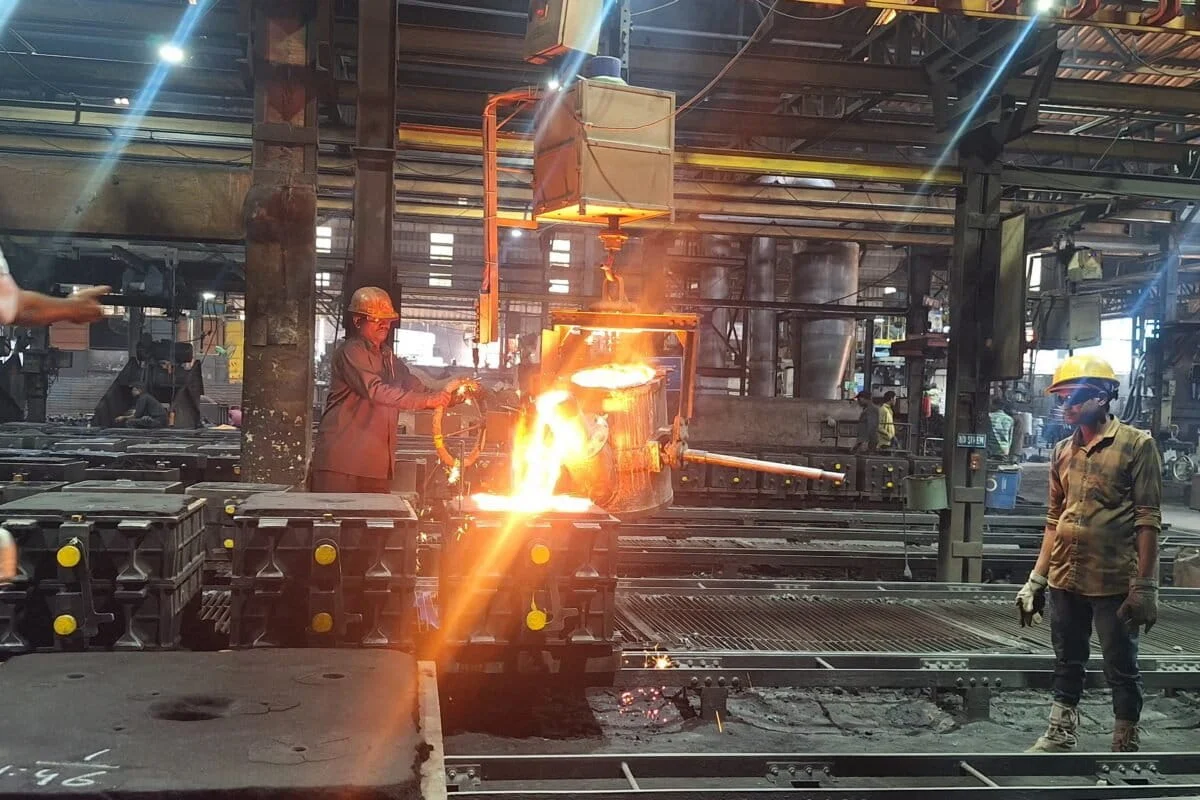
KOLHAPUR, MAHARASHTRA — Inside the sprawling foundries of Kolhapur, the air is thick with the scent of molten metal and the relentless roar of induction furnaces. Here, workers clad in yellow helmets and safety goggles navigate a subterranean heat that frequently climbs to 50°C. They feed blocks of pig iron and recycled steel scrap into furnaces pulsating at 1,600°C. This molten liquid is then precision-poured into sand moulds, destined to become the pumps, engine blocks, and industrial components that power global supply chains.
For decades, this rhythmic, high-heat labor has been the heartbeat of Caspro Metal Industries Private Limited. Producing 30,000 tonnes of metal castings annually, the company represents the pinnacle of India’s metallurgical prowess. However, a significant portion of its business—nearly 20% of its exports—is now under threat. The source of the anxiety is not a competitor’s lower price or a shift in engineering standards, but a complex climate regulation originating 7,000 kilometers away in Brussels.
“This is going to be a huge add-on cost for us,” says Vijay Patil, Manager at Caspro. The regulation he fears is the European Union’s Carbon Border Adjustment Mechanism (CBAM). As the EU erects what many call a "carbon wall" around its markets, the small and medium enterprises (MSMEs) of India’s industrial clusters are finding themselves on the front lines of a global trade war over climate responsibility.
Main Facts: The Mechanics of a Green Trade Barrier
The Carbon Border Adjustment Mechanism (CBAM) is the world’s first tax on the carbon content of imported goods. Designed to prevent "carbon leakage"—where EU-based companies move production to countries with laxer environmental standards—it imposes a levy on carbon-intensive products entering the Eurozone. The sectors currently targeted include iron, steel, cement, aluminum, electricity, hydrogen, and fertilizers.

For Indian exporters, the financial implications are staggering. According to the Global Trade Research Initiative (GTRI), Indian firms may need to slash their prices by 15% to 22% just to remain competitive against EU domestic producers who do not face the import levy.
The burden is particularly acute for India’s iron and steel sector. Unlike large-scale primary steel producers who may have the capital to invest in "Green Hydrogen" or carbon capture, India’s MSME foundries rely on traditional, energy-intensive processes. The EY professional services group notes that because manufacturing these materials is inherently emission-intensive, Indian exports face the highest exposure to these new "green" tariffs.
Chronology: From Proposal to Definitive Phase
The road to CBAM has been a swift and calculated legislative journey by the European Commission, leaving little time for developing economies to pivot their entire industrial infrastructures.
- July 2021: The European Commission officially proposes CBAM as part of the "Fit for 55" package, aiming to reduce EU greenhouse gas emissions by at least 55% by 2030.
- October 2023: The "Transition Phase" begins. During this period, Indian exporters were not required to pay the tax but were mandated to report the "embedded emissions" of their products. This phase served as a data-gathering exercise for the EU and a wake-up call for global supply chains.
- January 2026: The "Definitive Phase" commences. The transition period ends, and the financial bite begins. Importers must now purchase "CBAM certificates" corresponding to the carbon price that would have been paid had the goods been produced under the EU’s internal carbon pricing rules.
- April 2026: A draft report from the European Parliament’s Committee on the Environment suggests expanding the tax to include "Scope 2" emissions (emissions from the electricity used in production) for the steel and aluminum sectors as early as 2027.
- 2034: The EU plans to have fully phased in CBAM, coinciding with the phase-out of free emission allowances for its own domestic industries.
Supporting Data: The Erosion of Export Competitiveness
The impact of CBAM is no longer a theoretical projection; it is reflected in recent trade data. Analysis of government figures suggests that since the introduction of the carbon reporting requirements, the growth of iron and steel exports from Indian MSMEs has faltered.
In 20 of the EU’s 27 member states, exports of these products declined during the 2024–25 fiscal year compared to the previous period. Overall, iron and steel exports to the EU were 11% lower in 2024–25 than in 2022–23. More broadly, Ajay Srivastava, founder of GTRI, notes that total Indian exports of steel and aluminum to the EU plummeted by 24% in FY2025.

“I suspect that this decrease could be due to declining exports from MSMEs who simply cannot navigate the reporting hurdles,” Srivastava explains.
The cost of compliance itself is a major deterrent. Sudipta Das, Managing Partner at Futurestation, explains that firms must now track emissions from "cradle to gate." This includes the carbon footprint of raw material sourcing, manufacturing, and even transportation. For a typical MSME, the cost of measurement, reporting, and verification (MRV) can reach ₹2.5 million ($30,000) annually—a prohibitive sum for a workshop in Kolhapur or Raipur with thin profit margins.
Furthermore, the EU’s "default value" penalty creates a secondary trap. If a company cannot provide verified data on its emissions, the EU applies a punitive default value based on the most carbon-intensive producers in the world, effectively inflating the tax bill.
Official Responses: The Geopolitical Stance
The Indian government and industry bodies have criticized CBAM as a "unilateral trade barrier" that ignores the foundational principles of international climate law.
At the World Trade Organization (WTO) Council for Trade in Goods, India has argued that CBAM violates the principle of "Common But Differentiated Responsibilities and Respective Capabilities" (CBDR-RC). This principle, enshrined in the 1992 UNFCCC, acknowledges that industrialized nations bear a greater historical responsibility for climate change and that developing nations should not be held to the same immediate standards.

“MSMEs are particularly exposed,” says Vinod Kumar, President of the India SME Forum. “There is a lack of clarity on the methodology, and the certification systems are simply not affordable.”
In official responses to the Lok Sabha, the Ministry of External Affairs has noted that while India has secured a "technical dialogue" on CBAM implementation through its Free Trade Agreement (FTA) negotiations with the EU, the fundamental threat to metal and engineering exports remains unmitigated. The government’s 2025-26 Economic Survey highlighted that MSMEs account for 48% of India’s exports and 31% of its GDP, employing over 328 million people. A systemic failure in this sector due to green tariffs could trigger a wider economic crisis.
Implications: Decarbonize or Disappear
The long-term implications of CBAM suggest a radical reshuffling of the global industrial order. For clusters like Kolhapur, which houses 300 foundries, or Raipur, which has over 300 MSME steel units, the choice is stark: decarbonize or face exclusion from the lucrative European market.
Nilesh Bhattad, CEO of CleanCarbon.ai, points out that even "indirect" exporters are at risk. While a small foundry in Raipur might not ship directly to Germany, it likely supplies a larger merchant exporter who does. "If the small supplier can’t provide the data, the large exporter will drop them to protect their own EU contracts," Bhattad warns.
There is also the threat of regional competition. Countries like Turkey and South Korea, which are also major exporters to the EU, are moving faster to align their domestic carbon pricing with EU standards. If India lags behind in adopting green energy or improving furnace efficiency, its market share will likely be absorbed by these competitors.

However, some see a silver lining. Vinod Kumar suggests that MSMEs that adapt early could "integrate deeper into global value chains," becoming the preferred suppliers for a world increasingly obsessed with sustainability. This would require a massive transition—switching from coal-fired furnaces to electricity-based induction melting, and ensuring that electricity comes from renewable sources.
Currently, the reality on the ground remains a mix of confusion and resilience. At Jainam Ferro Alloys in Raipur, Chairman Archit Parakh says they are still waiting for clarity. “Our merchant exporters have not asked for data yet. We will get more clarity soon.”
As the "definitive phase" of CBAM takes hold in 2026, that clarity may come with a heavy price tag. The heat in the foundries of Kolhapur is no longer just a byproduct of the metal; it is a reflection of a global economy undergoing a painful, carbon-coded transformation. For India’s small-scale industrialists, the task is no longer just to shape iron, but to survive the cooling effect of a green trade border.
Data Summary at a Glance:
- Total MSME Contribution: 48% of India’s exports; 31% of GDP.
- CBAM Sector Impact: Iron, Steel, Aluminum, Cement, Fertilizers.
- Projected Price Impact: 15-22% reduction needed for competitiveness.
- Export Decline (FY25): 24% drop in steel/aluminum exports to the EU.
- Compliance Cost: Up to ₹2.5 million annually per enterprise for MRV.
